

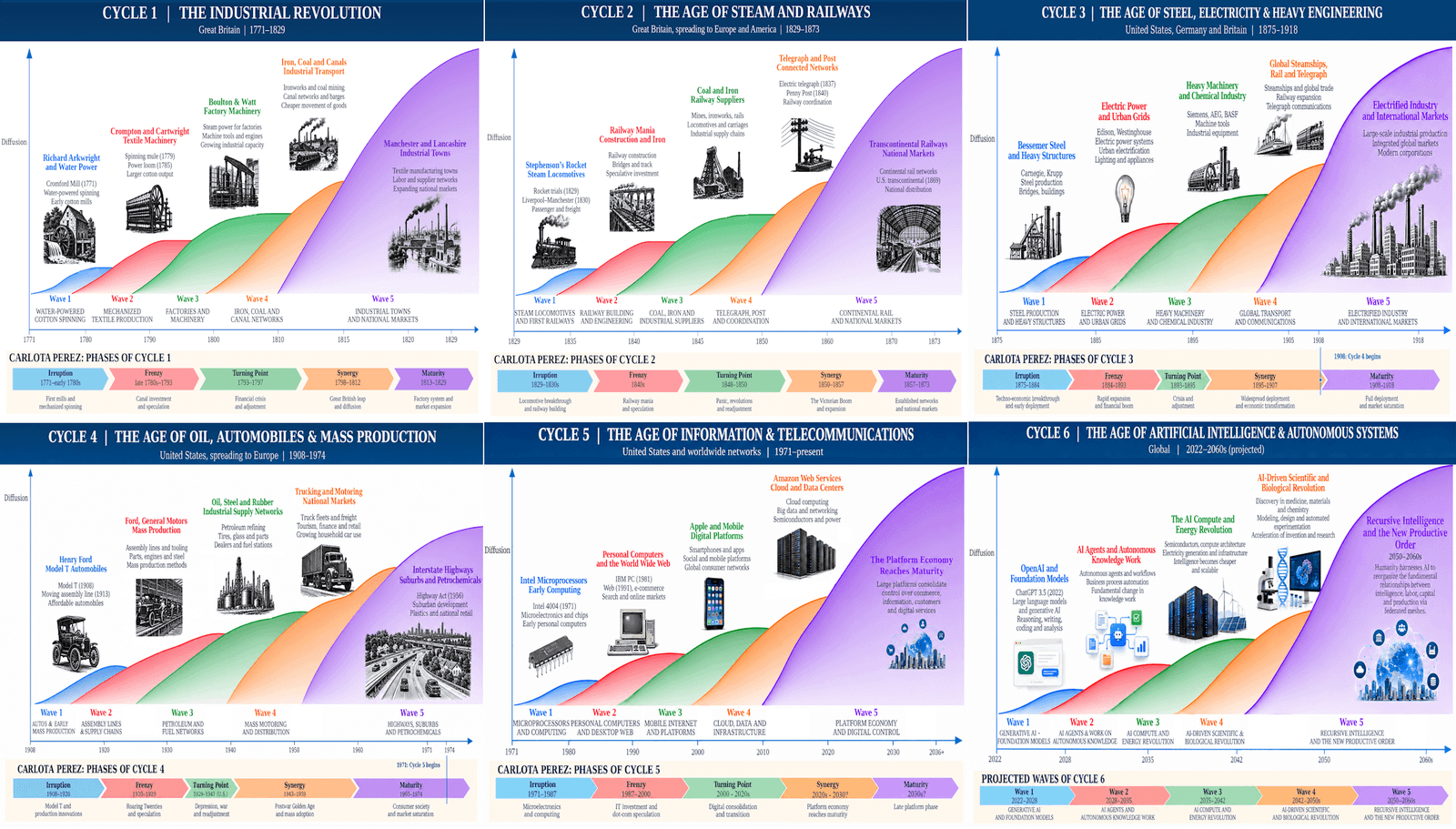
The Six Technology Supercycles
A New Model of How Technological Revolutions Transform Civilization
From Carlota Perez’s five technological revolutions to a new five-wave framework and the emerging sixth supercycle
Rethinking the History of Technological Revolutions
When I began developing TechnologyCycles.org, my objective was to make the work of economist Carlota Perez more accessible. Her research into technological revolutions offered one of the most useful explanations I had encountered for understanding how technology transforms economies over long periods. Having spent more than four decades working in the technology industry, much of that time developing business strategies, I recognized patterns in her work that I had witnessed firsthand.
Perez identified five great technological revolutions beginning with the Industrial Revolution in 1771. Her central insight was that technological change occurs through enormous surges of interconnected innovations that progressively reorganize economies. These transformations follow recurring economic and institutional phases as financial capital, productive investment, markets, and governments struggle to accommodate a new technological reality.
I agreed with much of her framework. I also found it increasingly useful in understanding the evolution of technology markets, the rise and decline of industrial leaders, and the economic disruptions that accompanied the digital revolution.
Yet the longer I studied these transformations, the more questions emerged. As I am in process of researching and writing a book about the middle-class ecosystem and its impact on the economy, my attention shifted toward the internal development of the technological revolutions themselves. I became especially focused in how clusters of innovations emerge, combine, and expand into entirely new economic systems.
Something important began to appear when I examined all five historical revolutions side by side.
Within each supercycle, I could identify five broad, overlapping waves of technological and economic development. Each wave expanded the possibilities opened by earlier innovations, while creating the conditions for further waves to emerge. Together, they transformed a breakthrough technology into a vast, interconnected system of industries, infrastructure, markets, and productive capabilities.
This observation changed how I understood technological supercycles. It also led me to reconsider one of the fundamental questions surrounding artificial intelligence.
Are we witnessing another development within the fifth technological revolution, or the beginning of a sixth?
My conclusion is that the sixth supercycle has already begun.
Two Complementary Ways of Understanding Technological Change
Carlota Perez’s framework remains central to this analysis. Her model describes how a technological revolution advances through five recognizable phases: Irruption, Frenzy, Turning Point, Synergy, and Maturity. These phases explain much of the relationship between technological development, speculative investment, financial instability, institutional adjustment, and the eventual diffusion of new productive capabilities.
Her distinction between Installation and Deployment is especially valuable. During Installation, new industries and infrastructures emerge, investors pursue extraordinary opportunities, and established economic arrangements come under increasing pressure. The transition toward Deployment requires societies to accommodate the new capabilities through institutional, economic, and organizational changes.
The historical record shows that these transitions can be extraordinarily disruptive. The financial and political institutions inherited from one technological era are often poorly suited to managing the next.
My five-wave framework examines another dimension of this process: the technological and industrial architecture being assembled inside the supercycle.
The waves represent successive concentrations of innovation and economic activity. One wave creates capabilities that subsequent waves expand, refine, distribute, or combine with complementary technologies. As the system grows, innovations that began in relatively narrow industries become part of the everyday operating structure of the economy.
The distinction matters because the technological system and the economic institutions surrounding it do not necessarily evolve at the same pace. A supercycle can continue producing remarkable new capabilities while its institutions struggle to distribute the economic benefits. Several technological waves may develop while the broader economy remains trapped in prolonged financial or political adjustment.
The charts therefore retain Perez’s phases beneath the historical timelines while displaying the five technological waves above them. The two perspectives provide different ways of understanding the same transformation.
What the Five Waves Reveal
The five colored curves in each chart represent overlapping waves of technological diffusion. They illustrate the expansion of related groups of innovations and the growing influence of those innovations over time.
The first wave generally establishes a revolutionary capability. Subsequent waves extend that capability into production systems, complementary industries, infrastructure, and increasingly interconnected markets. By the fifth wave, the combined technologies have often reorganized large portions of economic and social life.
These waves are interconnected. Their boundaries are approximate, their timing differs across industries and countries, and their development often overlaps substantially. The five-wave classification is an interpretive model drawn from the historical record, rather than a claim that every invention passes through five identical stages.
Equally important, the curves are conceptual illustrations of diffusion and increasing systemic influence. Their shapes do not represent measured adoption rates or comparable quantities of economic output. The projected portions of the fifth and sixth supercycles describe possible future development.
The important observation is how the waves build on one another. An early breakthrough is rarely sufficient to transform civilization by itself. The much larger transformation emerges as complementary innovations, industries, infrastructure, financial systems, labor capabilities, and markets begin working together.
Consider the first great technological revolution.
Water-powered spinning made textile production dramatically more productive. Mechanized textile machinery expanded the opportunity, factory systems organized labor and equipment around the new capabilities, and coal, iron, and canals enabled wider industrial production and distribution. Eventually, industrial towns, specialized suppliers, and expanding national markets emerged.
By that point, the original textile innovations had become components of an entirely new system of economic production.
The subsequent revolutions reveal variations of the same process.
The Six Technology Supercycles
Cycle One: The Industrial Revolution, 1771–1829
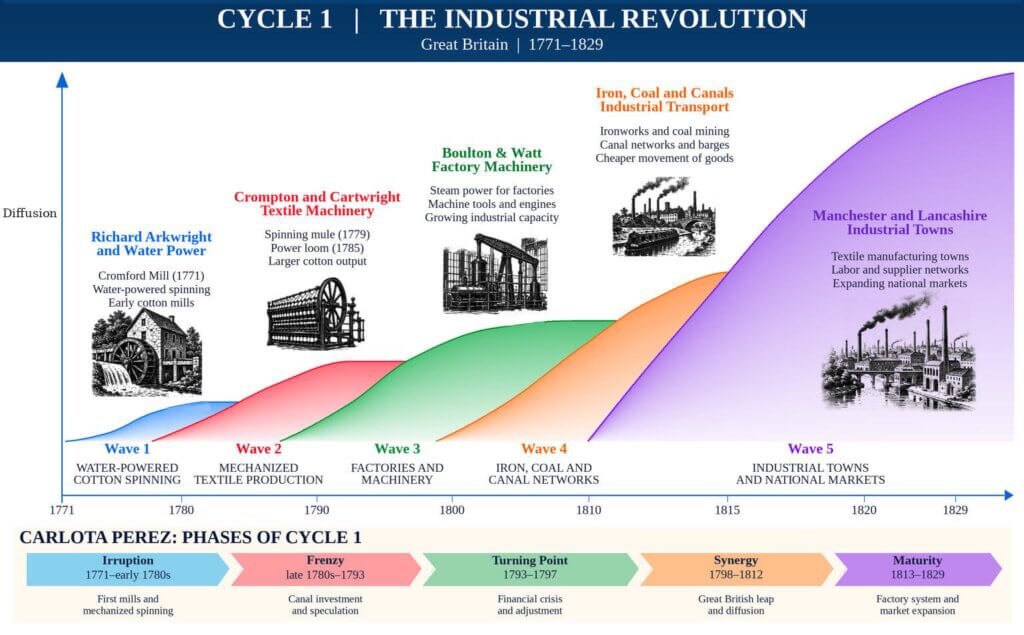
The first technology supercycle began in Great Britain with mechanized textile production and the emerging factory system.
Richard Arkwright’s water-powered cotton mills established an early industrial foundation. Innovations associated with Samuel Crompton and Edmund Cartwright expanded spinning and weaving capabilities, while improved steam engines and machinery increased the scale and flexibility of industrial production.
The five waves identified in the chart progress from water-powered cotton spinning through mechanized textile production, factories and machinery, iron and canal networks, and finally industrial towns and expanding national markets.
The result was far larger than a revolution in textiles. This supercycle established the industrial factory, reorganized work, expanded demand for mechanical skills, and created new relationships among labor, investment, infrastructure, and markets. It helped establish the foundations for the modern industrial economy and the gradual growth of a much broader middle class.
Cycle Two: The Age of Steam and Railways, 1829–1873
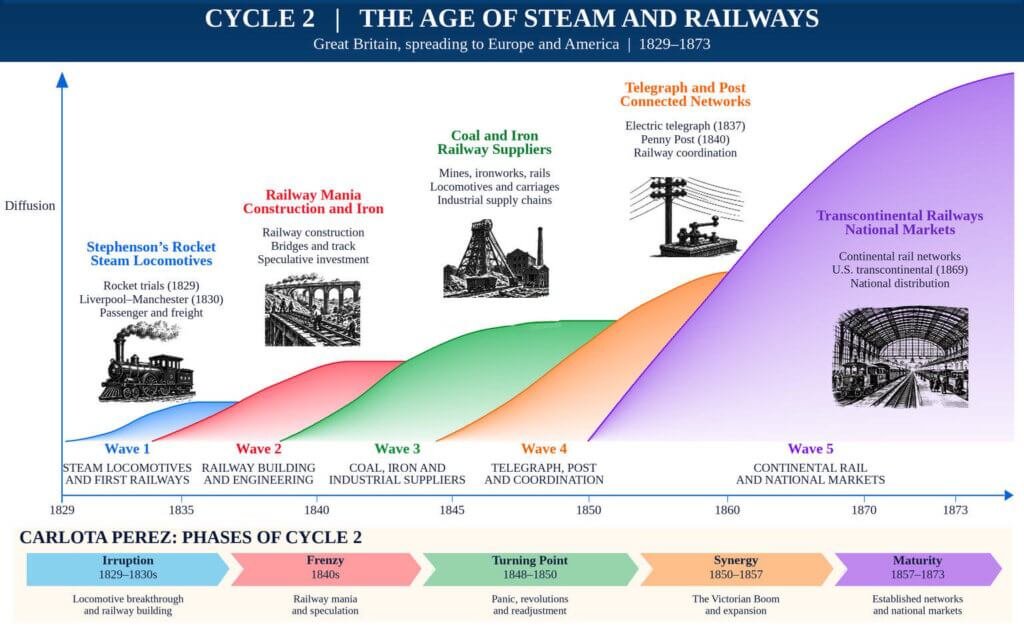
The second supercycle dramatically expanded humanity’s ability to move people, materials, and goods.
Early steam locomotives and railways established new transportation capabilities. Railway construction stimulated investment in iron, coal, bridges, engineering, and industrial equipment. Telegraph and postal systems improved coordination, while expanding railway networks connected increasingly distant markets.
Its five waves move from steam locomotives and early railways through railway building and engineering, coal and iron suppliers, telegraph and postal coordination, and finally continental railway networks and national markets.
The railway changed the economic meaning of distance. Industries could obtain materials from farther away, producers could reach customers beyond their immediate regions, and businesses could coordinate activities across increasingly large territories.
The infrastructure and industrial capabilities of one wave became essential inputs for the next.
Cycle Three: The Age of Steel, Electricity and Heavy Engineering, 1875–1918
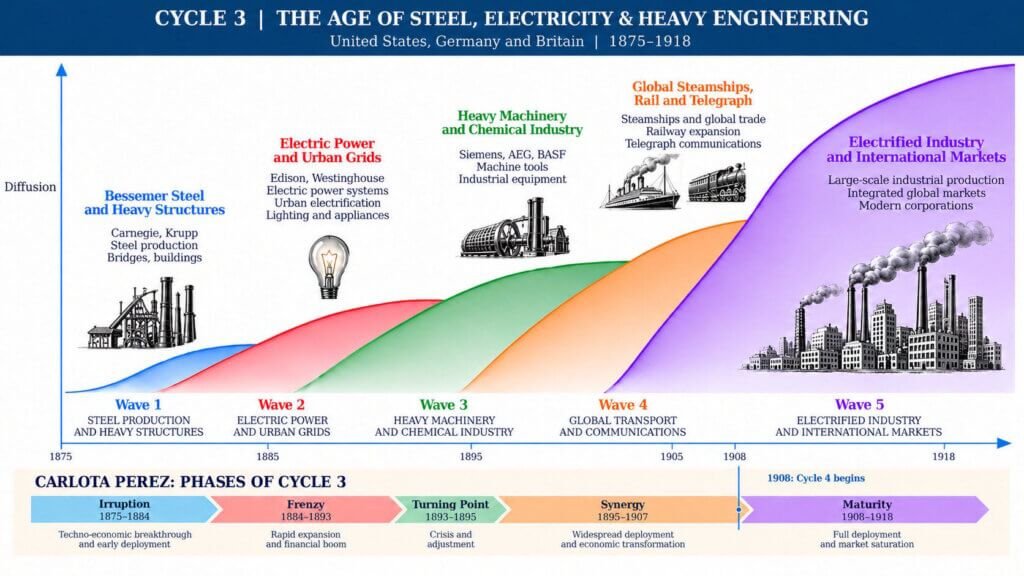
The third supercycle transformed the physical and industrial capabilities of modern civilization.
Cheap steel, new manufacturing techniques, electrification, and advances in heavy engineering enabled structures, machines, and industrial systems that previous generations could scarcely have imagined.
The five waves progress through steel production and heavy structures, electric power and urban grids, heavy machinery and chemical industries, global transportation and communications, and eventually electrified industry and international markets.
Electricity transformed factories and cities. Steel made larger buildings, bridges, ships, and machinery possible. Chemistry created new materials and industrial processes, while global transport and communications connected expanding industrial economies.
This supercycle also helped establish the modern large corporation, the professional engineering workforce, and increasingly sophisticated systems for coordinating production.
Cycle Four: The Age of Oil, Automobiles and Mass Production, 1908–1974
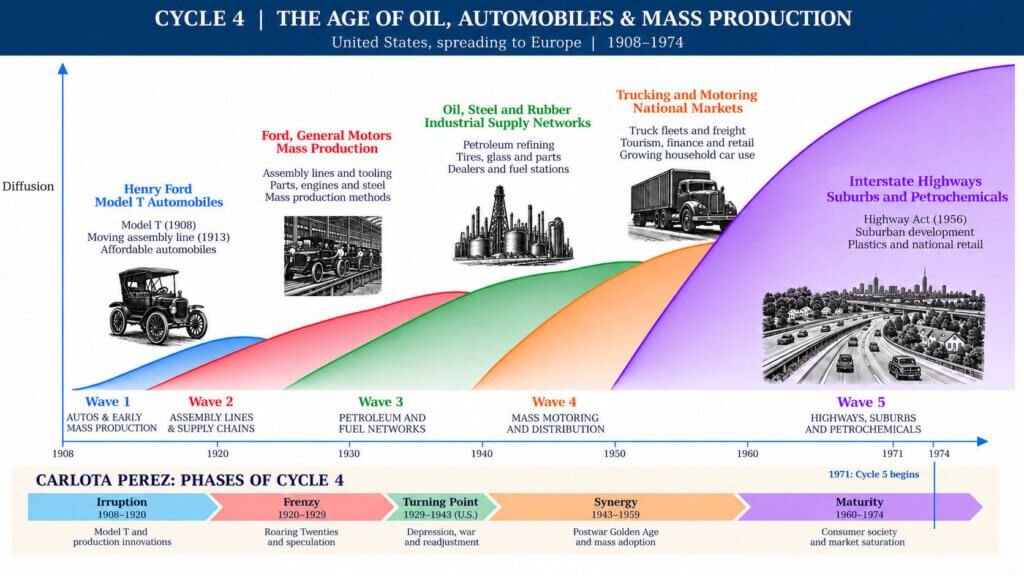
The fourth supercycle reorganized industry around mass production, petroleum, and the automobile.
Henry Ford’s Model T and the moving assembly line demonstrated how standardized manufacturing could lower costs and open enormous consumer markets. Automobile manufacturing created demand for steel, rubber, glass, petroleum refining, machinery, and specialized components.
The five waves expand from automobiles and early mass production through assembly lines and supply chains, petroleum and fuel networks, mass motoring and distribution, and finally highways, suburbs, and petrochemicals.
The final wave transformed much of the physical organization of society. Highways, suburban housing, national retail systems, transportation networks, and consumer manufacturing became interconnected parts of a new economic order.
Millions of workers participated in the industrial ecosystem created by these developments. The expansion of industrial employment, supporting institutions, education, and household purchasing power helped produce the broad middle-class societies associated with the twentieth century.
Cycle Five: The Age of Information and Telecommunications, 1971–Present
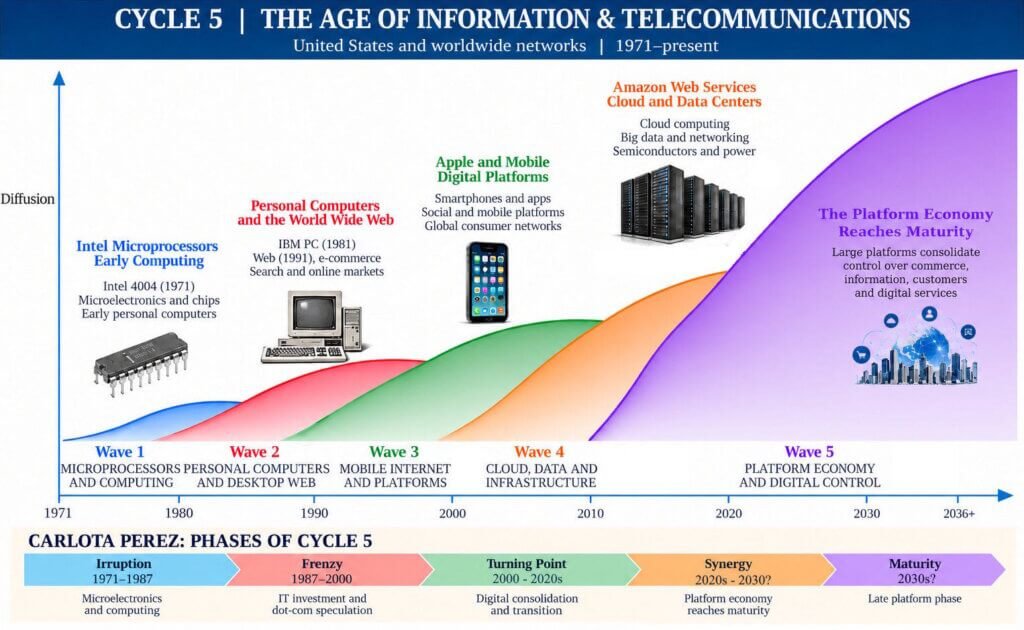
The fifth supercycle began with microelectronics and the dramatic expansion of computing capabilities.
The introduction of the commercial microprocessor in 1971 helped establish the foundation for an immense new technological system. Personal computers, computer networking, the World Wide Web, mobile communications, cloud computing, and digital platforms progressively transformed how information could be processed, transmitted, stored, and used.
The five waves identified in the chart are microprocessors and computing; personal computers and the desktop web; mobile internet and digital platforms; cloud, data, and infrastructure; and the eventual maturation of the platform economy.
What makes this supercycle especially significant is the enormous reduction in the cost of handling information and coordinating economic activity across distance.
Manufacturing could be organized through worldwide supply chains. Office and administrative functions could move across geographic boundaries. Technical and professional services became increasingly tradable internationally. Platforms connected customers, suppliers, workers, and businesses across markets that had previously operated more independently.
These developments brought extraordinary new capabilities and generated enormous wealth. They also changed the distribution of economic power.
Digital networks enabled companies to coordinate global activities while reducing their dependence on individual communities and local markets. Platform businesses increasingly controlled access to customers, information, and commercial infrastructure. The ability to participate in the economy often became dependent upon systems governed by a relatively small number of powerful enterprises.
These consequences are central to understanding the fifth supercycle. Technologies that dramatically expand productive possibilities can also concentrate control over the systems through which those possibilities are realized.
The fifth supercycle continues. Its final wave, the maturation of the platform economy, remains an evolving and partly projected development. Meanwhile, a new technological transformation has begun to emerge from the infrastructure it created.
Cycle Six: The Age of Artificial Intelligence and Autonomous Systems, 2022–2060s (Projected)
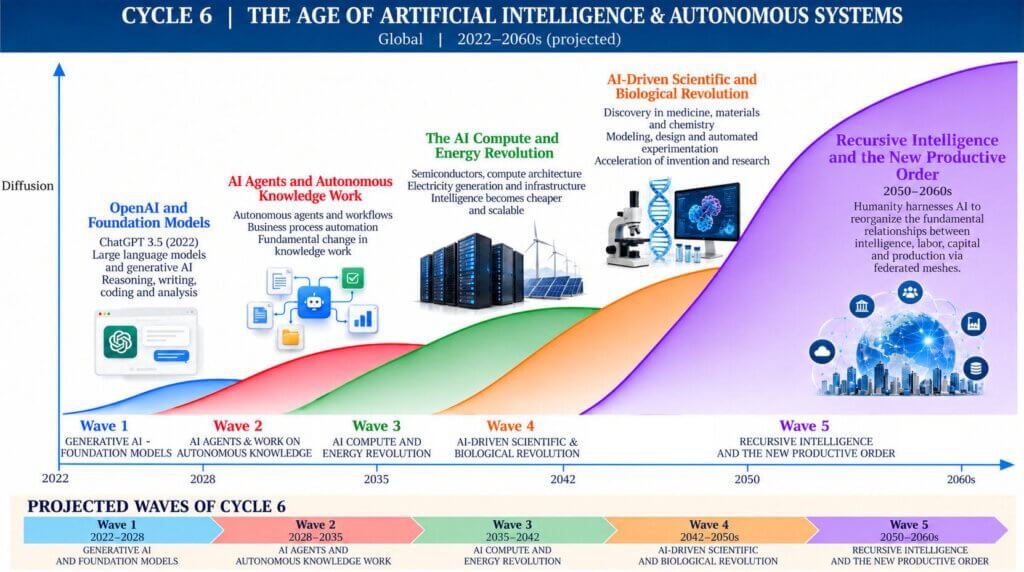
I believe the sixth technology supercycle began in 2022, marked by the public emergence of generative AI as a broadly accessible and increasingly general-purpose capability.
The importance of this development extends far beyond improvements in computing performance. Artificial intelligence introduces a new class of productive capability: machines able to perform an expanding range of activities previously dependent upon human cognitive work.
The distinction is fundamental. The fifth supercycle made information increasingly accessible, transferable, and computable. The sixth is beginning to transform how knowledge is applied, decisions are developed, problems are solved, and productive activity is organized.
My chart proposes five waves through which this transformation may unfold.
Wave One, Generative AI and Foundation Models, 2022–2028, establishes large-scale generative capabilities in language, software, analysis, and other forms of information processing.
Wave Two, AI Agents and Autonomous Knowledge Work, 2028–2035, projects a transition toward increasingly capable agents that coordinate activities, execute workflows, and perform substantial portions of complex knowledge work. Early versions of these capabilities already exist; the projected wave concerns their wider industrial and economic development.
Wave Three, The AI Compute and Energy Revolution, 2035–2042, centers on the infrastructure required to support AI at enormous scale. Semiconductor architectures, computing systems, electricity generation, transmission networks, and potentially major improvements in the energy efficiency of intelligence production become central to the supercycle’s continued expansion.
Wave Four, The AI-Driven Scientific and Biological Revolution, 2042–2050s, anticipates increasingly powerful applications of AI to medicine, materials, chemistry, biological research, and scientific experimentation. The potential is for AI to accelerate the process of invention itself.
Wave Five, Recursive Intelligence and the New Productive Order, 2050–2060s, represents the possible maturation of these capabilities into new systems of production and economic organization. AI systems may contribute increasingly to the improvement of other AI systems, coordinate complex productive networks, and reshape relationships among intelligence, labor, capital, and enterprise.
These future waves are projections, not predetermined outcomes. Their dates, sequence, and eventual scale will depend on technical breakthroughs, energy availability, investment, institutional responses, and the ability of economies to absorb these capabilities.
Nevertheless, the emerging pattern suggests the possibility of an economic transformation comparable in breadth to the earlier industrial supercycles.
Why I Disagree with Carlota Perez About AI
Carlota Perez has argued that artificial intelligence belongs within the fifth technological revolution, the age of information and telecommunications. Her reasoning is understandable. AI relies on semiconductors, software, networks, data, and computing infrastructure developed during the digital revolution.
I believe the five-wave analysis points toward a different conclusion.
Every technological revolution has depended heavily upon capabilities developed during its predecessor. Railways relied on machinery, ironworking, and steam technology that had been advancing for decades. The electrical and steel revolution developed alongside established railway and industrial systems. Automobile manufacturing depended on steel, petroleum, machine tools, and electrical infrastructure. The digital revolution emerged from generations of advances in electronics, communications, and industrial engineering.
The origins of a technology therefore tell us only part of its economic story. Its significance also depends upon the new productive possibilities it opens and the industries, infrastructures, organizations, and markets that develop around it.
That is the distinction I see in artificial intelligence.
The digital revolution transformed the economics of information. AI is beginning to transform the economics of intelligence applied to productive work. Its potential reaches into activities that were previously limited by the availability of human expertise, time, and cognitive capacity.
This creates new demands for computing, energy, specialized hardware, scientific research, organizational design, and autonomous productive systems. It also raises new questions about labor, ownership, market power, and the relationship between human capabilities and machine capabilities.
The emergence of a fundamentally different productive possibility, accompanied by new industrial investment and an expanding network of complementary technologies, is precisely the kind of development that characterizes the beginnings of earlier supercycles.
There is another historical consideration. Supercycles overlap.
The third revolution continued developing after the fourth began in 1908. The fourth had not fully concluded when the microprocessor helped initiate the fifth in 1971. Emerging systems grow within the mature infrastructure of their predecessors.
Consequently, the continued development of the fifth supercycle does not prevent the sixth from beginning. Indeed, the digital infrastructure created by Cycle Five provides much of the foundation upon which Cycle Six is now being built.
My conclusion is that artificial intelligence has crossed an important threshold. It is becoming the organizing foundation for a new constellation of productive capabilities.
The coming decades will test whether that constellation develops into the five-wave transformation projected here. I believe the evidence already visible supports treating it as the beginning of a sixth supercycle.
What This Means for Understanding Economic History
The five-wave framework changes the questions we can ask about technological revolutions.
A breakthrough invention attracts attention because it creates something new. The larger economic consequences frequently arrive much later, when industries develop the complementary capabilities needed to exploit that invention at scale.
The history of the automobile demonstrates this particularly clearly. Ford’s assembly lines were revolutionary, but their eventual economic consequences extended to petroleum, roads, freight transportation, suburban development, construction, retail, and consumer finance.
Likewise, the invention of the microprocessor was only the beginning of the fifth supercycle. The emergence of personal computing, networking, mobile platforms, cloud infrastructure, and digital marketplaces created an economic system whose scale and influence could scarcely have been anticipated in 1971.
The implications for AI are substantial. The technologies receiving the greatest attention today may represent only the opening wave of a much larger industrial transformation.
The framework also highlights the significance of bottlenecks and enabling systems. New capabilities create demand for materials, infrastructure, skills, energy, standards, and coordination. Solving one constraint can open opportunities for entire industries, while creating further constraints elsewhere.
This helps explain why the technological transformations of successive supercycles extend so far beyond their original inventions. Each new wave changes the opportunity space available to subsequent innovators.
It also helps explain the importance of looking beyond individual companies. Great technological transformations are produced by entire ecosystems of interacting capabilities. Corporations, entrepreneurs, workers, universities, governments, suppliers, investors, and customers all participate in their creation.
No single invention or company can independently produce a technology supercycle.
The Connection to the Middle-Class Ecosystem and the Creation of Wealth
My work on technology supercycles increasingly became inseparable from another question: where does the productive capacity behind modern wealth actually come from?
At the beginning of the Industrial Revolution, roughly 800 million people inhabited the Earth. The overwhelming majority lived in extreme poverty, and only a tiny fraction enjoyed anything resembling a modern middle-class standard of living. Across the following two and a half centuries, industrialization, education, scientific advances, and the cumulative development of human productive capabilities helped create a global middle class that surpassed four billion people in 2025. For the first time in human history, more than half of humanity had reached middle-class status. That’s is around a 16,000% increase!
The expansion of this middle-class ecosystem has been the greatest transformation of the economy and society in all of human history. More importantly, this expanding middle class became a productive force in its own right, developing the flexibility and resources that enabled each successive technology supercycle. My book takes all of the implications much further but for this discussion let’s keep our focus on the supercycles.
The history of the supercycles reveals why.
Each successive technological revolution inherited an enormous stock of knowledge and productive capacity accumulated by earlier generations. Schools educated the workers and engineers who built the factories. Public and private infrastructure connected markets. Research institutions expanded scientific knowledge. Skilled workers developed new techniques. Suppliers created specialized capabilities. Families and communities invested in the education, health, and development of future generations.
These contributions accumulated and became available to subsequent innovators.
The productive power of a modern economy therefore extends far beyond the capital invested in its individual enterprises. It rests upon a vast, interconnected ecosystem of capabilities developed and sustained over generations.
This insight became central to the book I have been writing. The middle-class ecosystem has played an active role in producing the very conditions that make modern corporate wealth possible. Its accumulated knowledge, resources, institutions, labor, and investments constitute an extraordinary productive asset.
The fifth technological supercycle exposed a growing tension within that system.
Digital technologies allowed production and economic activity to move across borders with unprecedented flexibility. They also enabled powerful platforms to control access to increasingly large portions of the economy. As those systems expanded, wealth and ownership became increasingly concentrated, even though their development depended upon the much broader economic ecosystem.
The sixth supercycle may intensify these pressures.
Artificial intelligence requires vast investments in semiconductors, data centers, electrical power, networks, and highly specialized knowledge. Its development also draws upon generations of publicly and privately funded science, education, infrastructure, and accumulated human expertise.
The economic question extends beyond how much new wealth AI will generate. It concerns who will own the productive systems, who will control access to their capabilities, and how the resulting wealth will support the ecosystem that makes continued innovation possible.
Technology supercycles explain how new forms of productive wealth emerge. Understanding the middle-class ecosystem helps explain the accumulated human and institutional capabilities that make those transformations possible.
Together, these perspectives raise a fundamental question about the future of capitalism: how can the enormous productive gains created by successive technological revolutions reinforce the broad economic ecosystem upon which future prosperity depends?
How the New Framework Connects the Research on TechnologyCycles.org
TechnologyCycles.org began as an effort to explain and preserve the history of technological revolutions. Over time, it expanded into a broader collection of research, historical references, technological innovations, mathematical interpretations, economic questions, and visual explorations of technological change.
The six-supercycle framework now provides a way to connect much of that material.
The history of technology cycle models documents the intellectual development that led from earlier long-wave theories to the work of Carlota Perez. This remains the historical foundation for understanding the larger patterns.
The Five Technology Cycles explains Perez’s framework and examines the great technological revolutions that began in the eighteenth century. The new five-wave interpretation adds another dimension to that existing analysis.
Disruptions Dawn examines the systemic forces through which revolutionary innovations transform industries. Infrastructure creation, cost disruption, standardization, capital alignment, labor organization, and new market formation help explain how technological breakthroughs acquire the momentum necessary for much larger transformations. These dynamics operate within and across the waves illustrated in the new charts.
The Singularity Stacks provides a historical repository of inventions, technological improvements, and supporting references. The five-wave framework offers another way of examining these records, grouping innovations according to the expanding capabilities and complementary systems they helped establish.
The website’s sections on economic theories, cycle mathematics, and the possibility of AI-based technology cycle modeling address another long-term ambition: the development of better tools for understanding and eventually modeling large technological and economic transformations.
The new waves suggest additional questions for such modeling. Can clusters of innovation be recognized from patterns in investment, patents, industrial capacity, infrastructure deployment, and market formation? Can the emergence of a new wave be distinguished from the continuing development of an established one? Can economic and institutional changes be studied alongside the evolution of the underlying technological system?
The website’s visual and artistic investigations offer yet another perspective. Technological revolutions change more than production techniques and markets. They transform how people experience space, time, community, communication, and culture. Those consequences can be observed in architecture, art, music, urban development, and the everyday experiences of people living through technological change.
The six-supercycle model brings these different lines of inquiry together around a common subject: the continuing transformation of civilization through interacting systems of technology, economic activity, and human capabilities.
A Model That Can Continue to Evolve
The five-wave framework is a developing interpretation of historical evidence. It provides a way to compare technological revolutions using a common visual and conceptual structure. Its usefulness will depend upon how well it explains the historical record and how effectively it helps us recognize emerging transformations.
The historical waves can be further examined through industrial data, infrastructure investment, technological adoption, changes in production, and the development of complementary markets. The proposed sixth supercycle offers opportunities for testing whether the projected clusters of AI capabilities and supporting industries emerge in the ways anticipated.
The analysis also requires attention to differences. Technological revolutions unfold at different speeds, across different geographic regions, and under different economic and institutional conditions. The diffusion of a capability into one industry may precede its wider adoption by decades.
The charts should therefore be read as maps of technological development rather than rigid timetables. They reveal an organizing pattern while leaving room for new evidence, historical revision, and unexpected developments.
This is consistent with the principle that originally helped guide the website, the statistician George Box’s observation that all models are wrong, but some are useful.
The value of a model lies in the new understanding it makes possible.
The Beginning of the Sixth Supercycle
Humanity has experienced an extraordinary transformation since the Industrial Revolution began. Five great technological supercycles progressively expanded the scale, speed, reach, and productive capacity of the modern economy.
Each inherited the achievements of its predecessors. Each created new industries and markets, changed the organization of labor and capital, and altered the relationship between economic opportunity and social institutions.
The sixth supercycle is beginning within the enormous technological infrastructure created by the fifth. Its ultimate trajectory remains uncertain, but its potential reaches into the organization of knowledge work, scientific discovery, energy systems, production, and the creation of future productive capabilities.
Its consequences will depend upon far more than the technology itself. The history of the preceding revolutions demonstrates that the development of new productive capabilities and society’s ability to benefit broadly from them are deeply connected, but they do not automatically advance together.
The five-wave model offers a new way to understand this unfolding process. By examining how innovations combine into expanding technological ecosystems, we can better recognize the forces driving economic transformation and the challenges that accompany it.
It also helps reveal something more fundamental about wealth creation. Every supercycle is built upon the accumulated capabilities of the civilization that preceded it. The achievements of previous generations become the productive foundation for the next.
The great question confronting the sixth supercycle is therefore larger than whether machines can develop increasingly powerful forms of intelligence.
It is whether humanity can use those capabilities to build a more productive, adaptable, and durable economic civilization, one in which the broad ecosystem responsible for creating wealth continues to share in the opportunities that wealth makes possible.
That is the perspective guiding the next stage of TechnologyCycles.org.