
Core Formation: The First Industrial Revolution
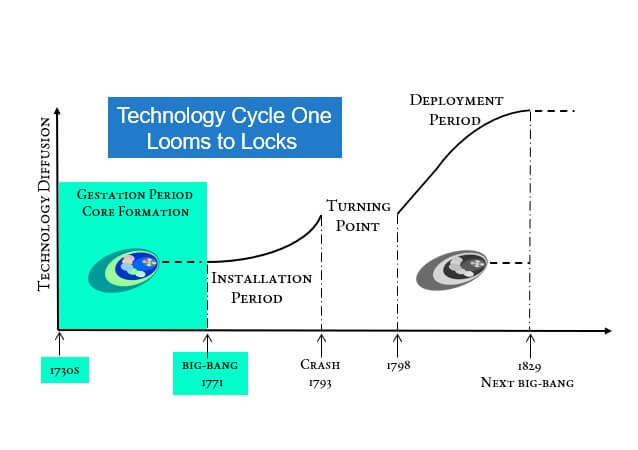
The Core Formation Period of the First Technology Supercycle (Approximately 1730–1771)
The Industrial Revolution did not emerge overnight. Decades before Richard Arkwright began constructing his water-powered cotton mill at Cromford in 1771, inventions and improvements were reshaping textiles, metallurgy, mining, transportation, mechanical engineering, and the organization of production. Some of these developments had begun even earlier, while others would continue evolving long after the first factory systems appeared.
Carlota Perez identifies 1771 as the starting point of the first great technological revolution. Her historical model explains how technological revolutions move through Installation, a Turning Point, and Deployment. I extend that model backward to examine what I call Core Formation, the period in which a combination of emerging technologies, industrial capabilities, organizations, and financial relationships develops before a revolution’s defining commercial breakthrough.
Core Formation is also related to what Perez describes as the gestation of a technological revolution. The five developmental phases used on this page are my own analytical extension. They organize the process into Initial Ripples, Coalescence Around Bottlenecks, Emergence of New and Revolutionized Industries, Imitation and Improvement, and Financial Reorientation.
These phases were neither rigid historical compartments nor a predetermined sequence followed consciously by eighteenth-century inventors. They overlap, and different industries reached comparable stages at different times. The purpose of the model is to reveal the relationships through which separate innovations can begin forming a productive system capable of changing an entire economy.
Textiles provide the clearest example. Faster weaving increased the usefulness of improved spinning. Better spinning equipment made organized production more attractive. Larger mills needed reliable mechanical power, machinery, buildings, transportation, financing, raw materials, and workers. The growing demand generated by one improvement encouraged development elsewhere in the system.
By 1771, enough of these capabilities had developed to make the construction of Arkwright’s Cromford Mill a defining event. The date marks the beginning of the mill project, rather than proof that its entire factory system was already operating at scale that year. Its subsequent success demonstrated the commercial power of bringing mechanized spinning, water power, labor organization, and capital investment together.
The story matters because it introduces a principle that recurs through all six technology supercycles: the capabilities behind a transformative breakthrough are created collectively across many industries, institutions, communities, and generations.
Phase 1: Initial Ripples, Apparently Unrelated Innovations (1730s–1740s)

The first phase brings together inventions developed for different practical purposes. Mining engineers needed to remove water from deep workings. Textile workers needed to manufacture cloth more efficiently. Ironmakers sought less expensive fuel. Farmers looked for ways to improve cultivation, while instrument makers pursued increasingly accurate mechanical devices.
The illustration shows a form of Thomas Newcomen’s atmospheric steam engine, first developed in 1712. Although that invention predates the approximate beginning of Core Formation, improvements and applications during the following decades made it an important part of the technological inheritance available to later industrialists.
These innovations did not initially constitute one unified industrial revolution. Their later significance became clearer as enterprises discovered how improvements in power, materials, machinery, and production could reinforce one another.
John Kay and faster weaving
In 1733, John Kay patented the flying shuttle, an important improvement in handloom weaving. It allowed a weaver to move the shuttle rapidly across the loom and made wider cloth easier to produce with fewer operators. As the technology spread, weaving productivity increased and demand for spun yarn grew.
The relationship between the flying shuttle and the eventual mechanization of spinning is important, although its effects were gradual and varied among different textile industries. Its adoption did not instantly double the output of every British weaver. Nevertheless, it revealed a recurring feature of industrial development: improving one production activity can increase pressure upon the capacity of another.
Abraham Darby and coke-fired ironmaking
In 1709, Abraham Darby I successfully used coke rather than charcoal to smelt iron at Coalbrookdale. His achievement preceded the period examined here, but its continuing development became essential to eighteenth-century metallurgy. Darby’s successors expanded and improved the operation as demand for cast iron and other metal products increased.
Coke reduced ironmaking’s dependence on supplies of wood suitable for charcoal. This created important possibilities for the expansion of iron production, although the commercial development of coke-fueled furnaces required time, appropriate coal, capital, and improvements in industrial practice. The process was part of a long transition rather than an immediate replacement of every charcoal furnace.
Agricultural improvements and food production
Agricultural improvement was also underway. Jethro Tull’s seed-drilling experiments began early in the eighteenth century, with his horse-drawn seed drill dating to around 1701. His agricultural writings and methods influenced continuing efforts to improve planting, cultivation, and the use of farm labor.
Changes in agriculture could support growing nonagricultural populations by increasing food supplies and altering labor requirements, although the historical process was uneven and involved many innovations beyond Tull’s machinery. Enclosure, crop rotation, selective breeding, transportation, and changing landownership relationships also influenced agricultural productivity and rural life.
Steam, mathematics, and precision instruments
Newcomen’s engine had demonstrated that steam-powered machinery could solve a serious economic problem by pumping water from mines. During the 1730s and 1740s, engineers continued adapting and maintaining engines for particular locations. The equipment was expensive and inefficient by later standards, but it expanded the resources available to mining enterprises.
Meanwhile, Leonhard Euler was developing mathematical work in mechanics, fluid dynamics, and analysis. John Harrison pursued precision timekeeping for marine navigation. Their contributions arose in different settings, but they formed part of the growing foundation of scientific and mechanical knowledge that later engineers could draw upon.
Glassmaking, chemical processing, metalworking, and instrument production also improved through numerous smaller developments. Some would eventually support factories, transport infrastructure, scientific instruments, and industrial equipment. Many were initially directed toward existing customers and established markets, with little indication of their future applications.
These were the initial ripples. They emerged from practical problems within different industries. Their importance to Core Formation becomes visible when we begin examining the constraints their success created for the wider productive economy.
Phase 2: Coalescence Around Interconnected Bottlenecks (1740s–1750s)

The second phase concerns the constraints that become visible when an improvement in one activity changes the requirements of another. In textiles, faster weaving increased pressure on the supply of yarn. In ironmaking, greater production required fuel, transport, furnaces, and reliable materials. Expanding industrial activity increased the value of better roads, waterways, mechanical power, and skilled labor.
The illustration shows Jacques de Vaucanson’s experimental automated loom, developed in France around 1745. It demonstrated sophisticated mechanical control of weaving operations, but it did not enter widespread industrial use. It is valuable evidence of the possibilities being explored, rather than evidence that automatic weaving had already transformed British textile manufacturing.
As these technological possibilities developed, inventors and entrepreneurs increasingly confronted problems extending beyond any single machine.
The spinning and weaving imbalance
The textile industry offers an especially useful example of coalescence. Producing cloth required preparing fibers, spinning yarn, weaving, and finishing. Improvement in one stage changed the requirements of the others. Kay’s flying shuttle made some forms of weaving faster, creating greater demand for spinning capacity as its adoption spread.
Traditional hand spinning required extensive labor, frequently performed in homes by women and families working within commercial putting-out systems. Merchants supplied raw material and purchased finished products, coordinating production across numerous independent households and workshops.
When weavers could work faster, merchants required more yarn of suitable strength and consistency. Increasing the number of spinners was one response. Developing machines able to produce several threads at once offered another. The changing relationship between spinning and weaving helped direct attention toward the mechanical inventions of the following decades.
Iron, coal, and the transport bottleneck
Metallurgical improvements created related pressures. Furnaces needed fuel and ore; foundries needed dependable supplies of pig iron; manufacturers needed suitable materials at prices they could afford. Coal and iron were expensive to transport by ordinary roads, making access to waterways and local resource deposits important to industrial geography.
The coke-smelting process offered important advantages, but those advantages depended upon suitable supplies of coal and the infrastructure needed to bring fuel and materials together. More capable iron production therefore increased the economic value of transportation, mining, and furnace improvement.
Power, location, and mechanical reliability
Waterwheels had powered mills and other machinery for centuries, but access to a dependable water supply restricted where enterprises could operate. Seasonal changes and local geography could limit production. Steam engines offered another means of obtaining mechanical power, although Newcomen engines consumed large amounts of fuel and were especially useful where coal was readily available.
Industrial expansion also depended upon better machine components. Equipment required cylinders, gears, shafts, valves, bearings, and other parts capable of operating under demanding conditions. These problems encouraged improvements in metalworking and precision craftsmanship. The need to produce machines became a source of demand for other machines and specialized tools.
Chemicals, materials, and skilled workers
Textile preparation, bleaching, dyeing, and finishing required dependable materials and increasingly effective production methods. Chemical processes were already established in various forms, but larger volumes of cloth increased the commercial importance of quality, consistency, and supply.
Skills were another constraint. A new machine required people who could construct, install, repair, and operate it. Mills and workshops depended upon experienced mechanics, carpenters, metalworkers, surveyors, and workers capable of learning new tasks. These capabilities developed through apprenticeships, workshops, commercial relationships, and repeated practical experimentation.
Coalescence does not imply that eighteenth-century industrialists met to design a single industrial revolution. The more important observation is that improvements changed what other industries needed to accomplish. Successful inventions created demand for complementary capabilities, making the relationships among industries increasingly important.
Phase 3: The Emergence of New and Revolutionized Industries (1750s–1760s)

The third phase introduces machinery, infrastructure, and business organizations capable of overcoming important production constraints. Inventors increasingly worked on ways to raise output, strengthen materials, improve mechanical power, and organize work at a larger scale.
The spinning jenny, developed by James Hargreaves around 1764 and illustrated here, enabled one operator to spin several threads at once. It offered an important response to the need for greater yarn production and became one of the most recognizable inventions associated with the early mechanization of textiles.
Other developments created new opportunities in transportation, factory organization, power systems, ceramics, and precision manufacturing. The productive capabilities of several industries were beginning to reinforce one another.
Hargreaves and the spinning jenny
The spinning jenny increased the amount of yarn one person could produce by allowing several spindles to operate together. Early machines remained dependent upon human power and were suitable for particular kinds of yarn. Their design and number of spindles changed as inventors and manufacturers experimented with improvements.
The jenny made it possible to expand spinning capacity without increasing the number of workers in direct proportion to output. It also disrupted established employment arrangements and became a source of conflict as workers faced uncertainty about their future livelihoods.
Hargreaves’ contribution was part of an expanding search for methods of mechanizing textile production. Different spinning technologies eventually served different requirements, including the production of strong yarn for warp and softer yarn for weft.
Arkwright’s spinning frame
Richard Arkwright and his collaborators developed a spinning machine employing rollers that rotated at different speeds to draw out fibers. Arkwright received a patent in 1769. The machine later became known as the water frame because it could be powered by water and was particularly valuable for producing strong cotton yarn.
The invention made larger-scale production attractive because the machinery could operate continuously under mechanical power. But a commercially successful mill required much more than a patent. The enterprise needed dependable energy, suitable premises, prepared cotton, trained workers, maintenance, working capital, and an organization capable of coordinating the production process.
Arkwright’s success therefore emerged through the combination of technological development and business organization. The machinery was essential, but its commercial usefulness depended upon the surrounding productive system.
Watt’s separate condenser and the future of steam power
James Watt developed the concept of the separate condenser during the 1760s and patented it in 1769. His invention addressed a major source of inefficiency in Newcomen-style steam engines by allowing the working cylinder to remain hot while condensation occurred in a separate vessel.
The patent was a major technical milestone, but it did not immediately transform factory power. Constructing dependable commercial engines required additional development and financial support. Watt’s partnership with Matthew Boulton began in 1775, and commercial engines incorporating the improved design entered service afterward.
Steam power therefore provides an important example of a technology whose invention and commercial impact were separated by years of engineering and organizational development. During Core Formation, the improvement represented a powerful emerging capability whose wider effects would belong to the Industrial Revolution’s subsequent stages.
Canals and the expansion of industrial markets
The Bridgewater Canal opened in 1761, providing an important commercial example of how dedicated water transportation could reduce the expense of moving coal into Manchester. As the canal developed, it demonstrated the advantages of large-scale infrastructure investment connecting resource-producing locations with growing markets.
Canal projects required surveying, excavation, construction, land agreements, financing, locks, aqueducts, and the organization of transportation services. Their development expanded demand for engineers and contractors while creating commercial opportunities for merchants and manufacturers.
Reliable transportation could make a factory more valuable by reducing its costs of acquiring fuel and materials and reaching customers. Infrastructure therefore became part of the productive capability of industrial enterprise rather than simply a service operating outside the factory.
Wedgwood, Boulton, and organized manufacturing
Josiah Wedgwood developed new approaches to pottery manufacturing through improvements in materials, design, quality control, marketing, and the organization of specialized work. His Etruria works, opened in 1769, became an important example of industrial production supported by a carefully organized enterprise.
Matthew Boulton’s Soho Manufactory, established in the 1760s, also demonstrated the potential of bringing specialized workers, equipment, and production processes into a coordinated operation. Boulton manufactured metal goods for expanding markets and developed commercial arrangements that later supported his work with Watt.
These enterprises were not identical to Arkwright’s cotton mills, and factories had existed before their establishment. Their importance lies in the different ways they demonstrated that improved technology, coordinated labor, product quality, financing, and commercial organization could support much larger production systems.
By the late 1760s, textiles, machinery, canals, ironmaking, ceramics, and industrial finance were developing capabilities that could be combined into increasingly ambitious enterprises. That process created the conditions for the fourth phase: competitive adaptation and improvement.
Phase 4: Imitation, Adaptation, and Improvement (Late 1760s–1771)

The fourth phase concerns the improvement and adaptation of technologies whose usefulness was becoming apparent. Inventors and manufacturers tested alternative designs, altered machinery to suit particular conditions, and searched for ways to make emerging production methods more reliable and commercially practical.
The illustration depicts Samuel Crompton’s spinning mule, developed in 1779. Its date is important: the mule belongs to the subsequent Industrial Revolution, not to the period ending in 1771. It is retained here as a retrospective illustration of the process of combining and improving earlier spinning technologies. Crompton brought together features of Hargreaves’ jenny and Arkwright’s water frame after both had entered use.
Within Core Formation itself, imitation and improvement can be observed through experimentation with existing spinning equipment, metalworking, power systems, transportation methods, and factory organization.
Adapting textile machinery to practical production
Early mechanized textile production encountered problems involving fiber quality, thread strength, equipment reliability, machine speed, and the organization of workers. Inventors and manufacturers made repeated adjustments to machinery and work practices as they attempted to turn promising designs into dependable production equipment.
Hargreaves’ spinning jenny and Arkwright’s spinning frame demonstrated different approaches to increasing yarn production. Their differences eventually encouraged further combination and improvement, including Crompton’s spinning mule in 1779. The later machine helps reveal how improvements made during Core Formation created additional possibilities after the revolution had begun.
The same pattern would continue in weaving. Edmund Cartwright patented his power loom in 1785, responding to a later stage of the changing relationship between spinning and cloth production. It would be historically incorrect to place Cartwright’s power loom within the pre-1771 Core Formation period. Its development belongs to the continuing process through which success in one part of the productive system created new pressures elsewhere.
Refining metallurgy and manufacturing techniques
Ironmakers continued adapting furnace operations, fuel supplies, casting methods, and metalworking practices to meet expanding demand. The use of coke in iron production spread through a prolonged process of technical and commercial adjustment, rather than a single uniform adoption of Darby’s original process.
Later developments illustrate the continued trajectory. Henry Cort’s puddling and rolling innovations emerged in the 1780s, after the Core Formation boundary. They became important to the wider expansion of wrought-iron production but should not be presented as achievements completed before Cromford Mill was begun.
During the 1760s, improvements in toolmaking, precision instruments, foundry practice, and machinery were already helping manufacturers respond to the growing requirements of industrial equipment. The ability to make parts more consistently became an increasingly valuable productive capability.
Transportation and the diffusion of engineering practice
The success of the Bridgewater Canal attracted attention to the commercial value of engineered waterways. Other projects adapted canal-building techniques to different geographical conditions and markets. Entrepreneurs and engineers needed to solve practical problems involving water supply, gradients, locks, tunnels, financing, and land access.
Road-building also improved through the work of surveyors, turnpike trusts, contractors, and engineers such as John Metcalf. Better roads could reduce some transportation difficulties, although moving heavy materials over land remained expensive compared with water transport.
The spread of infrastructure techniques created a growing body of engineering knowledge. Successful projects could inform later ones, while failures and unexpected difficulties became sources of practical experience.
Learning through competition and cooperation
Imitation and improvement were supported by competition, but also by cooperation among inventors, mechanics, suppliers, skilled workers, merchants, and financiers. Ideas moved through personal relationships, workshops, apprenticeships, publications, licenses, and the movement of experienced workers between enterprises.
Patents could reward inventors and help attract investment, while also creating disputes over ownership and access to technical knowledge. Secrecy sometimes slowed diffusion, and manufacturers often discovered that the practical operation of a machine required knowledge extending well beyond the written patent.
The important result was an expanding capacity for technological improvement. An invention could be copied, modified, combined with another invention, or used in circumstances different from those originally intended. This process would become one of the defining characteristics of industrial innovation.
Phase Four therefore marks a growing ability to learn from technological experience. It establishes the connection between initial breakthroughs and the repeated improvements that eventually create a mature productive system.
Phase 5: Financial Reorientation Toward Industrial Ventures (Late 1760s–1771)

The final phase concerns the commitment of financial resources to new productive arrangements. Industrial inventions required buildings, machinery, raw materials, workers, repairs, and funding before the enterprise could generate reliable revenues. Entrepreneurs increasingly needed partners and lenders prepared to finance uncertain technologies.
The illustration concerns Arkwright’s early Nottingham operation. Arkwright leased premises and pursued his spinning-machine development before 1771, but historical evidence indicates that the horse-powered mill did not begin operating until approximately December 1772. The premises and partnership were part of the preparation for Cromford, even though the Nottingham mill’s operation came later.
Arkwright’s changing partnerships provide a particularly clear example of how technical invention and financial organization developed together.
Arkwright’s partners and the financing of spinning machinery
Arkwright’s development of mechanical spinning required financial assistance. Early collaborators included John Smalley and David Thornley, while clockmaker John Kay contributed important mechanical expertise. Arkwright received his spinning-frame patent in July 1769, but patent protection did not eliminate the expense of building practical machinery or organizing production.
Additional financing became important as the enterprise developed. Jedediah Strutt and Samuel Need joined the partnership in January 1770, providing capital and commercial experience. The partners then sought ways to operate the machinery on a larger scale.
The Nottingham operation demonstrated both the opportunity and the difficulty of mechanized spinning. Its dependence upon horse power created economic and practical constraints, encouraging the search for a suitable water-powered location.
In August 1771, the partners leased land at Cromford in Derbyshire, where water resources and the availability of workers offered the basis for a more ambitious mill. The development marked an important financial commitment to a new industrial system.
The investment requirements of factories
The new cotton-spinning enterprise differed substantially from traditional household production. It required a purpose-built structure, equipment, mechanical power, regular supplies of raw cotton, maintenance, and a workforce operating within a common organization.
Investors committed capital before the commercial performance of the complete system was known. Their returns depended upon successful production, market demand, reliable machinery, and the ability to manage the enterprise. The need for working capital continued after construction, because wages and material purchases had to be financed before completed yarn was sold.
The early factory was therefore a financial and organizational innovation as well as a technological one. The individual machine could become economically transformative only when supported by an enterprise capable of operating it repeatedly and at increasing scale.
Canal finance and infrastructure investment
Canal construction provides a related example. Major projects required substantial capital expenditures before transportation revenues became available. Investors had to assess routes, expected traffic, construction costs, land requirements, and the commercial value of connecting mines, factories, and markets.
Partnerships, subscriptions, private wealth, and legal arrangements helped support these projects. The financial institutions used by eighteenth-century investors were not invented from nothing during Core Formation. Joint-stock enterprise, insurance, merchant credit, and organized commodity trading had much earlier histories.
What changed was their growing application to emerging industrial opportunities. Existing commercial institutions became part of the process through which new machinery and infrastructure could be financed and brought into use.
Banking, credit, and commercial risk
Country banks, merchants, and private lenders provided forms of credit that supported expanding businesses. Their importance increased as industrial enterprises required funds for equipment, inventories, wages, and transportation before receiving payment for finished products.
Insurance and other methods of managing commercial risk also mattered. Fire, shipping losses, machinery breakdowns, unreliable customers, and changes in market demand could threaten enterprises whose capital was concentrated in expensive assets.
The precise financial arrangements varied substantially. Industrial finance remained dependent upon personal relationships, reputation, merchant networks, partnership agreements, and local institutions. It would be misleading to describe the sophisticated banking, insurance, and corporate-finance systems of later centuries as though they had already been fully created by 1771.
Nevertheless, a major change was underway. Increasing amounts of investment could be directed toward fixed productive assets and the infrastructure needed to operate them. This made large-scale industrial development possible while introducing financial risks associated with long-lived capital investments.
The financing of an emerging productive ecosystem
The significance of Phase Five extends beyond individual investors. An industrial venture required a wider economic ecosystem capable of supplying materials, machinery, workers, buildings, transportation, finance, and customers. Each enterprise depended upon capabilities accumulated elsewhere in the economy.
Financing brought some of these capabilities together, allowing machinery, labor, buildings, and commercial organization to operate as a productive system. Successful enterprises then generated new demand for suppliers, transport providers, skilled mechanics, and further improvements.
Financial Reorientation therefore completes the Core Formation model by connecting technological possibility to the investment and organization required for commercial use. The defining test was whether emerging capabilities could be assembled into an enterprise capable of sustaining production.
1771: Cromford Mill and the Beginning of Installation
Carlota Perez uses 1771 and Richard Arkwright’s Cromford Mill to identify the beginning of the first technological revolution. The date has a particular meaning within her framework: it marks a defining commercial commitment to a new combination of industrial technologies.
Work on the original mill began in 1771. Surviving evidence indicates that the enterprise was operating by 1774, although the exact date when its early production reached regular commercial scale is less certain. Arkwright subsequently expanded the works, developed additional machinery, and helped establish the factory system that spread through other textile-manufacturing districts.
Cromford was not the world’s first factory in every possible sense. Earlier enterprises had brought machinery and workers together under organized production arrangements, including Derby’s successful silk mill in the early eighteenth century. Cromford’s importance was its influential combination of water-powered cotton spinning, purpose-built industrial facilities, capital investment, and coordinated labor.
It represented a model that other entrepreneurs could adopt, modify, and expand. The full industrial system emerged over time through further investment, invention, competition, and institutional change.
The distinction between the beginning of a mill project and the later operation of its machinery is worth preserving. Historical breakthroughs often identify the moment a new combination becomes commercially credible, even when its widespread productive consequences remain years or decades away.
Conclusion: Five Phases Converge Into a New Industrial System

The composite illustration brings together the five developmental phases. It depicts the accumulation of inventions, industrial connections, organizational capabilities, and investment relationships before the first revolution’s defining breakthrough.
The chart is a conceptual representation of growing technological interconnectedness. Its visual density should not be interpreted as a measured historical quantity or evidence that every revolution follows exactly the same timetable.
The Cromford Mill image below represents the transition from Core Formation to the construction and subsequent operation of an integrated cotton-spinning factory.

The relationship to Brian Arthur’s theory of technological evolution
Brian Arthur’s work on the nature of technology provides a useful way to understand this process. Technologies often evolve through the combination of existing components, practical knowledge, and previously developed methods. A device originally created to solve one problem may eventually become part of a much larger system whose possibilities were not visible to its inventor.
Core Formation exhibits this cumulative character. Improved spinning depended upon mechanical knowledge, materials, labor, and power systems. Factory organization depended upon buildings, machinery, financing, transportation, and management. An invention gained additional value as complementary technologies and institutions became available.
Arthur’s emphasis upon combination and technological evolution complements Perez’s historical model of technological revolutions. My five phases organize the development of these relationships before the initiating Big Bang of a supercycle.
The five-phase sequence
Initial Ripples introduce inventions and improvements arising from separate practical needs. Coalescence occurs as the success of one activity reveals constraints in others. Emergence brings machinery, infrastructure, and industrial organizations that begin overcoming those constraints. Imitation and Improvement expand the available capabilities through adaptation, learning, and competition. Financial Reorientation enables investors and entrepreneurs to combine these capabilities within larger productive enterprises.
The relationships overlap and reinforce one another. A technological improvement may solve one bottleneck while exposing another, creating an ongoing process of adaptation. Financial commitment may occur at several stages, and some of the most important improvements arrive after a supercycle has officially begun.
The construction of Cromford Mill in 1771 provides a useful historical boundary for this model. But the revolution itself continued through decades of industrial experimentation, economic upheaval, and institutional development.
A productive ecosystem emerges
The deeper historical development concerns the emergence of a new productive ecosystem. The factory depended upon agricultural production, merchants, workers, engineers, builders, machinery suppliers, transportation networks, creditors, and customers. None of these groups independently created the revolution.
Industrialization also imposed serious human costs. Factory employment could involve dangerous machinery, long hours, exhausting work, and the labor of children. The growth of British cotton manufacturing was connected to international trading networks shaped by colonial power and, increasingly, enslaved labor in the Atlantic economy. The creation of new productive wealth did not automatically provide fair working conditions or an equitable distribution of its benefits.
Those questions would become central to the development of the modern middle class. Over successive technological revolutions, improvements in education, labor institutions, public infrastructure, economic participation, and purchasing power would influence how widely the gains of industrial development spread.
This is why Core Formation matters to the larger Technology Supercycles thesis. The wealth created by revolutionary enterprises depended upon productive capabilities accumulated by a much larger society. The institutions determining who could participate in the new economy developed over generations.
Recognizing the next Core Formation
The historical pattern provides a way to investigate emerging technological revolutions. We can look for inventions that begin reinforcing one another, bottlenecks that attract coordinated development, new industrial combinations, repeated improvements, and growing financial commitment to an emerging productive system.
These indicators do not provide a mechanical forecasting formula. Many promising technologies fail to achieve broad commercial significance, and different revolutions develop under different economic, political, and institutional conditions. The usefulness of the framework lies in its attention to connections and productive capabilities that might otherwise remain hidden behind individual inventions.
The same analytical approach can be applied to the railways, steel and electricity, automobiles and mass production, digital networks, and the emerging Artificial Intelligence and Autonomous Systems supercycle. Each began developing from capabilities inherited from earlier generations, and each required complementary technologies and institutions to realize its economic potential.
The Industrial Revolution’s Core Formation therefore offers a starting point for the wider study of technology supercycles: technological wealth develops through accumulating capabilities that become increasingly powerful when they can work together.
Cycle One Research: The Singularity Stacks

The Singularity Stacks Reference Library contains the historical bibliography and innovation records associated with the first technological revolution. The Core Formation material includes research into textile machinery, steam power, ironmaking, agriculture, transportation, and industrial organization.
Cycle One Core Formation Bibliography
Historical Research and Further Reading
Historic England: Textile Mills, Introduction to Heritage Assets. The earlier silk mills, Kay’s flying shuttle, Hargreaves’ spinning jenny, Arkwright’s water frame, and the development of cotton factories.
Science Museum Group: Richard Arkwright. Arkwright’s machinery, patents, Nottingham operations, partners, and the development of Cromford Mill.
Historic England: Cromford Mill Historic Listing. The construction of the original mill in 1771 and the later development of the factory complex.
Derwent Valley Mills: Cromford Mill. Evidence concerning the early years of operation and the subsequent development of the water-powered spinning system.
Historic England: Ironbridge Gorge. Abraham Darby I’s use of coke to smelt iron in 1709 and the later development of the iron industry.
Science Museum: James Watt and the Separate Condenser. The technical development of Watt’s engine improvement and the distinction between invention and commercial use.
Musée des Arts et Métiers: Vaucanson’s Loom, circa 1745. The experimental automated weaving machine pictured in Phase Two.
National Park Service: The Industrial Revolution in England. The putting-out system, cotton spinning, weaving, and the development of mechanized production.
Brian Arthur, The Nature of Technology: What It Is and How It Evolves (2009). A conceptual account of technological combination, cumulative innovation, and the evolution of productive systems.
Continue the First Technology Supercycle
Return to Cycle One: The Industrial Revolution.
Continue to Cycle Two: The Rail Revolution.
Return to Carlota Perez’s Five Historical Technology Cycles.
Explore the Six Technology Supercycles and Their Innovation Waves.