
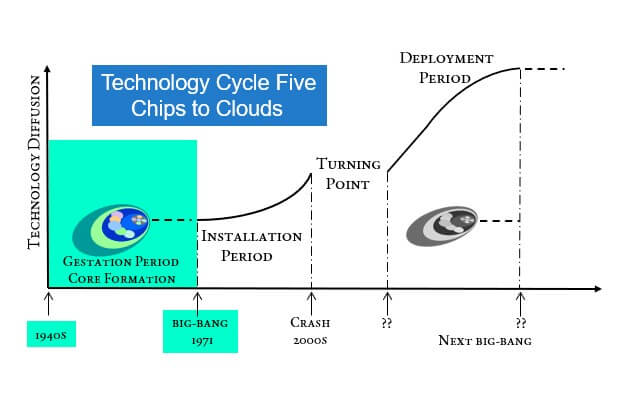
The Core Formation Period of the Fifth Technology Cycle (1940–1971)
Foundations of the Information Age
The Information Age emerged from three decades of technological development before the commercial introduction of the microprocessor in 1971. During those years, computers evolved from enormous experimental installations into commercially important systems. Transistors and integrated circuits transformed electronic manufacturing, software became an increasingly valuable independent capability, and telecommunications developed new methods for carrying information. Researchers also began connecting distant computers and investigating the transmission of data through optical fibers.
These developments occurred within different scientific, industrial, and institutional settings. Military research laboratories, universities, established electronics manufacturers, telephone companies, government agencies, and new semiconductor enterprises all contributed. Their investments were directed toward particular problems, but the technologies they developed increasingly became useful to one another.
In my Technology Supercycles framework, the fifth revolution involves six closely related industrial capabilities: Microprocessors and Computers, Telecommunications, Software, Networking and the Internet, Media Communications, and Digital Technology Manufacturing. The six categories overlap because the economic system they eventually created depends upon their interaction.
The period examined here belongs to Core Formation, the development preceding the fifth technological revolution’s defining commercial milestone. Carlota Perez dates the Information and Telecommunications revolution to 1971, using the commercial introduction of the Intel microprocessor as its initiating event. Her model then examines Installation, the Turning Point, and Deployment.
I extend that chronology backward through five analytical phases: Initial Ripples, Coalescence Around Bottlenecks, Emergence of New and Revolutionized Industries, Imitation and Improvement, and Financial Reorientation. These phases identify relationships among technologies, industries, and investment decisions that developed before the microprocessor’s arrival.
The phases overlap in time. They are useful historical categories rather than strict divisions imposed upon the actual development of technology. The transistor was invented while electronic computers were still experimental. Commercial software began emerging before the integrated circuit became widely available. Computer networking was being developed while the semiconductor industry continued solving manufacturing problems. The processes reinforced one another rather than following a perfectly ordered sequence.
This Core Formation period also demonstrates how the fifth revolution inherited capabilities from the fourth. Advanced manufacturing, electronics, scientific research laboratories, public infrastructure, mass communications, engineering education, and government-funded research all helped create the productive conditions from which the Information Age emerged.
The importance of the fifth revolution extended beyond the machines that processed information. Digital technology would eventually make it possible to coordinate productive activities across the world, reorganize manufacturing and office work, build global marketplaces, and concentrate control over important commercial gateways. Those consequences were decades away in 1971, but their foundations were already being assembled.
Phase 1: Initial Ripples, Seemingly Unrelated Innovations (1940s–1950s)
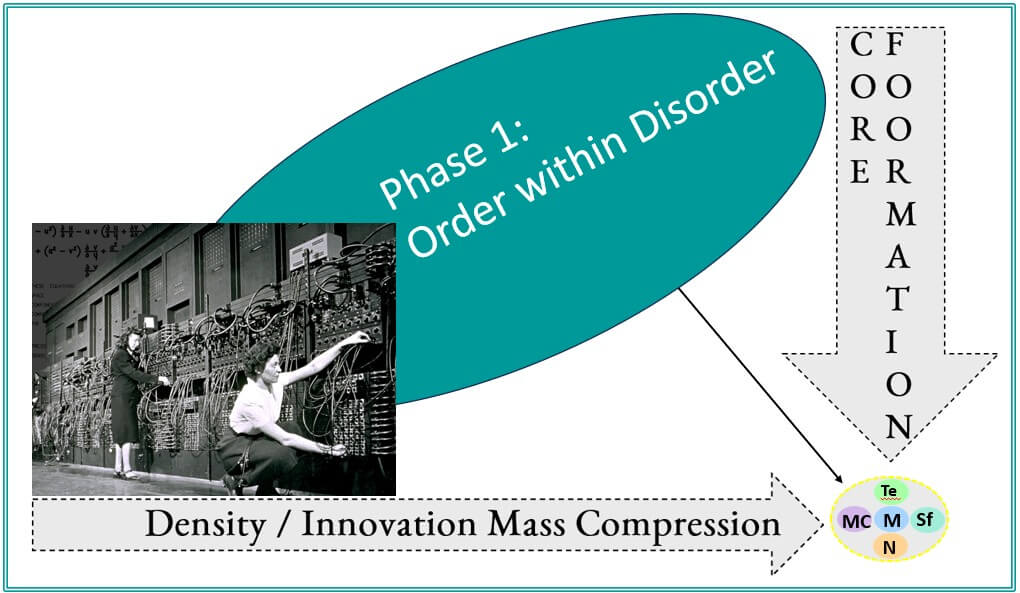
The image shows ENIAC, the Electronic Numerical Integrator and Computer, developed at the University of Pennsylvania’s Moore School for the United States Army. Construction began in 1943, the machine performed calculations in late 1945, and its public unveiling took place in February 1946.
ENIAC weighed approximately thirty tons and contained roughly 18,000 vacuum tubes. It occupied a large room, consumed considerable electrical power, and required extensive supporting equipment. Its original programming involved switches and connecting cables between functional units, as the illustration suggests.
ENIAC did not originally store programs in the modern sense. Its configuration was changed in 1948 to execute instructions encoded in function tables. The distinction reveals how electronic computing developed through several stages before reaching the stored-program architecture familiar today.
Electronic computing establishes a new possibility
ENIAC demonstrated that electronic circuits could perform calculations at speeds far beyond those of contemporary electromechanical equipment. Although its development had been motivated largely by military requirements, the implications extended into scientific research, engineering, and eventually business administration.
The machine also illustrates why technological invention and widespread economic usefulness are different events. ENIAC required enormous financial and technical resources. Programming was laborious, maintenance was demanding, and its size and cost placed it beyond almost every potential commercial customer.
Researchers were already investigating more flexible computing architectures. The development of electronic memory and stored-program systems during the later 1940s established important foundations for computers that could perform different tasks through instructions held in memory.
The Manchester Small-Scale Experimental Machine successfully ran a stored program in 1948. Other developments, including EDSAC at Cambridge in 1949 and subsequent commercial systems, demonstrated that electronic computing could become a more general-purpose capability.
The transistor begins the semiconductor revolution
In December 1947, John Bardeen and Walter Brattain demonstrated the point-contact transistor at Bell Laboratories, working in a research program led by William Shockley. The invention opened a route toward electronic devices that could eventually become smaller, more reliable, and more energy-efficient than many vacuum-tube systems.
The transistor did not immediately replace vacuum tubes. Early devices were difficult to manufacture consistently, and their performance differed across applications. Engineers spent years improving materials, device structures, production techniques, reliability, and cost.
The broader significance was the possibility of using semiconductor materials to perform electronic functions previously requiring more cumbersome components. This opened a new direction for computing, telecommunications, radio, and numerous forms of industrial control.
Information theory gives communications a mathematical foundation
In 1948, Claude Shannon published A Mathematical Theory of Communication in the Bell System Technical Journal. His work established a framework for understanding information, communication capacity, noise, and the reliable transmission of messages.
Shannon’s contribution was particularly important because communication could be analyzed independently of the specific meaning of a message. Engineers could investigate how signals were encoded, transmitted, protected against interference, and recovered at their destination.
That insight became central to digital communication and data processing. It eventually influenced computer networks, error-correcting codes, storage systems, and the development of increasingly efficient communications infrastructure.
Magnetic storage and the problem of remembering information
Early electronic computers needed methods for storing instructions and data. Punched cards, paper tape, delay lines, electrostatic memory, and other techniques offered different advantages and limitations. The ability to process information quickly was of limited value if a machine could not retain and retrieve the information required for its work.
Magnetic tape recording technology had existed before the late 1940s, primarily in audio applications. Its adaptation to computing during the following years made it possible to store substantial quantities of digital data for repeated processing.
UNIVAC I, delivered to the United States Census Bureau in 1951, used magnetic tape as an important part of its information-processing system. Later advances in magnetic core memory and disk storage gave computers additional methods for retaining and retrieving information.
IBM introduced the 305 RAMAC computer with a magnetic disk storage system in 1956. Random-access disk storage eventually changed how businesses maintained records, supported applications, and organized data processing.
Mobile communications emerge from radio engineering
Mobile voice communication developed from earlier advances in radio transmission, telephone service, and electronic equipment. American telephone companies introduced forms of Mobile Telephone Service during the 1940s. These systems allowed some users to make telephone calls through radio equipment installed in vehicles.
The early services had serious limitations. Equipment was expensive and bulky, the number of radio channels was small, and the systems could serve relatively few users within a geographical area.
Engineers at Bell Laboratories were already exploring the cellular concept during the late 1940s. Dividing service territories into smaller geographical cells and reusing frequencies offered a possible solution to the limited capacity of earlier mobile radio systems.
Turning that concept into a dependable commercial network required further advances in switching, antennas, frequency planning, electronics, and regulatory authorization. The practical cellular telephone industry would emerge much later, but important design concepts were already taking shape.
Long-distance telecommunications improve
Telephone networks had expanded enormously during the first half of the twentieth century. Coaxial cable systems helped increase the number of telephone conversations and other signals that could be carried over long distances. Microwave radio systems offered another approach to connecting major communication centers.
The postwar expansion of television and international telephone service increased demand for communication capacity. The first transatlantic telephone cable, TAT-1, entered service in 1956, providing a major new connection between North America and Europe.
These systems were part of a predominantly analog telecommunications economy. Their development nevertheless established engineering, switching, transmission, and operating capabilities that later supported digital networks.
Software begins separating from the machine
The earliest computers required programming closely tied to their hardware. Programmers worked with machine instructions, wiring arrangements, switches, and other methods that demanded specialized knowledge of particular equipment.
Assembly languages began making programming more manageable by allowing symbolic representations of machine instructions. Higher-level programming languages subsequently made it possible to express mathematical and business procedures in forms less dependent upon individual processor designs.
FORTRAN, introduced by IBM in 1957, became especially important to scientific and engineering computing. The development of COBOL began in 1959, with the first specifications appearing in 1960, to address business data-processing requirements.
The significance of these developments was the growing possibility of expressing productive knowledge through reusable instructions. Software could eventually become a valuable industrial capability in its own right, separate from the manufacture of the computer that executed it.
Media communications and portable electronics
Television expanded rapidly after World War II, building upon technologies developed during the fourth revolution. Broadcasters, equipment manufacturers, advertisers, and program producers created an increasingly important commercial system for distributing information and entertainment to large audiences.
The first commercially produced transistor radio, the Regency TR-1, appeared in 1954. It demonstrated how solid-state electronics could make consumer equipment substantially smaller and more portable.
These developments were not yet part of an integrated digital media economy. But they expanded markets for electronic components, communications equipment, recording technologies, and increasingly sophisticated consumer products.
Integrated circuits prepare the next stage
Jack Kilby demonstrated an integrated circuit at Texas Instruments in 1958. Robert Noyce subsequently developed an important silicon integrated-circuit approach at Fairchild Semiconductor in 1959, building upon planar manufacturing technology associated with Jean Hoerni.
Integrated circuits made it possible to place multiple electronic components within a common semiconductor structure. Their commercial development required further improvements in manufacturing, reliability, design, packaging, and cost.
The invention represented a major transition. Electronics could increasingly be constructed through repeatable manufacturing processes rather than by assembling very large numbers of individual components. This opened the possibility of far greater miniaturization and complexity.
The technologies emerging during Phase One appeared in different industries, but they already shared an increasingly important relationship: they created new ways to represent, process, retain, and transmit information.
Phase 2: Coalescence Around Interconnected Bottlenecks (1955–1960)
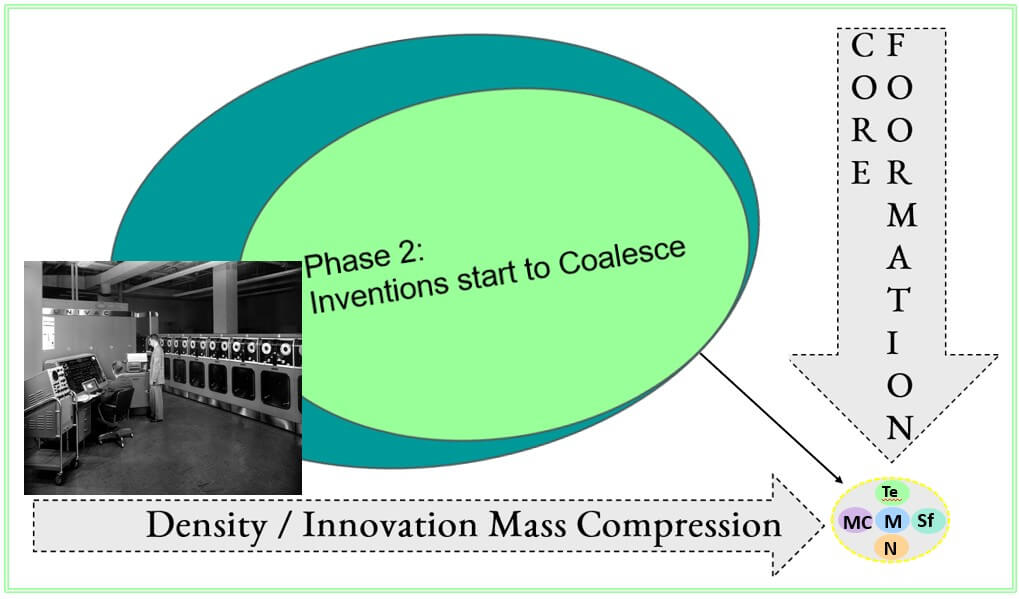
The image illustrates UNIVAC I, developed by J. Presper Eckert and John Mauchly and first delivered to the United States Census Bureau in 1951. It was among the earliest commercially produced electronic computers and helped establish electronic data processing as a practical organizational capability.
Remington Rand eventually delivered 46 UNIVAC I systems. Earlier computers were not all unique machines, and UNIVAC was not the first computer used for commercial purposes in every country. Its importance was the establishment of a recognizable commercial computer product used by multiple customers.
As more organizations began using computers, their limitations became clearer. Processing speed alone could not solve problems involving storage, programming, reliability, cost, and the movement of information.
The computing bottleneck: performance, reliability, and cost
Vacuum-tube computers required extensive power, cooling, maintenance, and specialized operating support. Although their speed represented an extraordinary improvement over earlier calculating equipment, their cost restricted adoption.
Businesses increasingly wanted computers capable of handling payroll, accounting, inventories, customer records, and other repetitive administrative activities. Scientific organizations needed more powerful machines for numerical analysis. Government agencies sought systems capable of processing extensive records and statistical information.
These applications required computers that could operate dependably, store large datasets, and justify their expense through useful work. The pressure therefore extended beyond increasing processor speed to improving the complete information-processing system.
Semiconductor manufacturing becomes a constraint
Transistors offered a way to reduce the size and power requirements of electronic equipment, but semiconductor production introduced difficult manufacturing problems. Material purity, device consistency, defects, packaging, and the ability to produce reliable components in volume determined whether the technologies could be used economically.
Integrated circuits promised additional advances by combining electronic components, but commercial production required new processes capable of producing extremely small structures with sufficient precision and yield.
The semiconductor industry’s central challenge became the reliable manufacture of increasingly complex electronic devices. That challenge required scientific research, advanced machinery, process control, specialized materials, and substantial investment.
Memory and data storage limit useful applications
Faster processors increased the importance of efficient memory and storage. Computers needed rapid access to instructions and working data, along with economical ways to retain larger quantities of information over time.
Magnetic core memory became an important technology for working storage during the 1950s. Magnetic tape provided economical sequential storage, while disk systems began allowing much faster access to particular records.
The relationship between processor performance and storage capability became a recurring feature of the digital economy. Improving one part of the system increased demand for corresponding advances in the others.
Communications networks face capacity and switching limits
Telephone networks had been designed primarily around voice communication. Their switching systems, circuits, and transmission infrastructure were effective for established applications, but increasingly extensive computing operations raised different requirements.
Organizations needed ways to exchange data between distant locations, provide remote access to computing facilities, and coordinate information across large operations. Modems and other communication equipment began adapting existing telephone lines for these purposes.
Telephone switching also became increasingly complex as networks grew. Electromechanical exchanges required substantial equipment and maintenance, encouraging research into electronic control and more flexible methods of managing connections.
Mobile systems confront limited radio capacity
Vehicle-based mobile telephone services were constrained by the small number of available radio channels and the difficulty of coordinating calls across geographical areas. Wider commercial adoption required more efficient frequency use, improved antennas, smaller electronic equipment, and reliable switching between different coverage locations.
The cellular architecture developed by telephone researchers offered a conceptual response. Practical implementation, however, depended upon technologies that were still developing in semiconductors, radio engineering, computer-controlled switching, and network management.
Software complexity threatens the value of computers
As computers became more capable, programming increasingly emerged as a constraint upon their use. Each application required development, testing, documentation, maintenance, and adaptation to the customer’s operating requirements.
Different computer models frequently required different programs. This created costly dependencies between hardware selection and software development. Organizations could face major redevelopment expenses when replacing a computer with a newer model.
Higher-level languages, compilers, operating systems, and more systematic software engineering practices began addressing these difficulties. The goal was to make software easier to develop, reuse, maintain, and transfer between systems.
Computer isolation limits information sharing
Many early computers operated as isolated installations. Data and programs moved between locations through physical media, printed documents, or other arrangements that were slow compared with electronic processing.
Researchers recognized the potential value of connecting computers so that users at one location could access resources at another. But networking raised new questions involving communications protocols, error handling, sharing expensive equipment, and managing simultaneous users.
The bottleneck was organizational as well as technical. Computers belonged to different institutions, often using incompatible equipment and operating methods. Networking required common arrangements through which unlike systems could exchange information.
The larger constraint: connecting an emerging information system
By the end of the 1950s, the limits of individual technologies were becoming increasingly interconnected. More capable computers required better memory and software. More extensive business applications increased the need for communications. Mobile networks required improved electronics and switching. Semiconductor manufacturers needed more sophisticated design and production methods.
These pressures directed investment toward complementary technologies rather than isolated breakthroughs. The emerging industrial system was beginning to organize itself around the requirements of processing, storing, and communicating information at increasing scale.
Phase Two therefore marks the recognition that the Information Age would depend upon an ecosystem of compatible capabilities. The value of any single component would increasingly be determined by how effectively it could operate with the others.
Phase 3: Emergence of New and Revolutionized Industries (1960–1965)
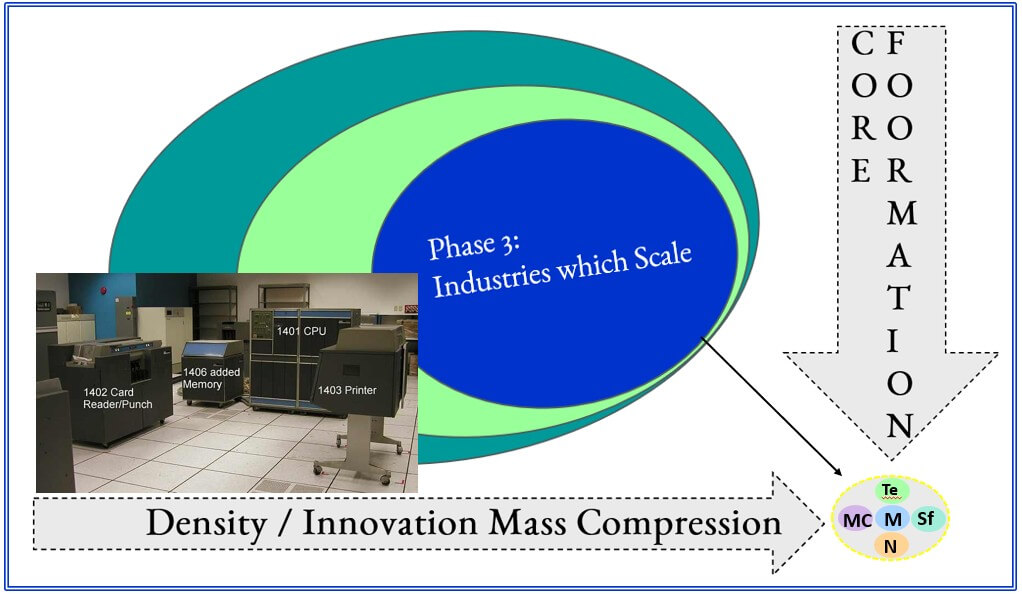
The image shows the IBM 1401 Data Processing System, introduced in 1959. Its importance was the development of a commercially successful computer serving a much larger business market than the earliest electronic systems.
The IBM 1401 helped establish electronic data processing as an economically practical activity for many organizations. It became one of the most widely installed computers of its era and demonstrated the growing demand for standardized, commercially supported information-processing systems.
The early 1960s brought increasingly organized industries capable of supplying computers, software, telecommunications equipment, electronic components, and related services to expanding markets.
System/360 turns computer compatibility into a commercial strategy
On April 7, 1964, IBM announced the System/360 family of computers. Its architecture represented a major commercial advance because customers could choose systems with different capacities while retaining a broadly compatible programming environment.
Earlier commercial computers had often been designed for specialized scientific or business applications. IBM’s System/360 brought these markets together around a common architecture, supported by a coordinated range of hardware, operating systems, software, peripherals, and services.
The investment was extraordinary. IBM committed extensive engineering and manufacturing resources to developing the family, and the software required to operate the systems became a major undertaking in its own right.
System/360 demonstrated that the computer industry was becoming more than a business selling individual machines. It increasingly supplied complete computing environments whose long-term value depended upon compatibility, software, peripherals, maintenance, and the customer’s accumulated investment in applications.
This development also introduced a form of technological dependence that would recur throughout the digital revolution. A successful architecture could make the computer ecosystem more valuable to its customers while increasing the difficulty of switching to an incompatible system.
Electronic switching changes telecommunications
Telephone companies continued investigating alternatives to traditional electromechanical switching. Bell System’s No. 1 Electronic Switching System entered commercial service in 1965, following extensive research and development.
The system used stored-program control, allowing electronic processing to manage important switching functions. Its speech switching network was still analog, so it would be incorrect to describe the 1965 system as having completed the transition to digital telephone switching.
Nevertheless, electronic control introduced new capabilities for network management and telecommunications services. It also established a relationship between computing and communications that would become increasingly important as telephone systems eventually migrated toward digital transmission and switching.
Cellular telecommunications becomes a network-design problem
During the 1960s, Bell Laboratories and other telecommunications researchers developed more detailed approaches to cellular radio systems. The key challenge was to create networks that could support many users while efficiently reusing limited radio frequencies.
The architecture required much more than radio transmitters. Engineers had to consider geographic coverage, interference, control systems, switching between cells, and the relationship between the mobile device and the wider telephone network.
These ideas established foundations for commercial cellular systems, but large-scale deployment remained limited by electronic technology, financing, spectrum allocation, and regulatory approval. The practical consumer market would develop during the 1980s and afterward.
Software becomes a specialized industrial activity
FORTRAN and COBOL helped establish programming as a commercial and professional discipline. Their growing use encouraged the development of compilers, utilities, operating systems, application programs, and methods for managing increasingly complex software projects.
Software companies also began offering products and services that could be purchased separately from computer hardware. Applied Data Research, founded in 1959, became an early example of a business developing software products for multiple customers.
The independent software market was still relatively small, and much software was supplied by computer manufacturers or developed internally by customers. But the economic value of programming knowledge was becoming increasingly visible.
The distinction would become central to the later Information Age. Software could encode business processes, calculations, and organizational knowledge in forms that could be copied and deployed through compatible computing systems.
Computer networking takes shape through research
The networking ideas that eventually produced the Internet developed through several independent research efforts. J. C. R. Licklider proposed influential concepts involving interactive computing and networks of computers during the early 1960s.
Paul Baran investigated distributed communications at RAND, producing important work beginning around 1960 and a detailed series of reports in 1964. Donald Davies independently developed packet-switching concepts at Britain’s National Physical Laboratory during the middle of the decade.
These researchers approached different problems, but their work helped establish the conceptual foundations for dividing information into manageable units and transmitting it through networks.
The ARPANET had not yet begun operating in 1962. Planning and research were underway, and the first working network would emerge later in the decade through government support, contractors, universities, and research laboratories.
Digital Equipment Corporation expands the computer market
Digital Equipment Corporation developed computers designed for technical, scientific, and other applications that could benefit from smaller and more economical systems. Its PDP-8, introduced in 1965, became an influential example of the commercially successful minicomputer.
Minicomputers created opportunities for laboratories, manufacturers, universities, and specialized users whose requirements differed from those of large corporate data-processing centers.
Their growth helped diversify the computer industry and demonstrated that electronic processing could serve a far wider range of activities than the original large scientific and administrative installations.
Media communications expands through electronics
Television, radio, recording, and the production of electronic consumer equipment continued expanding. Broadcasting was already a substantial commercial industry, but improving electronics made equipment more reliable, portable, and eventually less expensive.
These industries were still largely organized around analog media. Nevertheless, their investment in electronics, communications infrastructure, recording systems, and consumer markets created capabilities that would later be combined with digital information processing.
Fiber-optic research identifies a new transmission medium
Researchers had investigated optical communication and the transmission of light through fibers before the 1960s. But high signal loss limited the usefulness of available fibers for long-distance telecommunications.
In 1966, Charles Kao and George Hockham described how sufficiently pure glass could make optical fiber a practical communications medium. Their work identified the importance of reducing impurities and optical attenuation.
The idea provided a new research direction for telecommunications. Commercial use still required improvements in fiber manufacturing, lasers, optical components, and network equipment.
Phase Three therefore marks the appearance of increasingly recognizable digital industries. Hardware architectures, software, telecommunications, network research, and semiconductor production were developing specialized capabilities while becoming progressively more dependent upon one another.
Phase 4: Imitation, Adaptation, and Improvement (1965–1970)
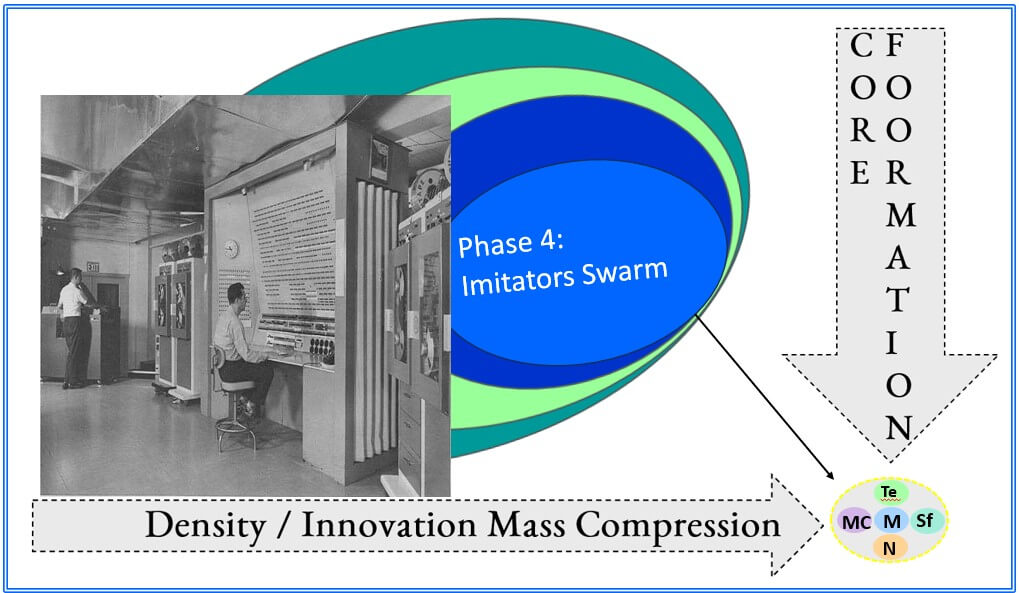
The illustration shows the Burroughs B5000 family, introduced in the early 1960s. Its architecture differed sharply from the approaches adopted by competing computer manufacturers. The B5000 used a stack-oriented design and was developed with strong support for high-level languages, particularly ALGOL.
Its presence here illustrates an important feature of Phase Four. The developing computer industry did not converge immediately upon one architecture. Different companies explored alternative approaches to processors, programming, memory, operating systems, and commercial applications.
Competition encouraged improvements, while compatibility and the growing investment in software influenced which systems customers were willing to adopt.
Semiconductor improvements transform the economics of computing
Integrated-circuit manufacturing advanced rapidly during the second half of the 1960s. Semiconductor companies improved production methods, device reliability, circuit density, and manufacturing yields.
Gordon Moore’s 1965 observation concerning the growth of components on integrated circuits became an influential guide to the industry’s development. The relationship later known as Moore’s Law described a historical trend and an increasingly important industry expectation rather than a guaranteed physical law.
Improvements in integrated circuits allowed manufacturers to design increasingly capable electronic products while reducing the size and often the cost of individual functions. These changes created new opportunities in computing, communications, industrial controls, and consumer electronics.
Silicon-gate and metal-oxide-semiconductor technologies became particularly important. They enabled increasingly dense circuits and helped establish the manufacturing foundation from which semiconductor memory and microprocessors would emerge.
The microprocessor concept begins to converge
The commercial microprocessor appeared in 1971, but its development began during the preceding years. Increasing integrated-circuit density made it practical to consider placing the central processing functions of a computing system onto a small number of chips.
In 1969, Japanese calculator manufacturer Busicom approached Intel about developing a specialized chipset. Intel engineers, including Ted Hoff and Stan Mazor, proposed a more programmable approach. Federico Faggin and Masatoshi Shima subsequently played essential roles in the detailed design and implementation of the Intel 4004.
The development was important because a programmable processor could perform different functions through software, reducing the need to create entirely different circuits for each application.
The full commercial significance was not apparent immediately. But the combination of semiconductor miniaturization, programmable logic, and standardized manufacturing had created a new possibility for computing.
Satellite communications expands the reach of networks
Intelsat I, commonly known as Early Bird, entered service in 1965. It became the first commercial geosynchronous communications satellite and demonstrated a new method of linking distant telephone and television networks.
Early Bird could carry approximately 240 simultaneous telephone conversations or one television channel. Its commercial significance involved the combination of satellite technology, ground stations, telecommunications operators, and international agreements.
Satellite communication complemented existing undersea cable systems rather than immediately replacing them. It increased the range of transmission options available to international operators and contributed to the continuing expansion of global communications.
The semiconductor path toward portable communications
Portable radio equipment became smaller and more practical as transistor technology improved. Motorola and other manufacturers developed substantial experience designing radios for military, public-safety, commercial, and consumer uses.
These capabilities helped prepare the eventual development of portable cellular telephones. But the first public demonstration of a handheld cellular telephone by Motorola’s Martin Cooper occurred on April 3, 1973, after the Core Formation period.
The historical distinction matters. Advances during the late 1960s were laying the technical groundwork for portable communications, while the complete commercial systems required for widespread cellular service remained to be developed.
IBM’s unbundling decision changes software economics
IBM’s 1969 decision to price certain software and services separately from hardware became an important milestone in the development of the commercial software industry. Previously, customers often received many programs and services as part of broader computer arrangements.
Separate pricing helped make software’s commercial value more visible. It contributed to the growth of independent software firms and encouraged customers to evaluate programs and services as products with costs and benefits of their own.
The change was part of a longer process. Software companies already existed, and the entire industry did not suddenly separate from computer manufacturing in 1969. Nevertheless, the policy influenced the economic conditions under which software could become a major independent business.
ARPANET demonstrates practical packet-switched networking
In 1968, the Advanced Research Projects Agency awarded a contract to Bolt Beranek and Newman to develop the Interface Message Processors needed for ARPANET. These devices became predecessors of the routers used in later networks.
The first network connection was established between UCLA and the Stanford Research Institute in 1969. On October 29, the first attempted remote login transmitted the letters LO before the receiving computer failed. The connection was subsequently restored and further communication succeeded.
By the end of 1969, ARPANET connected four research sites: UCLA, Stanford Research Institute, the University of California at Santa Barbara, and the University of Utah.
ARPANET demonstrated that geographically separated computers could exchange information through a packet-switched network. The modern Internet, which connects many independent networks through common protocols, developed later. TCP/IP became operational across ARPANET in 1983.
The important achievement during Core Formation was the proof that remote computer communication could become an organized, operational system rather than remaining a theoretical proposal.
Semiconductor manufacturing becomes a specialized industry
The growing complexity of integrated circuits increased the importance of precision manufacturing. Semiconductor fabrication required carefully controlled environments, photolithography, deposition, chemical processing, etching, testing, and packaging.
Production improvements helped raise the number of usable devices obtained from a wafer, reducing the cost of electronic functions. The result was a manufacturing industry whose success depended upon the continual interaction of scientific research, machinery, materials, engineering skills, and factory processes.
These capabilities were capital-intensive. Although software could be reproduced relatively cheaply after development, the chips executing it required sophisticated physical production systems. The digital revolution therefore depended upon an expanding industrial manufacturing base from its earliest years.
Optical fiber approaches practical use
The 1966 work of Kao and Hockham encouraged efforts to manufacture fibers with much lower optical losses. Research teams investigated glass purity, fabrication methods, and the relationship between optical materials and communication performance.
In 1970, Corning researchers Robert Maurer, Donald Keck, and Peter Schultz produced a low-loss optical fiber that met an important performance target for communications research.
Practical telecommunications networks still required further improvements in lasers, repeaters, connectors, installation, and network equipment. Yet the principal technical barrier that had made long-distance optical fiber appear impractical was being overcome.
The achievements of Phase Four demonstrate the cumulative nature of technological development. Semiconductor manufacturing improved the capabilities of computers and communications devices. Software increased the usefulness of hardware. Packet switching created opportunities to share information, while new transmission media expanded the possibilities for larger communication networks.
These developments were moving toward an industrial system in which information could be processed, stored, transmitted, and reused through increasingly compatible technologies.
Phase 5: Financial Reorientation Toward the Digital Economy (1970–1971)
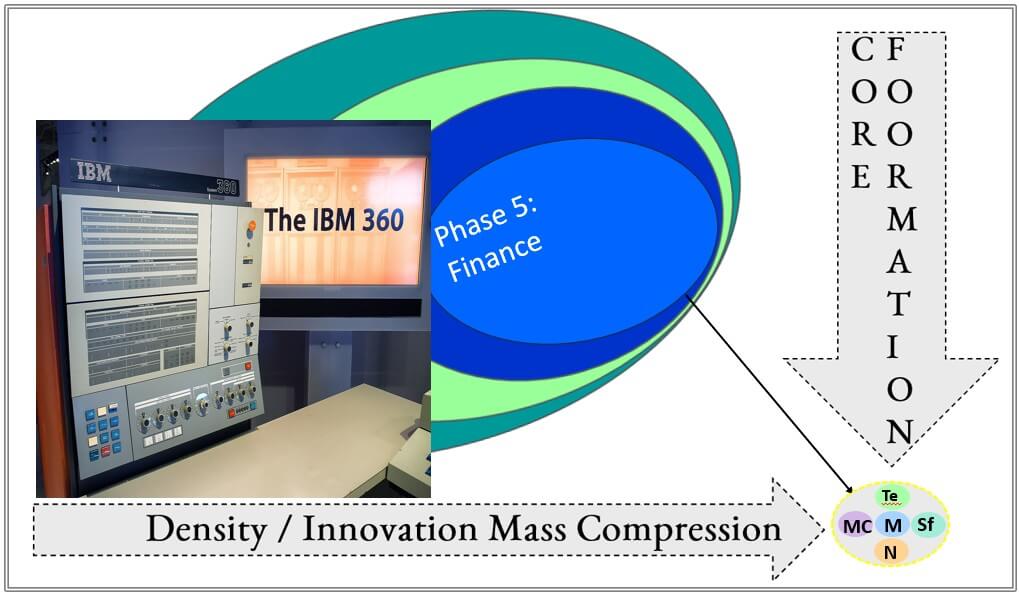
The final phase concerns a growing willingness to commit financial and institutional resources to computing, semiconductors, software, communications, and related digital technologies.
IBM’s System/360, announced in 1964, demonstrated that customers would invest in standardized computing architectures supported by software, peripherals, maintenance, and compatible future models. The System/360 was an important general-purpose computer family, although general-purpose computers existed before its introduction.
By the late 1960s, IBM was the dominant commercial computer manufacturer, a position reflected in the contemporary nickname Snow White and the Seven Dwarfs for IBM and its principal competitors. The industry was developing around both large established firms and a growing group of specialized semiconductor, software, and minicomputer companies.
The financial consequences of computer compatibility
System/360 changed the economics of computing because customers could invest in applications, training, data, and operating procedures with greater confidence that future compatible machines would preserve much of that investment.
The commercial benefits extended to IBM through hardware revenue, software, peripherals, support, and a large installed customer base. The model helped establish the importance of technological ecosystems in which compatibility and accumulated customer investment create substantial competitive advantages.
The consequence was larger than the success of one company. Organizations increasingly regarded electronic data processing as an essential productive capability. Computing expenditures became part of long-term plans for administration, manufacturing, finance, research, and commercial operations.
The size of the investment depended upon the customer. Large corporations and governments supported extensive centralized installations, while smaller computers created opportunities for laboratories, factories, educational institutions, and specialized applications.
Venture capital discovers semiconductors
The semiconductor industry increasingly attracted investors willing to finance technically uncertain businesses. Fairchild Semiconductor, established in 1957, became an important source of technological innovation and experienced entrepreneurs.
In 1968, Robert Noyce and Gordon Moore left Fairchild to establish Intel, with financial backing that included venture capitalist Arthur Rock. The company initially focused on semiconductor memory, which its founders believed could become a major commercial market.
Advanced semiconductor manufacturing required factories, specialized equipment, skilled personnel, research, and continual reinvestment. These requirements created substantial financial risk. At the same time, the possibility of rapidly improving device performance and reducing the cost per electronic function offered extraordinary commercial opportunities.
Intel introduced the 1103 dynamic random-access memory device in 1970, demonstrating the commercial potential of integrated semiconductor memory. Its later microprocessor was developed through the combination of this growing manufacturing capability with a customer’s particular requirements.
The significance of venture investment was the creation of an institutional route through which technical expertise, entrepreneurial organizations, and risk-bearing capital could be assembled. The model would become highly influential during the later digital revolution.
Telecommunications investment moves toward electronic control
Telephone networks required enormous fixed investment in switching equipment, transmission facilities, cables, buildings, and technical personnel. Their continued expansion created demand for systems capable of serving more users and providing increasingly sophisticated services.
Electronic switching offered opportunities to improve network flexibility and the management of connections. The Bell System’s investment in stored-program-controlled switching was part of a long research and deployment effort extending from the 1950s into subsequent decades.
The transition was gradual. Electronic control did not immediately make the entire telephone network digital. Analog transmission and switching remained important, while new electronic systems were introduced alongside existing infrastructure.
The financial importance lay in the continuing commitment to replace or improve an extensive installed infrastructure. Telecommunications companies would eventually become major customers for semiconductors, software, computing systems, and optical networking equipment.
Cellular development requires coordinated investment
The proposed cellular telephone system demanded several interdependent investments. Radio equipment needed to become smaller and more reliable. Switching systems had to support movement between cells. Network operators needed infrastructure, coverage planning, customer services, and access to suitable radio spectrum.
Bell Laboratories and Motorola pursued different approaches to mobile telecommunications. Their research developed within a regulatory environment in which the Federal Communications Commission exercised authority over radio-spectrum allocation and service authorization.
These developments were important to the fifth revolution, but the commercial cellular era remained in the future. The first handheld cellular telephone demonstration occurred in 1973, and significant commercial deployments followed during the 1980s.
The economic lesson is that mobile telecommunications could not emerge through a handset invention alone. The entire operating network, semiconductor technology, regulatory framework, and commercial organization had to develop together.
Software acquires a separate investment logic
Software development introduced an unusual economic relationship into industrial production. A program could require substantial initial investment in design, programming, testing, documentation, and maintenance. Once created, however, copies could often be reproduced at a much lower marginal cost than equivalent physical machines.
Applied Data Research became an important early example of a company commercializing software products separately from the manufacture of computers. Its Autoflow program demonstrated that software could be sold to multiple customers as a reusable product.
IBM’s 1969 unbundling decision strengthened the growing recognition that software and services carried independent economic value. The software industry continued developing through new firms, licensing arrangements, specialized applications, and increasingly sophisticated customer requirements.
But software never became independent of physical infrastructure. Its development and use depended upon computers, storage, telecommunications, electricity, skilled workers, and the institutions needed to finance and maintain those systems.
The combination of relatively low reproduction costs and expensive supporting infrastructure would become one of the defining economic characteristics of the digital revolution.
Public research funding prepares computer networking
The research leading to ARPANET was supported through the United States Department of Defense’s Advanced Research Projects Agency. Public financing helped make it possible for universities, contractors, and laboratories to investigate networking technologies whose future commercial value was still highly uncertain.
The initial network connected expensive research computers and allowed experiments in remote access and resource sharing. The project required specialized interface equipment, communications links, software, protocols, and cooperation among independent institutions.
The Internet emerged later through additional developments in networking protocols, commercial access, telecommunications, computer hardware, and software. Yet the early government-supported research helped establish knowledge and technical capabilities that private industry would eventually employ on a much larger scale.
The pattern demonstrates the importance of public and institutional investment in technological revolutions. Some of the most economically valuable capabilities begin as research projects before a large commercial market exists.
Media and digital manufacturing attract continued capital
Television broadcasters, electronics manufacturers, and communications companies continued investing in transmission facilities, recording equipment, consumer devices, and program production. Color television expanded its commercial market, while improved semiconductors lowered the size and cost of portable electronic products.
The media industry remained largely analog during Core Formation. However, its distribution networks, content production, advertising systems, and consumer-electronics markets created assets and capabilities that would later become central to digital media.
Semiconductor manufacturing also demanded increasing capital investment. As circuits became smaller and more complex, companies required better fabrication processes, equipment, materials, quality control, and research capabilities.
The emerging digital economy therefore contained two different but complementary financial structures. Software development could generate products whose reproduction costs were relatively low, while semiconductor production and communications networks required substantial continuing investment in physical capital.
The combination would become increasingly important as the digital revolution expanded. The financial advantages of software and network effects could generate substantial wealth, but those opportunities ultimately depended upon a productive foundation of physical infrastructure, manufacturing, scientific knowledge, and skilled labor.
Financial Reorientation creates the conditions for a new revolution
By 1970–1971, computing had become a significant commercial industry. Semiconductor manufacturers were developing more complex integrated circuits and memory devices. Software firms were establishing independent markets. Telecommunications companies were investing in electronic control and improved transmission. Government and university researchers were demonstrating operational computer networks.
These investments were not coordinated by one central organization. They arose through the activities of competing companies, universities, government agencies, financial institutions, customers, and individual engineers.
Their combined effect was to create an increasingly dense ecosystem of technological capabilities. A development in one industry expanded the opportunities available to another, making it possible to design products and services whose commercial value depended upon the integration of several technologies.
This is the defining characteristic of Core Formation’s final phase. Financial resources, organizational capabilities, and technical knowledge had accumulated sufficiently to support the next stage of industrial expansion.
1971: The Microprocessor and the Beginning of Cycle Five
On November 15, 1971, Intel publicly announced the 4004 microprocessor, developed for Japanese calculator manufacturer Busicom. The device incorporated the central processing functions of a small computer into a programmable integrated circuit.
The achievement emerged from the work of Ted Hoff, Stan Mazor, Federico Faggin, and Masatoshi Shima, together with the industrial capabilities of Intel and the requirements of its customer. The microprocessor was a product of accumulated semiconductor knowledge, circuit design, software concepts, precision manufacturing, and commercial investment.
The 4004 was a four-bit processor with approximately 2,300 transistors. Its initial applications were modest by later computing standards. But it demonstrated that a programmable processing unit could become a manufactured electronic component rather than requiring an entire large computer installation.
This created new possibilities for calculators, industrial equipment, embedded controls, personal computers, communications devices, and countless products that would eventually incorporate electronic intelligence.
Perez identifies this commercial breakthrough as the beginning of the fifth technological revolution. The date marks a historical transition in the capabilities available to manufacturers and entrepreneurs, although the full economic consequences would unfold over many decades.
The personal computer, commercial Internet, global digital platforms, cloud computing, smartphones, and artificial intelligence were still largely future developments. Their emergence would depend upon continuing improvements in hardware, software, networks, standards, public infrastructure, and business institutions.
Core Formation had established the productive foundations. The Installation period would bring those capabilities into expanding commercial markets, creating extraordinary innovation along with financial speculation and institutional disruption.
Summary: The Information Revolution’s Productive Foundation
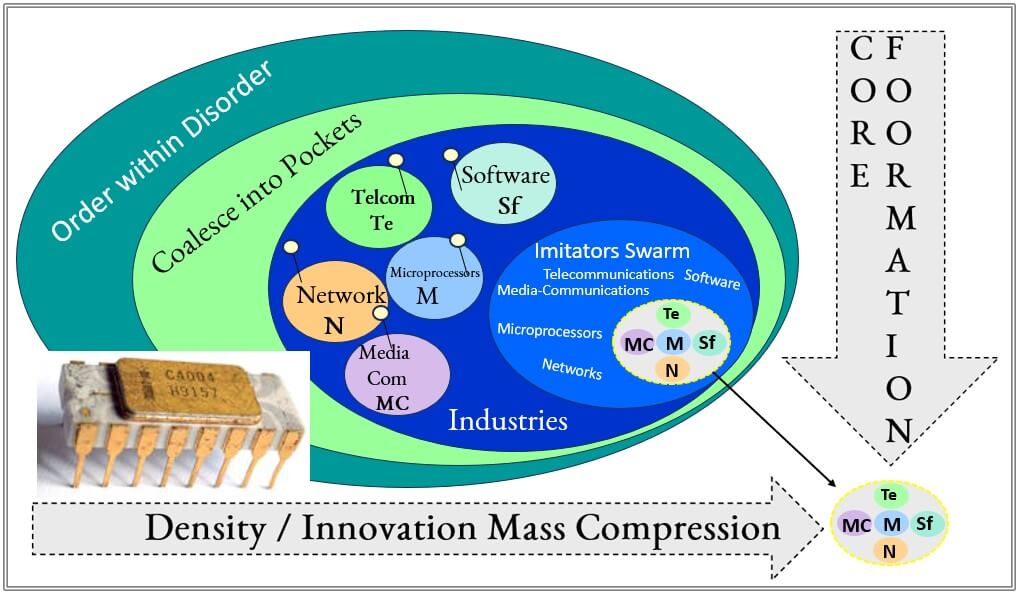
The illustration brings together the five phases of the fifth revolution’s Core Formation. Their convergence represents the accumulation of inventions, industrial capabilities, business organizations, investment relationships, and complementary technologies that prepared the economy for the commercial microprocessor.
The diagram is a conceptual model of increasing technological interconnectedness. Its visual density illustrates an argument about the relationships among technologies rather than a measured historical quantity.
The significance of 1971 lies in the commercial possibility created by combining programmable processing with increasingly sophisticated semiconductor manufacturing. The subsequent digital revolution would develop from the capabilities already accumulated across the broader productive ecosystem.
Six industries become increasingly interconnected
The six industrial capabilities identified in this model were not created simultaneously. Computers preceded commercial microprocessors. Telecommunications and mass media already possessed extensive histories. Software emerged through the development of electronic computing, while computer networking began as a specialized research activity.
What changed during Core Formation was the growing ability to combine these technologies. Electronic computers could process information, software could encode instructions, storage devices could retain data, communications networks could move messages, and semiconductor manufacturing could place increasingly complex functions into smaller physical devices.
The interaction among these capabilities became more important than the progress of any single component. Computers became more valuable when they could run sophisticated programs and access stored information. Communications networks became more useful as they gained the ability to connect computers. Semiconductor improvements increased the possible scale and affordability of both.
The eventual consequences would extend into almost every industry of the world economy. Information processing would transform manufacturing, transportation, finance, education, science, commerce, and public administration.
The relationship to technological evolution
Brian Arthur’s account of technology emphasizes the way new capabilities emerge through combinations of existing technologies and the ongoing recombination of components, methods, and knowledge. The fifth revolution provides a particularly clear example.
The microprocessor could not have appeared without earlier developments in transistors, integrated circuits, circuit design, semiconductor fabrication, computing architectures, and commercial electronics. Its economic usefulness also depended upon software, supporting equipment, communications, and demand from customers.
My five-phase Core Formation model examines the historical relationships through which these capabilities accumulated before the revolution’s defining commercial breakthrough. Perez’s framework then provides the larger structure for understanding the Installation, financial Turning Point, and Deployment that follow.
The two perspectives complement one another. Technology evolves through accumulating and combining productive capabilities, while financial markets and economic institutions shape the conditions under which those capabilities are developed and distributed.
The public and private origins of digital wealth
The fifth revolution provides powerful evidence for the collective origins of modern economic wealth. Universities, government laboratories, telecommunications companies, established manufacturers, venture investors, software developers, engineers, and numerous specialized firms contributed to the technological foundations of the Information Age.
Military and government-funded research supported electronic computing, packet-switched networking, and related scientific investigations. Private firms invested in commercial computers, semiconductors, communications equipment, software, and manufacturing. Universities educated scientists and engineers while developing knowledge and applications that extended beyond individual institutional boundaries.
Those contributions were supported by an even larger productive ecosystem. Electrical infrastructure, roads, factories, precision machinery, scientific instruments, public education, communications networks, legal institutions, and decades of accumulated expertise were inherited from earlier technological revolutions.
The extraordinary fortunes generated by the later digital economy would therefore depend upon capabilities that no individual corporation had independently created. This relationship lies at the center of my broader thesis about the middle-class ecosystem as a productive origin of wealth.
How digitalization would change the geography of work
At the close of Core Formation, computers were still expensive and communications networks were relatively limited. But the ability to represent information digitally created the foundations for a much larger economic transformation.
During the following decades, businesses would increasingly coordinate manufacturing and distribution across distant locations through computing and telecommunications. Information systems helped companies manage suppliers, inventories, production schedules, financial records, and commercial relationships over international distances.
These capabilities made certain forms of work more geographically movable. Industrial production could be reorganized through global supply chains. Later, clerical, administrative, technical, and professional activities could also be distributed more widely as digital networks expanded.
The consequences were mixed. Digital globalization helped create new industries and expand middle-class participation in developing economies, while some established industrial communities lost jobs, businesses, and accumulated productive capabilities.
Digital platforms would eventually create another important development: concentration of control over the routes through which businesses and customers reach one another. These changes occurred long after 1971, but the underlying possibilities emerged from the computing and networking capabilities developed during Core Formation.
The productive foundations of the emerging AI supercycle
The fifth revolution also established much of the productive foundation inherited by the emerging sixth supercycle of Artificial Intelligence and Autonomous Systems. Advanced processors, software, networked computing, digital storage, and telecommunications all developed from capabilities accumulated during the Information Age.
AI introduces new possibilities for applying machine intelligence to knowledge work, scientific research, engineering, robotics, and production. Yet its development remains dependent upon physical infrastructure, including semiconductor manufacturing, data centers, electricity, cooling, communications systems, and the scientific and industrial capabilities of the wider economy.
The relationship reinforces the importance of Core Formation. Each technological revolution inherits a productive foundation assembled through earlier investment and innovation. The commercial breakthrough makes a new capability visible, while the underlying productive system reflects decades of collective development.
Why This Story Was Told
The fifth revolution began developing long before the commercial introduction of the Intel 4004. Electronic computing, semiconductor research, software, communications, networking, and digital manufacturing accumulated through separate but increasingly connected efforts during the preceding three decades.
The five phases of Core Formation reveal how those efforts became a productive system. Initial inventions created new possibilities. Their growing usefulness exposed bottlenecks. New industries developed to overcome those constraints. Competition and improvement expanded technical capabilities. Financial and institutional investment then created the conditions for much larger commercial development.
The 1971 microprocessor gave that accumulation a defining commercial expression. Its subsequent impact depended upon technologies, institutions, knowledge, and industrial capabilities that had already been created throughout a much larger economic ecosystem.
That is the central lesson of Cycle Five’s Core Formation: the wealth generated by a technological revolution begins accumulating in the productive capabilities of society long before the companies that eventually capture its largest financial rewards become successful.
Cycle Five Research: The Singularity Stacks

The Singularity Stacks Reference Library contains the historical bibliography and innovation records associated with the fifth technological revolution. The Core Formation materials examine the development of computers, semiconductors, software, networking, telecommunications, media, and digital manufacturing before 1971.
Historical Research and Further Reading
Computer History Museum: Timeline of Computer History. The development of ENIAC, stored-program computers, the IBM 1401, commercial computing, and later computer architectures.
United States Census Bureau: UNIVAC I. The emergence of commercial electronic data processing and the early use of magnetic tape for government applications.
IBM: The IBM 1401. The expansion of electronic data processing into a larger business market beginning in 1959.
IBM: System/360, a Turning Point in Mainframe History. The 1964 compatible computer family and the development of standardized computing architectures.
DARPA: ARPANET. Government-supported computer networking research and the first operational network established in 1969.
IEEE Communications Society: Distributed Packet Switching. Paul Baran’s research into distributed communications and packet-based networking.
Corning: Low-Loss Optical Fiber. The 1966 research of Charles Kao and George Hockham and Corning’s 1970 demonstration of practical low-loss glass fiber.
Intel: The Intel 4004. The development of the microprocessor and the relationship between Intel and Japanese calculator manufacturer Busicom.
Intel: The Founding of Intel. The relationship between semiconductor innovation, entrepreneurial organization, and investment capital.
Motorola: Cell Phone Development. The history of portable communications and the distinction between the pre-1971 research foundations and later commercial cellular systems.
Brian Arthur, The Nature of Technology: What It Is and How It Evolves (2009). A framework for understanding the combination and evolution of technological capabilities.
Continue Exploring the Technology Supercycles
Continue to Cycle Five: Chips to Clouds.
Return to Cycle Four: Autos to Airways.
Explore Carlota Perez’s Five Historical Technology Cycles.
Explore the Six Technology Supercycles and Their Innovation Waves.