

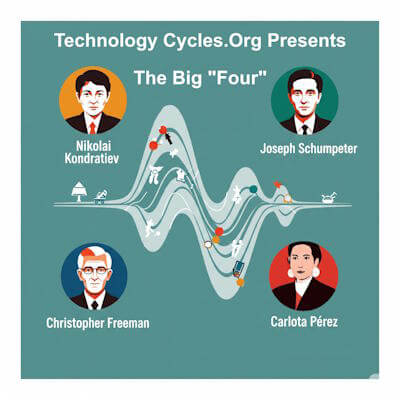
Four Foundational Economists in Technology-Cycle Theory
The modern understanding of technological revolutions developed over more than a century of economic research. Four economists made particularly important contributions to the historical framework explored on TechnologyCycles.org: Nikolai Kondratiev, Joseph Schumpeter, Christopher Freeman, and Carlota Perez.
Each approached the problem from a different direction. Kondratiev investigated long movements in economic activity. Schumpeter examined entrepreneurship, innovation, creative destruction, and the relationships between technological change and economic development. Freeman connected innovation with industrial transformation, national institutions, and long-term economic growth. Perez brought these ideas together into a historical framework describing how major technological revolutions interact with financial capital, production, and institutional change.
The progression matters because the object of study changed. Early researchers sought to explain recurring movements in prices and economic activity. Later economists examined how new technologies reorganize entire productive systems. Perez’s model added a particularly important explanation of the relationship between technological Installation, financial speculation, the Turning Point, and the possibility of a more broadly shared Deployment period.
My work at TechnologyCycles.org builds upon these foundations. The Six Technology Supercycles framework extends the historical interpretation into the emerging Artificial Intelligence and Autonomous Systems revolution beginning in 2022. It also examines five overlapping waves of innovation within each supercycle and the economic ecosystems that make technological wealth possible.
The four portraits below lead to the biographical material and historical essays associated with each economist. Kondratiev has a separate biographical account, while Schumpeter, Freeman, and Perez are examined through the site’s revised history of technology-cycle theory.
Nikolai Kondratiev (1892–1938). His investigation of long movements in prices, production, and economic activity provided an important starting point for later long-cycle research. His work raised the possibility that major changes in capitalism unfold over several decades, although the regularity and causes of those movements remain subjects of debate.
Joseph Schumpeter (1883–1950). Schumpeter placed entrepreneurship and innovation at the center of capitalist development. He examined how clusters of innovations could generate economic expansion and how creative destruction continually replaces established businesses and productive arrangements. His work brought technological change into the explanation of business cycles.
Christopher Freeman (1921–2010). Freeman helped establish the modern economics of innovation and technological change. He founded the Science Policy Research Unit at the University of Sussex in 1966 and investigated how technological systems, industrial capabilities, institutions, and public policy influence long-term development. His work helped connect innovation theory with the historical analysis of successive technological revolutions.

Carlota Perez (born 1939). Perez developed a historical framework identifying five great technological surges beginning with the Industrial Revolution in 1771. Her work explains how financial capital, technological Installation, speculative crises, institutional turning points, and productive Deployment interact. This framework provides the principal historical foundation for the six-supercycle model developed on TechnologyCycles.org.
From Long Economic Cycles to Technological Revolutions
The differences among these four economists are central to understanding how technology-cycle theory developed. Kondratiev investigated long economic movements using historical data on prices, interest rates, and production. His work helped establish a research question, but the apparent regularity of his proposed cycles remained contested.
Schumpeter placed innovation and entrepreneurship at the center of economic development. His theory of creative destruction showed how new productive capabilities continually challenge established industries, firms, and methods of production. He also examined how clusters of innovations could generate fluctuations in economic activity over different time horizons.
Freeman helped develop a broader account of innovation as a systemic process involving businesses, scientific research, industrial capabilities, education, government, and economic institutions. His work strengthened the relationship between technological change and the evolving productive structure of national and international economies.
Perez brought a powerful historical organization to these relationships. She identified five great technological surges, each associated with a new techno-economic paradigm. Her model explains why new technologies can attract speculative financial capital during Installation, why the resulting crises can expose the need for institutional change, and how successful Deployment can extend the benefits of new productive capabilities more broadly through the economy.
These contributions remain important because technological revolutions involve more than the development of individual inventions. They reorganize productive systems, investment, employment, industrial competition, and the institutions supporting economic activity. Their consequences are felt over generations.
The work on this site extends that interpretation by examining the emerging sixth supercycle of Artificial Intelligence and Autonomous Systems, the five innovation waves within each revolution, and the role of the middle-class ecosystem in creating the accumulated knowledge, infrastructure, and productive capabilities upon which modern technological wealth depends.
Recommended Books and Publications
These works provide additional background on the four economists and the development of technology-cycle theory.
Nikolai Kondratiev
The Works of Nikolai D. Kondratiev, edited by Natalia Makasheva, Warren J. Samuels, and Vincent Barnett. Four volumes, Pickering & Chatto, 1998, in The Pickering Masters series. The collection includes Kondratiev’s writings on economic dynamics, long cycles, agriculture, economic policy, and methodological questions. Later editions and reissues have appeared through Routledge.
The collection is particularly useful because it allows readers to examine Kondratiev’s actual economic research, including the evidence and arguments underlying his long-cycle interpretation. Publisher information.
Joseph Schumpeter
Thomas K. McCraw, Prophet of Innovation: Joseph Schumpeter and Creative Destruction. Belknap Press of Harvard University Press, originally published in 2007, with a later paperback edition in 2010. This biography examines Schumpeter’s life, intellectual development, and understanding of entrepreneurship, capitalism, innovation, and creative destruction.
Schumpeter’s own Business Cycles (1939) is also important for understanding how he attempted to connect different periods of economic fluctuation with the emergence and diffusion of innovations.
Christopher Freeman
Technology and the Human Prospect: Essays in Honour of Christopher Freeman, edited by Roy M. MacLeod. Frances Pinter, 1986. This collection explores the relationship among technological innovation, economic development, industrial change, employment, and public policy.
Another important work is As Time Goes By: From the Industrial Revolutions to the Information Revolution, by Christopher Freeman and Francisco Louçã, published by Oxford University Press in 2001. It examines historical technological revolutions, structural economic change, and long-term development.
Freeman’s writings can be difficult to locate, so I particularly recommend Remembering Chris Freeman. The memorial website includes personal recollections from his family and colleagues, articles about his life and work, and an extensive publications section. The material is especially valuable because it connects Freeman’s intellectual contributions with the people and institutions through which his research developed.
The University of Sussex history of SPRU also provides useful background on Freeman’s role in establishing the Science Policy Research Unit and developing modern innovation studies.
Carlota Perez
Carlota Perez, Technological Revolutions and Financial Capital: The Dynamics of Bubbles and Golden Ages. Edward Elgar, 2002. This is the essential starting point for understanding her framework of Installation, Turning Point, and Deployment, and the changing relationships between financial capital and the productive economy.
Techno-Economic Paradigms: Essays in Honour of Carlota Perez, edited by Wolfgang Drechsler, Rainer Kattel, and Erik S. Reinert. Anthem Press, 2009. This collection examines her work on technological revolutions, innovation, economic development, and institutional change. Publisher information.
Perez’s continuing research and publications are available through her official website.
Continue Exploring the History of Technology-Cycle Theory
The site’s four-part history follows these contributions in greater detail, beginning with the earliest long-cycle models and moving through Schumpeter, Freeman, and Perez.
- Part One: The Early Models and Nikolai Kondratiev
- Part Two: Joseph Schumpeter and Innovation Swarms
- Part Three: Christopher Freeman and the Evolution of Technology-Cycle Theory
- Part Four: Carlota Perez and the Great Technology Surges
Return to the TechnologyCycles.org Mission page, or explore the Six Technology Supercycles.