


Explore the Seven Movements
Hover over the painting, or select a movement below to learn more.
Seven movements. One evolving visual language.
Hover to preview. Click or tap to keep its details open.Impressionism
c. 1860s–1880sArtists: Claude Monet, Pierre-Auguste Renoir, Camille Pissarro, Alfred Sisley.
What changed: Changing light, visible brushwork, atmospheric color, and fleeting moments became central. Portable paints and railway access helped painters move beyond the studio.
Read: The Birth of ImpressionismPost-Impressionism
c. 1886–1905Artists: Vincent van Gogh, Paul Cézanne, Paul Gauguin, Georges Seurat.
What changed: Painters pushed beyond optical appearances toward intensified color, symbolic imagery, expressive brushstrokes, and stronger underlying structure.
Expressionism
c. 1905–1920sArtists: Ernst Ludwig Kirchner, Wassily Kandinsky, Franz Marc, Emil Nolde.
What changed: Distorted color, line, and perspective communicated emotional and psychological experience. Modern urban life became a powerful subject.
Cubism
c. 1907–1914Artists: Pablo Picasso, Georges Braque, Juan Gris.
What changed: Objects fractured into geometric facets; painters combined viewpoints instead of relying on one fixed perspective.
Surrealism
c. 1924–1940sArtists: Salvador Dalí, René Magritte, Max Ernst, Joan Miró.
What changed: Dreams, the unconscious, and improbable juxtapositions displaced everyday logic. Dalí’s impossibly elongated elephants make the familiar uncanny.
Abstract Expressionism
c. 1940s–1950sArtists: Jackson Pollock, Willem de Kooning, Mark Rothko, Lee Krasner.
What changed: Gesture, scale, color, and the physical act of painting became central, often without recognizable subject matter.
Pop Art
c. 1950s–1960sArtists: Roy Lichtenstein, Andy Warhol, Richard Hamilton, James Rosenquist.
What changed: Comics, mass advertising, and consumer goods entered fine art. Lichtenstein’s Whaam! monumentalized comic-book action.
Dates are approximate. These artistic movements overlapped and influenced one another rather than following a strict sequence.
The Technology Supercycles – Modernism’s Forge
It began with … Steam and Rail to Impressionism in the Birth of Modernism
Modernism was born from the Industrial Revolution. Long before artists began challenging centuries of artistic convention, technology was transforming the world they observed, the materials they used, and their understanding of light, color, motion, and time. The Second Technology Supercycle, driven by steam power, railways, and industrial manufacturing, helped create the conditions from which modern art would emerge.
J. M. W. Turner was indelibly affected by the transformation of the world into which he was born, a world of bucolic, open farmland being radically altered by the arrival of the railroads. He captured this upheaval in Rain, Steam, and Speed – The Great Western Railway (1844). The painting is pictured below in the left and a detail of the locomotive is on the right.
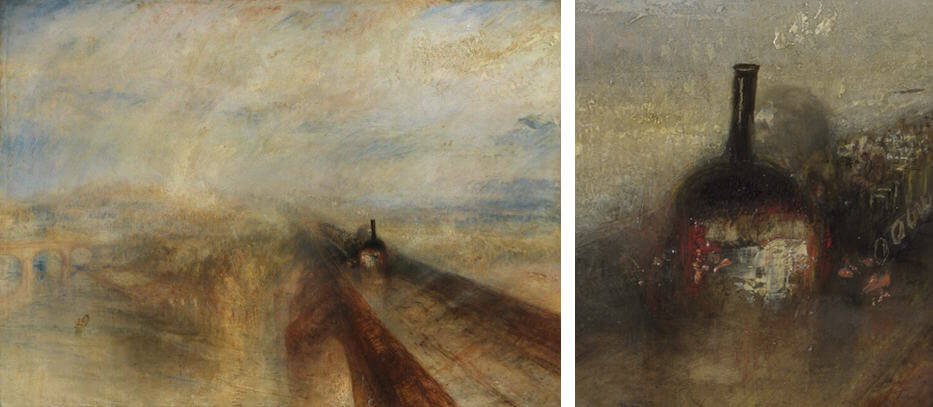
A locomotive races toward the viewer across the Maidenhead Railway Bridge. The train, capable of reaching an astonishing 60 miles per hour, emerges from a swirling atmosphere of rain, smoke, sunlight, and steam. The landscape appears to dissolve around it.
Turner was painting something unprecedented: the experience of a world being transformed by the automation of early machines.
The railway introduced new sensations of speed and movement. Distances contracted. Landscapes once experienced at the pace of a horse or carriage could now rush past in minutes. Turner translated this technological upheaval into a radical visual language in which atmosphere, light, and color became as important as recognizable objects. In fact, in a lecture in 1818, Turner coined the famous phrase: “light is colour.”
Meanwhile, another industrial revolution was unfolding inside the artist’s paintbox.
Advances in industrial chemistry and pigment manufacturing expanded the range of available colors. Prussian blue, cobalt blue, chrome yellow, and zinc white offered artists new possibilities for capturing the brilliance and subtle variations of natural light. The Industrial Revolution was changing the very materials from which art was made.
In 1841, American painter John Goffe Rand patented the collapsible metal paint tube. Previously, artists often stored prepared paints in animal bladders, which were inconvenient, fragile, and difficult to reseal. Industrially manufactured tubes made prepared oil colors increasingly portable, durable, and accessible.
This seemingly modest invention helped transform painting. Artists could carry an expanding palette into the countryside, onto city streets, and along rivers, working directly before their subjects as light and weather changed. Previously they were limited to working in studios as the colors were not easily transportable.
Together, these two technological developments helped give rise to the first school of artists to depart from humanity’s unbroken tradition of representational painting, a tradition stretching back to the earliest human-made images on cave walls. That school, of course, was Impressionism.
One of the earliest connections between Turner and the emerging Impressionists came through Alfred Sisley. Born in Paris in 1839 to English parents and raised in France, Sisley was sent to London as a young man to study business. During his time in England, he encountered the landscapes of J. M. W. Turner, whose treatment of light and atmosphere would become central to the artistic revolution that followed. Returning to Paris, Sisley abandoned business for painting and entered the studio of Charles Gleyre, where he studied and worked alongside Claude Monet, Pierre-Auguste Renoir, and Frédéric Bazille. These young artists, still students, would help form the nucleus of the Impressionist movement. Sisley’s ideas and experience provided an early connection between Turner’s artistic innovations and the painters who would carry them forward.
That connection deepened during the Franco-Prussian War of 1870–1871, when Claude Monet and Camille Pissarro sought refuge in England. There, at the National Gallery, they encountered Turner’s Rain, Steam, and Speed – The Great Western Railway. His experiments with atmospheric light and dissolving forms anticipated some of the most important characteristics of Impressionist painting.
Monet’s later depictions of railway stations, particularly The Gare Saint-Lazare (1877 – pictured below), reveal the extraordinary convergence of these developments.
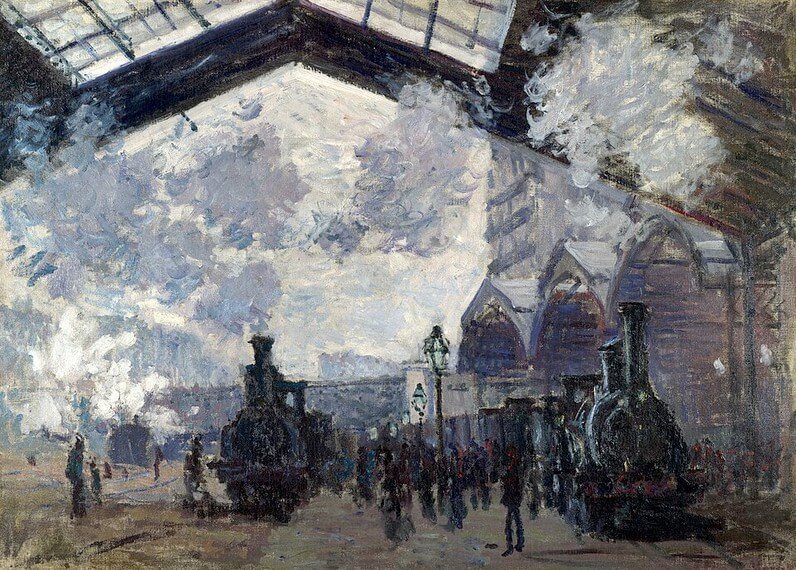
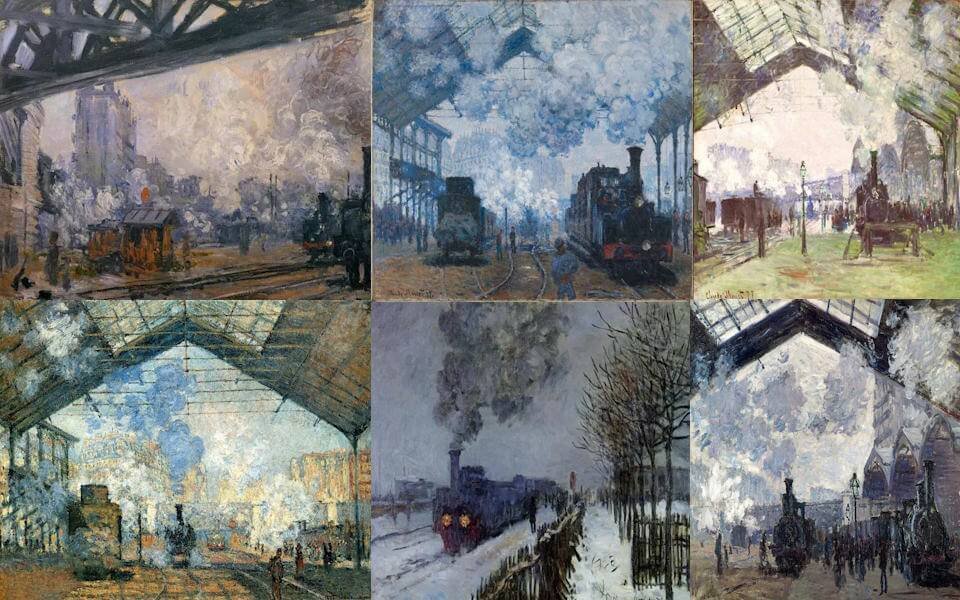
The images of trains dominated Monet’s early work. Monet created an entire series of paintings of the Gar Saint-Lazare train station along with paintings of trains moving through new areas of France. Steam engines, industrial architecture, manufactured pigments, and portable paints became part of a new artistic vision. Indeed, the visual effect of steam itself seems to permeate most Impressionist paintings, whether or not the artists were consciously aware of its influence. Six examples of Monet’s 1875-1877 obsession on technology are shown below.
Turner had helped demonstrate how the modern industrial world could transform painting itself. The Impressionists carried that exploration further, developing a visual language that would ignite three major schools of modernism: Expressionism, Cubism, and Surrealism. Together, these three movements formed the spine upon which modernism was built.
Every great technological revolution changes how humanity lives. It also changes how humanity sees. Modernism was one of the cultural revolutions forged by that process.
The work to assemble the supporting articles will be undertaken in future.
More on the Birth of Impressionism and the second Supercycle
The background art history of Turner’s Rain, Steam, and Speed – The Great Western Railway