

The History of Technology Supercycle Theory: Part Two
Joseph Schumpeter: Innovation Swarms and Creative Destruction
Joseph Schumpeter occupies an important place in the history of economic thought because he recognized that technological innovation is a central force driving economic development. While many economists concentrated on prices, employment, interest rates, and the management of existing markets, Schumpeter examined how entrepreneurs introduce new productive capabilities that fundamentally change those markets. His research into innovation clusters, capital formation, business cycles, and creative destruction helped establish the intellectual foundations upon which later theories of technological revolutions would develop.
Schumpeter was an Austrian-born economist who eventually taught at Harvard University. His interests extended across entrepreneurship, economic development, money and banking, the evolution of capitalism, and long economic cycles. His thinking differed from much of the emerging mainstream of twentieth-century economics because he regarded capitalism as a dynamic system constantly transformed by innovation. Understanding economic development required examining how entirely new combinations of resources, technologies, and organizations emerged and disrupted established arrangements.
His work was particularly important in advancing the long-cycle research begun by Nikolai Kondratiev. Kondratiev had identified possible long movements in economic activity but had not developed a convincing explanation of the technological forces that might produce them. Schumpeter sought to supply that missing mechanism by connecting long economic movements to clusters of innovations, entrepreneurial investment, and the expansion of new industries.
Schumpeter and the Rise of Keynesian Economics
Schumpeter’s research developed alongside another extraordinarily influential economist, John Maynard Keynes. The two men approached economic problems from different directions. Keynes concentrated heavily on aggregate demand, employment, financial instability, and the policy responses needed to stabilize economic activity. Schumpeter was more interested in the processes through which innovation transformed the underlying productive structure of capitalism.
Keynes published The General Theory of Employment, Interest and Money in 1936, three years before Schumpeter published Business Cycles in 1939. Keynes’s work helped transform macroeconomics and provided an intellectual foundation for policies addressing unemployment and economic instability. Schumpeter’s much larger historical investigation received comparatively less attention, particularly as governments and economists concentrated on depression, war, reconstruction, and the management of national economies.
Although Keynesian economics became enormously influential, it would be inaccurate to attribute every modern monetary policy instrument to Keynes. Central banking had developed long before his work, and modern monetary policy reflects contributions from several economic traditions. The important distinction for this history is that Schumpeter asked a different question: how do technological innovations transform the productive capabilities of capitalism, and why might those transformations generate recurring economic expansions and contractions?
Schumpeter Builds Upon Kondratiev
Schumpeter developed his theory over several decades. In The Theory of Economic Development, originally published in German in 1911 and translated into English in 1934, he argued that economic development occurs through what he called new combinations. These combinations could involve new products, new production methods, new markets, new sources of materials, or new forms of industrial organization. Entrepreneurs implemented these changes by redirecting economic resources toward opportunities that had previously been unavailable.
The significance of these innovations extended beyond the success of the first entrepreneur. A breakthrough could demonstrate an entirely new commercial possibility, attracting imitators, suppliers, investors, and additional inventors. Improvements and complementary innovations accumulated around the original development. Schumpeter described this concentration of entrepreneurial activity as swarming.1
In Business Cycles (1939), Schumpeter expanded this argument into a historical explanation of capitalist development. He incorporated Kondratiev’s proposed long economic cycles alongside shorter business fluctuations and examined how major innovation clusters could generate sustained periods of investment and industrial expansion. The theory sought to explain why economic development occurred unevenly, with intense bursts of entrepreneurial activity followed by periods of adjustment.
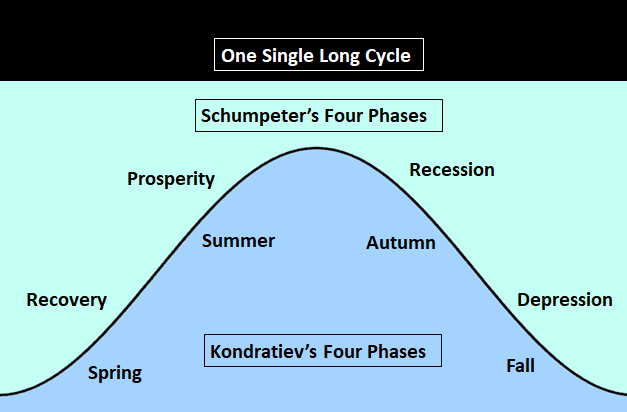
Schumpeter also developed a four-phase description of economic cycles: prosperity, recession, depression, and recovery. His work identified the transition toward prosperity as an important period for the emergence and commercial implementation of innovation clusters. The resulting expansion could stimulate further investment, competition, and imitation before the economy encountered the financial and industrial adjustments generated by the new productive system.2

The Long-Cycle Charts of Kondratiev and Schumpeter
The chart on the left compares the long-cycle terminology associated with Kondratiev and Schumpeter. The chart on the right reproduces a diagram from page 213 of Schumpeter’s Business Cycles. It is particularly important because illustrations from Schumpeter’s work are sometimes attributed directly to Kondratiev, obscuring how the theory developed from one economist to another.
Schumpeter adopted Kondratiev’s idea of long economic movements and referred to them as Kondratieff cycles. His writings included descriptions such as Kondratieff prosperity and Kondratieff depression, as well as references to successive long periods of capitalist development. He attempted to fit those movements into a broader model containing shorter Kitchin and Juglar cycles. The resulting framework was ambitious, but its historical dating and proposed interactions among cycles remained subjects of considerable debate.3
These distinctions become important when interpreting modern technology supercycles. Kondratiev was primarily examining long movements in economic data. Schumpeter introduced an explanation centered upon innovation, entrepreneurship, and changes in the productive structure. Their models addressed related questions, but the economic cycles they described should not automatically be treated as identical to the technological revolutions identified by later researchers.
George Garvy and the Interpretation of Long Cycles
Another important contribution to the historical discussion came from economist George Garvy, who examined Kondratiev’s long-cycle theory during the 1940s. Working within the research tradition associated with the National Bureau of Economic Research, Garvy questioned the statistical strength of Kondratiev’s conclusions and examined difficulties in the dating and interpretation of long economic movements.4
Garvy’s work illustrates the difficulties researchers encountered when examining historical economic records assembled across different countries, periods, and statistical methods. His analysis also contributed to the continuing debate over the interpretation of long cycles and long waves. Later writers sometimes used these expressions interchangeably, even though a complete cycle could be described as containing distinct rising and falling movements.
Schumpeter corresponded with Garvy in December 1943, acknowledging the importance of his critique while defending aspects of his own interpretation of successive stages of capitalist development. This exchange took place after Schumpeter’s Business Cycles appeared in 1939, so Garvy’s later paper could not have influenced the original publication. The correspondence nevertheless demonstrates that Schumpeter recognized the statistical and conceptual problems surrounding the long-cycle hypothesis.5
The debate continued because the underlying problem was difficult. Economists were attempting to identify recurring long-term patterns using incomplete historical data while also explaining why those patterns occurred. Schumpeter’s most enduring contribution was to move the explanation toward the innovations, entrepreneurs, and industries transforming the productive economy.
Innovation Swarms: The Engine of Economic Transformation
Schumpeter’s concept of innovation swarms provided a much more dynamic explanation of economic development. A major innovation introduced a new commercial or productive possibility, attracting entrepreneurs who sought to reproduce, improve, and extend its success. Their activities generated additional innovations and complementary products. As these opportunities multiplied, investments expanded across related industries, creating the conditions for a much larger economic transformation.
Consider the development of railways. Steam locomotives were revolutionary inventions, but railway expansion required far more than locomotives. New ironworks, coal mines, engineering firms, bridge builders, machine shops, communications networks, and financial organizations developed around the emerging transportation system. Each contributed capabilities needed by the others. The economic significance of the railway ultimately emerged from this expanding network of interconnected innovations and industries.
The personal computer industry provides a modern example of the same principle. Personal computing existed before IBM introduced its personal computer in 1981. Earlier machines included the Altair 8800 in 1975 and commercial systems from Apple, Commodore, and Tandy. IBM’s entry nevertheless helped establish a widely adopted architecture and encouraged the rapid growth of compatible hardware and software industries.
Companies began manufacturing IBM-compatible computers, while others developed operating systems, application software, printers, monitors, modems, storage devices, networking products, and an expanding range of peripherals. Competition encouraged improvements in price, performance, usability, and capability. The resulting ecosystem became far more economically significant than any single product. Schumpeter’s innovation swarm provides a useful explanation of how these complementary developments reinforced one another.
Schumpeter’s insight was that an economy could experience concentrated periods of entrepreneurial innovation and investment as new possibilities emerged. Innovations could attract further innovation, creating feedback between technological development and capital formation. These clusters helped explain why capitalist development often appeared as powerful surges of economic change rather than a smooth progression of incremental improvements.
Creative Destruction
Schumpeter’s other enduring contribution was his theory of creative destruction, developed most famously in Capitalism, Socialism and Democracy in 1942. As new technologies and productive methods spread, they challenged established enterprises, displaced older processes, and reorganized entire industries. Economic development repeatedly created opportunities for new businesses while undermining the commercial foundations of others.
The railway displaced substantial portions of the older transport economy. Automobile manufacturing transformed demand for horse-drawn transportation and its supporting industries. Digital networks dramatically changed newspapers, retail, advertising, entertainment, and communications. Each transformation introduced productive opportunities while placing older businesses, workers, investments, and communities under increasing pressure.
Schumpeter recognized that these changes occurred within the economic system itself. Competition increasingly involved new products, technologies, production methods, and organizational capabilities that could transform entire markets. A business might remain efficient within its established industry while discovering that the industry’s underlying economic structure was being replaced.
The Intellectual Connection to Marx
Schumpeter’s analysis also had an interesting intellectual connection to Karl Marx. Marx and Friedrich Engels had emphasized the capacity of capitalism to repeatedly transform productive forces, industrial relationships, and established social arrangements. Their interpretation led toward a very different understanding of capitalism’s future, but the recognition that capitalist production continually reorganized economic life anticipated part of Schumpeter’s later analysis.
Schumpeter developed creative destruction into a theory of entrepreneurial innovation and capitalist evolution. He emphasized the productive achievements of capitalism while also questioning whether its economic success might eventually weaken the social and institutional foundations needed to sustain it. In modern institutional economics, researchers such as Daron Acemoglu and James Robinson have further examined how political and economic elites can resist innovations that threaten established concentrations of power.
These ideas help explain why technological progress can become economically and politically disruptive. New productive systems challenge existing ownership arrangements, employment patterns, market relationships, and institutions. The capacity of society to accommodate these transformations becomes an important part of determining their eventual economic consequences.
Schumpeter’s Three Principal Works
Schumpeter developed his thinking across several major publications. Three works are particularly important to understanding how his ideas about entrepreneurial innovation, business cycles, capital formation, and creative destruction evolved.
The Theory of Economic Development (1911; English Edition 1934)
In The Theory of Economic Development, Schumpeter distinguished ordinary economic activity from the development created when entrepreneurs introduced new combinations of productive resources. His approach emphasized the entrepreneur as an agent of economic change, capable of creating opportunities that disrupted established production and market relationships.
These new combinations could involve a new product, an improved production process, access to another market, a new source of materials, or a different organization of industry. The resulting innovations disturbed existing economic arrangements and stimulated further entrepreneurial activity. Schumpeter recognized that successful innovations frequently attracted imitators and complementary developments, contributing to clusters of economic change.
Credit occupied a central role in this theory. Entrepreneurs often required access to resources before their innovations generated revenues. Banks could create new purchasing power through lending, enabling resources to move away from established uses and toward emerging opportunities. This relationship between innovation and credit creation was important because new productive capabilities often required substantial investment before their economic value could be demonstrated.
Business Cycles (1939)
In Business Cycles: A Theoretical, Historical, and Statistical Analysis of the Capitalist Process, Schumpeter attempted to explain how entrepreneurial innovation could generate recurring economic fluctuations. He combined historical research with a model of overlapping economic cycles of different lengths, including the shorter Kitchin and Juglar cycles and the much longer Kondratieff cycles.
Schumpeter argued that clusters of innovations could stimulate investment, employment, industrial expansion, and new business formation. Successful innovations encouraged imitation and complementary investment, while the eventual adjustment to new productive methods could contribute to recession and the reorganization of established industries. His four-phase cycle model identified prosperity, recession, depression, and recovery as broad stages of this economic process.
Schumpeter placed considerable importance on the timing of entrepreneurial innovation. New combinations were especially significant in initiating economic upswings, while subsequent expansion brought additional investment and commercial development. Innovations could continue throughout the cycle, but the clustering of major entrepreneurial initiatives was particularly important in his explanation of the transition into prosperity.
The historical analysis was ambitious, but it did not establish that every technological revolution followed an identical economic timetable. Questions remained about the dating of long cycles, their relationships to shorter fluctuations, and the institutional conditions influencing their development. These unresolved issues would later attract the attention of evolutionary economists and researchers into technological revolutions.
Capitalism, Socialism and Democracy (1942)
Schumpeter’s Capitalism, Socialism and Democracy placed innovation within a broader examination of capitalism’s economic and political future. The book developed his argument that capitalism continually transforms itself through creative destruction. Innovations change the competitive structure of markets by introducing new productive methods, industries, products, and forms of economic organization.
The book also reflected Schumpeter’s growing attention to the role of large corporations. Organized research, industrial laboratories, professional management, and systematic investment increasingly contributed to innovation alongside individual entrepreneurs. This development raised questions about how the institutional organization of capitalism might change as technological innovation became a more structured and capital-intensive activity.
Schumpeter suggested that capitalism’s own success could eventually weaken some of the social and institutional arrangements supporting it. His concerns extended beyond financial crises to the growth of bureaucratic organizations, changes in entrepreneurial leadership, political pressures, and the evolving relationship between large enterprises and society. These questions would become increasingly important as subsequent technological revolutions produced larger and more interconnected industrial systems.
Credit, Capital Formation and Innovation Clusters
The relationship between capital formation and technological innovation was one of Schumpeter’s most important contributions. The implementation of new productive combinations required resources, and those resources often had to be assembled before commercial returns were available. Bank credit provided entrepreneurs with purchasing power that could be directed toward machinery, labor, materials, and the establishment of new enterprises.
As early innovations demonstrated commercial possibilities, additional entrepreneurs and investors entered the market. Investment expanded into supporting industries, complementary technologies, distribution systems, and new productive capacity. The process became self-reinforcing as successful innovations attracted capital, while increased capital availability enabled further innovation.
The relationship was dynamic. Some investment preceded the successful introduction of innovations, while subsequent breakthroughs stimulated additional capital formation. Established businesses faced the possibility that investments in older machinery, technologies, and productive systems would lose value as new capabilities became commercially competitive.
Schumpeter therefore connected the creation of new capital with the destruction or devaluation of older capital. This interaction helped explain why technological change could generate extraordinary new wealth while simultaneously destabilizing existing enterprises and industries. It also established an important foundation for later research into speculative investment and the financial pressures accompanying technological revolutions.
When Do Innovation Swarms Develop?
Schumpeter regarded innovation clusters as important drivers of new economic expansions. Pioneering entrepreneurs implemented breakthroughs that created new productive and commercial possibilities. Other entrepreneurs followed, introducing refinements, complementary innovations, and competing products. This concentration of activity could accelerate economic development, particularly during the early stages of a major expansion.
The timing was important because innovations did not enter the economy uniformly. Their economic effects depended upon investment, entrepreneurial opportunity, technological readiness, market demand, and the capacity of existing institutions to accommodate new productive methods. A breakthrough could remain commercially limited until supporting innovations and infrastructure made wider adoption possible.
Schumpeter associated the strongest entrepreneurial innovation clusters with the emergence of economic prosperity following earlier adjustments. However, innovation itself could continue through recessions, periods of depression, and recovery. Secondary improvements, organizational innovations, and complementary developments frequently emerged as businesses adapted to changing conditions.
His historical framework did not provide a definitive explanation for the timing of every technological revolution. Carlota Perez would later develop a different interpretation, emphasizing how the installation of new technologies, speculative investment, financial crises, and institutional adaptation interact in the development of major technological surges.
The Sequence of Innovation and Industrial Development
Schumpeter’s research suggests a broad developmental process in which pioneering innovations introduce new productive possibilities, entrepreneurs pursue their commercial applications, complementary industries develop, and the resulting technologies spread across increasingly large portions of the economy. Over time, competition, standardization, investment, and organizational change can transform these innovations into established economic systems.
Schumpeter did not formalize this process as a specific sequence of five technological waves. His principal contribution was identifying the tendency of innovations to cluster, along with the entrepreneurial and financial mechanisms that help transform those clusters into economic development. Later researchers expanded the analysis to examine technological diffusion, industrial systems, infrastructure, and institutional adjustment.
This distinction is important to my own research. Schumpeter’s innovation swarms help explain how technological breakthroughs attract complementary innovations and entrepreneurial activity. My five-wave supercycle model examines the larger sequence through which these developments expand into interconnected industries, infrastructure, markets, and productive systems across the duration of a technological revolution.
Schumpeter’s Legacy and the Next Stage of Technology-Cycle Theory
Schumpeter transformed the study of economic development by placing innovation and entrepreneurship at the center of the process. Kondratiev had examined recurring long movements in economic data. Schumpeter sought to explain those movements through clusters of technological innovations, the creation of new businesses, capital formation, and the destruction of established productive arrangements.
His work left important questions unresolved. The timing and duration of long cycles remained uncertain, and his models did not fully explain how the institutional and financial systems surrounding each technological revolution might shape its development. Nevertheless, his research provided a powerful foundation for subsequent economists who examined technological change as an evolutionary process involving entire industries and economic systems.
Beginning in the 1970s, economists and researchers increasingly returned to Schumpeter’s work as they sought to explain industrial stagnation, technological change, international competition, and the emergence of the information revolution. Christopher Freeman and other evolutionary economists would develop these ideas further, eventually contributing to the research that helped establish Carlota Perez’s model of technological revolutions.
The next article follows these developments and explains how the study of innovation expanded into a broader understanding of technological, industrial, financial, and institutional transformation. Continue to Part Three: Christopher Freeman and the Evolution of Technology-Cycle Theory.
Footnotes
- Hansen, A. 1951. “Schumpeter‟s Contribution to Business Cycle Theory‟ The Review of Economics and Statistics ↩︎
- Long Wave Theory. Elgar Publishing 1996. Volume 69, The International library of critical writings in economics. Edited by Christopher Freeman. Page 299 Cycle Theory‟ The Review of Economics and Statistics ↩︎
- Kondratiev and the Dynamics of Economic Development. Long Cycles and Industrial Growth in Historical Context. By Vincent Barnett. Publisher Palgrave Macmillan; 1998. Page 136. ↩︎
- The National Bureau of Economic Research still exists today: nber.org/ ↩︎
- Kondratieff’s Theory of Long Cycles. Article by George Garvy. The Review of Economics and Statistics. MIT Press, Vol. 25 No. 4 (Nov., 1943), pp. 203-220 ↩︎