
Technology Cycle Two: The Rail Revolution
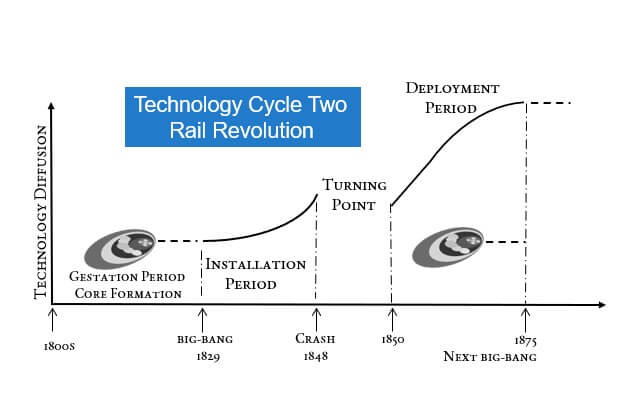
The Rail Revolution: When Industrialization Learned to Move
1829–1873. The second technological revolution transformed the geographical reach of the industrial economy. The first Industrial Revolution had demonstrated how machinery, energy, factories, and organized labor could dramatically increase production. The second made it possible to move the resulting materials, products, and people across distances that had previously imposed enormous economic barriers.
For centuries, the movement of heavy goods depended upon waterways, sailing vessels, animal power, and roads that were often unreliable or impassable during parts of the year. A merchant could purchase manufactured goods in one region and face considerable difficulty transporting them to customers elsewhere. Coal, iron, grain, timber, and other bulky materials were especially expensive to move over land.
The steam railway changed those relationships. Locomotives could haul heavy loads over specially constructed tracks, operating on schedules increasingly independent of weather, animal endurance, and the limitations of ordinary roads. As railway networks expanded, producers gained access to larger markets, industrial districts acquired more dependable supplies, and travelers could move between cities in a fraction of the time previously required.
Carlota Perez identifies 1829, the year of Stephenson’s Rocket and the Rainhill Trials, as the beginning of the second great technological surge. The locomotive was an important breakthrough because it demonstrated that several previously developed capabilities could be combined into a reliable system for fast, mechanically powered transportation.
The railway revolution extended beyond locomotives. It depended upon the continuing development of steam engines, iron production, machine tools, engineering, industrial chemistry, construction, finance, and communications. Together, these industries made the expansion of rail transportation possible and created demand for further technological improvements.
In my Technology Supercycles interpretation, this was the first great expansion of industrialization beyond the original factory system. The first revolution developed new methods of production. The second connected industrial production to increasingly large regional, national, and international markets. It expanded the scale at which industrial societies could organize economic activity.
Industrialization Expands Beyond the Factory
The importance of the railway revolution becomes clear when we consider the economic constraints inherited from the eighteenth century. Industrial factories could manufacture more textiles, tools, and other goods, but increasing output was useful only if businesses could obtain sufficient raw materials and reach customers capable of purchasing their products.
Canals had already reduced transportation costs during the first revolution. They were especially useful for coal, agricultural products, and heavy manufactured goods. But canals required suitable geography, extensive engineering, and access to water. Their routes were constrained by waterways, elevations, locks, and the expense of construction.
Railways introduced a different transportation system. Tracks required substantial investment, land, bridges, tunnels, and engineered foundations, but routes could connect important commercial and industrial centers that waterways could not reach conveniently. Locomotives provided mechanical power directly to vehicles traveling along the network.
The result was a fundamental expansion in the economic territory available to producers. Factories could draw materials from more distant suppliers. Agricultural regions could send products to urban markets. Mines could reach manufacturers and ports. Merchants could coordinate shipments across growing networks of towns and industrial districts.
This was an early stage of technology-enabled globalization. Steamships, improving ports, expanding railway systems, and commercial institutions helped reduce the economic importance of distance. Industrial development remained uneven, and international trade had existed for centuries, but the speed and carrying capacity of modern transport began transforming the organization of production and exchange.
The railway was therefore much more than a faster form of transportation. It changed which economic activities were practical, where businesses could operate, and how industrial regions could participate in larger markets. It allowed the productive capabilities developed during the first revolution to spread through an expanding economic system.
Five Interconnected Industries Powered the Revolution
Railway construction required the interaction of several industries whose development reinforced one another. I identify five principal technological clusters during the second supercycle: steam power, railway engineering and transportation, metallurgy, precision machine tools, and industrial chemistry.
Steam Power and Mobile Mechanical Energy
Steam engines had existed well before 1829. Thomas Newcomen’s atmospheric engine and James Watt’s later improvements had already established the commercial usefulness of steam power for pumping and manufacturing. But stationary industrial engines were fundamentally different from a compact machine capable of carrying its own power system while pulling heavy loads.
Richard Trevithick’s experiments with high-pressure steam in the early nineteenth century helped demonstrate that engines could become smaller and more powerful. Subsequent engineers improved boilers, cylinders, valves, wheels, and the relationship between steam pressure and mechanical motion. Locomotive development increasingly became a specialized engineering discipline.
As locomotives became more dependable, their growing commercial use encouraged improvements in manufacturing, maintenance, fuel efficiency, and the availability of replacement components. The development of a railway network created an increasingly large market for steam-engine technology.
Railway Engineering and Transportation Networks
A successful railway required far more than locomotives. Engineers had to construct tracks capable of supporting heavy moving loads, bridges crossing rivers and valleys, tunnels through difficult terrain, stations, yards, and facilities for maintaining equipment. Operators also needed reliable methods for scheduling traffic and preventing collisions.
The railway network became a large engineered system whose individual components depended upon one another. An unreliable section of track could interrupt movement across an entire route. The economics of transportation increasingly depended upon the coordinated performance of equipment, infrastructure, workers, and operating procedures.
Metallurgy and the Demand for Stronger Materials
Railway construction created enormous demand for iron. Rails, locomotives, wheels, bridges, machinery, and other equipment required materials of increasingly consistent quality. Early cast-iron rails were vulnerable to breakage under the weight of heavy locomotives, encouraging the development and adoption of more durable wrought-iron alternatives.
John Birkinshaw’s rolled wrought-iron rails, patented in 1820, represented an important improvement. Later, the development of less expensive steel-production methods provided a stronger material for heavily used railway networks. Henry Bessemer’s steelmaking process, announced in 1856, helped establish the foundation for the much larger steel revolution that would follow.
Railway demand therefore contributed to the development of the metallurgical capabilities that would become central to Cycle Three. The technologies of one revolution were already helping prepare the productive foundations of the next.
Machine Tools and Precision Manufacturing
Steam engines and railway equipment required components manufactured with increasing precision. Cylinders, pistons, wheels, bearings, valves, and mechanical linkages had to operate reliably under heavy loads and demanding conditions.
Developments in lathes, boring machines, planers, milling equipment, measuring devices, and workshop organization improved the ability of manufacturers to construct these components repeatedly. Skilled machinists, mechanics, pattern makers, foundries, and specialized suppliers became essential participants in the growing railway economy.
Over time, more consistent components and manufacturing methods made maintenance and equipment replacement easier. These capabilities also spread into other branches of industrial production, extending the benefits of railway-related engineering beyond transportation itself.
Industrial Chemistry and Supporting Production
Chemical manufacturing also expanded during the nineteenth century. Industrial processes supplied materials needed by textiles, paper production, metalworking, mining, construction, and other industries. Improvements in chemical processing helped increase production capacity and the consistency of manufactured goods.
Coal and its byproducts provided important materials for several industrial processes. The commercial development of synthetic dyes began a significant new stage in 1856 when William Henry Perkin discovered mauveine. This development illustrated the growing relationship between chemical research and industrial manufacturing.
The chemical industry was not created by the railways, and many of its advances developed independently. But the growing transportation network reduced the expense of moving raw materials and manufactured products, creating additional opportunities for the development of large industrial operations.
Together, these five industrial clusters established a new scale of economic coordination. Railways stimulated demand for materials and machinery, while improvements in those supporting industries made railways more dependable and economical. Each component helped expand the market and productive opportunities available to the others.
Financial Capital and the Expansion of Railway Infrastructure
Railway construction required financial investment on a scale that distinguished it from many earlier forms of enterprise. A railway company could not ordinarily begin operating by purchasing a locomotive and immediately selling transportation services. It first needed legal authority, surveys, land, track, bridges, stations, equipment, and employees.
Large amounts of capital had to be committed before the completed system could generate sufficient revenue. Investors therefore financed railway projects based upon expectations about future traffic, freight charges, passenger demand, regional development, and the commercial value of connecting particular markets.
This investment structure created extraordinary opportunities for both productive development and financial speculation. Successful railways could transform the economic value of entire regions. Projects whose anticipated traffic never materialized could leave investors facing severe losses.
Railway finance also encouraged the growth of joint-stock enterprises, specialized financial intermediaries, securities markets, and increasingly sophisticated arrangements for raising capital. The railway industry became a major example of the relationships between financial capital and the development of large productive infrastructure.
This relationship is central to Carlota Perez’s historical framework. During Installation, financial capital helps create the infrastructure of a new technological system. But expectations can move beyond the productive returns realistically available, creating speculative bubbles whose collapse imposes large economic and social costs.
The Railway Mania of the 1840s became one of the clearest early examples of this process.
The Four Developmental Periods of Cycle Two
The historical model developed by Perez divides technological revolutions into Installation, a Turning Point, and Deployment. Installation includes the early Irruption and later Frenzy. Deployment includes Synergy and Maturity.
My Technology Supercycles framework adds an earlier Gestation or Core Formation period, allowing us to examine the inventions and industrial capabilities that developed before the revolution’s initiating breakthrough.
The periods below provide an approximate historical organization of Cycle Two. Their boundaries should be understood as interpretive rather than exact universal dates. Technological advances, financial disturbances, and institutional adjustments developed at different times across countries and industries.
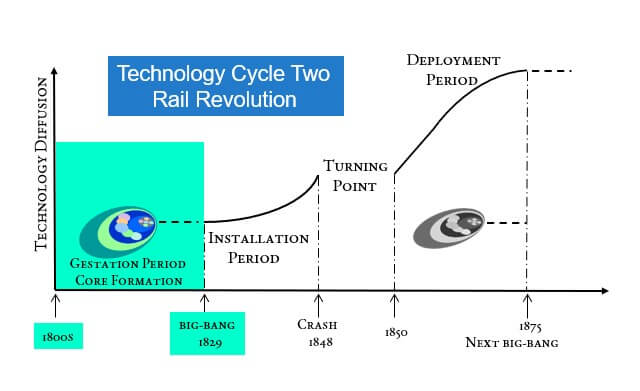
Gestation and Core Formation: Preparing the Railway Revolution (1800–1829)
The foundation of the railway revolution developed through decades of experiments involving mobile steam power, iron tracks, locomotive engineering, and precision manufacturing. During this period, inventors and entrepreneurs attempted to solve technical problems that prevented steam-powered transportation from becoming a widely used commercial system.
Richard Trevithick was among the most important early figures. In 1804, his steam locomotive successfully operated on rails at Penydarren in Wales. The demonstration showed that steam power could move heavy loads along a fixed track, although the locomotive’s weight and the weakness of the rails created serious operational problems.
Other engineers continued developing locomotives for mining and industrial transportation. George Stephenson built locomotives for the Killingworth collieries, while improvements in iron production, machine tools, and steam-engine construction gradually increased their reliability.
The Stockton and Darlington Railway opened in September 1825. Although horses continued to play an important role in its operations, the line demonstrated the commercial potential of steam locomotives hauling substantial loads over a public railway. Its development provided valuable experience in construction, financing, locomotive production, and railway management.
The next major achievement came with the Liverpool and Manchester Railway project. Its promoters sought a more dependable transportation link between an important manufacturing center and a major port. The proposed line required the development of a system capable of handling significant traffic between two economically important cities.
In October 1829, the Rainhill Trials brought several competing locomotive designs together to demonstrate their performance. Stephenson’s Rocket, developed by Robert Stephenson and his colleagues, demonstrated the usefulness of a highly effective combination of boiler design, exhaust draught, engine construction, and mechanical propulsion.
The trials provided a defining demonstration that steam locomotives could satisfy the requirements of a major intercity railway. Perez uses this achievement as the initiating event of the second technological revolution.
Core Formation therefore culminated in the ability to combine innovations from several industries into a commercially persuasive transportation system. The essential technological capabilities had existed in different forms for years. Their combination made a much larger railway industry possible.
The detailed Cycle Two Core Formation chapter examines this process through five stages: Initial Ripples, Coalescence, Emergence, Imitation and Improvement, and Financial Reorientation.
For the historical breakthrough, see the Science Museum Group’s account of the Liverpool and Manchester Railway.
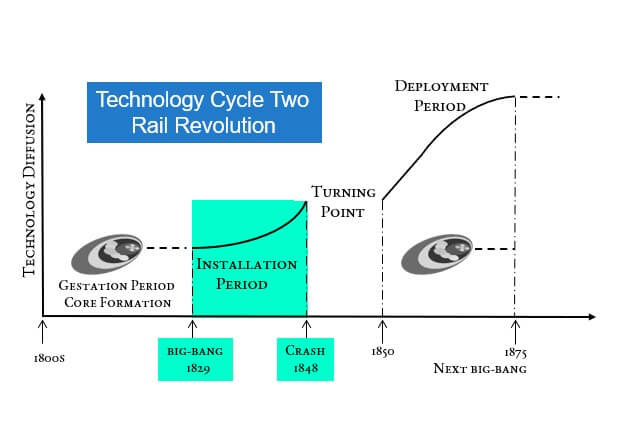
The Installation Period: Railway Expansion and Speculative Frenzy (1829–1848)
The opening of the Liverpool and Manchester Railway on September 15, 1830, demonstrated the commercial possibilities of a railway connecting major industrial and commercial centers. The line moved passengers and freight through a system designed around steam-powered transportation. Its importance extended far beyond the individual businesses that originally financed it.
The railway made the emerging technology visible to customers, engineers, investors, and public authorities. It encouraged other cities and industrial districts to consider how dependable mechanical transportation could change their economic relationships.
During the following years, railway construction expanded throughout Britain. The network connected manufacturing centers, coalfields, ports, and growing cities. Railway development attracted engineers, contractors, iron producers, machinists, financiers, and workers into a rapidly expanding collection of specialized activities.
New railway projects required surveys, bridges, tunnels, stations, land acquisition, locomotives, and substantial quantities of iron. The resulting investment stimulated additional industries and created new forms of employment. Railway engineers developed increasingly sophisticated methods of planning routes, building infrastructure, and organizing traffic.
Railways also encouraged the development of communication systems. Early electric telegraph networks were constructed alongside railway routes, allowing information to move faster than physical transportation. Operators could coordinate train movements, report delays, and improve safety as traffic increased.
One of the earliest permanent railway telegraph installations was established in Britain in 1839 between London Paddington and West Drayton. During the following decades, telegraph systems developed into a separate communications infrastructure with growing commercial importance.
The railway and the telegraph together began transforming the relationship between movement and information. Goods and people could travel more rapidly, while messages could increasingly reach distant locations before the physical arrival of those shipments or travelers.
Railway Mania: When Financial Expectations Outran Reality
The growing commercial possibilities of rail transportation attracted intense financial interest. During the 1840s, railway investment became a major speculative activity in Britain. Entrepreneurs promoted new routes, investors purchased shares in railway companies, and the stock market increasingly valued enterprises based upon expectations of future transportation demand.
The speculative boom accelerated during 1844 and 1845. Railway shares offered investors the opportunity to participate in a rapidly expanding industry whose future market appeared enormous. Many companies issued partially paid shares, allowing subscribers to control a claim on substantial railway capital through an initial payment representing only part of their eventual obligation.
That financing arrangement increased the potential returns available to investors, but it also created substantial risks. When companies required additional payments to fund construction, shareholders had to provide more money regardless of whether the market value of their investment had increased or declined.
Some proposed lines duplicated existing or competing routes. Others depended upon optimistic assumptions about passenger demand, freight volumes, construction costs, and future profits. Investors could become enthusiastic about the commercial potential of railways without understanding the substantial capital required to complete and operate an individual project.
British railway share prices peaked during 1845, followed by a prolonged decline. As expectations changed, financial pressure increased upon shareholders and the companies seeking further capital. Many investors suffered serious losses, while some projects were abandoned, reorganized, or absorbed into larger railway enterprises.
The financial difficulties interacted with broader pressures involving agricultural shortages, international commerce, monetary conditions, and the operation of the banking system. The commercial crisis of 1847 exposed severe vulnerabilities in British finance.
The Bank Charter Act of 1844 had placed restrictions upon the Bank of England’s note issuance. During the 1847 panic, the British government authorized a temporary relaxation of those restrictions. The announcement helped restore confidence even though the Bank did not ultimately need to exceed the statutory limit.
The crisis is an important example of the relationship between financial speculation and institutional change. Investors had financed an infrastructure system capable of transforming the productive economy, but their financial expectations and commitments exceeded what many projects could realistically support.
For detailed historical research, see the Federal Reserve Bank of New York’s study of Railway Mania and the 1847 crisis and Gareth Campbell’s research on railway financing and leveraged speculation.
The Installation period therefore established two important historical developments. Railways became an increasingly useful productive system, while the financial arrangements supporting their expansion generated risks that existing institutions were poorly prepared to manage.
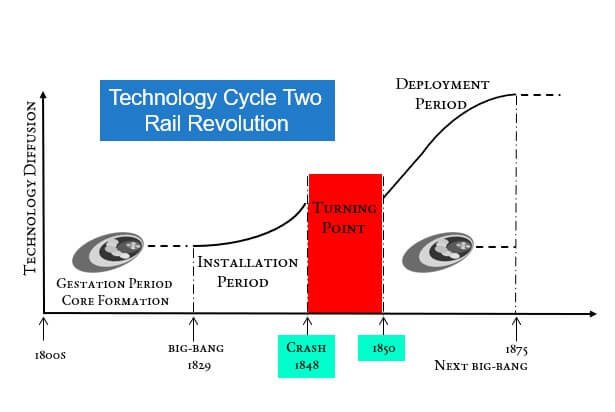
The Turning Point: Financial Reckoning and the Spring of Nations (1848–1850)
By 1848, Europe’s economic and political institutions were confronting extraordinary pressure. Railway speculation had already suffered a severe reversal, the financial crisis of 1847 had exposed weaknesses in commercial credit, and widespread social unrest was challenging established political arrangements across the continent.
The European revolutions of 1848, often called the Spring of Nations, developed from several overlapping forces. Economic hardship, poor harvests, food shortages, unemployment, demands for constitutional government, nationalism, and resentment of established political authority contributed to the unrest.
Revolutionary movements appeared in France, the German states, the Austrian Empire, and other European societies. Their immediate political objectives differed, but together they revealed widespread dissatisfaction with institutions that had struggled to accommodate changing economic and social conditions.
The relationship between these events and the railway revolution requires careful interpretation. Railway speculation did not single-handedly cause the revolutions of 1848. Financial pressures were part of a much larger set of economic and political disturbances, many of which had developed independently of the railway industry.
Nevertheless, the new transportation infrastructure influenced the movement of information and people during the revolutions. Railways and steamships allowed news to travel between cities more rapidly, while political activists, officials, and military forces could move through increasingly connected transportation systems.
These capabilities did not make European societies fully integrated. Railway networks remained incomplete, borders and political jurisdictions imposed restrictions, and messages often continued traveling through a mixture of steam transport, newspapers, and older communications methods.
Even so, the revolution demonstrated that industrial technology was beginning to change how political events developed and how quickly developments in one region could become known elsewhere.
For an examination of this relationship, see Technology and the Revolutions of 1848 and 2011, published by the Konrad Adenauer Foundation.
From Speculative Expansion to Productive Use
The financial collapse did not eliminate the economic value of the railway infrastructure already constructed. Tracks, bridges, stations, locomotives, and engineering expertise continued providing transportation services even when shareholders experienced substantial losses.
By 1850, Britain’s railway network had expanded to approximately 6,600 route miles, roughly three times its extent in 1844. The commercial infrastructure continued developing even as the financial returns to many early investors proved disappointing.
This distinction is one of the most important historical lessons of the railway revolution. The financial value of an individual railway company could collapse while the economic usefulness of its infrastructure remained substantial.
The result was a growing need to reorganize the industry around the practical operation of railway networks. Companies had to coordinate routes, manage traffic, improve maintenance, control costs, and develop commercially sustainable services. The financial enthusiasm of Installation was giving way to the longer process of integrating rail transportation into the wider economy.
Institutional adaptation occurred gradually. Railway regulation, company governance, safety practices, operating procedures, and the relationships among competing rail operators continued evolving throughout the nineteenth century.
Some companies failed, others consolidated, and new enterprises continued expanding the network. The process illustrates why the Turning Point of a technological revolution should be understood as a period of adjustment rather than a single event that instantaneously resolves every economic difficulty.
Perez’s framework provides a way to understand this transition. Financial capital helped establish the new infrastructure during Installation. The subsequent crisis exposed the limits of speculative financing and created pressure for institutions and businesses to develop more effective arrangements for using the productive capabilities already created.
The Turning Point also had a human cost. Investors lost wealth, businesses encountered financial difficulties, and workers experienced insecurity. These effects occurred within societies already struggling with political conflict and the uneven economic consequences of industrialization.
The historical outcome depended upon whether the growing infrastructure could become a foundation for productive activity extending beyond the original investors and railway companies.
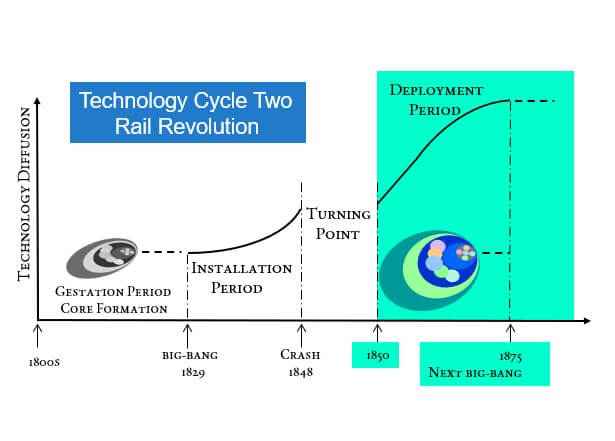
The Deployment Period: Railways Transform the Industrial World (1850–1873)
During the decades following 1850, railways became increasingly important elements of the industrial economies of Europe and North America. Their networks connected growing cities, industrial districts, agricultural regions, mines, and ports, expanding the geographical reach of productive activity.
The usefulness of railway transport extended beyond the movement of passengers and freight. A reliable transportation network could change where factories were built, which resources could be used economically, and the size of the markets available to a business.
Manufacturers could specialize in particular products while obtaining other materials and components from distant suppliers. Agricultural producers could reach urban consumers more reliably. Coalfields and mining regions could supply industrial centers that had previously been limited by transportation costs.
These developments encouraged specialization, larger-scale production, and increasingly complex relationships among industries. The railway network became a central infrastructure system supporting the continuing expansion of industrialization.
The United States Builds a Continental Economy
The railway revolution transformed the United States as well as Britain and continental Europe. In 1830, the United States possessed only a small railway network. By 1850, it had more than 9,000 miles of railway, and by 1860 the network had expanded to approximately 30,000 miles.
Railways connected rapidly growing industrial centers with agricultural and resource-producing regions. The availability of reliable inland transportation encouraged urban development, commercial specialization, manufacturing, and the expansion of domestic markets.
During the American Civil War, railways became essential to the movement of troops, equipment, and supplies. Their military importance demonstrated how transportation infrastructure had become a strategic resource as well as an economic one.
On May 10, 1869, the completion of the first transcontinental railroad at Promontory Summit, Utah, marked another important development. The line connected the expanding eastern railway system with the Pacific coast, transforming the speed and economics of transportation across the North American continent.
Its construction depended upon federal support, private investment, engineering, and large amounts of labor, including the contributions of Chinese workers whose role was often minimized in later historical accounts. Railway expansion also accelerated settler colonization and the dispossession of Indigenous peoples, imposing severe costs upon communities whose land and ways of life were disrupted.
By 1870, the United States possessed approximately 53,000 miles of operating railroad. The network had become a foundation for national industrial development, commercial exchange, and the growth of modern transportation businesses.
For the historical record, see the Library of Congress guide to the Pacific Railway Act and the transcontinental railroad.
Railways, Telegraphs, and the Coordination of Modern Business
As railway networks expanded, their operation required increasingly sophisticated coordination. Operators needed to know where trains were located, whether tracks were available, when shipments would arrive, and how equipment and employees should be assigned.
Telegraph systems helped address these challenges. Messages could travel ahead of trains, enabling improved scheduling and traffic control. Businesses could also exchange information about prices, orders, shipments, and commercial conditions across greater distances.
These capabilities encouraged new forms of management and organization. Large railway companies developed procedures for accounting, maintenance, staffing, traffic coordination, and the administration of extensive networks of assets and employees.
The growing importance of reliable schedules also encouraged more standardized approaches to time. Railway operators and passengers needed common references for departures, arrivals, and connections, contributing to the gradual adoption of standardized timekeeping.
The railway and telegraph together helped establish foundations for the later development of large-scale business administration. Organizations increasingly depended upon the systematic movement of information alongside the movement of people and materials.
This was a major step toward the modern economy, in which productive activity depends upon the coordination of numerous specialized organizations across increasingly large geographical areas.
The Development of New Industrial Capabilities
Railway demand helped accelerate improvements in metallurgy, machine tools, and engineering. Locomotive manufacturers required increasingly durable materials and precise components. Track networks needed stronger rails, better bridges, and more reliable construction methods.
Henry Bessemer’s process for producing steel, announced in 1856, became one of the important technological developments that connected the railway revolution to the next industrial era. Improvements in steelmaking eventually made stronger and more economical rails available while supporting a wider transformation in machinery, buildings, ships, and other industrial structures.
Industrial chemistry also developed new products and methods. Scientific investigation increasingly became an important source of commercial innovation, while the availability of transportation expanded markets for specialized materials and manufactured goods.
The growing railway economy supported technical occupations, engineering education, skilled manufacturing, and the development of increasingly sophisticated industrial enterprises. These capabilities accumulated within communities, institutions, firms, and professional networks.
Over time, they became part of the productive foundation inherited by later technological revolutions. The emerging third revolution of steel, electricity, and heavy engineering would build upon the industrial infrastructure and specialized capabilities that railways had helped create.
Railways and the Expansion of Global Markets
Railway construction spread beyond Britain, Europe, and the United States. Networks developed in parts of Asia, Latin America, and other regions, frequently linking ports with agricultural districts, mines, and growing centers of commerce.
In India, the first passenger railway service opened between Bombay and Thane in 1853 under British colonial rule. During subsequent decades, railways became important to the movement of raw materials, people, and manufactured goods across the subcontinent.
The consequences of these developments were complex. Railway networks could reduce transportation costs and create economic opportunities, but their routes and financing often reflected the priorities of colonial governments, foreign investors, and commercial interests. The resulting benefits were distributed unequally, and some networks were designed principally to move resources toward ports and export markets.
Railway expansion therefore contributed to the increasing integration of world markets while also reflecting the political and institutional inequalities of the nineteenth century.
These developments helped create the international industrial and commercial relationships through which later technological revolutions would spread. Transport systems connected production and consumption across greater distances, making the location of industrial activity increasingly important to global economic development.
The Crisis of 1873 and the End of the Railway Age
The Deployment period did not end with a universal collapse of railway transportation. Railways continued operating and expanding after 1873. But financial and industrial conditions were changing, and the opportunities available from the original revolution were increasingly accompanied by new forms of economic pressure.
In the United States, extensive railway expansion had depended upon substantial borrowing and speculative investment. The financial failure of Jay Cooke & Company in September 1873, following difficulties financing the Northern Pacific Railway, helped trigger a major American financial panic.
The crisis occurred within a wider international period of financial instability that included the Vienna stock-market crash earlier in 1873. Economic downturns developed across several countries, with consequences influenced by national monetary systems, industrial conditions, financial institutions, and patterns of investment.
Railway overinvestment and financial leverage were important contributors to the American crisis. Large amounts of capital had been committed to construction projects whose anticipated returns had not always materialized. When financing tightened, railway enterprises and the institutions supporting them became vulnerable.
The Panic of 1873 illustrates another recurring pattern in the history of technological revolutions. Productive infrastructure can become deeply established even while the financial arrangements supporting its expansion prove unsustainable.
The date also provides a useful boundary for Cycle Two in my framework. Railways had become fundamental economic infrastructure, while developments in steel, electricity, and heavy engineering were beginning to support a different industrial system.
Perez identifies 1875 as the beginning of the third technological revolution. The transition was gradual, and many technologies associated with Cycle Three developed before that date. The two revolutions therefore overlap through the capabilities inherited by the emerging industrial system.
For an account of the American crisis, see Virginia Tech’s history of railroad construction and the Depression of 1873.
The Railway Revolution and the Growth of the Middle-Class Ecosystem
The railway revolution contributed to an economic transformation extending far beyond the fortunes of railway companies and their investors. It changed the possibilities available to industrial workers, farmers, merchants, engineers, manufacturers, and growing urban communities.
By connecting larger markets, railways helped create opportunities for increased industrial specialization, more reliable access to goods, and the development of new occupations. They supported the expansion of cities, commercial institutions, education, engineering, and the industrial capabilities upon which later economic growth depended.
The revolution also required the contributions of a large productive ecosystem. Railways depended upon engineers, surveyors, builders, miners, machinists, ironworkers, mechanics, financiers, administrative employees, and countless businesses providing materials and services.
The productive achievements of the railway age were therefore collective. No individual railway company independently created the metallurgy, mechanical knowledge, infrastructure, commercial institutions, or labor capabilities upon which its success depended.
These contributions accumulated across generations. Engineering skills developed through locomotive construction became valuable to other industries. Industrial regions gained commercial knowledge and supporting enterprises. Public institutions acquired experience managing transportation, land use, safety, and infrastructure.
The resulting capabilities helped expand the productive foundations of the modern middle class. However, the benefits were distributed unevenly. Many railway workers experienced dangerous conditions, long hours, and limited economic security. Industrial expansion also intensified the disruption of communities and the economic pressures associated with urbanization.
Railway construction and finance created fortunes for some investors while imposing losses upon others. In colonial territories, railway development could strengthen foreign commercial control while providing limited economic participation to local populations.
The wider historical development of a middle-class economy therefore depended upon much more than the availability of new transportation technology. Education, legal rights, public infrastructure, labor institutions, economic competition, and the distribution of productive opportunities influenced how the benefits of industrial development spread.
That process continued through subsequent technological revolutions. Railways helped establish an industrial foundation upon which electricity, mass production, digital computing, and artificial intelligence would eventually develop.
From Railways to Global Digital Networks
The railway revolution established a pattern that would recur in later technological supercycles. New technology reduced the cost of connecting economic activities across distance. Those connections created larger markets, increased specialization, and encouraged businesses to reorganize production around the infrastructure becoming available.
The electrical revolution later expanded the scale and flexibility of industrial power. Automobiles and mass production changed the geography of transportation and consumer markets. Digital computing made it possible to coordinate information, production, and business processes across the world with extraordinary speed.
The contrast is revealing. Railways made the movement of physical goods and people faster and less expensive. Digital networks made the movement of information faster and less expensive, allowing businesses to coordinate manufacturing and increasingly specialized work across much greater distances.
These technologies developed in different historical settings, but their economic effects share important relationships. Each created new infrastructure. Each required substantial complementary investment. Each changed the geography of economic opportunity. Each generated financial speculation and institutional pressures as the productive possibilities expanded.
The emerging AI supercycle introduces another transformation in the relationship between information, human work, productive capability, and economic organization. Its development depends upon the digital systems inherited from Cycle Five and the physical infrastructure, electricity, semiconductors, and industrial capabilities accumulated through earlier revolutions.
Understanding the railway revolution therefore helps explain a larger historical process. Technology changes what societies are capable of producing and how their productive activities can be connected. The economic consequences depend upon the institutions, ownership relationships, and financial arrangements developed around those capabilities.
Why the Railway Revolution Matters
The second technological revolution made industrialization a geographically expansive system. Its railways connected the machinery, factories, materials, markets, and workers created during the first revolution. Its engineers and supporting industries developed capabilities that would become essential to the revolutions that followed.
It also demonstrated the extraordinary importance of infrastructure. A single invention can create a new opportunity, but a network of complementary technologies and organizations can transform the productive possibilities available to an entire society.
Railway Mania revealed the dangers of financing a technological revolution through expectations that outrun achievable returns. The resulting losses did not erase the value of the transportation infrastructure already built. The productive system continued expanding, while financial institutions and businesses gradually developed new ways to organize and operate it.
The revolution therefore illustrates one of the central relationships in technology-supercycle theory: financial capital helps create new productive capabilities, but the wider economic benefits depend upon how those capabilities become integrated into the productive ecosystem.
The railways made industrial wealth more mobile, created new economic connections, and helped establish the foundations of modern national and international markets. Their history also reminds us that productive progress and financial reward do not always travel together.
The next technological revolution would build upon this infrastructure through cheaper steel, electrical power, heavy engineering, and increasingly complex industrial systems. The railway age made that transformation possible.
Cycle Two Research: The Singularity Stacks

The Singularity Stacks Reference Library documents the inventions, technological improvements, industrial developments, and research publications associated with the second technological revolution.
Cycle Two’s collections examine the development of steam power, rail transportation, metallurgy, machine tools, and industrial chemistry. The research is organized around Core Formation and the later Installation, Turning Point, and Deployment periods.
Cycle Two: Core Formation Bibliography and Innovations
Cycle Two: Installation through Deployment Bibliography
Further Historical Sources
Science Museum Group: Liverpool and Manchester Railway. The Rainhill Trials, the commercial emergence of steam-powered intercity transportation, and the opening of the railway in 1830.
Federal Reserve Bank of New York: Railway Mania and the Commercial Crisis of 1847. A historical examination of railway speculation, financial leverage, monetary conditions, and banking instability.
Gareth Campbell: Deriving the Railway Mania. Research examining how partially paid railway shares and leveraged investment amplified financial speculation.
Science Museum Group: Bessemer Steel. The development of more economical steel production and its implications for railways and the subsequent industrial revolution.
Library of Congress: Pacific Railway Act. The federal financing and construction of the American transcontinental railroad completed in 1869.
Virginia Tech: U.S. Railroad Construction, 1860–1880. The expansion of American railway infrastructure and its relationship to the financial crisis of 1873.
Continue Exploring the Technology Cycles
Return to Cycle One: The First Industrial Revolution.
Continue to Cycle Three: Steel, Electricity, and Heavy Engineering.
Return to Carlota Perez’s Five Historical Technology Cycles.
Explore the Six Technology Supercycles and Their Innovation Waves.