

The History of Technology Supercycle Theory: Part Four
Carlota Perez: The Breakthrough That Made Technology-Cycle Theory Useful
In 2002, Carlota Perez published Technological Revolutions and Financial Capital: The Dynamics of Bubbles and Golden Ages. For me, this was the breakthrough in the long history of technology-cycle theory. Kondratiev had identified possible long economic cycles. Schumpeter had recognized that clusters of innovation and entrepreneurial activity could drive economic transformations. Christopher Freeman and the evolutionary economists had examined the larger industrial and institutional systems surrounding technological change. Perez brought these ideas together and explained how technological revolutions interact with financial capital, productive investment, economic crises, and the institutions governing society.
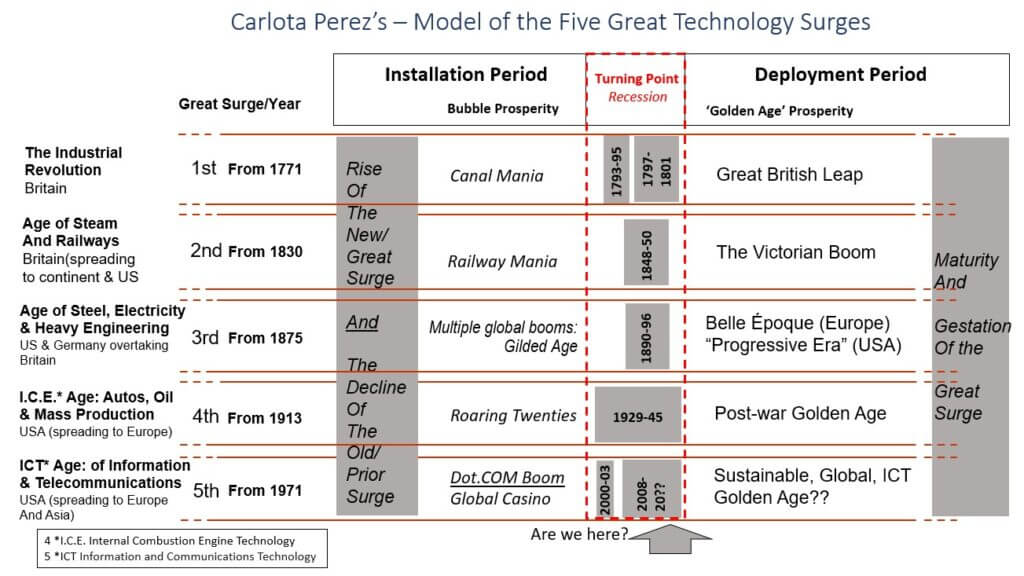
Her contribution was remarkable because she identified a recurring structure within the economic transformation associated with each technological revolution. She examined five great surges of technological development beginning with the Industrial Revolution in the eighteenth century and extending through the Information and Telecommunications revolution that began in 1971. She showed how the emergence of new technological systems could produce periods of extraordinary investment and speculation, followed by crises and institutional adjustments, before their productive capabilities became more widely established throughout the economy.
I believe her contribution deserves recognition comparable to that given to Kondratiev and Schumpeter. I have often thought that these great surges would be better known as Perez Cycles. That is my preference rather than an established academic convention. Her framework represents a major advance in understanding how technological revolutions actually unfold and why societies experience such profound economic disruptions during their development.
Technology Cycles Are More Than Economic Seasons
Earlier economists had used broad descriptions of economic movements such as prosperity, recession, depression, and recovery. Some accounts also relied upon seasonal metaphors, dividing economic cycles into spring, summer, autumn, and winter. These descriptions identified recurring economic conditions, but they offered limited insight into the technological, financial, and institutional forces producing those conditions.
Perez approached the problem by examining what was occurring inside the transformation itself. She considered how new technologies emerged, how investors funded their development, how companies introduced new products and production methods, and how the resulting innovations spread across the larger economy. Her analysis also examined the social and political pressures generated when established industries and institutions struggled to adapt.
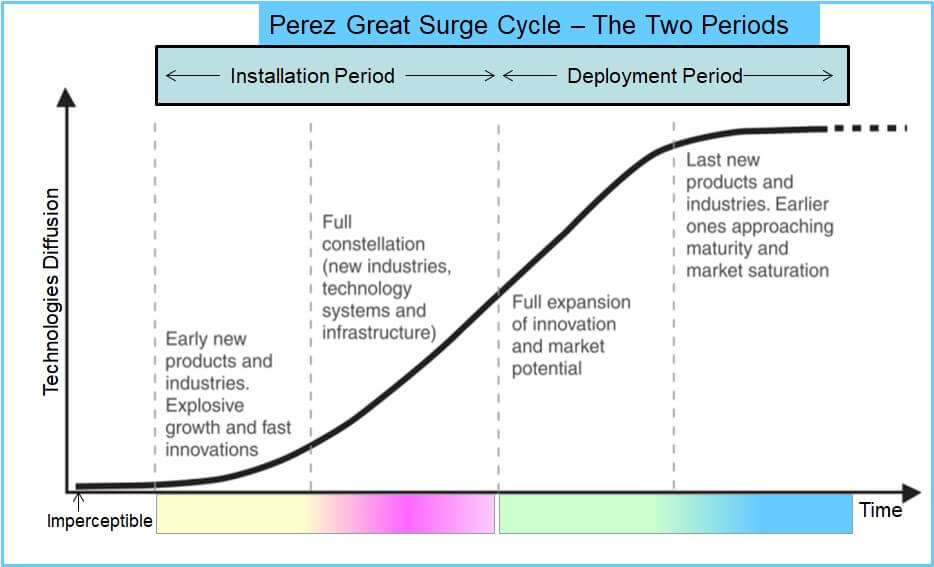
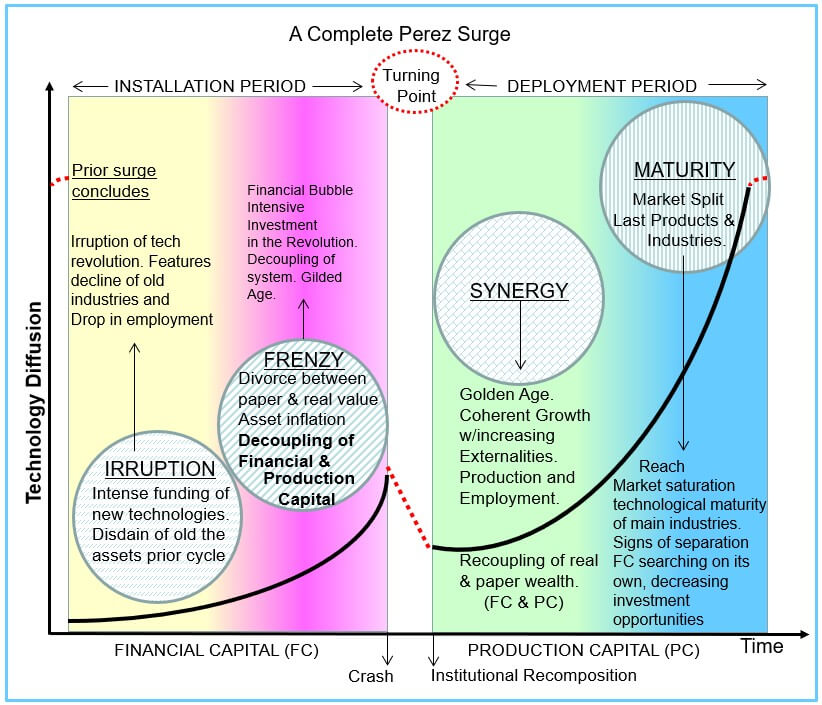
This was a crucial change in perspective. Rather than relying upon a calendar of recurring economic conditions, Perez examined the underlying structure of technological transformation. Her model identifies two broad periods, Installation and Deployment, separated by a Turning Point. The original framework also describes more detailed phases within those periods: Irruption, Frenzy, Synergy, and Maturity.
The diagram below illustrates this structure. It provides a foundation for understanding why technological revolutions generate both extraordinary economic opportunities and periods of severe economic instability.
The Installation Period
The first major period of a technological revolution is Installation. During this period, a new collection of technologies begins to establish itself within an economy still largely organized around the productive systems of the previous revolution. At first, the emerging technologies may attract relatively little attention because existing industries continue to dominate employment, investment, infrastructure, and economic policy.
As the new technologies demonstrate their capabilities, however, entrepreneurs begin developing commercial applications and investors recognize the possibility of enormous financial returns. New enterprises appear, supporting industries develop, and the emerging technological system begins attracting capital away from established activities. The process accelerates as improvements and complementary innovations make the new technologies increasingly useful.
Schumpeter’s creative destruction is especially visible during Installation. New productive capabilities challenge established industries, undermine older business models, and render previously valuable investments less competitive. Jobs disappear in some sectors while new opportunities develop elsewhere. Established communities may experience painful economic decline even as new industries and regions begin expanding rapidly.
Perez emphasized that financial capital plays a particularly important role during this early period. Investors supply funding to enterprises that may require substantial resources long before their products and markets have matured. Their willingness to take risks helps develop the new technological infrastructure. Yet the very success of early investments can encourage speculation and increasingly unrealistic expectations of future returns.
A New Revolution Emerges During the Decline of the Previous One
One of the most revealing features of Perez’s model is that the Installation period begins while the economic system created by the previous revolution is approaching maturity. The resulting overlap can make the beginning of a new technological era difficult to recognize.
Consider 1971. The industries associated with mass production, automobiles, petroleum, and heavy manufacturing were encountering growing competitive and economic pressures. Within a few years, many established industrial communities would experience factory closures, unemployment, and the consequences of stagflation. Yet in that same year, Intel introduced the 4004 microprocessor, one of the foundational technologies of the coming Information and Telecommunications revolution.
The Intel 4004 had emerged from a project involving the Japanese calculator company Busicom. The company needed electronic components for its calculators, and Intel’s engineers developed a programmable microprocessor capable of performing functions that previously required more specialized hardware. Busicom subsequently went bankrupt in 1974. Intel, meanwhile, became one of the most important companies in the emerging semiconductor industry.
The contrast illustrates how one technological revolution can begin almost invisibly while the previous productive system continues to dominate public attention. Few people observing the economic troubles of the early 1970s could have anticipated the scale of the computer, software, networking, and communications industries that would develop from the new technological foundations.
From Technological Promise to the Financial Casino
Perez described the later part of Installation as the Frenzy phase, when financial capital increasingly becomes absorbed in speculation surrounding the new technologies. The opportunities are genuine. The technologies can be revolutionary. Yet investors begin assigning valuations based upon extraordinary expectations of future growth, often paying little attention to immediate profitability or the economic sustainability of individual companies.
The Information and Telecommunications revolution provides an extraordinary example. By the 1980s and 1990s, personal computers were spreading through businesses and households. Software, networking equipment, telecommunications, and semiconductor industries were expanding rapidly. The commercialization of the Internet opened further opportunities for new products, services, and entire business models.
I remember this period particularly well. Personal computers were still expensive, and with young children at home I could not justify buying a new machine. Instead, I assembled my own from components, mounting the parts on a piece of plywood. I connected to bulletin-board systems through external modems operating over ordinary copper telephone lines. The connections were painfully slow by today’s standards, but the possibilities were fascinating.
Those early experiences revealed a remarkable new world of information exchange and computer networking. What had once been confined to universities, large corporations, and specialized technical communities was beginning to enter ordinary households. The supporting ecosystem of hardware, software, communications equipment, and online services was developing quickly, although its ultimate economic significance remained difficult to imagine.
America Online and the Height of the Internet Frenzy
Among the services I used was America Online, or AOL, which had a strong presence in Northern Virginia. It was particularly convenient because I could connect through a local telephone call. I even sent Steve Case suggestions for improving the service in those early years. AOL would become one of the best-known companies of the Internet era and, eventually, one of its most memorable examples of speculative financial enthusiasm.
On January 10, 2000, AOL and Time Warner announced an enormous merger. The transaction was completed in January 2001. Under its terms, AOL shareholders received approximately 55 percent of the combined company, even though Time Warner possessed an extensive portfolio of established media, entertainment, and publishing businesses. The market valuation of AOL had become so large that a relatively young Internet enterprise could effectively acquire control of one of the most important traditional media companies.
Steve Case became chairman of AOL Time Warner, while Gerald Levin served as chief executive officer. The company would soon face enormous financial difficulties as Internet valuations collapsed and the anticipated commercial benefits of the merger failed to materialize. In 2003, the company dropped AOL from its corporate name, and AOL was eventually separated from Time Warner in 2009.
For anyone who lived through that period, the merger was an extraordinary demonstration of what speculative enthusiasm could accomplish. AOL provided a genuine and important service, but the financial expectations surrounding the company had moved far beyond what its underlying business could ultimately sustain. Perez’s description of the financial casino captures the atmosphere remarkably well.
The Turning Point
The Turning Point is one of the most important contributions of Perez’s model. It describes the difficult transition between the speculative Installation period and the possibility of a broader Deployment period. By this stage, the new technological infrastructure has developed substantially, but financial speculation and the destruction of older industries have created serious economic and social imbalances.
Financial bubbles eventually encounter the limits of what their underlying businesses can support. When confidence breaks, valuations collapse, access to capital tightens, and companies that had depended upon continuing investment suddenly confront the need to survive on actual revenues. Some businesses disappear, others are acquired, and a smaller group emerges with the financial and productive capabilities necessary to continue developing the new technological system.
During the fourth great surge, the stock market crash of 1929 and the subsequent Great Depression became central to the historical Turning Point. During the fifth surge, the collapse of the Internet and telecommunications investment bubble in 2000–2002 exposed the extraordinary valuations and speculative excesses that had accumulated around the digital revolution.
The fifth revolution then developed an additional and profoundly damaging financial crisis. Following the collapse of Internet-related investments, financial institutions increasingly expanded their involvement in mortgage lending, securitization, and related financial products. The growth of the housing bubble, deteriorating mortgage standards, and extensive use of leverage created vulnerabilities that culminated in the financial crisis of 2007–2009.
This sequence is especially important to my interpretation of the fifth supercycle. The financial casino did not simply close after the dot-com collapse. Much of its speculative activity moved into other asset classes, particularly housing and mortgage-related securities. The consequences extended across the entire economy, destroying household wealth, undermining financial institutions, and requiring extraordinary government intervention.
Perez’s Turning Point involves more than the collapse of a financial bubble. It is also the period when societies confront the consequences of creative destruction and determine whether institutions, policies, and investment priorities will change sufficiently to support broader economic development. The transition is therefore political and social as well as financial and technological.
Structural Similarities Across Technological Revolutions
The chart below compares the behavior of financial markets during two different periods of technological transformation. The black line illustrates the earlier Dow Jones market experience, while the red line represents the technology-heavy Nasdaq during the Information and Telecommunications revolution. The comparison is particularly interesting because it suggests a resemblance between periods of speculative enthusiasm and subsequent market collapse.
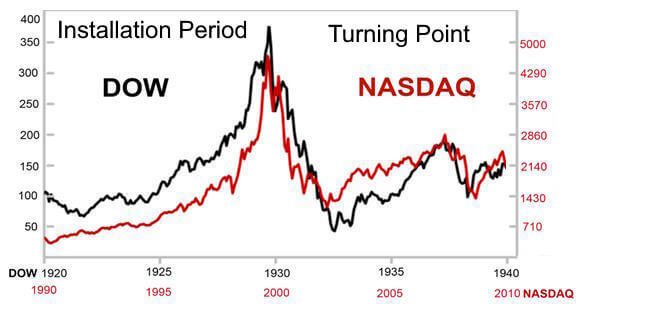
I encountered this comparison years after becoming convinced of the usefulness of Perez’s model. What fascinated me was that the resemblance emerged from financial market history rather than from an attempt to construct a technological revolution model. When I first saw the chart, the hairs on the back of my neck stood up. It seemed to provide a vivid illustration of the recurring speculative behavior Perez had described.1
These kinds of historical market comparisons require care. The Dow Jones and Nasdaq indexes represent different collections of companies, and any comparison depends upon the choice of starting dates, market measurements, and chart scales. The similar shapes are therefore an illustration of possible recurring financial behavior rather than proof that two technological revolutions followed identical paths.
That distinction actually reinforces one of Perez’s most valuable insights. Her model is concerned with recurring relationships among technological opportunities, financial capital, productive investment, and institutional adjustment. Each revolution unfolds within different political, economic, and technological circumstances. The historical events change, even when recognizable structural patterns reappear.
The Strength of a Model That Can Adapt
One of the qualities I most admire about Carlota Perez is her willingness to continue refining her interpretation as new evidence becomes available. Her original book examined the phases within Installation and Deployment in considerable detail. In later writing, she often emphasized the two broader periods and the importance of the Turning Point, particularly when discussing the unusually prolonged difficulties of the Information and Telecommunications revolution.
That ability to reconsider a model in light of subsequent history matters enormously. Anyone who has spent years developing business strategies knows how difficult it can be to abandon an interpretation after becoming invested in it. A useful model must illuminate changing conditions rather than force every new development into an inflexible historical timetable.
Perez’s 2022 article, A Long Delayed Golden Age: Or Why Has the ICT Installation Period Lasted So Long?, provides a particularly important example of this approach. She examines why the information revolution has failed to produce the broad, socially beneficial Deployment period experienced during earlier technological surges.
Her explanation deserves special attention because the fifth revolution has already transformed global production, finance, communications, and everyday life. Yet its enormous technological achievements have coexisted with financial instability, widening economic inequalities, and the weakening of established industrial communities.
Why the Information Revolution’s Turning Point Has Lasted So Long
Perez argues that the Information and Telecommunications revolution has followed an unusually prolonged and complicated course. By 2022, she observed that society had yet to complete the institutional changes required for a broadly beneficial Deployment period. The earlier financial collapses had failed to produce the kind of political and economic realignment that allowed previous technological revolutions to deliver more widely shared prosperity.
Several features distinguish the fifth revolution. Digital technologies have progressively extended automation from physical production into mental and administrative work. Their ability to coordinate activity across international boundaries has enabled an extraordinary globalization of production, services, and markets. The underlying infrastructure also developed in stages, with microprocessors appearing decades before the commercial Internet became widely accessible.
These characteristics have made the digital transformation unusually extensive. However, Perez places particular emphasis on the international economic environment and the continuing power of global finance. The reentry of China and the former Soviet economies into global markets created vast new supplies of labor and production capacity. Meanwhile, financial capital retained extraordinary influence over the allocation of investment and the distribution of economic rewards.
Perez’s Primary Concerns: Global Finance and the Delayed Turning Point
In her analysis, several interconnected developments help explain why the digital revolution has failed to produce the kind of broad economic settlement that followed earlier technological revolutions.
- The continued dominance of financial capital. Financial activity has remained unusually detached from investment in productive enterprises. Speculation, asset appreciation, and financial engineering have continued to offer substantial returns, allowing the casino-like behavior of the Installation period to persist.
- Rising inequality between asset owners and wage earners. Increasing asset values have disproportionately benefited those who already own financial assets, businesses, and property. Many workers have experienced weaker gains in purchasing power and economic security, even while the productive capabilities of the digital economy have advanced.
- Socialized risk and private rewards. Governments intervened to stabilize financial markets after major crises, using public resources and central-bank support. These interventions protected important economic institutions, but they did not ensure that the resulting financial assistance would generate proportionate investment in productive capacity or broadly shared economic opportunity.
- Insufficient productive investment. Financial support and abundant liquidity did not consistently produce the investment in infrastructure, industrial capabilities, environmental improvements, and productive enterprises that might have supported a broader Deployment period.
- Growing political and social instability. Economic insecurity, regional decline, and widening disparities have contributed to political discontent. The prolonged Turning Point has placed increasing pressure on the social and political institutions that helped support earlier periods of widely shared economic growth.
The consequences of these developments are substantial. The new technological system has produced extraordinary corporate wealth and enabled businesses to operate at global scale. Yet much of that wealth has become concentrated among a relatively small portion of the population. The economic risks associated with crises have frequently been spread across households, workers, and taxpayers, while the rewards of successful investment have remained concentrated.
Perez warns that without the institutional changes necessary to reconnect technological opportunity with productive investment and wider social prosperity, societies may experience another prolonged Gilded Age. Such an outcome would allow extraordinary private fortunes to coexist with deteriorating economic security for large portions of the population.
The Additional Forces Delaying Deployment
Perez also identifies broader economic developments that have contributed to the unusually long Installation period of the fifth technological revolution.
- China’s emergence as a global manufacturing center. The expansion of Chinese industrial production, supported by international supply chains and low-cost manufacturing, prolonged the economic life of mature mass-production technologies and industries.
- The expansion of international labor and product markets. The reintegration of China and the former Soviet economies into the global system dramatically increased access to labor, production capacity, and potential consumers.
- The globalization of digital production and services. Information technology allowed companies to reorganize business activities across countries and continents, creating new economic opportunities while placing established workers and communities under competitive pressure.
- The delayed emergence of a fully digital infrastructure. Microprocessors and computing technologies developed long before the commercial Internet achieved widespread penetration, extending the period during which the new paradigm was being installed.
- The difficulty of transforming institutional leadership. Established political, financial, and corporate institutions have often continued operating according to the priorities of the previous economic order, slowing the adjustments required for broader diffusion of digital technologies.
These factors help explain why the fifth revolution has been so different from its predecessors. Its productive capabilities have expanded across the world, while the economic and institutional adjustments needed to distribute their benefits more widely have lagged behind.
For readers interested in Perez’s own explanation, I recommend the complete 2022 article. It provides a fuller account of the interactions among global finance, Chinese manufacturing, international labor markets, technological change, and political institutions.
The implications extend far beyond the history of financial crises. Technology has transformed the geography of production, altered the relationship between employers and workers, and created extraordinary concentrations of corporate economic power. These changes help explain why the economic opportunities associated with the digital revolution have developed so unevenly across regions, industries, and social groups.
The Deployment Period
The second major period in Perez’s model is Deployment. During this period, the technologies established in Installation can spread more extensively throughout the productive economy. Companies in established industries adopt the new capabilities, redesign production methods, reorganize management systems, and develop new products and services. Investments increasingly support the practical use of technologies whose commercial potential has already become apparent.
Perez associates this transition with a change in the relationship between financial capital and production capital. During Installation, speculative investors and financiers play a particularly prominent role in funding emerging enterprises and their infrastructure. During successful Deployment, productive businesses increasingly direct investment toward using the technologies across established industries and wider markets.
The resulting transformation can become the foundation for sustained economic growth. Technological capabilities that were once limited to specialized industries become ordinary elements of production and management. New infrastructure expands, complementary industries mature, and new business practices spread. The emerging paradigm increasingly defines what companies regard as efficient, competitive, and economically sensible.
Perez has used the expression creative construction to describe the broader development that can follow the initial period of creative destruction. The new technological system becomes capable of supporting more widespread productive investment and social development. The most successful Deployment periods are the historical golden ages associated with technological revolutions, although their emergence depends upon institutional, political, and economic conditions.
Industrial Consolidation and the Automobile Revolution
The development of the American automobile industry provides a useful illustration of how technological revolutions produce powerful industrial organizations. During the early decades of the twentieth century, numerous automobile manufacturers competed to establish products, production methods, distribution systems, and market positions. Over time, a smaller number of companies acquired competitors, developed integrated manufacturing systems, and established increasingly recognizable brands.
General Motors was founded in 1908 and quickly expanded through acquisitions. Buick was part of the original organization, Oldsmobile joined in 1908, Cadillac was acquired in 1909, and Chevrolet became part of GM in 1918. Oakland, acquired in 1909, later became associated with the Pontiac brand. These acquisitions occurred largely during the early development of the automobile industry, decades before the industry’s postwar maturity.
As automobile manufacturing developed, the industry became increasingly concentrated around major producers capable of operating extensive production facilities, purchasing networks, distribution systems, and supporting research organizations. Ford, General Motors, and Chrysler came to dominate the American automobile market for much of the twentieth century.
The process illustrates how an emerging technological system can develop from a collection of competing enterprises into a mature industrial structure. Individual technologies become embedded within larger networks of suppliers, producers, distributors, workers, consumers, and public infrastructure. The economic significance of the automobile came to encompass far more than the vehicle itself.
The Emergence of Standards and Mature Productive Systems
As industries develop, common standards become increasingly important. Standardized components, manufacturing processes, safety requirements, and operating practices make it possible to produce goods at larger scale and with greater consistency. Regulations and industry agreements also help establish shared expectations across producers and consumers.
The automobile industry developed common systems involving braking, lighting, signals, instrumentation, manufacturing methods, and highway infrastructure. These improvements emerged over many decades rather than during one sharply defined phase. Their cumulative effect helped turn an experimental industry into an established transportation system supporting enormous numbers of businesses and households.
Similar developments can be observed in other technological revolutions. Railroads required standardized track gauges, operating practices, and communications. Electrical systems required compatible equipment, transmission infrastructure, and safety standards. The digital revolution has depended upon communications protocols, computing architectures, software standards, and the development of interconnected networks.
These supporting capabilities are among the reasons technological revolutions become so powerful. Individual inventions create new possibilities, but the larger productive system emerges through the accumulation of complementary technologies, standards, infrastructure, skills, and institutions.
Maturity and the Limits of the Established Paradigm
The later stages of Deployment are associated with technological maturity. As the dominant productive system becomes widely established, many opportunities for revolutionary improvement give way to incremental refinements, efficiency gains, and increasingly intense competition. Established industries may continue to innovate, but the economic advantages of the original technological breakthroughs become more widely available to competitors.
Mature technologies also spread internationally. Companies in new regions acquire production capabilities, improve manufacturing methods, and compete with established producers. This can place substantial pressure on industries that previously benefited from technological leadership and strong domestic market positions.
The American automobile industry experienced such pressures as Japanese and European manufacturers developed increasingly competitive products. Smaller vehicles, manufacturing efficiency, product quality, and changing consumer preferences challenged established American producers. These developments interacted with fuel prices, exchange rates, labor costs, and broader changes in international competition.
The transition toward maturity does not automatically produce stagnation or a particular rate of inflation. Economic outcomes depend upon many factors, including energy costs, financial conditions, labor markets, competition, and government policy. Nevertheless, Perez’s model helps explain why the opportunities created by an established technological system eventually differ from those available during its initial expansion.
The End of the Fourth Surge and the Emergence of the Fifth
By the late 1960s and early 1970s, the economic arrangements associated with mass production were encountering substantial difficulties. The international monetary system was changing, industrial competition was intensifying, and the oil shocks of the 1970s would place additional pressure on manufacturing, transportation, and household purchasing power.
I remember President Richard Nixon appearing on television to announce wage and price controls in 1971. It was a remarkable moment, reflecting the difficulty policymakers faced in managing inflation and the economic tensions developing within the United States. The combination of high inflation and weak economic performance became an especially troubling feature of the decade.
These developments reflected a complex combination of monetary, energy, industrial, and institutional pressures. They also occurred during a period when the productive system associated with mass manufacturing was being challenged and the foundations of the next technological revolution were beginning to appear.
This overlap is one of the important insights made visible by technology-cycle analysis. The economy experiences the weakening of established industries and the emergence of new productive capabilities at the same time. The social and political consequences of the older system’s difficulties can dominate public attention while the technologies of the next revolution are still too immature to make a substantial contribution to overall economic performance.
The diagram below illustrates more of the recurring structure identified by Perez, including the interaction between Installation, the Turning Point, and Deployment.
The Shape of a Technological Revolution
The conceptual foundation of this diagram comes from Perez’s work.3 In developing my illustration, I incorporated a different curve based upon historical financial-market comparisons that I had discussed with Carlota. My objective was to make the relationship between technological development and speculative financial activity more visible.
What makes Perez’s model so useful is the distinction between the development of a technological revolution and the financial or economic events occurring around it. A financial crash can mark a critical transition, but the underlying technological capabilities may continue developing. Companies and industries can keep adopting new technologies even during periods of financial instability, political conflict, or economic weakness.
This distinction became particularly important during the COVID-19 pandemic. The enormous economic disruption and sudden increase in unemployment were caused by an extraordinary public-health crisis. The event dramatically affected economic activity and accelerated some forms of digital adoption, but it did not itself establish the beginning of a new technological revolution or the completion of an existing one.
A model relying too heavily upon the size and timing of individual economic contractions might interpret such a disruption as evidence of a new cyclical phase. Perez’s framework encourages us to examine what was occurring within the productive system itself, including the spread of technologies, the development of infrastructure, and the relationship between financial and productive investment.
That is an enormous improvement over attempts to identify technological revolutions through a fixed calendar or a simple succession of recessions and recoveries. It provides a structure that can be examined against historical events while recognizing that every revolution develops within different circumstances.
Comparing Kondratiev, Schumpeter, and Perez
To illustrate how much technology-cycle theory evolved, I created a comparison using the dates and long-cycle interpretations associated with Kondratiev and Schumpeter alongside Perez’s chronology of technological revolutions. The purpose was to make their different approaches visible rather than require readers to compare several lengthy historical explanations.
The comparison revealed differences that I believe are significant. Kondratiev and Schumpeter approached long economic movements primarily through economic data and theories of business fluctuations. Perez identified technological revolutions through the development and spread of new productive systems, then examined how financial and institutional changes interacted with those systems.
When these interpretations are placed on a common timeline, some of the older long-cycle dates and turning points appear inconsistent with the historical sequence of industrial development and major financial crises. Their third long-cycle interpretations are particularly interesting because the transition toward the Great Depression complicates attempts to apply a simple rising-and-falling economic wave model.
Comparing Perez’s Model with Kondratiev and Schumpeter
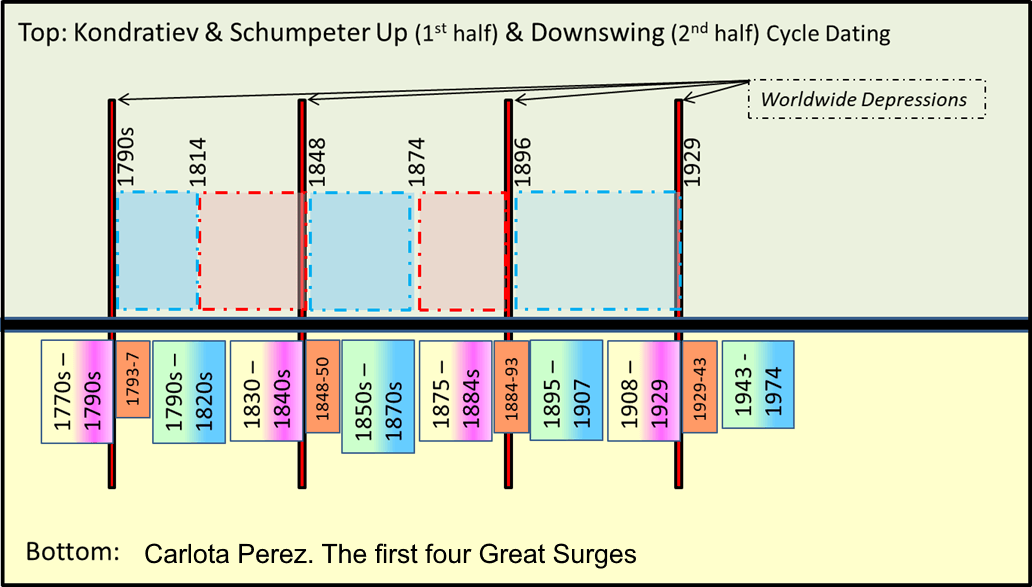
Part of the explanation lies in the different evidence and questions available to these economists. Kondratiev worked with limited historical series on prices, wages, interest rates, and related economic measures. Schumpeter expanded the explanation by examining technological innovation, entrepreneurship, and capital formation, but he was still attempting to connect these forces to recurring business-cycle movements.
Perez had the advantage of a much longer historical record, more developed economic statistics, and the ability to examine the emergence of additional technological revolutions. More importantly, she examined the interaction among technological innovation, finance, production, institutions, and broader historical change. This allowed her to construct a more comprehensive explanation of how great surges of technological development unfold.4
Christopher Freeman also emphasized the interaction among science, technology, politics, economics, and culture. Technological revolutions influence all of these dimensions, and their development depends upon the changing relationships among them. This broader perspective helps explain why identical technologies can generate very different economic and social outcomes in different historical settings.
The Limitations of the Earlier Long-Cycle Models
Looking across the historical record, I believe the limitations of the original Kondratiev and Schumpeter models become apparent. Their proposed long cycles do not consistently align with the development of successive technological revolutions. The dating of major transitions and the interpretation of economic peaks and troughs can vary significantly depending upon the indicators selected.
The comparison chart makes these differences easier to recognize. In particular, the arrangement of the third long cycle raises questions about how the original rising and declining movements corresponded to the economic turmoil surrounding the Great Depression. I regard those inconsistencies as important reasons to avoid using the older models as mechanical forecasts of future technological or financial events.
This does not diminish the contributions of Kondratiev and Schumpeter. They were pioneers working with limited historical information and attempting to explain economic transformations that were only beginning to be understood. Kondratiev introduced the possibility of measurable long economic movements. Schumpeter supplied the essential insight that innovations tend to cluster and can transform the productive structure of capitalism.
Perez built upon those foundations and greatly improved our understanding of the processes involved. Her model remains useful because it examines the relationships among technological development, investment, financial speculation, industrial transformation, and institutional adaptation. Its strength comes from those relationships rather than from assigning fixed dates to recurring historical events.
From Perez’s Five Revolutions to Six Technology Supercycles
The history reviewed across these four articles leads to an important conclusion. Understanding technological revolutions requires more than identifying individual inventions or locating financial crises on a historical timeline. Each revolution creates a new productive system through the development of complementary technologies, industries, infrastructure, markets, institutions, and economic relationships.
Carlota Perez provided the most useful foundation I have encountered for understanding the relationship between these revolutions and the financial and institutional changes accompanying them. Her model explains how new technological systems emerge, attract speculative investment, encounter disruptive turning points, and may eventually support broader economic development.
My own research builds upon that foundation while examining another dimension of technological change: the sequence of interrelated innovation waves that develop within each supercycle. These waves introduce successive productive capabilities, reinforce one another, and expand the economic consequences of the original technological breakthroughs.
I also believe that the emergence of generative artificial intelligence in 2022 represents the beginning of a sixth technology supercycle. The Information and Telecommunications revolution continues to mature and spread, while artificial intelligence introduces a new collection of technological capabilities, industrial requirements, and economic possibilities. As with earlier revolutions, the development of the new system will overlap with the continued evolution of the previous one.
These overlapping developments are central to my six-supercycle, five-wave framework. They allow us to examine both the larger historical structure identified by Perez and the sequence of technological and industrial transformations through which each new productive system develops.
That is why this history matters. Kondratiev, Schumpeter, Freeman, and Perez each contributed an essential piece to understanding long economic and technological change. Their work provides the foundation for exploring how successive technological revolutions have transformed the modern world and how the emerging sixth supercycle may reshape the economies and societies of the future.
Footnotes
- Chart from J.C. Phillips. Editor of Forecast-Chart.com’s market trend research. URL https://www.forecast-chart.com/great-depression-stock-chart-nl.html ↩︎
- Carlota Perez Slide from her presentation at APDC’s Summit Lisbon, July 2009 ↩︎
- Technological Revolutions and Financial Capital: The Dynamics of Bubbles and Golden Ages. By Carlota Perez Edward Elgar Publishing. 2002 ↩︎
- Quote from Christopher Freeman. The full quote “market economies evolve in the constant interaction among five semi-autonomous spheres: science, technology, politics, economics, and culture. The good times occur when they enter in synchrony, the turbulent times are those when they are in disharmony.” ↩︎