

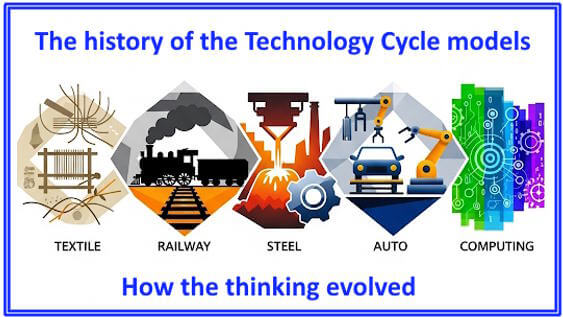
The History of Technology Supercycle Theory: Part Three
Christopher Freeman and the Evolution of Technology-Cycle Theory
The 1970s: The Return of Schumpeterian Economics
During the 1970s, economists began returning to Joseph Schumpeter’s work as they struggled to explain the growing difficulties confronting industrial economies. The extraordinary postwar expansion was losing momentum. Inflation and unemployment rose together, energy shocks disrupted production, and industries that had supported decades of economic prosperity came under increasing pressure from international competition and technological change.
The effects were visible throughout the industrial world. Steel mills closed, automobile manufacturing encountered new competitors, and established industrial communities experienced rising unemployment and economic insecurity. The daily accounts of factory closures and industrial decline made these changes difficult to ignore. They were affecting the lives of millions of workers and families whose prosperity had depended upon the industries created during the fourth technological revolution.
Schumpeter had approached economic development as part of a larger historical process in which innovation, entrepreneurship, investment, and institutional change continually transformed productive activity. His ideas attracted renewed attention because conventional economic models offered limited explanations for the structural changes occurring across mature industrial economies. Researchers increasingly recognized that technological change deserved a more central place in understanding long-term economic growth and industrial transformation.1
The renewed interest in long economic cycles brought together economists from several intellectual traditions. Some emphasized innovation clusters and entrepreneurial investment. Others examined changes in industrial organization, financial markets, labor relations, or the institutions governing economic activity. Their approaches differed, but they shared a growing recognition that economic development could not be fully understood without examining how productive systems evolved over time.
Gerhard Mensch and the Search for Innovation Clusters
One important contributor to the revival was German economist Gerhard Mensch, whose research examined the relationship between technological innovation and periods of economic stagnation. Drawing upon Schumpeter’s theory of innovation swarms, Mensch argued that major technological breakthroughs tended to emerge during periods of economic difficulty, when established industries had exhausted many of their opportunities for expansion.
His interpretation suggested that economic stagnation could stimulate the search for new technologies capable of opening entirely different markets and industries. As successful innovations attracted additional entrepreneurs, related inventions and improvements could develop around them, eventually creating new opportunities for economic growth. Mensch’s work helped renew academic interest in the possibility that clusters of innovation were connected to long economic movements.
However, his interpretation of the timing of these clusters became controversial. Christopher Freeman and other researchers questioned whether the evidence supported Mensch’s conclusion that major innovations were concentrated during depressions. They also challenged the ways innovations had been classified and connected to particular economic periods. The disagreement demonstrated how difficult it remained to distinguish the invention of a technology from its commercial development and widespread economic adoption.2
Despite these disagreements, Mensch contributed to the revival of long-cycle research. His work encouraged economists to examine innovation more systematically, compare historical periods, and reconsider the relationship between technological breakthroughs and industrial development. The questions raised during this debate would become increasingly important as researchers attempted to explain the emergence of the information revolution.
The French Regulation School
Another important development emerged in France during the 1970s. The French Regulation School, associated with economists including Michel Aglietta, Robert Boyer, and Alain Lipietz, examined how capitalism could maintain relatively stable patterns of economic growth for extended periods before encountering structural crises. Their research investigated the relationships among production, consumption, wages, investment, institutions, and the broader organization of society.3
The term Regulation in this school refers to more than government regulation. It encompasses the institutional arrangements, social relationships, business practices, and economic structures that allow a particular system of production and accumulation to function. Labor agreements, wage structures, competitive arrangements, financial institutions, government policy, and prevailing methods of industrial organization all influence the stability of an economic system.
The Regulation School was particularly interested in the economic arrangements associated with Fordism, the system of mass production and mass consumption that developed around the automobile, petroleum, and related industries. During the decades following World War II, productivity growth, expanding wages, mass manufacturing, and household purchasing power reinforced one another across many industrial economies. These relationships helped sustain the broad expansion of the middle class.
By the 1970s, however, this system was experiencing growing difficulties. International competition, changing production technologies, inflation, energy costs, and the weakening of established industrial relationships challenged the arrangements that had supported postwar prosperity. The Regulation School examined how those relationships had developed and why they were becoming increasingly difficult to maintain.
This research contributed another important dimension to the study of technological and economic transformation. The productive capabilities created by a technological revolution operate within a larger institutional system. When technologies and industries change, the institutions that supported an earlier economic order may no longer be adequate. The resulting pressures can persist long after the new productive capabilities have become technologically viable.
The Unwinding of Depression-Era Financial Regulations
The relationship between financial institutions and economic stability became especially important as Western economies moved toward greater financial deregulation. Following the Great Depression, the United States had established new safeguards intended to reduce financial instability. The Banking Act of 1933, commonly associated with Glass-Steagall, separated important commercial and investment banking activities and established federal deposit insurance through the Federal Deposit Insurance Corporation.
Beginning in the 1980s, governments in the United States and the United Kingdom increasingly embraced deregulation and greater reliance upon financial markets. Restrictions on banking activities were gradually weakened, while financial institutions developed increasingly complex products and expanded their involvement in securities markets. The Gramm-Leach-Bliley Act of 1999 removed significant restrictions on affiliations between commercial banks, investment banks, and insurance companies.
These developments coincided with the growing influence of global financial capital. New communications technologies allowed funds to move rapidly across international markets, while advances in computing enabled increasingly complicated financial instruments and trading strategies. The digital infrastructure created during the fifth technological revolution expanded the scale, speed, and complexity of financial activity.
The financial crisis of 2007–2009 revealed the dangers that had accumulated within this system. Excessive leverage, deteriorating mortgage-lending standards, securitization, derivatives, inadequate risk management, and failures of regulatory oversight created interconnected vulnerabilities. Some large financial institutions operated with extraordinarily high ratios of assets to equity, leaving them exposed to relatively small declines in asset values. As mortgage losses spread, confidence collapsed and funding markets became unstable.
The crisis cannot be attributed exclusively to the repeal of Glass-Steagall. The weakening of financial safeguards, inadequate supervision, excessive borrowing, and the development of increasingly complex financial products interacted over many years. These failures allowed enormous risks to accumulate, frequently outside the institutions and arrangements through which regulators had traditionally monitored financial stability.
Governments and central banks intervened on an extraordinary scale to prevent the collapse of the financial system. These interventions stabilized important institutions and markets, but they also exposed how heavily economic activity had become dependent upon credit expansion, asset valuations, and financial arrangements that could prove highly unstable under stress.
Why Institutional and Financial Change Matter to Technology Cycles
The history of deregulation and the financial crisis illustrates why technological development cannot be separated from the institutions governing economic activity. Revolutionary technologies can dramatically improve productivity and expand markets while simultaneously enabling new concentrations of financial risk. Digital communications and computing made global finance faster and more interconnected, but those capabilities also made it possible for instability to spread through an increasingly complex international system.
The resulting economic consequences extended far beyond financial institutions. Households lost wealth, businesses reduced investment, governments accumulated new obligations, and communities experienced prolonged unemployment and insecurity. The financial system required extraordinary public intervention even as the productive potential of the digital revolution continued to expand.
These developments reinforce the importance of understanding how technological revolutions interact with financial capital and economic institutions. They also help explain why technological progress can continue during periods when broader economic growth and the distribution of its benefits remain under pressure. Such relationships would eventually become central to Carlota Perez’s interpretation of technological revolutions.
The Changing Foundations of Economic Measurement
The revival of long-cycle research also occurred alongside broader changes in economic measurement and analytical methods. Modern national income accounting had begun developing during the Great Depression, when economists including Simon Kuznets constructed increasingly systematic estimates of national economic activity. These methods expanded during World War II and eventually provided the foundations for the national accounts used to measure gross domestic product.
By the 1970s, economists possessed more sophisticated statistical methods, computing capabilities, and historical information than earlier researchers such as Kondratiev and Schumpeter. Yet the availability of additional data did not automatically resolve the problems involved in studying long technological and economic transformations.4
Researchers still needed to determine which economic variables mattered, how the variables interacted, and whether the historical periods being compared reflected similar underlying processes. Long-cycle theories posed particular difficulties because the available historical record contained only a small number of proposed cycles. Economic conditions, financial institutions, production technologies, and statistical definitions had changed substantially between them.
The challenge was therefore both empirical and conceptual. Economists required better data, but they also needed models capable of distinguishing the technological forces transforming productive systems from the financial and institutional effects accompanying those transformations.
Variables, Models, and Historical Timing
During this period, researchers increasingly applied mathematical and systems-based approaches to economic development. One important example was the System Dynamics National Model developed at the Massachusetts Institute of Technology under Jay Forrester and his colleagues. The model attempted to describe the interactions among production capacity, capital investment, employment, prices, demand, and economic policy.
The MIT approach examined how feedback relationships within an economy could generate extended periods of expansion and contraction. Investment in productive capacity could stimulate economic growth, but investment decisions based upon delayed information and changing expectations could also produce excessive capacity and subsequent economic adjustment. These processes offered another possible explanation for long economic fluctuations.5
From my perspective, an important limitation of models concentrating heavily on capital investment and industrial capacity was their ability to explain the emergence of entirely new technological systems. Overinvestment can create serious economic instability, but long technological revolutions also involve changes in production methods, infrastructure, market organization, labor capabilities, and financial relationships that may extend far beyond the movement of conventional business cycles.
This does not mean the mathematical models were necessarily wrong. They represented serious attempts to understand complex systems through measurable relationships. Their usefulness depended upon the choice of variables, the timing of historical events, and the assumptions connecting different parts of the economy. These questions remain relevant to the development of more sophisticated models of technological supercycles.
Evolutionary Economics Takes a Fresh Look
Evolutionary economics offered another approach to the study of economic development. Rather than assuming that markets and industries continually returned to stable arrangements, evolutionary economists examined how firms, technologies, institutions, and productive capabilities changed over time. Innovation was understood as a cumulative process involving experimentation, learning, competition, adaptation, and the development of new economic relationships.
The research drew upon several intellectual traditions, including Schumpeter’s theories of innovation, historical institutional economics, systems thinking, and selected insights from Marxian analyses of capitalism. Researchers examined how economic structures evolved through interacting processes of technological change, competition, investment, and institutional development.
My own research into the history of technological revolutions benefited from this willingness to examine evidence across intellectual traditions. I read extensively among historians who interpreted economic and social change through the development of productive systems, including Eric Hobsbawm and Tony Judt. Although their perspectives differed, their histories helped illuminate relationships among industrial development, political institutions, economic opportunity, and the experiences of people living through major transformations.
In assembling the material for TechnologyCycles.org, I repeatedly encountered references to historians whose work examined the economic forces shaping modern societies. Their contributions reinforced my belief that technological revolutions must be understood within a much larger historical setting. The significance of an innovation depends upon the productive capabilities it creates, the industries that emerge around it, and the economic and social arrangements through which its effects are experienced.
The revival of evolutionary economics helped bring these relationships into the mainstream study of technological innovation. Researchers increasingly examined how new technologies interacted with organizations, infrastructure, education, investment, and institutions. Christopher Freeman would become one of the most important figures in this development.
Christopher Freeman: Bringing Technological Innovation into Economic Research
Christopher Freeman was among the founders of modern innovation studies and played a central role in reviving the study of long technological and economic transformations. In 1966, he founded the Science Policy Research Unit at the University of Sussex in England, serving as its first director until 1982. SPRU became an important interdisciplinary research center devoted to understanding the relationships among science, technology, industry, economic development, and public policy.
Freeman’s work represented an important shift in how technological innovation was studied. He recognized that new technologies could not be understood solely through individual inventions or the performance of individual firms. Their economic consequences depended upon the organizations, industries, skills, infrastructure, and institutions needed to develop and apply them.
Much of this research was taking place during the emergence of microelectronics and modern information technology. Semiconductor improvements, computing systems, telecommunications, and software were beginning to establish new productive capabilities. Freeman and his colleagues recognized that these developments could eventually reorganize industries and economies on a scale comparable to earlier industrial revolutions.
There is an interesting historical parallel between Freeman and Kondratiev. Both established important research efforts devoted to economic transformations that were insufficiently understood by the dominant theories of their respective periods. Kondratiev sought long economic patterns within historical statistics. Freeman examined how technological innovations and the systems surrounding them could transform economic development over extended periods.
Freeman’s Contributions to Innovation Studies
Freeman made several important contributions to the study of technological and economic change. His research helped establish innovation as a subject of systematic empirical investigation, examining how firms developed technologies, how innovations spread through industries, and how public policy influenced scientific and industrial development.
His book The Economics of Industrial Innovation helped establish a foundation for understanding the economic importance of research, technological development, entrepreneurship, and industrial competition. Freeman examined the relationships among innovation, investment, international trade, employment, and productivity, demonstrating that technological change was essential to understanding long-term economic growth.
His work also contributed to the development of what became known as techno-economic paradigm theory. This approach examined how major technological transformations established new patterns of industrial production, investment, organization, infrastructure, and economic activity. A revolutionary technology could become the foundation for much broader changes across the productive economy.
Freeman and SPRU played an especially important role in recognizing the historical significance of microelectronics and information technology. The technologies emerging during the fifth revolution offered new possibilities for processing information, coordinating production, managing enterprises, and connecting markets. Their eventual economic consequences extended across manufacturing, services, international commerce, and labor organization.
These developments reinforced the importance of examining technological revolutions as interconnected systems. The productive capabilities of a new technological era emerge through relationships among many innovations, industries, institutions, and forms of accumulated knowledge. Understanding those relationships became central to the work of researchers building upon Schumpeter’s earlier theories.
As Time Goes By: From the Industrial Revolutions to the Information Revolution
One of Freeman’s most important later contributions was As Time Goes By: From the Industrial Revolutions to the Information Revolution, written with Portuguese economist Francisco Louçã and published around 2001–2002. The book placed the emerging information revolution within the broader history of industrialization and long-term economic transformation.6
Freeman and Louçã examined successive industrial revolutions involving mechanization, steam power, railways, electricity, automobiles, mass production, and information technology. Their analysis connected technological innovations with changes in business organization, infrastructure, employment, and the wider economic environment. The information revolution could therefore be understood as part of a much longer historical development rather than as an isolated transformation.
The book was particularly valuable to my own research because it brought together the historical and technological dimensions of long economic change. I had been applying technology-cycle thinking to business strategy for years, and As Time Goes By provided an important connection between that practical experience and the evolving academic research.
Freeman also collaborated with Carlota Perez, whose work would bring even greater clarity to the relationship between technological revolutions and their financial and institutional consequences. Their research helped establish the foundations for examining how new techno-economic paradigms emerge, spread, and eventually transform the broader economic system.
The Bridge to Carlota Perez
By the end of the twentieth century, the study of long economic cycles had developed substantially beyond Kondratiev’s original statistical observations. Schumpeter had connected economic development to clusters of innovation and entrepreneurial activity. Evolutionary economists examined how technologies, firms, and institutions changed over time. Freeman and his colleagues expanded the research into the industrial and organizational systems that allowed technological revolutions to reshape economic activity.
Yet important questions remained about the relationship between technological development and financial capital. Why did revolutionary technologies repeatedly attract speculative investment? Why did financial crises so often accompany the development of new industries? And what conditions allowed the productive benefits of new technologies to spread more broadly throughout the economy?
Carlota Perez developed a framework that brought these relationships into a more comprehensive historical interpretation. Building upon the research of earlier economists, she examined the recurring phases through which technological revolutions move from their initial emergence and speculative installation toward broader economic deployment.
Her work provided one of the most useful models I encountered for understanding the relationship between technological development, financial markets, and institutional adaptation. It also became the foundation upon which I would later develop my own interpretation of technology supercycles and their five overlapping waves of innovation.
The next article examines Carlota Perez’s contribution and explains how her model brought together many of the ideas developed across more than a century of economic research. Continue to Part Four: Carlota Perez and the Great Technology Surges.
Footnotes
- Technology and the Human Prospect. Published by Frances Pinter Ltd, England 1986 Edited by Roy M. MacLeod. Page 197. ↩︎
- Long Wave Theory. Elgar Publishing 1996. Volume 69, The International library of critical writings in economics. Edited by Christopher Freeman. Pages 133 – 134. ↩︎
- Members of the Regulation School: Alain Lipietz, Jacques Mistral, Robert Boyer, and Michel Aglietta ↩︎
- The Bretton Woods conference in 1944 ↩︎
- Long Wave Theory. Elgar Publishing 1996. Volume 69, The International library of critical writings in economics. Edited by Christopher Freeman. Pages 313 – 320. ↩︎
- As Time Goes By. Oxford University Press. From the Industrial Revolutions to the Information Revolution. By Chris Freeman and Francisco Louçã. 2001 ↩︎