
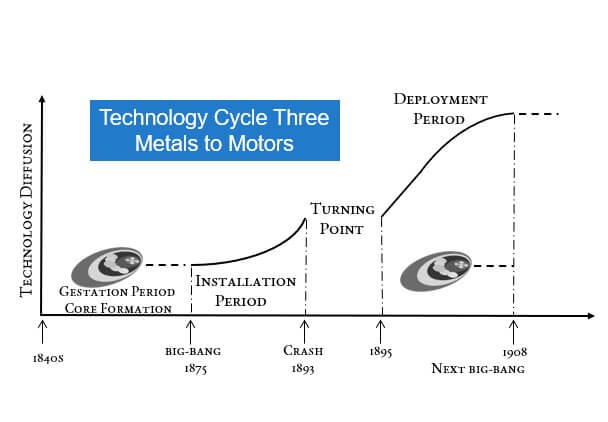
Technology Cycle Three: Metals to Motors
1875–1918. The third technological revolution transformed the industrial economy through inexpensive steel, electrical power, heavy engineering, modern communications, and the increasingly systematic application of scientific knowledge to production. Together, these innovations created the foundations for a new scale of industrial organization and economic activity.
The first Industrial Revolution had reorganized production around machinery and factories. The second connected those factories to expanding markets through steam railways, ships, telegraphs, and supporting infrastructure. The third revolution transformed the materials, power systems, and organizational capabilities upon which modern industrial production depended.
Steel allowed engineers to construct larger machines, stronger bridges, taller buildings, and more durable transportation systems. Electricity made it possible to transmit power from central generating stations to factories, streets, commercial buildings, and eventually individual machines. Telecommunications allowed information to move rapidly through increasingly extensive networks.
These technologies helped create new industries while changing the organization of existing ones. Manufacturing became more dependent upon specialized engineering, scientific research, sophisticated capital investment, and large enterprises capable of coordinating complex operations. The modern industrial corporation emerged as an increasingly important economic institution.
Carlota Perez identifies 1875 as the beginning of the third great technological surge, using Andrew Carnegie’s Bessemer steelworks near Pittsburgh as its defining breakthrough. Carnegie’s Edgar Thomson Steel Works demonstrated the growing commercial potential of large-scale steel production in the United States.
In my Technology Supercycles framework, Cycle Three illustrates how the combination of improved materials, new energy systems, scientific engineering, communications, and capital-intensive infrastructure can transform an industrial economy. It also demonstrates the growing importance of institutions capable of coordinating increasingly complex productive systems.
The Industrial Economy Acquires a New Foundation
By the early 1870s, railways had transformed the movement of raw materials, manufactured goods, and people. Industrial enterprises operated across wider markets, and manufacturing increasingly depended upon specialized equipment and large supplies of coal, iron, and other materials.
Yet the industrial system still faced important constraints. Iron was heavy, subject to wear, and unsuitable for some demanding applications. Mechanical power was often distributed through line shafts, belts, gears, and other arrangements that limited the location and organization of machines. Communications were improving, but managing large enterprises across distant facilities remained difficult.
Cycle Three began changing these relationships. Economical steel became available in quantities sufficient to transform industrial construction. Electrical generation and distribution offered new possibilities for organizing industrial power. Telephones and improved telegraph systems expanded the speed and reach of communications.
New methods of industrial chemistry contributed to the development of synthetic materials, fertilizers, pharmaceuticals, dyes, and other products. Scientific laboratories became more important to commercial innovation, while industrial enterprises increasingly employed engineers and researchers to improve production.
These developments reinforced one another. Better steel supported the machinery used in power stations and factories. Electricity created opportunities for new industrial processes. Advanced machinery made chemical and metallurgical production more efficient. Communications helped businesses manage the larger operations that these technologies made possible.
The result was an industrial system increasingly capable of expanding through the continuous improvement and combination of technologies. Productive capacity developed through a growing network of complementary industries, skills, infrastructure, and institutions.
The Five Major Technological Clusters
Five interconnected technological clusters were especially important to the third revolution: steel and advanced metallurgy, electricity and power systems, heavy engineering and industrial machinery, telecommunications, and industrial chemistry.
Steel and Advanced Metallurgy
Henry Bessemer announced his steelmaking process in 1856, nearly two decades before Perez’s chosen starting date. The process forced air through molten pig iron to remove carbon and other impurities, providing a route toward much faster and less expensive steel production. Commercial success required additional engineering and metallurgical improvements, including better control of composition and the treatment of different iron ores.
The Siemens-Martin open-hearth process developed during the 1860s offered another important approach to steelmaking. Later improvements, including methods for treating phosphorus-rich iron, expanded the range of ores suitable for large-scale steel production.
Carnegie’s Edgar Thomson Steel Works, which began operating in 1875, demonstrated the industrial possibilities of high-volume steel production. Steel gradually became an essential material for railways, bridges, structural construction, machinery, ships, and other demanding applications.
More affordable steel also changed the possibilities of architecture and industrial construction. Engineers could design taller structures, stronger frames, longer bridges, and equipment capable of operating under greater mechanical stress. Steel production became a foundational industry supporting many others.
Electricity and Power Systems
The commercial development of electricity transformed the relationship between energy and industrial organization. Earlier factories commonly relied upon waterwheels, steam engines, and mechanical transmission systems. Electrical power made it possible to distribute energy through wires and eventually operate individual motors throughout a production facility.
Thomas Edison’s Pearl Street Station began supplying electric power to customers in New York City on September 4, 1882. Its direct-current system demonstrated the practical combination of generators, distribution networks, lighting equipment, meters, and commercial service arrangements.
Electrical systems developed through competition among inventors, engineers, and firms. Alternating-current technology, transformers, and improved electric motors expanded the practical distance over which electricity could be transmitted. Nikola Tesla, George Westinghouse, and many other engineers contributed to the development of these systems.
The hydroelectric development at Niagara Falls became a defining example. Generation began in 1895, and alternating-current power was transmitted to Buffalo in 1896, demonstrating the commercial usefulness of supplying electricity across significant distances.
Electrification continued well beyond Cycle Three. Many factories and homes retained older power and lighting arrangements for decades. The significance of the early electrical revolution was the establishment of a productive infrastructure whose applications could continue expanding through later technological cycles.
Heavy Engineering and Industrial Machinery
The combination of better materials, improved machine tools, and new power systems expanded the capabilities of industrial machinery. Manufacturers could construct larger turbines, stronger engines, more precise equipment, and machinery designed for increasingly specialized operations.
Industrial engineering became more systematic as businesses sought to improve the reliability, efficiency, and organization of production. Technical drawings, measuring instruments, standardized components, maintenance practices, and specialized engineering occupations became increasingly important.
These capabilities helped make larger production facilities practical. They also supported the development of industries requiring heavy investment in specialized equipment, including steelmaking, chemical manufacturing, power generation, transportation, and mining.
Telecommunications and Information Coordination
Telegraph networks had already become important during the railway revolution. Their continued expansion helped connect financial markets, businesses, news organizations, and governments across national boundaries. The successful permanent transatlantic telegraph cable of 1866 had established a foundation for much faster communications between Europe and North America.
Alexander Graham Bell’s telephone patent in 1876 introduced another important communications technology. Telephone networks gradually developed into commercial services, allowing people to exchange spoken information without requiring a telegraph operator to translate messages.
As networks expanded, organizations acquired new capabilities for coordinating decisions, managing business relationships, and responding to changing conditions. The telegraph and telephone began altering the relationship between information, distance, and economic activity.
Wireless communication also began developing near the end of the nineteenth century. Experiments involving electromagnetic waves eventually contributed to commercial radio telegraphy, although the much wider radio broadcasting systems familiar to later generations belonged largely to the twentieth century.
Industrial Chemistry and Scientific Manufacturing
The third revolution also witnessed the growing commercialization of chemistry. Synthetic dyes, industrial acids, fertilizers, pharmaceuticals, explosives, and increasingly specialized materials became important parts of the modern industrial economy.
Germany became especially influential through the development of industrial chemical research and manufacturing. Firms such as BASF, Bayer, and Hoechst developed substantial research and production capabilities, demonstrating how scientific knowledge could be organized into continuing commercial innovation.
The development of industrial research laboratories created new relationships between universities, scientists, engineers, and manufacturing enterprises. Scientific discovery increasingly became a continuing input into product development and industrial production.
These five clusters reinforced one another. Steel supplied materials for industrial machinery, electricity powered new equipment, heavy engineering increased production capacity, telecommunications improved coordination, and chemistry expanded the range of materials and processes available to industry.
Together, they created an increasingly interconnected industrial system whose productive opportunities extended across national boundaries and into industries that had barely existed when the railway revolution began.
The Four Developmental Periods of Cycle Three
Carlota Perez’s framework distinguishes Installation, the Turning Point, and Deployment. Installation contains Irruption and Frenzy, while Deployment contains Synergy and Maturity. My Technology Supercycles model adds an earlier Gestation or Core Formation period to examine the development of the technological foundations preceding the initiating breakthrough.
The dates below provide an approximate historical organization of Cycle Three. Industrial change, financial crises, political developments, and technological diffusion occurred at different times across countries. The period boundaries are therefore interpretive rather than rigid divisions.
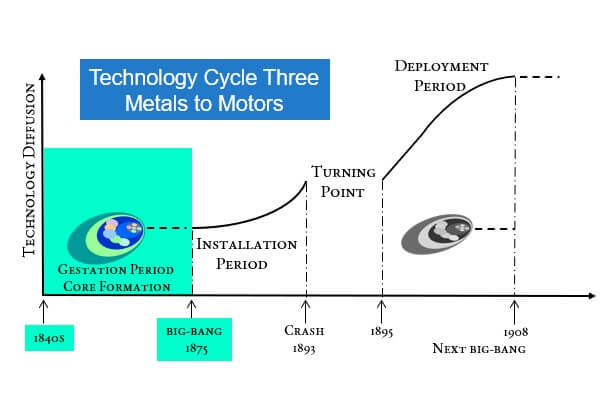
Gestation and Core Formation: Preparing the Third Industrial Revolution (Approximately 1840–1875)
The third technological revolution developed from inventions and industrial capabilities created before its 1875 starting point. Improvements in metallurgy, mechanical engineering, chemistry, electrical science, and communications gradually established the foundation for the next industrial system.
Telegraph networks expanded during the 1840s, introducing a new ability to coordinate information across long distances. Industrial chemistry developed through improvements in manufacturing processes and the growing application of scientific investigation. The discovery of mauveine by William Henry Perkin in 1856 demonstrated how synthetic chemistry could open entirely new commercial opportunities.
Steelmaking was undergoing an especially important transformation. Bessemer’s process, announced in 1856, offered a method of producing steel more economically than many earlier techniques. Practical difficulties involving impurities, composition, and production reliability encouraged additional work by metallurgists, manufacturers, and engineers.
The open-hearth steelmaking process developed during the 1860s, providing another route to large-scale production. Improvements in machinery and furnaces increased the ability of steelmakers to control their products and supply industrial customers.
Electrical science was also becoming increasingly practical. The development of generators, motors, and improved electromagnetic knowledge established the foundations for commercial power systems. Werner von Siemens’ work on dynamo-electric machinery in 1866 was an important contribution to this process.
These developments were interconnected. More capable machinery supported improved materials production. Better materials made electrical and mechanical equipment more reliable. Electrical research created possibilities for energy systems that would eventually transform industrial production.
By 1875, enough of these capabilities had developed to support an expanding industrial system built around steel, electricity, and heavy engineering. Carnegie’s steelworks became a defining example of the transition from experimental and specialized technologies toward increasingly large commercial production.
Core Formation illustrates a central principle of my model: the visible beginning of a technological revolution depends upon innovations and productive capabilities accumulated during earlier decades.
The detailed Cycle Three Core Formation chapter examines the technologies and relationships that made the third revolution possible.
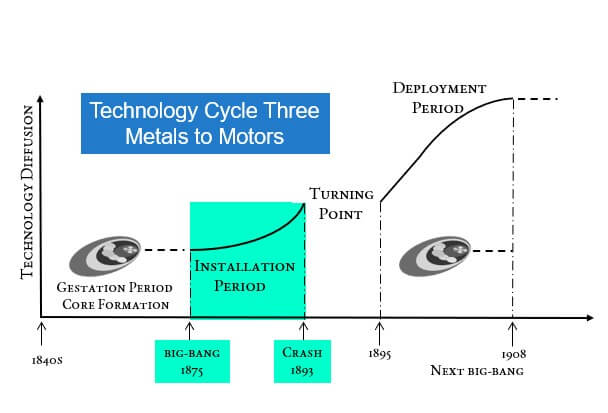
The Installation Period: Creative Destruction and Industrial Expansion (1875–1893)
The Installation period began as the new technologies demonstrated their commercial possibilities. Steel production expanded, electrical equipment entered practical use, communications networks grew, and industrial firms developed increasingly sophisticated methods of organizing production.
In the United States, Carnegie’s steel operations helped establish Pittsburgh as an important center of the emerging steel industry. The demand for stronger and less expensive materials came from railways, bridge builders, manufacturers, shipyards, and construction enterprises.
Steelmaking encouraged the development of larger industrial facilities and more capital-intensive production processes. Companies increasingly invested in specialized equipment, transportation connections, raw-material supplies, and technical personnel whose performance had to be coordinated across large operations.
Electrical power introduced a second major transformation. Edison and his collaborators developed commercial lighting and generating systems, while other engineers pursued alternating-current technologies and equipment capable of transmitting electricity over greater distances.
The opening of Pearl Street Station in 1882 demonstrated the commercial operation of an urban electric distribution system. During the following decade, competing firms installed generating equipment, lighting networks, and industrial electrical systems in growing markets.
These developments were initially expensive and geographically limited. Businesses had to construct generating facilities, install wiring, manufacture equipment, establish service relationships, and persuade customers that electric systems offered advantages over established alternatives.
The same challenge appeared in telecommunications. Telephone networks needed exchanges, wires, switching equipment, trained operators, and customers who found sufficient value in the new service. Their expansion depended upon commercial organization and infrastructure as well as the original invention.
The revolution also changed the international competitive environment. Britain remained an important industrial power, while the United States and Germany became increasingly influential in steel, engineering, chemicals, and electrical manufacturing.
Large industrial firms accumulated productive capabilities that earlier enterprises could rarely have coordinated. They combined research, manufacturing, procurement, distribution, finance, and increasingly extensive managerial organizations.
These changes created new economic opportunities, but they also placed pressure upon established producers. Smaller firms could struggle to compete with enterprises possessing advanced machinery, extensive capital resources, specialized knowledge, and control over raw materials or distribution.
The Installation period therefore illustrates how technological revolutions can simultaneously expand productive capacity and concentrate economic power. The new industrial system created opportunities for engineers, workers, suppliers, and entrepreneurs, while the ownership of its increasingly expensive infrastructure became an important determinant of economic influence.
The Casino Phase: Industrial Finance and Speculative Expansion
The commercial opportunities associated with steel, electricity, communications, and international industrial expansion attracted substantial financial capital. Investors financed factories, power systems, railways, urban development, mining enterprises, and businesses pursuing new markets.
Capital markets became increasingly international. Financial institutions in London, New York, Paris, and other centers facilitated investment in industrial and infrastructure projects extending across national boundaries.
These arrangements created opportunities for productive development, but they also encouraged speculative investment. The expected value of an enterprise could depend upon future markets that had not yet developed, financing conditions that might change, or assumptions about industrial growth that proved excessively optimistic.
The failure of Baring Brothers’ exposure to Argentine investments during the crisis of 1890 demonstrated how financial difficulties in one part of the international economy could threaten institutions operating in another. The Bank of England and private financial institutions organized support to prevent the crisis from spreading further through the British banking system.
Additional financial pressures developed in the United States. Railroad overbuilding, corporate leverage, unstable banking arrangements, and concerns about the country’s monetary system contributed to increasing vulnerability.
In 1892, the Homestead Strike at Carnegie Steel exposed another side of industrial expansion. Workers and management engaged in a violent conflict over wages, labor organization, and control of production. The dispute demonstrated how the growing power of industrial corporations was creating major challenges for labor institutions and communities.
Financial speculation and labor conflict were distinct developments, with different immediate causes. Both reflected growing tensions within an industrial economy whose productive capabilities and corporate organizations were changing rapidly.
By 1893, financial instability had become severe. The collapse of important railroad enterprises, bank failures, monetary uncertainty, and weakening economic activity produced one of the most serious American financial crises of the nineteenth century.
The episode illustrates Perez’s argument that the financial expansion associated with technological Installation can create conditions requiring an institutional and economic adjustment. Yet the Panic of 1893 should not be attributed solely to speculation in steel or electricity. Railroads, monetary policy, banking weaknesses, and international financial pressures all played important roles.
For the historical financial background, see Federal Reserve History: Banking Panics of the Gilded Age.
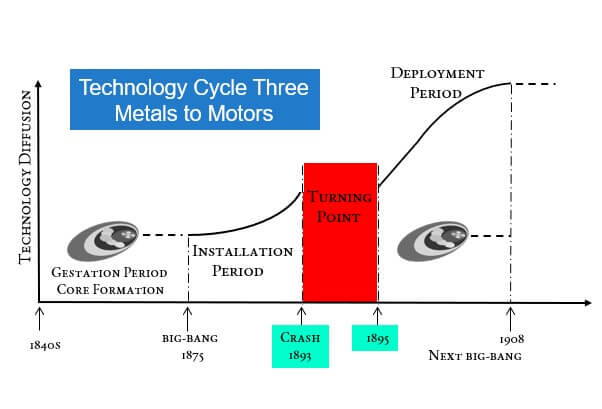
The Turning Point: Financial Crisis and Industrial Reorganization (1893–1895)
The Panic of 1893 created extraordinary financial and economic distress in the United States. Bank failures, railroad bankruptcies, collapsing investment, falling production, and rising unemployment exposed the vulnerability of an economy increasingly dependent upon complex financial relationships and large industrial enterprises.
Problems had been accumulating before the panic. Economic activity had weakened, bank balance sheets were under pressure, and concerns about Treasury gold reserves undermined confidence in the monetary system. The failure of several major enterprises intensified the crisis, contributing to bank runs and financial contraction.
The crisis disrupted financing across the productive economy. Businesses struggled to obtain credit, industrial investment declined, and households experienced severe insecurity. Financial failures affected enterprises whose operations depended upon the continued availability of loans and working capital.
The depression following the panic extended beyond the approximate 1893–1895 Turning Point used in this framework. Economic weakness and adjustment continued through the middle and later 1890s, with conditions differing among industries and regions.
Financial instability also raised questions about the institutions governing banking and corporate finance. The American banking system remained vulnerable to panics, and its limitations would remain unresolved for another two decades.
The crisis influenced investment decisions while the technologies of the third revolution continued developing. Steel, electrical generation, telecommunications, and industrial chemistry had already demonstrated productive capabilities that would remain valuable after speculative investments were written down or reorganized.
Some enterprises failed, others consolidated, and stronger firms acquired equipment, markets, or competitors. Industrial restructuring contributed to the emergence of larger corporations whose activities extended across numerous production facilities and markets.
The reorganization of productive activity was accompanied by social conflict. In 1894, workers at the Pullman Company began a strike that developed into a national railway boycott. Federal intervention, arrests, and violence revealed the tensions surrounding labor rights and the growing economic importance of interconnected transportation and industrial systems.
These events illustrated the institutional problems accompanying the new productive economy. Large enterprises could coordinate resources and markets on an unprecedented scale, while workers and communities struggled to influence decisions affecting their livelihoods.
The Turning Point therefore represents more than a financial crisis. It marks a period when the economic, political, and labor institutions inherited from earlier industrial development encountered pressures created by increasingly concentrated capital and interconnected productive systems.
Not every problem was resolved by 1895. Corporate concentration, labor conflict, financial instability, and the regulation of industrial enterprises remained major public questions throughout the following decades. The Panic of 1907 would eventually contribute to the establishment of the Federal Reserve System in 1913.
This longer institutional development is important when interpreting Perez’s model. The Turning Point identifies a historical transition, but economic institutions generally change through continuing negotiation, experimentation, legislation, and political conflict.
The productivity of steel and electricity survived the financial crisis. The larger challenge was to establish economic arrangements capable of using those technologies more effectively and distributing their benefits through the expanding industrial economy.
For historical accounts of the labor conflicts, see the Library of Congress: Homestead Strike and the National Park Service: Pullman Strike of 1894.
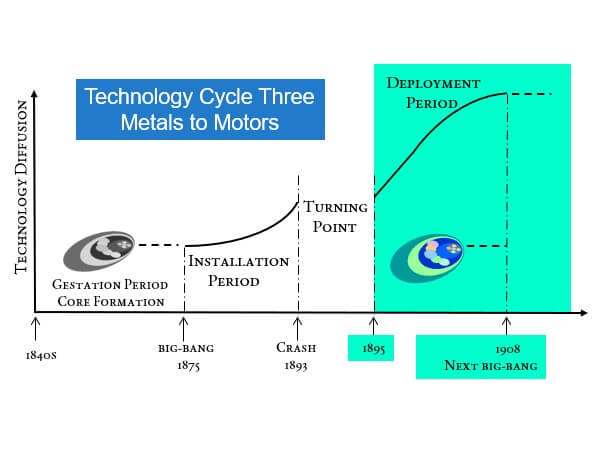
The Deployment Period: Industrial Power, Networks, and Modern Production (1895–1918)
During the years following the financial crisis, steel, electricity, telecommunications, heavy engineering, and industrial chemistry became increasingly integrated into the productive economy. Their wider application supported new industries, larger enterprises, expanding urban infrastructure, and the development of increasingly complex industrial systems.
The Deployment period was marked by continuing technological innovation as well as the broader commercial use of capabilities developed during Installation. Electrical power systems became more practical, steel production expanded, and scientific research became increasingly important to industrial manufacturing.
These developments extended beyond individual inventions. The productive importance of each technology grew as supporting industries, standards, engineering practices, and infrastructure became more widely available.
Electricity Becomes Industrial Infrastructure
The development of the Niagara Falls power system demonstrated how large generating facilities could supply electricity to industrial and urban customers. Alternating-current transmission expanded the geographical possibilities of electrical service, allowing power to be generated at locations separated from many of its eventual users.
Electric lighting transformed commercial buildings, streets, factories, and public facilities. Electrical motors increasingly offered manufacturers the possibility of operating machinery without relying entirely upon the mechanical transmission arrangements associated with earlier factories.
These possibilities required extensive supporting investment. Generating stations, transmission lines, transformers, local distribution systems, electrical equipment, maintenance services, and trained personnel were essential to the expansion of electrification.
Industrial companies began experimenting with factory layouts that took advantage of electrical power. Machines could eventually be arranged according to the requirements of production rather than the location of a central mechanical drive system.
The full productivity benefits developed gradually. Factories often required years of redesign and investment before the flexibility of electrical motors could be fully exploited. The conversion of homes and rural communities to electrical service extended well into the twentieth century.
This historical delay illustrates why a technology’s invention, commercial introduction, and economy-wide productive impact can occur at very different times. The revolution continued creating economic opportunities long after its earliest electrical systems had demonstrated their usefulness.
Steel and the Rise of the Modern Industrial Corporation
Steel production continued expanding as railways, manufacturers, construction firms, shipyards, and other industries adopted stronger and more economical materials. Larger furnaces, improved machinery, specialized engineering, and more extensive raw-material networks increased the scale at which steel could be produced.
The organization of production also changed. Industrial firms increasingly combined activities that had previously been performed by separate enterprises. A steel company might control mines, transportation systems, furnaces, rolling mills, and distribution arrangements in order to coordinate supplies and reduce costs.
The creation of U.S. Steel in 1901 provided an extraordinary example of industrial consolidation. Organized through the combination of Carnegie Steel and other enterprises, the corporation became one of the largest industrial organizations in the world.
The rise of such companies demonstrated how control over capital, infrastructure, and markets could become concentrated within large organizations. These enterprises possessed the resources to operate extensive productive systems, but their economic power also raised questions about competition, labor relationships, and the ability of independent businesses to participate.
Government responses evolved through antitrust legislation, regulatory institutions, and public debate. The Sherman Antitrust Act of 1890 established an early American legal foundation for challenging certain restraints of trade and monopolistic practices, while its interpretation and enforcement continued developing during the following decades.
The growing industrial corporation became an increasingly important institution of modern economic life. Its advantages in scale, finance, research, and coordination were accompanied by questions about the distribution of authority and the benefits of industrial development.
Scientific Research Becomes a Productive Capability
Industrial chemistry and electrical engineering encouraged closer relationships among scientific research, manufacturing, and commercial product development. Firms increasingly recognized the economic value of employing scientists and engineers to investigate materials, production processes, and new applications.
German chemical companies became especially influential in the commercialization of scientific knowledge. Their research capabilities supported advances in dyes, pharmaceuticals, fertilizers, and specialized industrial materials.
Electrical companies also developed extensive engineering organizations. The formation of General Electric in 1892 and the expansion of Westinghouse’s industrial activities demonstrated the increasing importance of firms capable of combining invention, manufacturing, technical standards, and commercial distribution.
Modern industrial research laboratories became part of a growing productive ecosystem that included universities, technical schools, public institutions, specialized suppliers, and professional engineering communities.
These relationships would prove enormously important in later technological revolutions. The continual accumulation of scientific knowledge and engineering capability helped transform innovation from an occasional breakthrough into an increasingly organized process of industrial development.
The Expansion of Global Industrial Competition
During the late nineteenth and early twentieth centuries, industrial leadership became more geographically distributed. Britain remained an important commercial and manufacturing power, while the United States and Germany expanded rapidly through steel, engineering, electricity, chemicals, and large-scale industrial production.
Japan also developed modern industrial capabilities during the Meiji period, drawing upon imported technologies, domestic investment, education, and institutional reforms. Its industrial development demonstrated how countries could adopt and adapt productive systems that had initially emerged elsewhere.
Railways, steamships, international telegraph networks, and commercial institutions helped connect these expanding industrial economies. New materials, machinery, and manufactured goods moved through increasingly extensive international markets.
The resulting globalization was uneven and frequently shaped by imperial power. Colonial relationships influenced access to resources, markets, finance, and industrial opportunity. The expansion of productive capacity in leading industrial countries did not guarantee equivalent economic participation elsewhere.
Nevertheless, the capabilities developed during Cycle Three helped create the foundations for later industrialization across a much larger part of the world. Steel, electrical infrastructure, engineering, communications, and scientific manufacturing eventually became essential components of modern economic development.
The Financial Panic of 1907 and Institutional Reform
Although the Deployment period brought substantial productive expansion, financial instability did not disappear. The Panic of 1907 exposed continuing weaknesses in the American banking system and the arrangements through which financial institutions supplied credit and liquidity.
Private financiers, including J. P. Morgan, helped organize emergency support during the panic. But the crisis reinforced concerns that the United States lacked institutions capable of responding consistently to a nationwide financial emergency.
The resulting debates contributed to the Federal Reserve Act of 1913, which established the Federal Reserve System. The new central bank was intended to improve the stability and flexibility of the monetary and banking system, although its design and responsibilities would continue evolving.
This development illustrates another important relationship in Perez’s framework. Institutional adaptation may continue long after the first financial Turning Point associated with a technological revolution. Productive systems and financial institutions evolve together through repeated challenges.
The history of Cycle Three therefore includes more than a single financial crisis followed by uninterrupted prosperity. Its broader Deployment required continuing changes in finance, regulation, corporate organization, labor relationships, and public infrastructure.
1908–1918: The Next Revolution Begins Before the Previous One Ends
In 1908, Ford introduced the Model T, the event Perez identifies as the beginning of the fourth technological revolution centered upon automobiles, oil, and mass production.
The Model T emerged from capabilities developed during earlier cycles. Steel production supplied essential materials. Precision machinery supported engine and vehicle manufacturing. Industrial chemistry contributed to fuels, rubber, coatings, and other products. Electrical equipment and increasingly sophisticated factories provided supporting capabilities.
Ford’s introduction of the moving assembly line in 1913 established another important stage in the development of mass production. The new methods would eventually transform manufacturing, labor organization, transportation, and consumer markets during the fourth revolution.
But Cycle Three did not suddenly end when Cycle Four began. Steel, electricity, industrial chemistry, telecommunications, and heavy engineering continued expanding. Many of their most important productive applications developed alongside the emerging automobile and mass-production industries.
The First World War, beginning in 1914, accelerated some forms of industrial production and technological development while imposing extraordinary human and economic destruction. Wartime mobilization increased demand for steel, chemicals, electrical equipment, heavy machinery, transportation, and industrial coordination.
The war also disrupted international trade, financial relationships, political institutions, and the economies of participating countries. Its conclusion in 1918 provides a useful historical boundary for this overview, although the technologies established during Cycle Three remained essential to industrial development for decades afterward.
The overlap between Cycles Three and Four is especially important to my Technology Supercycles model. A new revolution begins emerging while the technologies and institutions of the preceding revolution continue developing and spreading.
Technological revolutions therefore cannot be understood as a sequence in which one productive system completely disappears before another begins. Each inherits capabilities from earlier systems and develops new combinations that expand the possibilities available to the economy.
The Third Revolution and the Growth of the Middle-Class Ecosystem
The importance of Cycle Three extends beyond the growth of steel, electricity, or industrial corporations. It helped establish the technological and institutional foundations upon which the modern middle class would expand during the twentieth century.
New industries created opportunities for engineers, technicians, machinists, electrical workers, chemical specialists, skilled manufacturing employees, managers, and independent businesses supplying increasingly complex productive systems.
Education and technical training became more important as industrial production required specialized knowledge. Universities, engineering schools, research laboratories, public institutions, and professional organizations contributed to the accumulation and diffusion of productive capabilities.
Infrastructure also became increasingly important. Electricity, communications, industrial transportation, water systems, and urban public services supported the development of growing communities and commercial markets.
The resulting economic opportunities were accompanied by serious inequalities. Industrial workers often faced dangerous conditions, long hours, and limited bargaining power. Labor conflicts exposed disagreements about wages, working arrangements, and the distribution of the financial returns generated through industrial production.
The Homestead and Pullman strikes illustrate how difficult it could be for workers to influence the organizations controlling increasingly important productive infrastructure. Large industrial corporations possessed financial and political resources that individual employees and local communities often lacked.
The benefits of industrial productivity therefore developed through institutional change as well as technological improvement. Labor organizations, education, public infrastructure, regulatory systems, and political reforms gradually influenced how ordinary people participated in the expanding economy.
The third revolution also increased the importance of accumulated knowledge. A corporation using advanced steelmaking equipment depended upon generations of metallurgical research, industrial experimentation, transportation development, and the skills of its workers and suppliers.
Electrical systems depended upon scientific discovery, engineering education, public infrastructure, specialized manufacturers, and the continuing cooperation of customers, utility operators, and technical personnel. Industrial chemistry drew upon scientific research and institutions whose benefits extended far beyond individual firms.
The resulting industrial wealth emerged from a productive ecosystem larger than any one corporation. Its capabilities were accumulated across generations and sustained by the participation of communities, workers, businesses, and public institutions.
This history supports my broader argument that the middle-class ecosystem is itself a creator of wealth. Its collective investments in education, expertise, scientific knowledge, infrastructure, institutions, and productive work established the capabilities inherited by subsequent technological revolutions.
The expansion of modern industrial prosperity therefore depended upon how those productive capabilities were developed and how the resulting economic rewards became available to wider populations.
The Institutional Legacy: Corporations, Competition, and Economic Power
Cycle Three also transformed the organization of economic power. Large-scale industrial production increasingly required substantial capital investments, specialized infrastructure, coordinated supply networks, and technically sophisticated management.
These requirements encouraged the growth of corporations capable of organizing extensive industrial operations. Companies could acquire suppliers, control transportation arrangements, purchase competitors, and coordinate activities across increasingly large markets.
Such organizations created genuine productive advantages. They could finance expensive equipment, develop technical expertise, and manage operations that would have been difficult for smaller businesses to undertake independently.
But the concentration of productive capabilities also created risks. Enterprises controlling essential infrastructure or market access could influence the competitive opportunities available to other businesses. Workers and local communities could become dependent upon decisions made by organizations whose financial and managerial interests extended far beyond them.
These questions would recur during later technological revolutions. Mass production increased the importance of large manufacturing organizations. Digital platforms concentrated control over access to information, customers, and electronic marketplaces. The emerging AI supercycle is creating new forms of economic power around computing infrastructure, semiconductors, electricity, and autonomous systems.
In each revolution, productive scale creates new opportunities while raising questions about competition, ownership, market access, and the distribution of economic benefits.
The third revolution therefore offers an important historical foundation for understanding the institutional challenges of today’s technology economy. The relationship between technological capability and economic power has been developing for well over a century.
From Industrial Power to Digital Networks and Artificial Intelligence
The technologies developed during Cycle Three became foundational components of the revolutions that followed. Steel made the modern automobile, heavy machinery, and large-scale construction possible. Electricity supported increasingly flexible manufacturing, communications, transportation, and consumer technologies.
Industrial chemistry created new materials and processes. Scientific research laboratories developed continuing methods of technological improvement. Large corporations established organizational capabilities that supported extensive production and distribution networks.
The fourth revolution combined these foundations with petroleum, automobiles, standardized production, and new transportation systems. The fifth transformed the movement of information through computing, software, telecommunications, and digital networks.
The sixth supercycle, which I identify as beginning with the broad commercial emergence of generative AI in 2022, is developing upon the digital infrastructure inherited from Cycle Five. Yet its expansion also depends upon steel, electricity, advanced materials, industrial manufacturing, and other physical capabilities whose history reaches back to earlier revolutions.
AI requires powerful computing equipment, enormous capital investment, advanced semiconductors, data centers, electrical generation and transmission, cooling systems, and complex global supply chains. Its emerging productive system therefore combines digital intelligence with an expanding physical industrial foundation.
This relationship illustrates one of the most important principles of technology-supercycle theory. New revolutions develop from capabilities accumulated during earlier revolutions. Their economic importance emerges through the combination of technologies, productive institutions, infrastructure, and human knowledge.
Why Cycle Three Still Matters
The third technological revolution changed the productive foundation of industrial society. It made stronger materials more economical, established electricity as a commercial energy system, developed new communications networks, expanded scientific manufacturing, and created organizations capable of managing increasingly sophisticated industrial operations.
It also revealed growing tensions between productive expansion and financial speculation, between large corporations and independent enterprises, and between the wealth created by industrial development and the opportunities available to workers and communities.
The financial crisis of 1893 exposed vulnerabilities in an economy undergoing rapid transformation. The growth of industrial corporations created new opportunities for productive scale while encouraging debates about competition and economic power. Labor conflicts demonstrated the importance of institutions through which workers and communities could influence the conditions of industrial development.
Meanwhile, the productive technologies continued spreading. Steel, electricity, communications, and scientific manufacturing became increasingly important foundations for the modern economy, creating opportunities that extended far beyond the original businesses and investors.
The third revolution demonstrates how technological wealth accumulates through the interaction of scientific knowledge, productive investment, infrastructure, human capability, and institutional development. It also illustrates why the ownership of productive assets and the distribution of economic power matter to the wider prosperity of society.
The next revolution would build directly upon these capabilities. Oil, automobiles, mass production, and the development of new consumer markets would transform the industrial world again, expanding the productive possibilities available to an increasingly large middle-class population.
Cycle Three Research: The Singularity Stacks

The Singularity Stacks Reference Library documents the inventions, technological improvements, industrial developments, and historical publications associated with the third technological revolution.
Cycle Three’s collections examine the foundations of steelmaking, electrical generation and distribution, heavy engineering, telecommunications, industrial chemistry, and the commercial organizations supporting their expansion.
Cycle Three: Core Formation Bibliography and Innovations
Cycle Three: Installation Through Deployment Bibliography and Innovations
Further Historical Research
Carlota Perez, Technological Revolutions and Financial Capital, Chapter One. The historical model identifying 1875 and Carnegie’s Bessemer steelworks as the beginning of the third technological revolution.
Smithsonian National Museum of American History: Edison’s Pearl Street Power Station. The development of commercial electrical generation and distribution in New York City beginning in 1882.
National Park Service: The Origins of Hydroelectric Power. The development of alternating-current transmission and the Niagara Falls power system.
Federal Reserve History: Banking Panics of the Gilded Age. The financial instability surrounding industrial expansion and the Panic of 1893.
Library of Congress: The Homestead Strike of 1892. Industrial labor conflict during the expansion of the American steel industry.
National Park Service: The Pullman Strike of 1894. Labor conflict and institutional pressures during the industrial Turning Point.
Federal Reserve Bank of New York: The Founding of the Federal Reserve. The banking crises and institutional changes that culminated in the Federal Reserve System.
Continue Exploring the Technology Cycles
Return to Cycle Two: Steam Power and Railways.
Continue to Cycle Four: Oil, Automobiles, and Mass Production.
Return to Carlota Perez’s Five Historical Technology Cycles.
Explore the Six Technology Supercycles and Their Innovation Waves.