

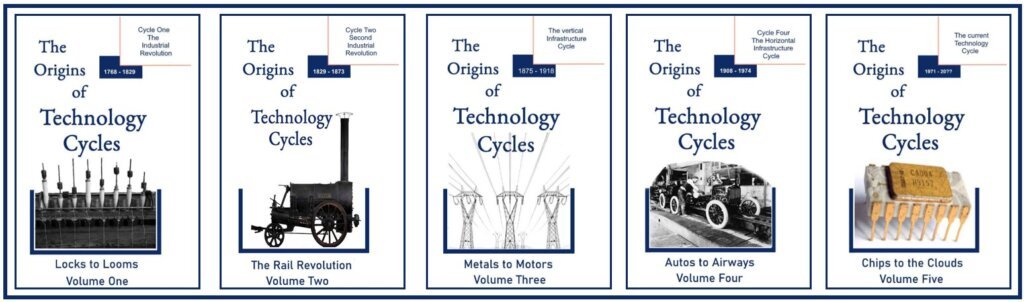
The five volumes of The Origins of Technology Cycles examine the historical foundations of the five technological revolutions identified by Carlota Perez. The first volume was published; the remaining manuscripts are presented here through summaries of their Core Formation research.
The Origins of Technological Revolutions: What Five Cycles Reveal
From Innovation Mass Compression to the Big Bang
What causes a technological revolution to occur? Carlota Perez identifies defining commercial breakthroughs, which she calls Big Bang moments, and traces the installation, turning point, and deployment that follow. She also recognizes that each revolution has a gestation period, sometimes lasting decades. My investigation began with the question of what happens during those formative years, and whether their development follows a recurring pattern.
Reconstructing the gestation periods of five revolutions revealed a common sequence. The inventions and historical settings differed greatly, but the growing relationships among technologies, industries, organizations, and investment repeatedly followed five overlapping phases of Core Formation. I call the resulting process Innovation Mass Compression.
Phase 1: Initial Ripples. Innovations appear in separate, sometimes apparently unrelated fields. Their eventual usefulness to one another is rarely evident at the outset. Early textile machines, improved ironmaking, locomotive experiments, internal-combustion engines, and electronic computers all began within such broader fields of experimentation.
Phase 2: Coalescence Around Bottlenecks. As innovations develop, they expose constraints in related activities. Faster weaving requires more yarn; locomotives need stronger rails and precision parts; computers require better memory, semiconductors, and software. Efforts to solve these bottlenecks draw previously separate capabilities into closer contact.
Phase 3: New and Revolutionized Industries. Complementary inventions become practical industrial systems. Specialized firms, manufacturing methods, skills, and infrastructure develop around them. Advances in one cluster increasingly support or depend on advances in others.
Phase 4: Imitation and Improvement. Competitors copy, adapt, improve, and recombine successful approaches. Techniques travel among firms, industries, and countries. As Joseph Schumpeter observed, innovations can arrive in clusters or swarms; their interaction increases what the emerging system can accomplish.
Phase 5: Financial Reorientation. Capital and organizational resources increasingly flow toward the emerging industries. The expanding capacity to produce, finance, distribute, and improve new technologies draws the clusters into a more interconnected whole. Investment can begin in earlier phases and continue long afterward; these five phases are a way to examine an overlapping historical process, not a rigid timetable.
The accompanying diagrams depict this growing interdependence as innovation mass compression. Scattered inventions coalesce into pockets, industries scale, imitators swarm, and a concentrated technological core emerges. The term is a visual and analytical metaphor for increasing technological interconnectedness, not a measured physical compression or a claim that inventions progress in an automatic sequence.
The resulting core contains capabilities whose collective value can exceed what any invention could achieve alone. A commercially transformative development then gives that accumulated potential a defining expression. In Perez’s terminology, this is the Big Bang, the recognizable beginning of a new technological revolution. The five histories suggest that understanding the formation of the core may help explain why such revolutions arise.
Five Core Formation Periods Compared
| Cycle | Period examined | Defining Big Bang milestone |
|---|---|---|
| 1. Canals and Textiles | 1730–1771 | Arkwright’s Cromford Mill, 1771 |
| 2. Steam and Railways | 1800–1829 | Stephenson’s Rocket, 1829 |
| 3. Steel and Electricity | 1840–1875 | Edgar Thomson Steel Works, 1875 |
| 4. Automobile Age | 1870–1900, with developments leading to 1908 | Ford Model T, 1908 |
| 5. Digital Revolution | 1940–1971 | Intel 4004 microprocessor, 1971 |
These dates identify the periods investigated and the milestones used to mark the revolutions. The periods overlap historically; the later development of one cycle can supply the inventions and infrastructure for the next. The fourth study concentrates on 1870–1900 and then looks forward to the Model T in 1908, rather than claiming that the full gestation period ended in 1900.
How This Investigation Began
When AI burst onto the scene in late 2022, I thought it might help investigate an aspect of Carlota Perez’s theory that especially interested me. Perez had acknowledged the gestation periods preceding technological revolutions but had offered relatively little detail about their internal development. Could a close historical reconstruction reveal how a revolution forms before its recognized starting point?
My approach was to work backward from each Big Bang and follow earlier inventions chronologically. I wanted to discover what improvements they inspired, which technical and economic bottlenecks they created or solved, how separate fields began reinforcing one another, and whether the same processes appeared across successive revolutions.
I was genuinely surprised by how far AI could take the research in 2023. The technology required extensive spoon-feeding, historical direction, correction, and guidance, and it still does. Working with TYPE.AI, I nevertheless produced five manuscripts exploring the origins and development of technological revolutions.
Following the innovations in historical sequence revealed relationships that are easy to overlook when history is told mainly through famous inventors and celebrated breakthroughs. The striking possibility was that a revolution might arise from the growing interactions among many inventions, firms, and industries rather than from one isolated invention.
Ultimately, I published only the first volume, Canals and Textiles. The research across the series was fascinating, but the writing suffered from considerable repetition. I may eventually return to the remaining manuscripts and use more advanced AI to consolidate and refine them. For now, the summaries below introduce the historical investigations and link to their detailed Core Formation pages.
The Five Volumes
The Origins of Technology Cycles, Volume 1: Canals and Textiles
Examining the First Technological Revolution: Core Formation through Deployment (1730–1830s)
The first volume of The Origins of Technology Cycles examines the birth of the Industrial Revolution through Carlota Perez’s theory of technological revolutions. Using AI to reconstruct the historical sequence of inventions, industrial development, financial investment, economic disruption, and institutional change, the book explores whether the first great technology cycle followed the recurring patterns described by Perez.
The investigation begins in the decades before the Industrial Revolution, between 1730 and 1760. During this period, seemingly unrelated innovations appeared across textiles, metallurgy, steam power, chemicals, and transportation. John Kay’s flying shuttle, improvements in ironmaking, early spinning machines, precision engineering, and canal construction gradually began reinforcing one another. Drawing upon Joseph Schumpeter’s concept of technological clustering, the book demonstrates how innovations gathered into increasingly interconnected groups, creating the technological core necessary to launch a revolution.
This process, called Core Formation, is an important extension of Perez’s framework. The book proposes that technological revolutions require a gestation period during which innovations accumulate, solve one another’s bottlenecks, attract imitators, establish new industries, and gradually concentrate enough productive potential to ignite a major economic transformation.
The second act examines the Installation Period, beginning around 1771. Richard Arkwright’s mechanized textile production, James Watt’s improved steam engine, expanding iron production, and growing canal networks transformed scattered inventions into an increasingly integrated industrial system. Factories emerged, traditional methods of production were displaced, and financial capital flowed toward the new technologies. Entrepreneurs and imitators accelerated innovation as Britain began reorganizing its economy around industrial production.
By the late 1780s, investment enthusiasm had developed into speculation. Canal companies attracted enormous interest, culminating in the canal mania of 1792 and the financial crisis of 1793. The book examines this episode as the first technological cycle’s Turning Point, tracing the consequences through industrial Manchester, struggling businesses, unemployment, social unrest, political radicalization, and emerging institutional responses. This section explores Perez’s argument that financial capital can become detached from productive investment during the speculative climax of a technological revolution.
The fourth act follows the Deployment Period through the 1830s. As speculative excess subsided, industrial development continued through improved machinery, expanding canal networks, standardized production methods, and the growing application of steam power. Production capital increasingly directed economic development, while new institutions, labor movements, technical education, and industrial communities adapted to the emerging economic order.
The book also explores the profound social consequences of industrialization, including the transformation of work, rapid urbanization, resistance to mechanization, and the expansion of international trade.
Ultimately, the investigation finds substantial historical correspondence with Perez’s model. The first technological revolution developed through identifiable stages of core formation, installation, financial upheaval, and deployment. By the 1830s, its mature industrial system was already generating the technologies and infrastructure that would support the next revolution, centered on railways and steam.
The central conclusion is that technological revolutions emerge from interconnected systems of innovation whose development follows recognizable historical patterns, offering a framework for understanding subsequent revolutions, including the emerging age of artificial intelligence.

Completed Core Formation diagram, Cycle 1. The image illustrates how five overlapping phases compress scattered innovations into a more interconnected technological core. Open the original full-size diagram.
Why this story was told. The first revolution’s core assembled textiles, power, metallurgy, chemicals, and transport into a mutually reinforcing system before Arkwright’s Cromford Mill became the defining milestone in 1771. Explore the detailed Core Formation investigation for Cycle 1.
The Origins of Technology Cycles, Volume 2: Steam and Railways
Examining the Core Formation of the Second Technological Revolution (1800–1829)
The second volume of The Origins of Technology Cycles examines the approximately three decades of gestation preceding the Steam and Railway Age, exploring how innovations emerging from the first Industrial Revolution gradually combined to create the foundations of a second technological revolution. Building upon Carlota Perez’s theory of technological cycles and Joseph Schumpeter’s concept of innovation clustering, the investigation seeks to identify the recurring processes through which a new technological revolution takes shape.
The research identifies five interconnected industrial capabilities that formed the technological core of this revolution: Steam Power, Railroads, Chemicals, Metallurgy and Machine Tools, and Precision Manufacturing. Through a chronological examination of their development between 1800 and 1829, the study traces five overlapping phases of Core Formation.
The first phase, from 1800 to 1810, witnessed seemingly unrelated innovations across these industries. Richard Trevithick developed compact high-pressure steam engines and experimented with steam locomotives. William Murdoch advanced coal-gas lighting, Henry Maudslay improved precision machine tools, and Joseph Marie Jacquard introduced programmable textile manufacturing. Although these inventions addressed different industrial needs, they established capabilities that would eventually reinforce one another.
Between 1810 and 1815, the second phase emerged as technological advances exposed limitations in existing industrial systems. Steam engines needed to become more portable, experimental railways required reliable tracks and locomotives, and increasingly sophisticated machinery demanded greater precision. Chemical production faced growing industrial demand, while manufacturers sought standardized components and more dependable production methods. Solving these bottlenecks created new opportunities for innovation across multiple industries.
The third phase, from 1815 to 1820, saw these innovations develop into increasingly organized industrial activities. Commercial steam navigation expanded, railway projects moved toward practical implementation, and chemical manufacturing grew to supply industrial materials. Improvements in machine tools and interchangeable-part manufacturing helped establish the foundations of systematic industrial production. Separate technologies were beginning to function as components of a larger economic system.
From 1820 to 1825, competition, imitation, and incremental improvements accelerated technological development. Engineers refined steam engines and locomotive designs, manufacturers improved machinery, and chemical processing became more sophisticated. Knowledge spread among competing enterprises, strengthening the interconnections among the five industries.
The final phase, from 1825 to 1829, involved the growing mobilization of financial capital. Railway construction, steam-engine manufacturing, chemical facilities, and precision machinery required substantial investment. The Liverpool and Manchester Railway, chartered in 1826, exemplified how joint-stock financing could support ambitious industrial infrastructure projects.
The investigation concludes that the second technological revolution emerged through a recognizable process of invention, bottleneck resolution, industrial formation, imitation, and capital mobilization. Compared with the first cycle, its gestation period was shorter and its industrial systems increasingly sophisticated.
By 1829, these developments had created the foundations for a new Installation Period, setting the stage for railway expansion and steam-powered industrialization.
The significance of this investigation lies in its exploration of why technological revolutions occur. It suggests that successive revolutions emerge when interconnected innovations accumulate sufficient technological, industrial, and financial momentum to transform the broader economy, offering further support for the proposed Core Formation process.

Completed Core Formation diagram, Cycle 2. The image illustrates how five overlapping phases compress scattered innovations into a more interconnected technological core. Open the original full-size diagram.
Why this story was told. Steam, railways, chemicals, metallurgy, and precision manufacturing developed together until Stephenson’s Rocket provided a defining demonstration in 1829. Explore the detailed Core Formation investigation for Cycle 2.
The Origins of Technology Cycles, Volume 3: Steel and Electricity
Examining the Core Formation of the Third Technological Revolution (1840–1875)
The third volume’s examination of Carlota Perez’s technological revolutions began with a deceptively simple question: How does a technological revolution take shape before the moment history recognizes as its beginning? Perez identifies the Age of Steel, Electricity and Heavy Engineering with the industrial transformation that accelerated from the 1870s. The investigation therefore moved backward, tracing the approximately thirty-five years from 1840 to 1875 to see whether the foundations of that transformation developed in an identifiable sequence.
The first phase, during the 1840s, was marked by innovations that appeared to belong to separate worlds. Telegraphy crossed the threshold into commercial service with Samuel Morse’s Washington–Baltimore line in 1844. Railroad engineers mapped expanding routes, manufacturers developed powerful forging equipment, chemists advanced the study of coal-tar compounds, and experimenters continued exploring electric lighting and the generation of electricity. Individually, these developments seemed to answer narrow problems. Collectively, they suggested a growing set of capabilities that could transform the infrastructure of the steam age.
Between 1850 and 1855, those capabilities began to converge around practical bottlenecks. Railroads demanded stronger rails and bridges. Larger machines required more reliable metals and greater precision. Expanding telegraph networks required systematic organization, while industrial production created new opportunities for chemical processing and electrical equipment. The important finding was the relationship among the problems: progress in one field increasingly depended on improvements in others.
The years from 1855 through 1865 brought a decisive change. Bessemer’s steelmaking process offered a route toward much cheaper steel. William Henry Perkin’s synthetic mauve dye helped launch a new chemical industry. Improvements in generators and machine tools extended the possibilities of industrial production. Transcontinental railway construction and the ambitious transatlantic telegraph project expanded the scale on which people imagined transportation and communication. What had been scattered technical developments were beginning to become distinct, investable industries.
The next phase, from 1865 to 1870, was characterized by imitation, refinement and diffusion. Open-hearth steelmaking challenged the Bessemer process. Improved dynamos made electrical generation more practical. Steel rails began replacing iron, telegraph networks expanded, and Nobel’s dynamite supplied a powerful new tool for construction and mining. Competition accelerated learning, while innovations crossed national boundaries and reinforced one another.
Crucially, the six industries were not growing at identical speeds. Electricity remained largely experimental, while railroads and telegraphy were already commercial systems. That uneven development matters when judging the model’s explanatory value.
By the early 1870s, finance was increasingly drawn toward the infrastructure and enterprises needed to exploit these advances. Steelworks, railways, machinery manufacturers, chemical producers and communications networks required capital on a scale that smaller workshops could rarely provide. The emerging system was becoming more integrated, more capital intensive and more international.
For the Perez hypothesis, the significance of the investigation lay in this sequence. The steel and electrical revolution did not emerge fully formed in 1875. It was preceded by decades of experimentation, bottleneck solving, industrial formation and financial preparation. The historical reconstruction thus offered a way to examine how a revolutionary technological paradigm assembles before its installation phase becomes visible.

Completed Core Formation diagram, Cycle 3. The image illustrates how five overlapping phases compress scattered innovations into a more interconnected technological core. Open the original full-size diagram.
Why this story was told. Steel, electricity, machinery, railroads, chemicals, and telecommunications formed increasingly complementary industrial capabilities, setting the stage for the 1875 steel-industry milestone. Explore the detailed Core Formation investigation for Cycle 3.
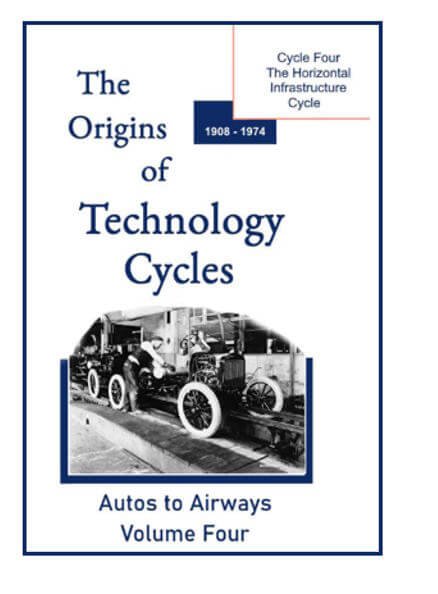
The Origins of Technology Cycles, Volume 4: The Automobile Age
Examining the Core Formation of the Fourth Technological Revolution (1870–1900)
The fourth volume of The Origins of Technology Cycles concentrates on the years 1870–1900, a formative period leading toward the Automobile Age and its 1908 Big Bang, exploring how innovations in transportation, energy, materials, and manufacturing gradually converged to create the foundations of the twentieth-century industrial economy. Building upon Carlota Perez’s theory of technological revolutions, the investigation seeks to understand how seemingly independent technological developments accumulated sufficient momentum to launch an entirely new economic era.
The research identifies six interconnected fields that contributed to the emerging technological core: Automobiles, Oil, Steel, Petrochemicals, Aviation, and Mass Production. Through a chronological reconstruction of developments between 1870 and 1900, the study traces five overlapping phases of Core Formation.
The first phase, Initial Ripples, from 1870 to 1875, witnessed scattered innovations in engine technology, petroleum refining, steelmaking, chemistry, aerodynamics, and precision manufacturing. Developments such as improved internal combustion engines, new steel production techniques, and experiments in powered transportation established capabilities whose eventual relationships were far from obvious. These advances would provide essential components of a much larger industrial transformation.
The second phase, Coalescence to Solve Bottlenecks, from 1875 to 1885, explored how inventors and entrepreneurs began combining technologies to overcome practical limitations. Karl Benz and Gottlieb Daimler advanced the development of motor vehicles, while John D. Rockefeller integrated petroleum production, refining, and distribution. Andrew Carnegie expanded steelmaking through technological improvements and industrial organization. Progress increasingly depended on coordinating developments across several industries.
Between 1885 and 1892, the third phase witnessed the emergence of recognizable new industries. Automobile manufacturing moved toward commercial production, oil exploration expanded geographically, and chemical manufacturers developed increasingly sophisticated industrial processes. Advances in precision machinery and standardized components established the foundations for mass production. Aviation experiments also continued building the scientific understanding necessary for powered flight.
The fourth phase, Imitation and Improvement, from 1892 to 1897, brought growing competition and international diffusion. Automobile manufacturers in Germany, France, and Britain refined engine designs and vehicle construction. Petroleum producers improved drilling and refining techniques, while manufacturers adapted production methods developed in other industries. Innovation increasingly accelerated through imitation, experimentation, and the transfer of knowledge across industrial boundaries.
The final phase, Financial Reorientation, from 1897 to 1900, examined how investment capital began shifting toward emerging industrial enterprises. Automobile manufacturers, petroleum companies, steel producers, and chemical businesses required increasingly large commitments of capital. New corporate structures, industrial financing arrangements, research laboratories, and engineering institutions helped prepare these industries for expansion.
The investigation concludes that the Automobile Age emerged from decades of technological convergence and institutional development. Each innovation created opportunities and bottlenecks that stimulated further advances, gradually transforming separate industries into an interconnected industrial system.
By 1900, important technological, financial, and organizational foundations were in place. Further advances in vehicles, production methods, fuel supply, and commercial organization connected those foundations to the Model T’s introduction in 1908. Ford’s moving assembly line followed in 1913; the River Rouge complex developed later still. These are distinct developments within the expanding automobile revolution.
The central finding reinforces the Core Formation hypothesis: technological revolutions develop through recurring processes of invention, convergence, imitation, industrial organization, and financial mobilization. The Automobile Age provides another historical example of how these forces combine to create the conditions for a new technological revolution.

Completed Core Formation diagram, Cycle 4. The image illustrates how five overlapping phases compress scattered innovations into a more interconnected technological core. Open the original full-size diagram.
Why this story was told. Engines, petroleum, steel, chemicals, aviation research, and manufacturing methods laid the groundwork for the Model T in 1908 and the later spread of mass production. Explore the detailed Core Formation investigation for Cycle 4.
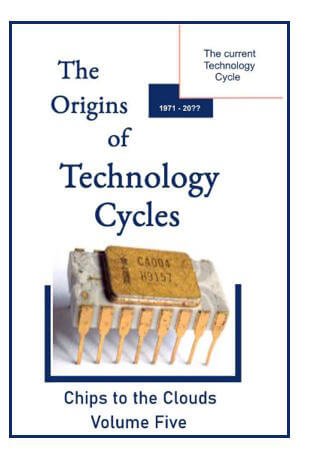
The Origins of Technology Cycles, Volume 5: The Digital Revolution
Examining the Core Formation of the Fifth Technological Revolution (1940–1971)
The fifth volume of The Origins of Technology Cycles examines the approximately three-decade gestation period preceding the Digital Revolution, exploring how advances in computing, semiconductors, telecommunications, software, and networking gradually converged to create the technological foundations of the modern information economy. Building upon Carlota Perez’s theory of technological revolutions, the investigation seeks to understand how these developments accumulated sufficient technological density to launch the fifth great technology cycle.
The research introduces the concept of Technological Density, describing the concentration of complementary innovations, infrastructure, knowledge, and capabilities necessary for a technological revolution to emerge. Through a chronological examination of developments between 1940 and 1971, the study traces how independent scientific discoveries and engineering advances evolved into an increasingly interconnected technological system.
The investigation begins in the 1940s with the emergence of electronic computing. Early machines developed by Konrad Zuse, the British Colossus project, and America’s ENIAC demonstrated the possibilities of automated information processing. The development of stored-program architecture transformed computers from specialized calculating machines into programmable systems capable of performing increasingly complex tasks. Advances in electronic memory and early programming methods established additional foundations for digital computing.
During the 1950s, computing began transitioning from experimental laboratories into commercial enterprises. UNIVAC and IBM demonstrated the growing economic value of computers, while new programming languages such as FORTRAN, LISP, and COBOL expanded their applications across science, engineering, and business. Meanwhile, the invention of the transistor in 1947 and the integrated circuit in 1958 initiated a revolution in electronic miniaturization, improving reliability while dramatically reducing size and cost.
The 1960s witnessed accelerating convergence. Semiconductor improvements enabled smaller, more affordable computers, while developments in operating systems, software engineering, and time-sharing expanded computing capabilities. Telecommunications networks incorporated electronic switching, digital transmission, satellites, and emerging mobile communications. The creation of ARPANET in 1969 demonstrated that computers could exchange information across geographically separated networks, establishing essential foundations for the Internet.
These developments increasingly reinforced one another. More powerful semiconductors made advanced computing possible, while sophisticated software expanded the usefulness of hardware. Improvements in telecommunications enabled distributed computing, and growing demand for digital applications encouraged further investment in electronics and networking. Media technologies, electronic storage, and computer-controlled manufacturing added further capabilities to the emerging technological system.
By 1971, the introduction of Intel’s 4004 microprocessor symbolized the convergence of decades of innovation. Computing, memory, software, and communications had developed into complementary technologies capable of supporting an entirely new industrial paradigm.
The investigation concludes that the Digital Revolution emerged through the systematic accumulation and integration of technological capabilities. Its Core Formation Period produced four reinforcing dimensions of technological density: component, functional, network, and knowledge density.
The central finding extends the Core Formation hypothesis developed throughout the series. Technological revolutions emerge when innovations across multiple industries become sufficiently interconnected to generate sustained, self-reinforcing development. The fifth cycle demonstrates how this process can create the foundations for an economic transformation extending far beyond the industries that initially produced it.

Completed Core Formation diagram, Cycle 5. The image illustrates how five overlapping phases compress scattered innovations into a more interconnected technological core. Open the original full-size diagram.
Why this story was told. Semiconductors, computing, telecommunications, software, networks, and manufacturing accumulated complementary capabilities that found a defining commercial expression in the 1971 microprocessor. Explore the detailed Core Formation investigation for Cycle 5.
The Common Finding
Across all five studies, the same broad process appears: inventions create new possibilities; bottlenecks encourage integration; industries take shape; imitation spreads and improves the new capabilities; and financial and organizational investment helps the system expand. The diagrams depict these relationships as Innovation Mass Compression, while the five defining Big Bang moments mark the emergence of a commercially transformative technological paradigm.
The research offers a historical hypothesis rather than a physical law. Its purpose is to make the gestation period visible, so that the origins of technological revolutions can be examined as carefully as their later economic consequences. Explore Carlota Perez’s five technological revolutions or return to the Technology Cycles home page.
ChatGPT edited the output of TYPE.AI’s work to build this webpage in through high level summaries.