

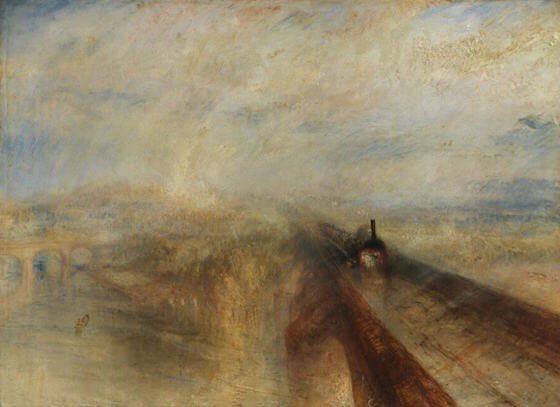
J.M.W. Turner: Rain, Steam, and Speed – The Great Western Railway – 1844
Railways Impact – from the National Gallery (London)
Catalogue commentary by Judy Egerton, from The British Paintings (National Gallery, London, 2000).
‘The railways have furnished Turner with a new field for the exhibition of his eccentric style’, remarked The Times when he exhibited this picture at the Royal Academy in 1844. Turner specified ‘The Great Western Railway’ in its title and, from over one hundred miles of that line which had been constructed by 1844, chose a train crossing Maidenhead Railway Bridge as its focal point.
Turner is likely to have been familiar with some of the many contemporary engravings described by McCoubrey as representing roadbeds and trains ‘cutting diagonally across panoramic landscapes by means of heroic engineering’.1 Gage 1972 reproduces T.T. Bury’s View of the Railway across Chat Moss, 1831,2 which depicts a train running across a Lancashire peat-bog (on a track which was one of George Stephenson’s engineering triumphs) at a diagonal angle much like Turner’s train. A lithograph entitled The Lickey Inclined Plane, Birmingham and Gloucester Railway, published in 1840 (fig. 3),3 is even closer to Turner’s painting; but as he observes, while such documentary scenes may have provided ‘a certain pictorial dynamism’,4 Turner’s imagination worked on them to paint ‘much more than a particular crossing of the Thames by the Great Western Railway’.5
Something very close to this form of ‘pictorial dynamism’ had in fact been apparent in Turner’s work long before he painted Rain, Steam, and Speed. In his lectures as Professor of Perspective at the Royal Academy, first given in 1811, he discussed the potential of parallel perspective, whose principles he had taught himself through studying Poussin and Claude. In parallel perspective, horizontal lines perpendicular to the picture plane converge to a vanishing point known as the perspective centre point, which is always directly opposite the artist’s eye (though not necessarily in the centre of the picture);6 as Turner observed, it ‘gives plainness, elevation, simplicity, and lines: frequently grandeur’.7 He had used parallel perspective to good effect over the years;8 he was to employ it to particularly striking effect in several pictures painted only a few years earlier than Rain, Steam, and Speed, each with very different subject matter. The version of The Burning of the Houses of Lords and Commons, 16th October 1834 exhibited at the British Institution in 18359 depicts Westminster Bridge in dramatically foreshortened perspective, slanting across the right half of the picture. Juliet and her Nurse (fig. 6),10 exhibited in 1836, prefigures the composition of Rain, Steam, and Speed still more closely, the scenic differences between Venice and Maidenhead hardly obscuring the fact that in both pictures a bridge thrusts sharply into the bottom right corner of the picture and allows views on either side. Even closer in date to Rain, Steam, and Speed – in a sense almost a rehearsal for it – is Bellinzona from the Road to Locarno (fig. 1), a finished watercolour painted in 1843, based on a sample study of a year or so earlier. Here an ‘un-picturesque’ but impressive modern bridge thrusts across the river Ticino with much the same diagonal force as the Maidenhead Railway Bridge in Rain, Steam, and Speed, probably painted at about the same time. From Bellinzona to Berkshire was no great distance for Turner’s imagination.
Whether Turner’s picture was directly inspired by a recent journey on the Great Western Railway (GWR) must remain conjectural. By 1844, he could have been travelling on the GWR for six or seven years. He may (or may not) have been travelling to London on that line on a night of storm in June 1843. During the small hours of the next morning (according to an account written down at Ruskin’s request some years later),11 Jane O’Meara then a young girl of about eighteen (later Mrs. John Simon) – boarded the train, and found herself in a first-class carriage with two elderly gentlemen. One of them (‘with the most wonderful eyes I ever saw, steadily, luminously, clairvoyantly, kindly, paternally looking at me’) took a keen interest in the storm which was still raging when they reached Bristol; during a ten-minute stop there, he asked her permission to put down the window and leaned out of it for ‘nearly nine minutes’, regardless of being drenched by torrents of rain. As the train moved on, he ‘leant back with closed eyes for I daresay ten minutes’. She remained unaware of his identity until, seeing Rain, Steam, and Speed in the next Royal Academy exhibition, she deduced that her fellow-passenger had been Turner.12
Her story is quoted, partially and sceptically, in almost every account of Rain, Steam, and Speed. It deserves fuller and fairer examination, if only because Ruskin was sufficiently convinced of its veracity to encourage Mrs Simon, whom he knew and trusted, to write down her recollection for him as fully as possible.13 Ruskin calls it ‘a sketch from life’; published in his Dilecta (correspondence etc. which he collected in 1886), it occupies three and a half closely printed pages, too long to be quoted here in full.14 Mrs Simon does her best to recollect two different things: her journey, about which she is very clear, and Turner’s picture, about which she is not clear. Each stage of her own journey on that stormy night in June 1843 is accurately related: she had been staying at Plymouth, intending to travel by boat to Southampton to meet her fiancé, but having missed the boat, took a horse-drawn coach to Exeter at 2 pm, arriving there at 8 pm; she continued in that coach as far as Beambridge (near Wellington), but by that time the storm was so fierce that coaching was unsafe, and she got out and waited in ‘the shed which served as a station’ for the next train.15 When it arrived, she got into a first-class carriage, and there found ‘Turner’ and his companion, who had boarded the train (evidently not an express) at Exeter.16 When ‘Turner’ gazed at the storm through a carriage-window, it was during a ten-minute stop at Bristol. By the time they reached Swindon, the storm was over; the train stopped there long enough for passengers to get out to buy refreshments (‘My friend with the eyes said: “Tea! poor stuff; you should have had soup” ’). After that her companions dozed, while she watched the dawn of a bright day. At 6am they ‘steamed into Paddington station’
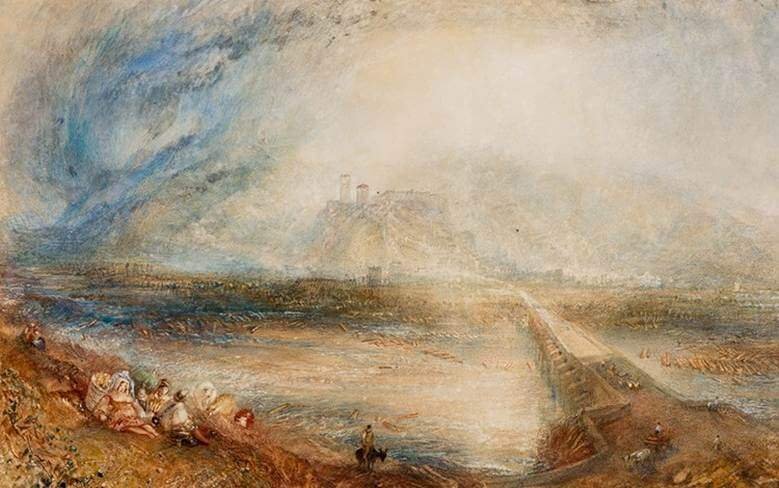
Fig. 1
Bellinzona from the Road to Locarno (Switzerland), 1843. Watercolour, with scraping-out, on paper, 29.3 × 45.6 cm. City of Aberdeen Art Gallery and Museums Collections. © City of Aberdeen Art Gallery and Museums Collections.
These facts are clear enough. It is the disparity between her account of the storm which she and ‘Turner’ watched during the night (‘torrents of rain’ and ‘a chaos of elemental and artificial lights and noises’) and the picture which she saw the next year in the Royal Academy exhibition which has caused doubts about her story. She stood in front of Turner’s picture in the Royal Academy exhibition and remarked: ‘I was in the train that night, and it is perfectly and wonderfully true’; yet in Turner’s picture passing showers alternate with gleams of sunlight. But what Turner chose to make of his picture need not have been tied to what any co-witness of that long journey saw and chiefly remembered about it.
If Mrs Simon’s circumstantial account of her journey is of no other use, it serves as a reminder of how long-drawn out and uncertain travel could be in the 1840s. Travel by train did not abolish hazards and delays, but it diminished them. Turner had all his life been a traveller in search of fresh material. He had adapted from the 1820s to travelling by steamboats at home and abroad; he is unlikely to have ignored the advantages of locomotives. His choice of the Maidenhead stretch of the GWR for the setting was probably governed by the presence of the new yet noble bridge17 which served as viaduct for the railway. The prefix Great in the name of the GWR may have influenced his choice, since it gave the picture’s title additional force. Though the prefix Great was not peculiar to the GWR (it was also used in the names of the Great North of England Railway, and even of the Great Leinster & Munster Railway), the ‘greatness’ of the GWR was undisputed in 1844. A German visitor called it ‘the most perfect and splendid railroad in Great Britain’, with its ‘roads and carriages … of astonishing dimensions’ and its ‘gigantic locomotives’.18 The Great Western Railway Company, though not the first to be formed, was foremost in 1844, having single ownership of the longest main line in the kingdom. It also had the advantage of the dynamic energies of Isambard Kingdom Brunel (1806–59), a prodigy who had been appointed engineer of the projected Great Western in 1833, at the age of 27, the same age at which Turner had been elected RA .19 While the track was being constructed, using Brunel’s pioneering broad gauge (7 ft), Brunel designed and built the Maidenhead Railway Bridge; built of brick, its two great arches each with a span of 128 feet were the largest and flattest that had (and possibly have) ever been constructed. The bridge was one of the wonders of the day.20 The first London–Maidenhead section of the line opened to the public on 4 June 1838, with four trains running each way on weekdays and three on Sundays.21 Queen Victoria herself took her first journey by train on the GWR in 1842, travelling from Slough (the nearest station to Windsor Castle) to Paddington, there to be greeted by ‘deafening’ demonstrations of loyalty, writing afterwards to her uncle Leopold, King of the Belgians, that she had arrived ‘in half an hour, free from dust and crowd and heat’, ‘quite charmed’ by the railway.22 The line was steadily extended westwards, reaching Bristol in 1841 and Exeter in May 1844.
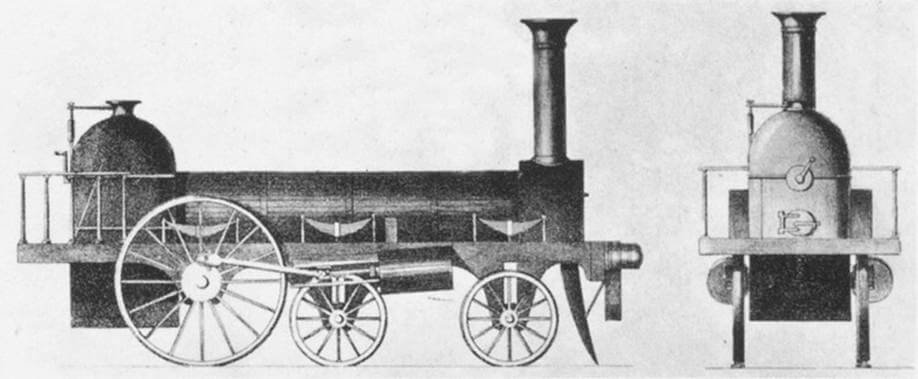
Fig. 2
Ixion, from the Firefly class of broad-gauge engines designed for the GWR in 1841. Detail from an engraving of 1841–2.
Turner’s train is proceeding from London towards the West of England, along what in fact is a double track, though he chooses not to show it as double. The engine is one of the ‘Firefly’ class23 designed for the Great Western Railway by Daniel Gooch, another prodigy, appointed locomotive engineer to the GWR at the age of 21. By 1844 there were 62 engines of the ‘Firefly’ class in operation on the GWR; ‘unsurpassed for general excellence and economy of working’, each of them had a name suggestive of super-human power embossed in bold letters on a brass plate on its side.24 Turner’s (unidentified) engine would have looked more or less exactly like Ixion, ‘Firefly’ class of 1841 (fig. 2), built in Leeds. Turner has deliberately chosen to show his engine drawing a train of open-goods wagons, in which ‘persons in the lower stations of life’ were allowed, on sufferance, to travel at a cheap rate (those who could afford the first-class fare travelled in passenger coaches, and second-class passengers travelled in coaches which were roofed, though low-sided and open to the weather).25 The average speed on the Great Western in 1844 was 33 mph, but on the long level stretch between Paddington and Swindon, on which the Maidenhead Railway Bridge is situated, the Great Western expresses could reach 55–60 mph.26
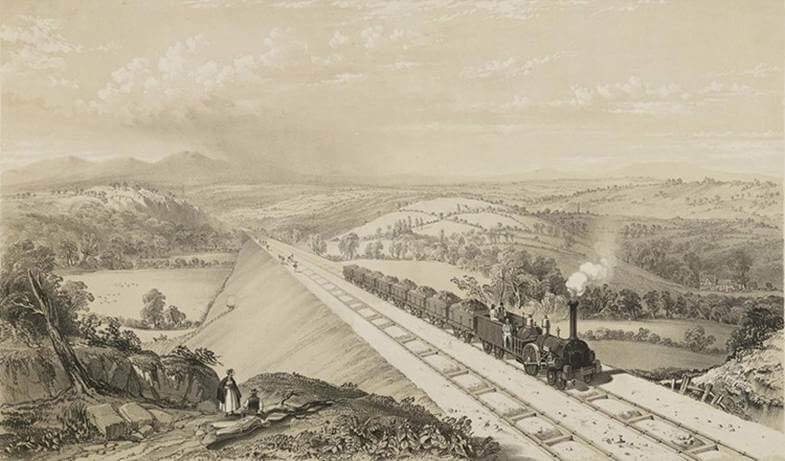
Fig. 3
F.J. Dolbey, engraved by (?) E.T. Dolbey, The Lickey Inclined Plane, on the Birmingham-Gloucester railway line, c. 1840. Lithograph. Science Museum Group © The Board of Trustees of the Science Museum
John Gage 1972 does well to remind us that ‘as the title of the picture makes clear, Turner was painting not a view of the Great Western Railway, but an allegory of the forces of nature’.27 Rain falls steadily through this picture, though not heavily enough wholly to obscure gleams of sunshine which fall on woods and fields on either side of the bridge. Steam is a minor yet (in vapourish form) pervasive element in the picture. The great heads of steam emitted by railway trains in popular prints were not attained by trains in 1844. Turner more accurately represents his ‘Firefly’ engine putting out three smallish and evenly spaced puffs of smoke, slightly discoloured now, but never as conspicuous as they are in Brandard’s engraving (fig. 5). The progress of a typical train of the period was described by the engineer Sir Francis Head as ‘marked by white steam meandering above it and by red-hot coals of different sizes occasionally falling from beneath it’.28 Speed is primarily represented by the train itself, counter-pointed by two small but telling details of unmechanised activity.
The first of these is a hare, running along the track ahead of the train. The hare was not part of the original conception of the picture. Lightly brushed in on top of the existing paint of the railway track, it was a late addition. Because its paint has sunk into the paint of the track beneath it, it has long been almost invisible, even photography under magnification producing only a blurred image of it.29 It is Brandard’s engraving of the picture (more fully discussed below) which has largely preserved the image of the hare in the collective memory. Brandard, carrying out a self-imposed duty of clarifying Turner’s details, gave the hare firm definition and, for good measure, invented its shadow, which does not appear in the painting. In defining the hare, he seems (paradoxically) to have given it much the same shape as the hound coursing a hare in Turner’s Apollo and Daphne,30 which his younger brother and pupil Edward was engraving at the same date.
The hare is unlikely to be overtaken by its strange pursuer, nor does Turner intend that it should be. He was sufficiently familiar with Thomson’s The Seasons to recognise the reproach in the line ‘Poor is the triumph o’er the timid hare!’31 Gage is surely right in believing that Turner painted in the hare ‘jocularly as an emblem of speed’, and in adding that ‘no hare was likely to be outpaced by any locomotive of this period’.32 Had Turner intended his picture to prompt thoughts of imminent danger to life of any sort (and there had been accidents enough on the GWR and other lines to warrant some such hint), he would surely have introduced a more forceful (and premeditated) symbol.33
The nine-year-old George Leslie (son of Charles Robert Leslie RA ), who was allowed to watch Turner at work on Varnishing Day, 1844, recollected seventy years later that Turner ‘talked to me every now and then, and pointed out the little hare running for its life in front of the locomotive on the viaduct’.34 According to Leslie, it was ‘the hare, and not the train’ which Turner intended to represent the Speed of his title, and ‘the word [“Speed”] must have been in his mind when he was painting the hare, for close to it, on the plain below the viaduct, he introduced the figure of a man ploughing, “Speed the plough” (the name of an old country dance) probably passing through his brain.’35 The man driving a horse-drawn plough, a small but vivid detail in the foreground on the right, offers a second contrast to the train’s mechanised progress. Here, knowing just what he wanted to achieve, Turner brushed in an image of strenuous effort which, even on a small scale, shows that the going is hard. Brandard translates this into a rustic vignette which might have been taken from W.H. Pyne’s Microcosm: or a Picturesque Delineation of the Arts, Agriculture, Manufactures &c of Great Britain.36
Rain, Steam, and Speed is the work of a painter in his seventieth year who had never averted his eyes from contemporary life. Paintings such as Staffa, 1832; The Burning of the Houses of Parliament, 1834; Keelmen heaving in Coals by Night, 1835; The Fighting Temeraire, 1839; Snow Storm – Steamboat off a Harbour’s Mouth, 1842, and the Whaling pictures of 1845–6, all testify to his readiness (in Andrew Wilton’s phrase) to ‘make an entirely contemporary picture about the visual splendour of his own world’.37 The assumption that because Turner was an artist he ‘must have’ deplored industrialisation is one which Ruskin repeatedly but wrongly made. As Gage observes, Ruskin could not bring himself to write one word about Rain, Steam, and Speed: when asked in conversation why Turner had chosen to paint a steam engine, he replied shortly ‘To show what he could do even with an ugly subject.’38 And yet, as Gage points out, ‘there is nothing to suggest that Turner felt that the train and bridge were ugly’.39 Others have construed Rain, Steam, and Speed as Turner’s protest that the railway had invaded and must despoil the countryside.40 It is true that Turner had known and painted this stretch of the Thames for forty years, exploring the river by boat as well as its hinterland by horse, once remarking that it could show finer scenery than any river in Italy. But at no point of his life was Turner a reactionary. The inclusion in his picture of the old thirteen-arch Maidenhead bridge, completed around 1780, and now receding in the background, may deliberately allude to the fact that nothing will turn the clock back. Nor does Turner – who had painted all aspects of travel, in Britain and on the Continent – suggest that this would be desirable. It is likely that he took to trains as he had taken to steamboats, relishing the fact that they made travel easier and quicker. Without a steamboat such as Maid of Morven, could Turner have painted Staffa?41 or so easily have explored the Seine?
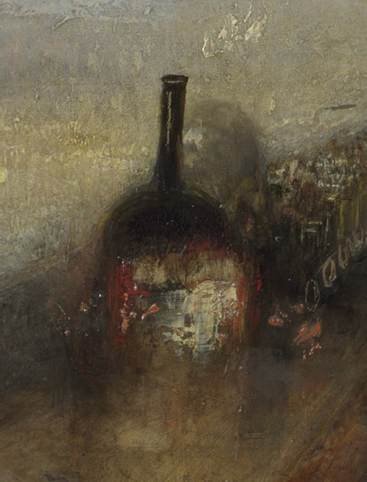
Fig. 4
Rain, Steam, and Speed, detail (© The National Gallery, London)
Not everyone saw the railways as a form of progress. ‘Hear ye that whistle?’ Wordsworth asked prophetically, envisaging a ‘long-linked Train’ sweeping onwards to destroy the beauty and ‘beloved retreats’ of Britain; and in a series of communications to the Editor of the Morning Post during 1844 he opposed the projected Kendal and Windermere Railway.42 Ruskin supported him, and (at his most young-fogeyish) wrote that ‘Going by railway I do not consider as travel at all; it is merely being “sent” to a place, and very little different from becoming a parcel.’43 Wordsworth, Ruskin and many others of the social class which they had attained were élitists, wanting to reserve the beauty of the countryside for ‘the meditative few who have inherited by nature, or derived from education, a taste for the beautiful’.44
Dickens gave to Mr Dombey (in Dombey and Son, first published in instalments, 1846–8)45 a tortured vision of the railway train as ‘a type of the triumphant monster, Death’. Most of this hectic passage (with its reiterated ‘Away, with a shriek, and a roar, and a rattle…’) is too well-known to need quotation here. Attention should rather be drawn to one of its less sensational descriptions of the train, since it may be based on Dickens’s recollection of Turner’s picture: ‘Breasting the wind and light, the shower and sunshine, away, and still away, it rolls and roars, fierce and rapid, smooth and certain, and great works and massive bridges crossing up above, fall like a beam of shadow an inch broad upon the eye, and then are lost…’
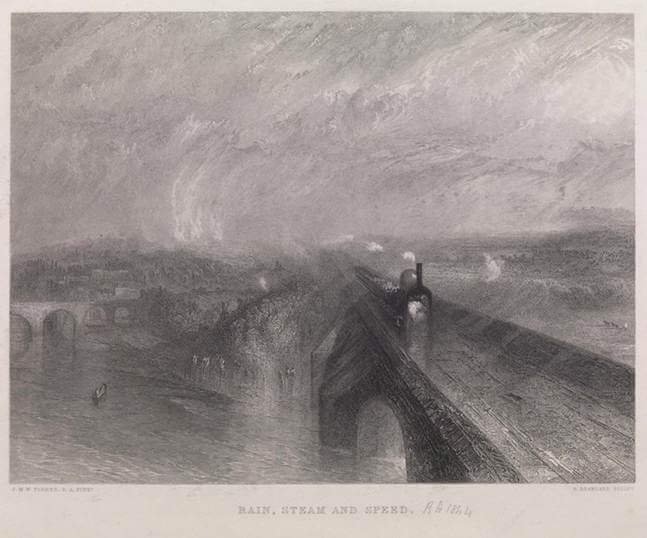
Fig. 5
Rain, Steam, and Speed, engraved by Robert Brandard, 1859.
The atmospheric effects diffused throughout the picture by rain, fitful sunlight and the vapour of steam mean that details are deliberately obscured. Brandard’s engraving of 1859 (fig. 5) does its best to clarify them. During Turner’s lifetime, Brandard had engraved many of his pictures, working under the artist’s supervision and to his satisfaction.46 After Turner’s death, he was one of the ‘Turner school’ of engravers who were commissioned to engrave 60 plates for publication as The Turner Gallery, issued in sets between 1859 and 1861, with letterpress by Ralph Wornum, Keeper of the National Gallery (later reissues had different authors’ texts).47 Brandard was given eight pictures to engrave, including two of the most difficult (because most atmospheric) subjects: Rain, Steam, and Speed and Snow Storm – Steam Boat off a Harbour’s mouth, making signals in shallow water, and going by the lead. The author was in this storm on the night the Ariel left Harwich.48 In each case he took pains to define details which Turner (who once reputedly said ‘Indistinctness is my forte’) had deliberately left undefined.
In Rain, Steam, and Speed, almost every detail is indistinct except for the engine itself, whose forward rush is expressed, as Jack Lindsay observed,49 by ‘making the engine darker in tone and sharper in edge than any other object, so that it shoots out in aerial perspective ahead of its place in linear perspective’. This onrushing sensation is lessened by the engraving. Within the limits of monochrome, and with the artist’s guidance no longer available, Brandard did his best; but he sharpens details in a manner which Turner may or may not have approved. In Turner’s painting, the figures on the river-bank are indistinct, and have sometimes been thought to be locals, waving at the train, as if this spectacle was still quite novel; in the engraving, the figures (of which there are at least twelve) appear to be almost Claudian, and not waving but dancing,50 and not one of them looks at the train. Turner’s undulating golden mass behind the figures is interpreted in the engraving (probably correctly) as a thickly wooded hillside, from which a thin stream of smoke rises (roughly level with the centre of the train); a larger plume of smoke rises from the woods on the other side. Before Turner’s picture became discoloured, this smoke rising on either side would have helped to balance the puffs of smoke from the engine. The engraver has seemingly edited out the ‘persons’ (or the illusion of persons) travelling in the wagons, which now appear to be full of coal. The structure of the ‘old’ bridge51 has been clarified, and substantial houses have become visible behind it.
The bright flames generating energy within the engine’s boiler contrast insistently with the soft drizzle outside. Robert K. Wallace 1988 observes that this contrast was to be powerfully echoed in Whalers (boiling Blubber) Entangled in Flaw Ice,52 another contemporary subject exhibited two years later, in 1846; the detail he reproduces of the ‘pure, lurid light of the red frontal flame’ on the whaling ship’s deck vividly recalls the ‘Firefly’ engine’s fire. Whether or not Turner correctly located the fire seemingly occupying half his engine’s boiler was to be disputed: the Morning Chronicle wondered ‘how engine fires blaze where no one ever saw them blaze’.53
Turner showed seven pictures at the Royal Academy in 1844.54 The Morning Chronicle of 8 May 1844 described Rain, Steam, and Speed as ‘the most insane and the most magnificent’ of them.55 Writing under the pen-name ‘Michael Angelo Titmarsh’, Thackeray in Fraser’s Magazine combines admiration with a mock-analysis of Turner’s palette which parodies all ‘Technical Notes’ :56 As for Mr. Turner, he has out-prodigied almost all former prodigies. He has made a picture with real rain, behind which is real sunshine, and you expect a rainbow every minute. Meanwhile, there comes a train down upon you, really moving at the rate of fifty miles an hour, and which the reader had best make haste to see, lest it should dash out of the picture, and be away up Charing Cross through the wall opposite. All these wonders are performed with means not less wonderful than the effects are. The rain, in the astounding picture called ‘Rain – Steam – Speed’, is composed of dabs of dirty putty slapped on to the canvass with a trowel; the sunshine scintillates out of very thick, smeary lumps of chrome yellow. The shadows are produced by cool tones of crimson lake, and quiet glazings of vermilion. Although the fire in the steam-engine looks as if it were red, I am not prepared to say that it is not painted with cobalt and pea-green. And as for the manner in which the Speed is done, of that the less said the better, – only it is a positive fact that there is a steam-coach going fifty miles an hour. The world has never seen anything like this picture. Turner’s ‘railway picture’ amazes us because of his choice of subject and his treatment of it. Railway travel itself was not new in 1844, but a representation of it hanging ‘on the line’ in the Royal Academy was. The public at large quickly grew accustomed to railways. Six years after Turner’s painting was exhibited, the engineer and author Sir Francis Head wrote:57 When railways were first established, every living being gazed at a passing train with astonishment and fear: ploughmen held their breath: the loose horse galloped from it, and then, suddenly stopping, turned round, stared at it, and at last snorted aloud. But the ‘nine days’ wonder’ soon came to an end. As the train now flies through our verdant fields, the cattle grazing on each sides do not even turn their heads to look at it… It is the same with mankind. On entering a railway station, we merely mutter to a clerk in a box where we want to go – say ‘How much?’ – see him horizontally poke a card into a little machine that pinches it – receive our ticket – take our place – read our newspaper – on reaching our terminus drive away perfectly careless of all or any of the innumerable arrangements necessary for the astonishing luxury we have enjoyed.Sun, Wind and Rain, a large watercolour by David Cox, painted the year after Turner’s picture was exhibited and now one of his best-known works, pays direct homage to Turner in its title and atmospheric effects, acknowledging the debt with the inclusion of a distant train.58 A version in oil now known as Rain, Wind and Sunshine, dated 1845, is in Aberdeen Art Gallery. Cox’s oil of Calais Pier painted in emulation of Turner is noted under NG 472 (p. 265). But as Gage observes, Rain, Steam, and Speed had a more significant effect after Turner’s death, and in France. Claude Monet and Camille Pissarro would have seen it during their visit to London in 1870–1, and were perhaps thereby encouraged to paint similar subjects (see Gage 1972, figs. 45–7, 49–50), at first treated more realistically (Monet told a critic that Turner was ‘antipathetic to him because of the exuberant romanticism of his fancy’59), later more atmospherically. In composition, Monet’s Railway Bridge at Argenteuil,60 painted in 1875, most evidently recalls Turner’s picture; but the atmospheric legacy of Rain, Steam, and Speed is more potently expressed in his Gare St Lazare61 of 1877. Paul Signac, who called his visit to London in 1898 a ‘pilgrimage to Turner’, made several visits to the National Gallery, including what he called in his diary for 29 March 1898 ‘a serious visit to Turner’, noting that from 1834 ‘he frees himself from black and looks for the most beautiful colorations; colour for colour’s sake’. Later, in a letter to his friend Angrand, he singled out a group of paintings by Turner in the National Gallery, including Rain, Steam, and Speed, the Deluge pair and The Exile and the Rock Limpet, for this comment: ‘These are no longer pictures, but aggregations of colours (polychromies), quarries of precious stones, painting in the most beautiful sense of the word.’62
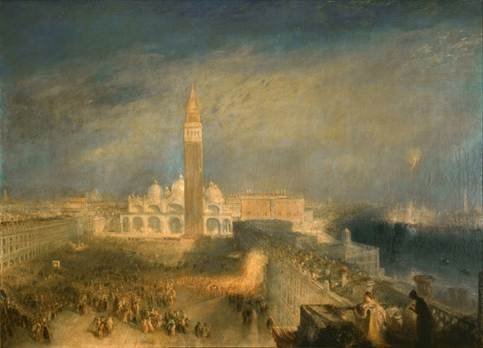
Fig. 6
Juliet and her Nurse, exhibited 1836. Oil on canvas, 92 × 123cm. Buenos Aires, Colección Amalita / Fundación Amalia Lacroze de Fortabat
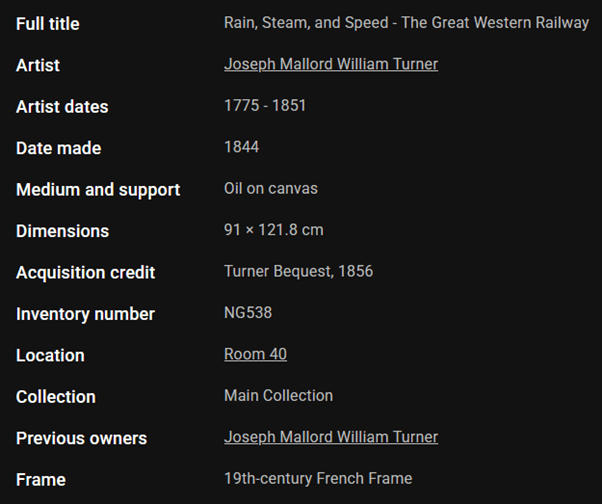
Painting information at
Painting information at the National Gallery London (located in Trafalgar Square).