
The Birth of Impressionism
On April 15, 1874, a small group of artists opened an independent exhibition in the former Paris studio of photographer Nadar. Their paintings looked unlike anything the French artistic establishment was accustomed to seeing. Landscapes dissolved into flickering brushstrokes. Shadows appeared in blues and violets rather than blacks and browns. Ordinary people, railway stations, rivers, gardens, and city streets replaced the grand historical and mythological subjects that had dominated European painting for centuries.
Critics ridiculed the exhibition. One sarcastically borrowed the title of Claude Monet’s Impression, Sunrise to describe the artists as “Impressionists.” The insult became the name of a movement that would transform Western art.
Yet the revolution that emerged in Paris had been developing for decades. Its origins reached back to the Industrial Revolution, when steam engines, railways, industrial chemistry, and new manufacturing techniques began transforming both the world artists observed and the tools with which they painted.
Impressionism was an artistic revolution forged within a technological one.
A World Transformed by Steam and Rail
The Second Technology Supercycle, driven by steam power, railways, and industrial manufacturing, transformed European society throughout the nineteenth century. Cities expanded, factories multiplied, and railroads cut across landscapes that had remained largely unchanged for generations.
These developments altered the experience of everyday life. A journey that once required days by horse or carriage could be completed in hours. Railways made previously distant landscapes accessible to millions of people. Industrial cities introduced unfamiliar arrangements of buildings, machinery, smoke, artificial lighting, and human activity.
Artists were witnessing an extraordinary transformation in the physical world, and some began searching for new ways to represent it.
Few painters responded more dramatically than the English artist J. M. W. Turner.
Born in 1775, Turner lived through the transformation of Britain from an overwhelmingly agricultural society into the world’s leading industrial nation. His paintings increasingly explored the relationship between light, atmosphere, movement, and the industrial technologies reshaping the landscape.
In Rain, Steam, and Speed – The Great Western Railway (1844), a locomotive races toward the viewer across the Maidenhead Railway Bridge. The engine, capable of speeds approaching 60 miles per hour, emerges from a swirling atmosphere of rain, sunlight, and steam.
The landscape seems almost to dissolve around the oncoming train.
Turner was attempting to capture the experience of a world being transformed by machines. Instead of carefully delineating every object, he allowed light, color, and atmosphere to dominate the composition. The physical world remained recognizable, but its boundaries became increasingly uncertain.
His paintings offered an extraordinary preview of the artistic developments that would follow.
The Industrial Revolution Enters the Artist’s Paintbox
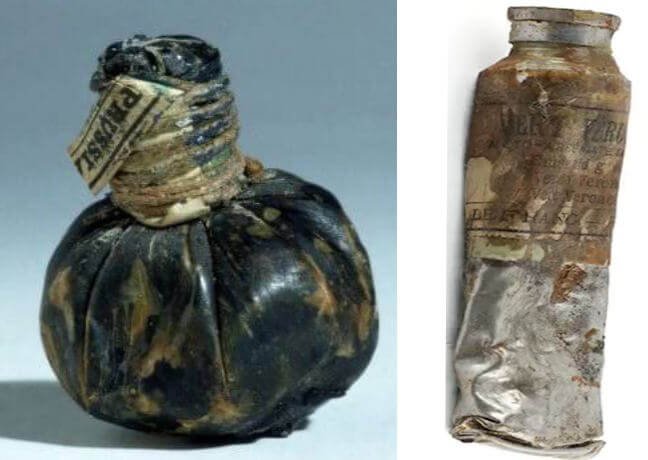
While Turner was exploring the visual effects of industrialization, another technological transformation was taking place inside the artist’s studio.
For centuries, painters had relied upon pigments derived from minerals, plants, insects, and other natural substances. Many colors were expensive, difficult to manufacture, or chemically unstable. Artists frequently ground pigments themselves and mixed them with oils to produce usable paint.
The Industrial Revolution changed that process.
Advances in chemistry and industrial manufacturing introduced new pigments and made existing colors more widely available. Prussian blue, cobalt blue, chrome yellow, synthetic ultramarine, and zinc white dramatically expanded the possibilities of the painter’s palette. These developments were particularly important to artists interested in representing natural light. A growing range of blues, greens, yellows, and whites allowed painters to experiment with color combinations that had previously been difficult or prohibitively expensive.
The invention of the collapsible metal paint tube provided another transformation. In the photo above – a pig’s bladder is shown on the left and the new paint tube is on the right.
In 1841, American painter John Goffe Rand patented a method of storing prepared oil paints in squeezable metal tubes. Previously, artists frequently kept mixed paints in animal bladders that were difficult to transport, open, and reseal. Manufactured paint tubes made colors portable, convenient, and increasingly accessible. Artists could carry their materials into fields, forests, villages, and along riverbanks without the complicated preparations traditionally associated with oil painting.
Painting outdoors was already an established practice, but industrially manufactured paints made it considerably easier.
The consequences would be revolutionary.
Painting Leaves the Studio
During the early nineteenth century, French landscape painters had begun challenging the conventions of academic painting.
Artists associated with the Barbizon School, including Jean-Baptiste-Camille Corot, Théodore Rousseau, and Jean-François Millet, traveled into the countryside to study nature directly. Working around the Forest of Fontainebleau, they gave landscapes and ordinary rural life an importance that academic tradition had generally reserved for historical or religious subjects.
Their approach helped prepare the ground for Impressionism.
Another crucial influence was Eugène Boudin, whose paintings of the Normandy coast explored constantly changing skies, clouds, and coastal light.
In the late 1850s, Boudin befriended a young artist named Claude Monet in Le Havre. He encouraged Monet to work outdoors, observing the landscape directly rather than relying entirely upon sketches and memories reconstructed in a studio.
Monet discovered that light was never stationary. Colors changed as clouds passed overhead, shadows shifted, and sunlight moved across water and buildings.
A landscape painted at nine in the morning could look dramatically different by afternoon.
Capturing these changes demanded a new technique. Artists needed to work quickly, applying colors directly while the conditions they observed still existed.
The availability of portable paints and an expanding industrial palette helped make this approach practical.
The Impressionists would eventually transform these outdoor experiments into an entirely new language of painting.
Alfred Sisley and the English Connection
One of the most intriguing connections between English landscape painting and the emerging French Impressionists came through Alfred Sisley. Born in Paris in 1839 to English parents, Sisley was raised in France but retained British citizenship throughout his life. In 1857, his family sent him to London to study business, expecting him to pursue a commercial career.
Instead, Sisley developed an increasingly serious interest in painting.
During his years in England, he encountered the landscapes of Turner and John Constable. Their treatment of atmosphere, weather, and the changing effects of natural light left a lasting impression on the young artist.
When Sisley returned to Paris, he abandoned his intended business career and entered the studio of Charles Gleyre. There, in the early 1860s, he met three other young painters: Claude Monet, Pierre-Auguste Renoir, and Frédéric Bazille.
The friendships formed among these students became central to the emergence of Impressionism.
They studied together, exchanged ideas, and increasingly questioned the artistic conventions they were being taught. They also ventured into the countryside to paint directly from nature, examining how changing light altered the appearance of familiar landscapes.
Sisley’s exposure to English landscape painting provided an important connection to the artistic innovations already underway across the English Channel.
Long before the Impressionists became a recognized movement, these young painters were developing a shared interest in the relationship between atmosphere, color, and direct observation.
Paris Becomes a Modern Industrial City
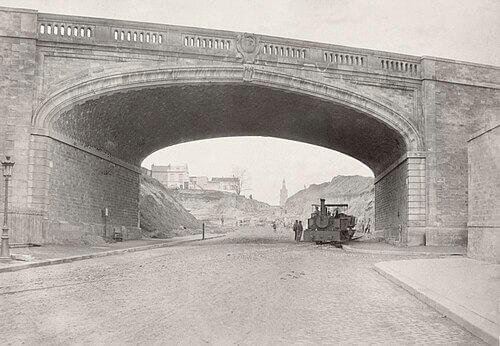
Pictured above is a photograph of Charles Marville from 1853. He took photos of the reconstruction of Paris. In the photo, under the bridge is an early French steam engine. Photography’s rapid maturation in being able to create images representing the world was pushing artists, like the Impressionists to create something which photography could not. This was a major technological driver for the rise in Impressionism.
The physical transformation of Paris provided another essential ingredient in the development of Impressionism. Between 1853 and 1870, Napoleon III and Baron Georges-Eugène Haussmann undertook an enormous reconstruction of the French capital. Old neighborhoods gave way to broad boulevards, parks, railway stations, modern buildings, and new public spaces. Railways connected the city to rapidly developing suburbs and leisure destinations along the Seine.
The changing urban environment created an expanding range of subjects for artists. Parisian life increasingly unfolded in public. Cafés, theaters, parks, dance halls, and railway stations became gathering places for a growing urban middle class. The railways also made excursions into the countryside and suburban river resorts accessible to people who previously could not easily reach them.
Artists followed.
At Argenteuil, Bougival, Chatou, and other communities along the Seine, painters discovered a fascinating convergence of traditional landscapes and modern industrial life. Sailboats shared the waterways with steam-powered vessels. Railway bridges crossed quiet rivers. Factory chimneys appeared beyond gardens and fields.
The industrial landscape had become part of ordinary life.
These subjects were particularly attractive to the emerging Impressionists because they offered opportunities to study the changing effects of sunlight, reflections, movement, and atmosphere.
Technology was shaping both the places they visited and the scenes they chose to paint.
The First Impressionist Experiments
By the late 1860s, the artistic ideas that would define Impressionism were becoming increasingly visible.
In the summer of 1869, Monet and Renoir painted together at La Grenouillère, a popular bathing and boating resort on the Seine.
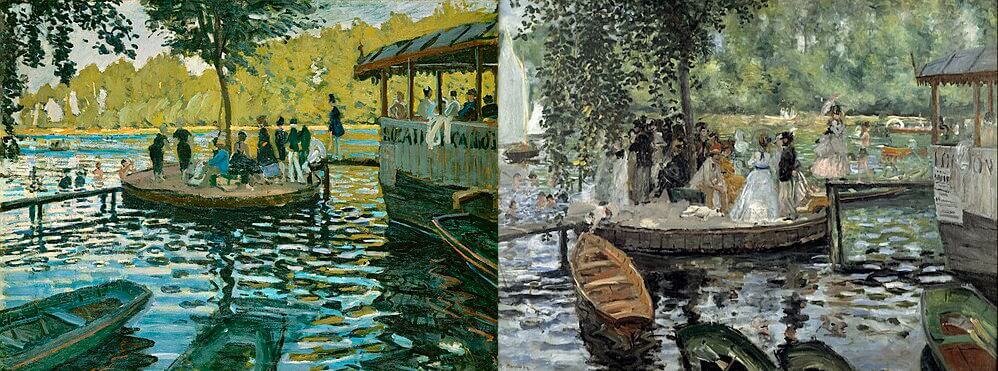
Monet’s painting of La Grenouillère (left) is shown alongside Renoir’s depiction of the same scene (right). The greatest contribution of the Technology Supercycles since the onset of the Industrial Revolution was the creation of an ever-expanding middle class. This transformation helps explain why Monet and Renoir chose this subject.
Working side by side, they sought to capture sunlight dancing across moving water, reflections shimmering around boats, and the vibrant colors of a growing middle class enjoying a remarkable new privilege: leisure time. For the first time in history, ordinary people were increasingly able to spend their free time relaxing along riverbanks, boating, swimming, and socializing. Previously, such opportunities had been largely reserved for a tiny privileged class, primarily the aristocracy and high-ranking church officials, who together represented roughly 5% of the population.
Monet and Renoir were capturing more than the changing effects of light and color. They were painting the emergence of an entirely new way of life made possible by the Industrial Revolution.
Their paintings represented a dramatic departure from traditional academic technique.
Rather than carefully blending every color into a smooth surface, they applied visible brushstrokes, placing distinct colors beside one another. The viewer’s eye combined these strokes into an impression of movement, light, and atmosphere.
The technique was particularly effective when depicting water, foliage, and sunlight.
These paintings reveal something remarkable about the emerging movement. The artists were beginning to treat the changing appearance of the world as an artistic subject in its own right.
They were interested in what the eye experienced at a particular moment.
The industrially expanded palette and portable paint tube helped support these experiments, allowing artists to respond more directly to the world before them.
Turner, Monet, and Pissarro in England
The Franco-Prussian War of 1870–1871 created another important connection between English painting and the future Impressionists.
Claude Monet and Camille Pissarro fled France and sought refuge in England.
In London, they encountered the paintings of Turner, whose atmospheric experiments had anticipated important aspects of their emerging artistic interests.
Turner’s Rain, Steam, and Speed – The Great Western Railway offered a particularly striking example of a painter treating steam, rain, sunlight, and movement as the central forces of a composition. This was discussed on the introduction to this article.
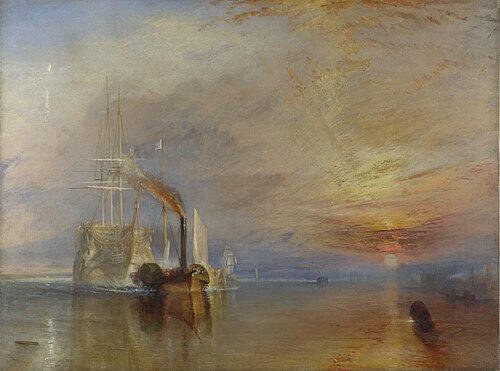
Pictured above is Turner’s Turner The Fighting Temeraire from 1839. The painting depicts HMS Temeraire, one of the last surviving ships to have fought at the Battle of Trafalgar, being towed up the Thames in 1838 by a paddle-wheel steam tug toward its final berth in Rotherhithe, where it would be broken up for scrap. The symbolism could hardly be more powerful: an ordinary steam-powered tug towing a magnificent wind-powered warship, celebrated for its role as the greatest naval victory in British history, to the scrapyard. It is difficult to imagine how Turner could have made his understanding of the Second Technology Supercycle’s impact on humanity any clearer.
The influence extended beyond the representation of industrial machinery. Turner had shown how recognizable objects could emerge from fields of color and atmosphere, allowing the viewer to experience light and movement without requiring every detail to be precisely defined.
Monet and Pissarro were already pursuing related experiments, and their time in England exposed them to an earlier generation of artists exploring similar problems.
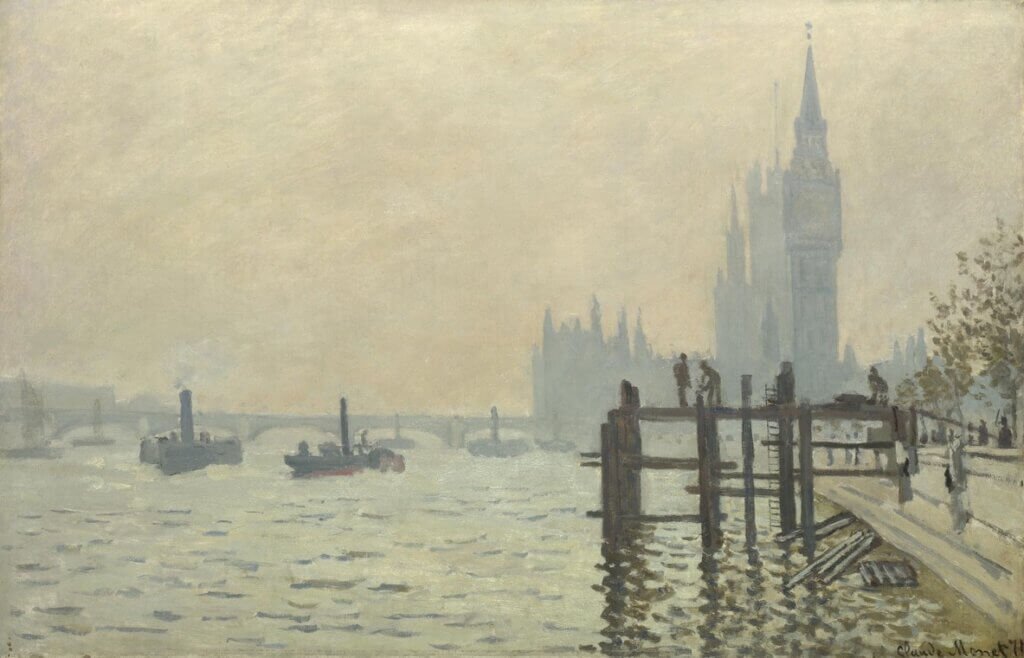
Above, pictured is Monet’s painting titled the The Thames at Westminster (1871). It was painted during his exile in England. It features two steam tugboats in the foreground, though their are six steam powered tugboats in the painting. The painting The Fighting Temeraire, had hung in the National Gallery of Art, located in Trafalgar Square in London since 1851. This is where Monet saw it and Turner’s Rain, Steam, and Speed – The Great Western Railway along with Pissaro and Sisley.
Their exile also brought an important commercial relationship.
Through the painter Charles-François Daubigny, Monet and Pissarro met the French art dealer Paul Durand-Ruel, who had also fled the war.
Durand-Ruel began purchasing and promoting their paintings. His eventual commitment to the Impressionists would become essential to the movement’s survival and international success.
The artistic revolution needed more than revolutionary painters. It also needed new ways to reach an audience.
A New Way of Seeing
Other technological and cultural developments were contributing to the changing visual language of nineteenth-century painting.
Photography, introduced commercially in 1839, offered an entirely new means of recording the visible world. The camera could capture accidental arrangements, unusual perspectives, cropped figures, and moments that traditional artistic composition often avoided.
Meanwhile, the expansion of international trade brought Japanese woodblock prints into European markets.
Artists encountered compositions in which figures were unexpectedly cropped, viewpoints appeared elevated or asymmetrical, and ordinary scenes received extraordinary visual attention.
These influences encouraged experimentation with composition and challenged the assumption that a painting needed to organize every element around a carefully balanced central subject.
The Impressionists increasingly embraced immediate observation, unconventional viewpoints, and the fleeting character of everyday experience.
Their artistic revolution was developing alongside a broader transformation in the technologies and habits of seeing.
The Exhibition That Gave Impressionism Its Name
By 1874, these experiments had developed into a recognizable artistic movement, but the French art establishment remained largely hostile.
The official Paris Salon controlled the principal route through which artists gained recognition, commissions, and commercial success. Its juries generally favored carefully finished paintings of historical, mythological, and religious subjects.
Many of the younger painters repeatedly encountered rejection.
Rather than remain dependent upon the Salon, they organized an independent exhibition.
On April 15, 1874, approximately thirty artists presented their work at 35 Boulevard des Capucines in Paris, in the former studio of the photographer Nadar.
Among the exhibitors were Monet, Renoir, Sisley, Pissarro, Edgar Degas, Berthe Morisot, and Paul Cézanne.
Their subjects and styles varied considerably. Degas explored dancers, theaters, and urban interiors. Morisot examined domestic life and intimate social settings. Pissarro concentrated on rural landscapes and working communities. Monet, Renoir, and Sisley pursued changing light and atmosphere in landscapes and scenes of modern leisure.
What united them was their determination to paint the world through direct observation and to exhibit independently of the established artistic institutions.
The exhibition attracted curiosity and ridicule.
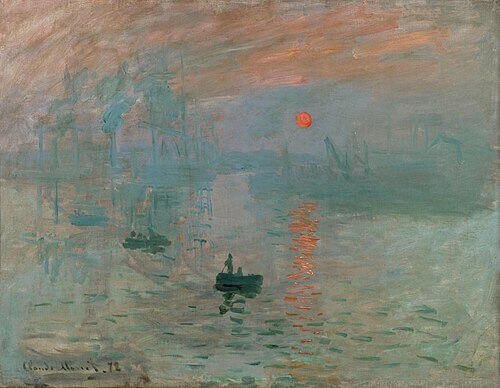
The critic Louis Leroy seized upon Monet’s Impression, Sunrise, a painting of the harbor at Le Havre, and sarcastically applied the term “Impressionists” to the group. That painting of an industrial shipyard complete with smokestacks is pictured above.
The painting itself captured much of what was revolutionary about the movement.
A brilliant orange sun rises through a blue-gray atmosphere of mist and industrial smoke. Boats appear as loosely defined silhouettes. Water and sky seem almost to merge.
The harbor’s physical details were subordinate to the experience of light at a particular moment.
Leroy intended the description as an insult, suggesting that the artists had produced mere impressions rather than finished paintings.
Instead, he had given a name to an artistic revolution.
The Birth of a New Artistic Age
The first Impressionist exhibition was neither a critical nor a commercial triumph. Many of the artists continued to struggle financially, and their unconventional paintings remained controversial for years.
Nevertheless, the movement survived.
Between 1874 and 1886, the artists and their associates organized eight independent exhibitions. Their influence gradually spread, aided by dealers, collectors, and a changing public appreciation of modern painting.
The revolution they had begun extended far beyond their original subjects.
Painting had acquired new possibilities for representing light, color, movement, atmosphere, and the immediate experience of modern life.
The Industrial Revolution had made these possibilities.
New pigments expanded the artist’s palette. Manufactured paint tubes made outdoor painting more convenient. Railways opened landscapes and created new leisure destinations. Industrial cities provided unfamiliar subjects, while photography and international printmaking challenged established ways of composing images.
Turner’s atmospheric experiments, Sisley’s English connections, Monet’s early training, and the collaborative work of the young French painters helped bring these developments together.
Impressionism emerged from the meeting of artistic imagination with a world transformed by technology.
The movement would eventually help open the way to Expressionism, Cubism, Surrealism, and the broader development of modern art.
Its origins demonstrate a recurring relationship between technological and cultural change. New technologies alter the physical environment, expand human capabilities, and introduce unfamiliar experiences. Artists respond by developing new ways to interpret and represent the world.
The Impressionists transformed painting because they were looking at a world that was itself undergoing transformation.
The Second Technology Supercycle had changed how humanity lived, traveled, worked, and experienced time and distance.
Impressionism helped change how humanity saw.