

The Marxist School: Profitability, Financial Crises, and the Missing Technology Cycle
Marxist Perspectives on Financial Depressions
Major economic depressions have repeatedly forced economists to reconsider their explanations of capitalism. Financial markets collapse, productive investment contracts, workers lose their livelihoods, and institutions that appeared stable during prosperous periods prove incapable of preventing widespread destruction. The resulting crises expose relationships among finance, production, employment, ownership, and economic power that are often less visible during periods of expansion.
Marxist economics offers one of the most influential historical interpretations of these relationships. Developed from the work of Karl Marx and Friedrich Engels during the nineteenth century, it examines how capitalist enterprises accumulate productive capital, how labor and machinery contribute to production, how competition affects profitability, and why periods of economic expansion may give way to crises.
The Marxist tradition also asks who controls productive resources and who receives the wealth generated through their use. These questions are especially important during technological revolutions, when new industries can create extraordinary financial fortunes while disrupting the occupations, communities, and economic relationships upon which large populations depend.
But Marxist economics is frequently misunderstood. Its central theory concerns the organization of production, accumulation, class relationships, and economic power. Government spending to stimulate aggregate demand is more closely associated with Keynesian economics. Marxists have developed differing views about government intervention, public ownership, democratic socialism, market socialism, and state planning. These disagreements should not be collapsed into a single prescription for government control of the economy.
My interest in Marxist analysis is its potential contribution to technology-supercycle theory. Marx and Engels recognized that industrial capitalism could generate remarkable productive capabilities while creating devastating social dislocation. They also understood that competition, technological investment, profitability, and ownership could produce recurring conflicts within the economic system.
Yet I believe their larger interpretation was shaped by the historical stage of industrialization they experienced. They witnessed severe disruption during the expansion of a new technological system and concluded that its contradictions would ultimately require capitalism to be replaced. The subsequent development of industrial societies revealed a more complicated process in which institutions, technology, labor relationships, and productive capabilities continued evolving.
That argument is developed further in my companion essay, Marx and Engels: Errors.
The Profitability Crisis Thesis
Profitability occupies a central place in many Marxist explanations of economic crises. Capitalist enterprises invest because they expect productive assets, labor, materials, and organizational capabilities to generate returns. When expected profitability deteriorates, businesses may reduce investment, postpone expansion, abandon projects, or seek alternative ways to preserve their financial returns.
Marx developed a distinctive explanation of these pressures through his theory of value and the relationship between labor and capital. In his account, labor creates new value, while machinery, materials, and other means of production transfer the value already embodied in them to the final product. Capitalists acquire surplus value by employing workers whose production exceeds the value of their compensation.
Competition encourages businesses to improve productivity through machinery, technology, and increasingly sophisticated production methods. A company that introduces more efficient equipment may lower costs and gain a temporary competitive advantage. Its rivals must eventually respond, causing the new methods to spread through the industry.
Marx argued that this process could increase the proportion of capital invested in machinery and other productive assets relative to the capital spent on labor. Within his theory of value, that changing relationship could place downward pressure upon the average rate of profit even as the productivity of labor increased.
This is the argument commonly called the tendency of the rate of profit to fall. It does not mean that profits must decline continuously or that an increase in wages is always responsible. Marx expressly recognized that technological progress could increase the total quantity of profit while the rate of profit, measured against the capital invested, declined.
He also identified forces capable of counteracting the tendency, including more intensive production, reductions in the cost of machinery and materials, changing wages, foreign trade, and other developments affecting the relationship between capital and surplus value. These qualifications are important because Marx described a tendency whose effects could be modified or reversed under different economic conditions.
The relevant original discussions appear in Volume Three of Capital, Chapter 14, on counteracting influences, and Chapter 15, on the contradictions of the falling-profit tendency.
The Central Problem with Marx’s Theory of Value
I have a fundamental disagreement with Marx’s accounting of the origin of economic wealth. His labor theory of value assigns a distinctive role to labor in the creation of surplus value. Although Marx recognized the extraordinary productive power of scientific knowledge, machinery, cooperation, and the accumulated capabilities of society, I believe his framework does not adequately explain the much larger ecosystem responsible for creating modern technological wealth.
Consider a semiconductor manufacturer. Its productive capabilities depend upon engineers, technicians, machinery, specialized materials, scientific research, software, electricity, transportation, laboratories, suppliers, educational institutions, and decades of accumulated technical knowledge. A successful company combines these capabilities, but it did not independently create the entire productive system upon which its success depends.
The same is true of digital platforms and artificial intelligence. Their technologies depend upon generations of public and private investment in scientific discovery, education, computing, telecommunications, energy infrastructure, industrial manufacturing, and institutional development. They also depend upon the continuing participation of workers, consumers, businesses, and communities throughout the economy.
The productive economy is therefore a collective achievement extending far beyond an individual enterprise’s ownership of machinery or its employment of a particular workforce. The middle-class ecosystem accumulated much of the knowledge, infrastructure, purchasing power, institutional stability, and productive expertise that makes contemporary corporate wealth possible.
My objection is also historical. Marx and Engels witnessed industrialization during a period when the new factory system was rapidly changing the relationship between labor and capital. They could not observe the full development of electricity, mass production, modern education, digital computing, global supply chains, and artificial intelligence.
These later developments reveal how successive technological revolutions inherit and combine capabilities accumulated across many generations. The distribution of wealth cannot be understood adequately by examining only the immediate relationship between an employer and the workers employed in a particular enterprise.
This criticism does not require abandoning Marx’s insights about ownership, bargaining power, and the concentration of economic rewards. Those insights remain important. But I believe the productive origin of modern wealth must be understood through a wider historical system that includes technology, institutions, public investment, education, infrastructure, and the accumulated capabilities of the global middle class.
Profitability Before the Great Depression
Marxist economists have long argued that weaknesses in productive profitability can precede financial crises. A decline in the returns available from productive investment may encourage businesses and financial institutions to pursue increasingly speculative opportunities. The resulting expansion of financial claims can temporarily conceal weaknesses in the productive economy.
The economic history preceding the Great Depression provides material for evaluating this argument. During the 1920s, American manufacturing expanded, productivity increased, large corporations grew more powerful, and stock-market speculation became increasingly important. Yet some contemporary analysts identified deteriorating relationships between profits and the capital required to generate them.
In his 1934 book The Decline of American Capitalism, Lewis Corey assembled historical data from corporate income reports to examine profitability in American manufacturing. His calculations placed the rate of profit on total manufacturing capital at approximately 9.2 percent in 1923, 6.1 percent in 1924, 7.7 percent in 1925, 5.5 percent in 1927, and 7.5 percent in 1929.
These figures suggest that the estimated rate of profit in manufacturing fluctuated considerably during the decade while remaining below its 1923 level in the peak year of 1929. Corey also found that the total dollar amount of profits rose between 1923 and 1929. The distinction between the amount of profit and the return earned on invested capital is essential to understanding his argument.
The figures should be understood as Corey’s historical reconstruction, based upon the accounting practices and data available to him, rather than a universally accepted measure of the economy-wide rate of profit. Different definitions of capital, profit, depreciation, and financial income can produce different results.
Even so, this evidence provides a useful basis for investigating whether structural difficulties in productive investment were emerging before the 1929 financial crash. It challenges explanations that begin and end with the subsequent banking panic or the movement of monetary aggregates.
For the original data, see Lewis Corey, The Decline of American Capitalism, Chapter Eight: The Fall in the Rate of Profit.
Financial Versus Productive Capital: The Diversion of Investment
One of the most valuable aspects of Marxist economic analysis is its examination of the relationship between financial accumulation and productive investment. Financial activity can support genuine economic development by collecting savings, assessing risks, financing infrastructure, and providing capital to businesses. It can also generate opportunities for speculative gains that become increasingly detached from the production of goods and services.
Marxist economists have examined how periods of financial expansion can coincide with weaker returns in productive industries. Businesses and investors may seek higher earnings through securities trading, credit expansion, financial leverage, and the acquisition of existing assets when the prospects for new productive investment become less attractive.
The American economy of the 1920s provides a particularly striking example. Lewis Corey reported that the profits of financial corporations increased from approximately $870 million in 1923 to $2.438 billion in 1929. That represented an increase of roughly 177 percent.
Over the same period, Corey reported that profits of nonfinancial corporations rose from approximately $4.948 billion to $5.645 billion, an increase of about 14 percent. The financial sector’s profits expanded far more rapidly than those of the broader nonfinancial corporate economy.
Corey also assembled estimates showing large increases in speculative profits and rising payments to investors. His analysis interpreted these developments as evidence of growing financial power and a widening separation between the ownership and control of wealth and the productive activities generating it.
These historical estimates come from The Decline of American Capitalism, Chapter Four: Profits and Prosperity, and Chapter Twenty-One: Monopoly and Finance Capital.
The numbers are worth preserving because they demonstrate how a contemporary Marxist analyst investigated the relationship between financial and productive profits before the Depression. But the disparity alone does not prove that every dollar entering financial markets was diverted from productive investment or that declining profitability was the sole cause of the crisis.
The broader historical question is whether financial expansion was creating productive capabilities sufficient to support the valuations and obligations being accumulated. That question remains central to the analysis of technological revolutions.
During the railway revolution, financial speculation helped finance infrastructure that subsequently transformed transportation and markets. During the digital revolution, the Internet bubble financed useful computing and telecommunications capabilities while also supporting many unsustainable business models. Financial capital can perform both functions at once.
My concern is what happens when financial opportunities become increasingly detached from productive investment, and when the resulting claims upon wealth concentrate among a relatively small group of asset owners.
From the Roaring Twenties to Financial Collapse
The Great Depression developed through the interaction of industrial weaknesses, financial speculation, monetary contraction, international economic pressures, and institutional failures. The stock-market crash of 1929 exposed enormous financial vulnerabilities, while the banking panics that followed intensified the contraction through the destruction of credit and deposits.
Marxist economists place greater emphasis upon the productive economy that existed before these events. They ask whether profitability, overinvestment, production imbalances, and the concentration of purchasing power had already created conditions that made the financial system vulnerable to collapse.
The financial crash therefore becomes an event within a larger structural problem rather than the complete explanation of the Depression. This interpretation differs from approaches emphasizing monetary contraction, the collapse of aggregate demand, or the expansion of unsustainable credit.
These explanations are not necessarily mutually exclusive. Declining profitability can discourage investment, while financial speculation can temporarily conceal economic weakness. A stock-market crash can then undermine confidence, and banking failures can spread the damage through the monetary system. Falling spending further reduces production and profitability, creating an increasingly severe economic contraction.
Marxist economist Thomas Weisskopf examined the profitability question in his research on postwar American economic crises. Other scholars, including Gérard Duménil and Mark Glick, have investigated the possible contribution of falling profitability to the Great Depression. Their work illustrates the continuing effort to test Marxist crisis explanations against economic evidence.
See Duménil, Glick, and Rangel, Theories of the Great Depression: Why Did Profitability Matter?
The Long Recovery: What Profitability Explains
The extraordinary length of the Great Depression provides an important challenge to theories that assume markets will quickly restore economic equilibrium after a financial disturbance. Productive investment remained weak, unemployment persisted, and the financial system struggled to recover from the failures of the early 1930s.
Marxist explanations emphasize that recovery depends upon conditions that make renewed investment profitable. Businesses must be able to employ capital productively, generate sufficient returns, and develop expectations that justify committing resources to new production.
From this perspective, financial stabilization alone cannot guarantee recovery. Banks may remain solvent and interest rates may fall, while businesses continue postponing investment because productive opportunities appear insufficiently profitable.
Economic crises can alter those conditions through debt restructuring, the closing of unprofitable operations, changes in wages and prices, the replacement of outdated equipment, and the development of new industries. These adjustments can restore investment incentives, although they may impose tremendous costs upon workers and communities.
The historical record also reveals important qualifications. The American economy began recovering in 1933 after the extraordinary contraction of the preceding years. Economic activity increased substantially between 1933 and 1937, although unemployment remained high. A further severe recession in 1937–1938 interrupted the recovery.
World War II subsequently produced an enormous expansion of industrial production and employment through public spending and the mobilization of manufacturing capacity. The wartime economy achieved a level of productive activity that had remained unattainable during much of the preceding decade.
These events demonstrate that the recovery occurred in stages. The assertion that absolutely no recovery took place before wartime mobilization would misrepresent the substantial expansion beginning in 1933. Yet the war unquestionably brought the prolonged period of mass unemployment to an end through extraordinary public expenditure and industrial production.
The Federal Reserve’s history of the Great Depression and its account of the 1937–1938 recession provide useful historical background.
The larger lesson for technological revolutions concerns the relationship between financial recovery and productive renewal. Restoring spending can preserve employment and revive demand, but sustained expansion depends upon the productive opportunities, infrastructure, industries, and institutions available to the economy.
World War II and the State-Directed Industrial Economy
The wartime transformation of the American economy presents a revealing example of the ability of government to mobilize productive capabilities on an enormous scale. Manufacturing plants were expanded or converted, research and engineering accelerated, and industries were coordinated around the requirements of military production.
Government procurement provided demand for industrial output, while public financing helped establish new facilities and production capacity. Companies received contracts that supported large-scale investment, and workers moved into industries that had previously operated far below their potential capacity.
Some Marxist analysts describe this arrangement as a form of state-directed capitalism. The government exercised extraordinary authority over investment, resources, prices, and production priorities, while much of the underlying industrial system remained privately owned and operated.
The resulting transformation demonstrated how enormous industrial resources could be mobilized when institutions committed themselves to a common objective. It also provided a historical foundation for later debates about industrial policy, public investment, military research, and the relationship between government and private productive enterprise.
But wartime mobilization cannot be treated as a practical model for ordinary economic development. The war involved immense destruction, loss of life, rationing, restrictions upon ordinary consumption, and extraordinary demands upon society. Its historical importance lies in what it reveals about productive capacity, institutional coordination, and the consequences of large-scale public investment.
Nor does the wartime experience establish that replacing private enterprise with centralized economic direction provides a general solution to capitalist crises. The government directed production toward specific wartime objectives within an industrial system that retained substantial private ownership, markets, and managerial capabilities.
What interests me most is the evidence that productive capabilities can remain underutilized for years when the economic and institutional relationships supporting their use have broken down. Restoring those capabilities requires an understanding of production as well as finance.
Creative Destruction and the Renewal of Productive Capital
Marx’s analysis of capitalist crises includes the devaluation of previously accumulated capital. Machinery, factories, inventories, financial assets, and commercial enterprises may lose their economic value when their productive methods become outdated or when demand no longer supports their operation.
Such changes can create opportunities for new investment. Older assets are abandoned or acquired at reduced prices, while emerging technologies offer alternative methods of production. The economy reorganizes around activities that appear capable of generating greater returns.
Joseph Schumpeter later placed the recurring replacement of established productive arrangements at the center of his theory of creative destruction. Schumpeter’s account differed substantially from Marx’s. It emphasized entrepreneurship, innovation, and the development of new productive combinations rather than deriving economic crises principally from the labor theory of value.
Nevertheless, the two traditions share an important historical insight: capitalist development continually transforms the productive system. New technologies change the economic value of existing machinery, skills, industries, and organizations. The resulting transitions can be highly disruptive even when they ultimately create much greater productive capabilities.
The difficulty is that the losses experienced during technological transformation do not fall exclusively upon obsolete businesses or speculative investors. Workers, communities, public institutions, and independent enterprises can lose economic relationships and accumulated capabilities that took generations to develop.
That distinction becomes increasingly important when we consider the productive ecosystem supporting the modern middle class. The destruction of an industrial community can eliminate far more than the market value of its factories. It can weaken networks of skilled labor, suppliers, education, commercial relationships, public services, and technical knowledge.
Understanding technological renewal therefore requires examining what an economy gains through new innovations and what it loses when established productive systems deteriorate.
The Difference Between Marxist Crisis Theory and Technology Supercycles
The most important limitation of Marxist economic analysis for my research concerns its explanation of where an economy stands within the historical development of a technological revolution.
A declining rate of profit may reflect problems within a particular industry. But established industries do not all experience the same technological transformation simultaneously. Some may be approaching maturity while others are expanding through emerging technologies. The overall economy may therefore contain declining, stable, and rapidly growing productive systems at the same time.
This creates a problem for economic models that attempt to interpret all industrial changes through an economy-wide profitability cycle. A decline in the returns available from mature industries may coincide with extraordinary opportunities in new industries whose productive capabilities are still developing.
The history of technological revolutions provides many examples. Railways transformed transportation while established canal operators faced declining competitive advantages. Electricity changed the economics of machinery and industrial power. Automobiles challenged older transportation systems while creating new industries in petroleum, rubber, steel, roads, and manufacturing.
Digital computing later reorganized manufacturing, communications, commerce, and administrative work. The development of artificial intelligence is now introducing additional productive possibilities while changing the economic prospects of some established digital businesses and occupations.
These transformations cannot be adequately explained through a universal decline in profitability. Their timing and consequences depend upon the technological capabilities being developed, the industries being displaced, and the financial and institutional arrangements influencing their adoption.
Carlota Perez’s model provides a different historical framework. Her five great technological revolutions began in 1771, 1829, 1875, 1908, and 1971. Each involved a new cluster of industries and productive capabilities, followed by financial and institutional transitions that shaped the wider economy.
My own six-supercycle framework builds upon that history by examining five overlapping waves of innovation within each revolution and proposing a sixth supercycle centered upon Artificial Intelligence and Autonomous Systems beginning in 2022.
Marxist profitability analysis may contribute useful evidence about investment and crisis conditions within those revolutions. But the technological framework is needed to understand how the productive economy itself is changing and why different industries experience different stages of development simultaneously.
Nikolai Kondratiev: The Danger of Confusing Different Cycle Models
Marxist economists have sometimes incorporated Nikolai Kondratiev’s long-cycle hypothesis into their analyses of capitalist development. Kondratiev investigated long movements in prices, production, interest rates, and other economic indicators during the early twentieth century. His work helped establish questions later examined by Schumpeter, Freeman, Perez, and other economists studying long-term technological and economic transformation.
Kondratiev’s political and intellectual position requires care. He worked in the early Soviet Union and participated in debates surrounding economic planning and agricultural development. He had also been associated with the Socialist-Revolutionary movement and came into serious conflict with Soviet authorities. He should not automatically be treated as a Marxist simply because he conducted research within Soviet institutions.
His economic work was also different from the later technological-revolution framework. Kondratiev’s long cycles were reconstructed from historical economic movements, especially price series, while Perez identified successive clusters of technological change that transformed the productive economy.
The difference matters because the historical dates do not align. A Kondratiev wave diagram may place the 1970s at a different point in its long-term sequence than Perez’s model, which identifies 1971 as the beginning of the Information and Telecommunications revolution.
In Perez’s framework, the fourth revolution of oil, automobiles, and mass production was entering maturity as the fifth revolution began emerging. Established industries could experience declining opportunities at the same time that computing and telecommunications began creating a new productive system.
A model that treats all industrial profitability changes during the 1970s as evidence of a single generalized decline risks missing this transition. The condition of mature automobile manufacturing cannot by itself establish the productive prospects of semiconductors, computing, software, and telecommunications.
For a detailed account of Kondratiev’s work and its later interpretation, see Nikolai Kondratiev’s Biography and Kondratiev’s Theory and Impacts.
The 1970s: The End of One Technological Era and the Beginning of Another
The 1970s provide a particularly valuable example of why the placement of technological revolutions matters. During that decade, mature industrial economies experienced inflation, slowing productivity growth, international competition, and changing relationships among labor, capital, and government.
Established industries built around steel, automobiles, petroleum, mass production, and earlier industrial methods faced increasing pressures. Yet the commercial microprocessor, introduced in 1971, was helping initiate another transformation whose full economic importance would become clear only over the following decades.
Computing and telecommunications gradually made it possible to coordinate productive activities across much greater distances. Businesses could reorganize manufacturing, administration, technical services, and eventually entire supply chains through digital information systems.
This process changed the geography of production. Industrial capabilities that had supported particular communities for generations became increasingly movable. New regions and countries developed manufacturing capacity, while established industrial centers encountered growing competition and the loss of some productive activities.
Marxist analysis can identify consequences involving labor, capital ownership, bargaining power, and profitability. But the broader pattern becomes clearer when those changes are placed within the emergence and diffusion of the fifth technological revolution.
The difficulty is therefore one of historical interpretation. Economic indicators must be understood in relation to the productive technologies, industries, and institutions that generate them. A single long-wave diagram cannot automatically distinguish the maturity of one revolution from the emergence of another.
The Historical Comparison Chart
The following image is retained from the original article. It illustrates a later Kondratiev-wave interpretation in which the position of the 1970s differs from the boundary used in Carlota Perez’s technological-revolution chronology.
The red marker identifies the approximate position assigned to the 1970s in the illustrated long-wave sequence. In that interpretation, the period appears within a continuing Kondratiev cycle. In Perez’s framework, 1971 marks the beginning of a new revolution centered on information and telecommunications.
The distinction should not be interpreted as proof that every economist using Kondratiev’s model misunderstands technological change. Different cycle models measure different phenomena, and their boundaries depend upon the indicators and historical assumptions used. My criticism concerns treating those different chronologies as interchangeable or using a price-cycle diagram as though it were a complete history of technological revolutions.
There is also a correction to my original discussion of American industrial history. The United States was already an important industrial economy during the railway revolution and became one of the world’s leading manufacturers during the nineteenth century. Its manufacturing output exceeded Britain’s by the late nineteenth century, well before the automobile and mass-production revolution began in 1908.
That development strengthens the importance of comparing technological revolutions across nations. Britain played a central role in the first two revolutions, while the United States and Germany became increasingly important during the third. By the fourth revolution, American industry was among the principal centers of global technological and productive development.
See the United States Department of Labor’s history of industrial employment for background on the rise of American manufacturing during the nineteenth century.
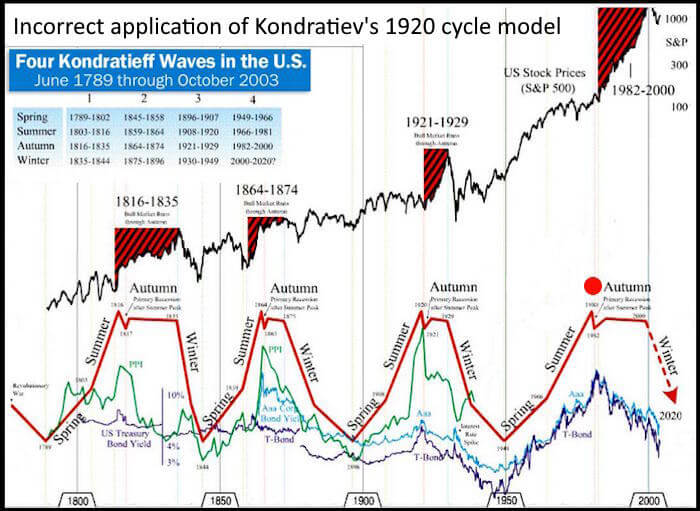
Chart note: This illustration reproduces a later interpretation of Kondratiev cycles. It is included to compare alternative historical chronologies. Kondratiev’s original research and Perez’s later technological-revolution model should be evaluated according to their different purposes, evidence, and definitions.1
For the history of these ideas, continue with The Early Models and Kondratiev, Schumpeter and Innovation Swarms, Christopher Freeman, and Carlota Perez and the Great Technology Surges.
What Marxist Analysis Contributes to Technology-Supercycle Theory
Despite my disagreements with Marxist economics, several of its central questions are extremely valuable to the study of technological revolutions. The first concerns the relationship between profitability and productive investment. A technological revolution creates new opportunities, but those opportunities must eventually generate sufficient economic returns to support continued development.
The second concerns the relationship between financial capital and productive activity. Investment can develop useful infrastructure, industries, and capabilities. It can also flow toward speculative claims upon existing assets, especially when investors expect rising valuations to continue providing returns.
The third concerns ownership and economic power. Businesses that control essential productive assets, distribution systems, or access to markets can influence how the rewards of technological development are divided among owners, workers, customers, and other participants.
The fourth concerns the distribution of economic insecurity. When a productive system is transformed, the costs of adjustment may fall heavily upon workers and communities whose skills, investments, and local institutions were developed around the earlier technological economy.
Marxist analysis draws attention to all four relationships. Its limitation, for my purposes, is that it does not provide a sufficiently detailed historical account of the successive technological systems whose development transforms these relationships across generations.
Technology-supercycle theory can place profitability, financial accumulation, ownership, and labor relationships within the changing productive architecture of each revolution. This helps explain why financial crises may occur while technological capabilities continue expanding and why economic instability can persist when existing institutions are poorly adapted to a new productive system.
Financialization and the Extended Turning Point of Cycle Five
The fifth technological revolution offers an important modern example. Beginning in 1971, computing and telecommunications expanded through semiconductors, software, personal computers, digital networks, the Internet, cloud services, and global digital platforms.
Financial capital helped finance this enormous technological expansion. During the 1990s, extraordinary expectations surrounding Internet businesses attracted large amounts of investment, including to companies that had yet to demonstrate sustainable profitability.
The resulting dot-com collapse destroyed many businesses and financial investments. Yet much of the underlying digital infrastructure survived, and the technologies continued spreading through the productive economy.
Subsequently, credit expansion and financial speculation increasingly involved housing and mortgage-related securities. The crisis of 2007–2009 exposed the consequences of excessive leverage, complex financial instruments, weak lending standards, and interconnected financial institutions.
I interpret these episodes as connected developments within the prolonged financial and institutional transition of the fifth technological revolution. The speculative casino moved from Internet-related securities toward mortgage finance, while the larger digital productive transformation remained unfinished.
Marxist analysis helps explain why financial capital may seek expanding returns through increasingly complex claims upon wealth. It also directs attention to the concentration of ownership and the relationship between financial valuations and the productive activities upon which those valuations ultimately depend.
But the digital revolution introduced further developments that extend beyond the conventional profitability crisis thesis. Technology-enabled globalization made industrial production, administrative functions, and increasingly specialized technical work easier to coordinate across international boundaries.
These capabilities helped expand the middle class in developing economies while weakening the economic position of some established industrial communities. Digital platforms also acquired increasing control over commercial gateways, leaving many independent enterprises dependent upon the access conditions and operating rules of dominant providers.
The resulting economy created extraordinary technological wealth while increasingly separating some of the financial rewards from the communities and productive relationships that made the technologies possible.
This is why I believe the fifth revolution has experienced an extended Turning Point. Financial interventions prevented severe collapses from becoming even more destructive, but they did not automatically resolve the institutional problems surrounding competition, productive investment, employment, ownership, and the distribution of wealth.
Marxist economics offers valuable questions about those problems. Perez’s technology-cycle framework provides a larger historical setting in which to examine how they developed.
Capital Concentration and the Modern Middle-Class Ecosystem
One of Marx’s enduring insights concerns the tendency of competitive economic activity to concentrate productive capital and economic power. Businesses can expand by reinvesting profits, acquiring rivals, controlling infrastructure, and building advantages that become increasingly difficult for smaller enterprises to overcome.
This process has become especially important in the digital economy. Large platforms can control access to customers, data, software ecosystems, cloud infrastructure, advertising markets, and other essential commercial services. Businesses that depend upon these systems may have limited negotiating power over fees, rules, ranking, distribution, and competitive access.
The wealth generated through these systems can become concentrated among a relatively small number of shareholders and controlling organizations even though the underlying technologies depend upon a much larger productive ecosystem.
That larger ecosystem includes scientific research, public infrastructure, universities, education, skilled labor, industrial manufacturing, commercial institutions, and generations of accumulated technological knowledge. It also includes the productive activities and purchasing power of the global middle class.
The history of industrialization transformed an economy in which most of humanity faced severe material constraints into a world supporting a middle-class population approaching four billion people, depending upon how middle-class income and consumption are defined.
This development occurred through successive technological revolutions and the gradual creation of economic institutions that allowed increasing numbers of people to participate in modern productive activity.
The middle class became an essential contributor to the accumulation of the knowledge, institutions, resources, skills, infrastructure, and purchasing power that made these revolutions possible. Its economic importance extends far beyond the wages received by individual workers or the value of the shares held by households.
My broader argument is that this ecosystem should be recognized as a productive origin of modern wealth. The economic rewards arising from its collective capabilities must be examined in relation to the institutions and ownership arrangements that determine who receives them.
Marxist economics raises important questions about the concentration of capital and the distribution of economic rewards. Technology-supercycle theory adds the historical process through which the productive capabilities generating those rewards developed.
The Emerging Sixth Supercycle: Artificial Intelligence and the Ownership Question
The emerging Artificial Intelligence and Autonomous Systems supercycle makes these questions more urgent. Beginning with the broad commercial emergence of generative AI in 2022, the new revolution is developing capabilities that may transform professional work, scientific research, engineering, industrial production, and increasingly autonomous systems.
AI depends upon advanced semiconductors, enormous computing installations, electricity, cooling, communications networks, scientific knowledge, and industrial manufacturing. Its development requires substantial capital investment and the coordination of capabilities distributed across the global productive economy.
Some of the companies leading the revolution already control important digital platforms and computing infrastructure developed during Cycle Five. Their ownership of financial resources, technical expertise, customer relationships, and distribution systems can provide significant advantages in the development of AI.
The resulting concentration of economic power could influence the distribution of wealth generated through the next technological revolution. The ability of independent businesses and workers to participate may depend increasingly upon access to computing infrastructure, AI systems, energy, data, distribution channels, and markets controlled by large organizations.
Marxist analysis provides useful concepts for investigating these relationships, particularly the concentration of capital, the changing relationship between labor and machinery, and the ownership of productive assets.
Yet the emerging AI productive system also challenges any explanation that assigns the creation of wealth to one immediate factor of production. AI is developing through the accumulated scientific, technological, institutional, and productive capabilities of generations. The economic ecosystem making it possible is vastly larger than the individual companies commercializing particular applications.
The next revolution therefore raises a question that extends beyond traditional debates about capitalism and socialism: how should the economic system recognize the collective investments that made these new productive capabilities possible, and how should the resulting wealth be distributed?
My six-supercycle framework treats this as a central economic and institutional issue rather than assuming technological productivity will automatically generate broadly shared prosperity.
The Institutional Problem with Centralized Economic Control
Marx and Engels devoted considerable attention to the contradictions they identified within industrial capitalism. They described exploitation, class conflict, the concentration of ownership, and the disruption of established economic relationships. They also envisioned an economic system in which private capitalist ownership would eventually give way to different social arrangements.
But their writings did not provide a sufficiently developed institutional design for organizing a modern complex economy without recreating concentrated economic and political power.
A productive society must coordinate investment, production, consumer needs, scientific research, infrastructure, distribution, and the use of scarce resources. Businesses and public institutions require systems for evaluating information, making decisions, responding to errors, and allowing participants to challenge decisions that prove harmful.
The historical experience of centrally planned communist economies revealed severe difficulties in performing these functions while preserving political freedom, independent economic initiative, and meaningful constraints upon those controlling productive resources.
These difficulties do not erase Marx’s criticisms of capitalist inequality or financial concentration. They show that changing the formal ownership of productive assets cannot, by itself, resolve the challenges of economic coordination, accountability, and the distribution of power.
Modern economies have generally developed through combinations of markets, public institutions, private enterprise, regulation, education, infrastructure, and social protections. The appropriate balance remains a continuing subject of economic and political debate.
My approach emphasizes the adaptive capacity of the productive ecosystem. The institutional arrangements governing markets and wealth must remain capable of responding to technological change without placing unlimited economic or political authority in the hands of either private owners or government institutions.
This concern is central to the broader analysis developed on TechnologyCycles.org and in Marx and Engels: Errors.
Conclusion: What Marx Saw and What Technology Cycles Reveal
Marxist economics makes an important contribution to understanding financial depressions and technological transformation. It directs attention to profitability, investment, the accumulation of capital, financial speculation, ownership, labor relationships, and the distribution of economic power.
These are essential relationships in the history of capitalist development. Financial crises can expose weaknesses in productive investment that were obscured during periods of speculative expansion. Technological change can increase output while disrupting employment. The concentration of productive assets can influence who receives the rewards created through economic development.
But the historical interpretation of these developments matters. A decline in the profitability of mature industries may occur while new technologies are creating extraordinary opportunities elsewhere. A financial crisis may destroy speculative investments while leaving behind valuable productive infrastructure. Industrial decline in one country may coincide with expanding productive opportunities and middle-class growth in another.
These developments are more clearly understood through the historical evolution of technological revolutions. Carlota Perez’s framework explains how emerging productive systems interact with financial capital, speculative investment, institutional Turning Points, and the possibility of broader economic Deployment.
My six-supercycle model extends that interpretation into the emerging AI revolution while examining the five overlapping waves of innovation within each technological transformation.
The larger conclusion concerns the origins of modern wealth. Successive revolutions depend upon the accumulated knowledge, productive work, infrastructure, institutions, and investments of a global middle-class ecosystem. Those capabilities were created over generations and became the foundation upon which modern corporations and new technologies developed.
Marx and Engels witnessed the extraordinary suffering produced during the early development of industrial capitalism. They recognized real economic and social problems. But the industrial system they experienced continued evolving through technological innovation, expanding productive capabilities, political struggle, institutional reform, and the emergence of a much larger middle class.
Their historical error, in my interpretation, was treating the disruptive conditions of a technological transition as evidence of capitalism’s unavoidable final destination.
The history of technological revolutions suggests a different challenge. Economic systems must continually adapt to the productive capabilities they create. Financial institutions must support genuine investment. Markets must remain open to competition and productive participation. The wealth generated through technological development must sustain the people and institutions upon which its creation depends.
Marxist analysis helps identify pressures within the economic system. Technology-supercycle theory helps explain the changing productive system that gives rise to those pressures. Understanding both is necessary to develop a more useful model of technological revolutions and their consequences for the middle class.
Research Sources and Further Reading
Karl Marx, Capital, Volume Three, Chapter 14: Counteracting Influences. Marx’s explanation of the forces that can offset the tendency of the rate of profit to fall.
Karl Marx, Capital, Volume Three, Chapter 15: Exposition of the Internal Contradictions of the Law. The relationship among profitability, capital accumulation, speculation, and economic crisis.
Lewis Corey, The Decline of American Capitalism, Chapter Four: Profits and Prosperity (1934). The source of the historical comparison between financial and nonfinancial corporate profits during the 1920s.
Lewis Corey, The Decline of American Capitalism, Chapter Eight: The Fall in the Rate of Profit (1934). A contemporary Marxist interpretation of profitability in American manufacturing before the Great Depression.
Gérard Duménil, Mark Glick, and José Rangel, Theories of the Great Depression: Why Did Profitability Matter? (1987). An examination of declining profitability as a possible contributor to the crisis.
Federal Reserve History, The Great Depression. The chronology of economic contraction, banking panics, recovery, and institutional change.
United States Department of Labor, Labor in the Industrial Era. The development of American industrial production and employment during the nineteenth century.
Marx and Engels: Errors. My companion analysis of Marx and Engels, the technological transformation they experienced, and the institutional problem they left unresolved.
Nikolai Kondratiev’s Theory and Impacts. The original long-cycle hypothesis, its subsequent reinterpretations, and its relationship to technological-revolution theory.
For the wider framework, continue with The Four Economic Schools, Carlota Perez’s Five Historical Technology Cycles, Cycle Five: Chips to Clouds, and The Six Technology Supercycles.
Return to The Four Economic Schools of Thought
For general background on Marxist economics, see Marxian Economics.
- The source for the chart is: financialsense.com/contributors/christopher-quigley/kondratieff-waves-and-the-greater-depression-of-2013-2020 ↩︎