

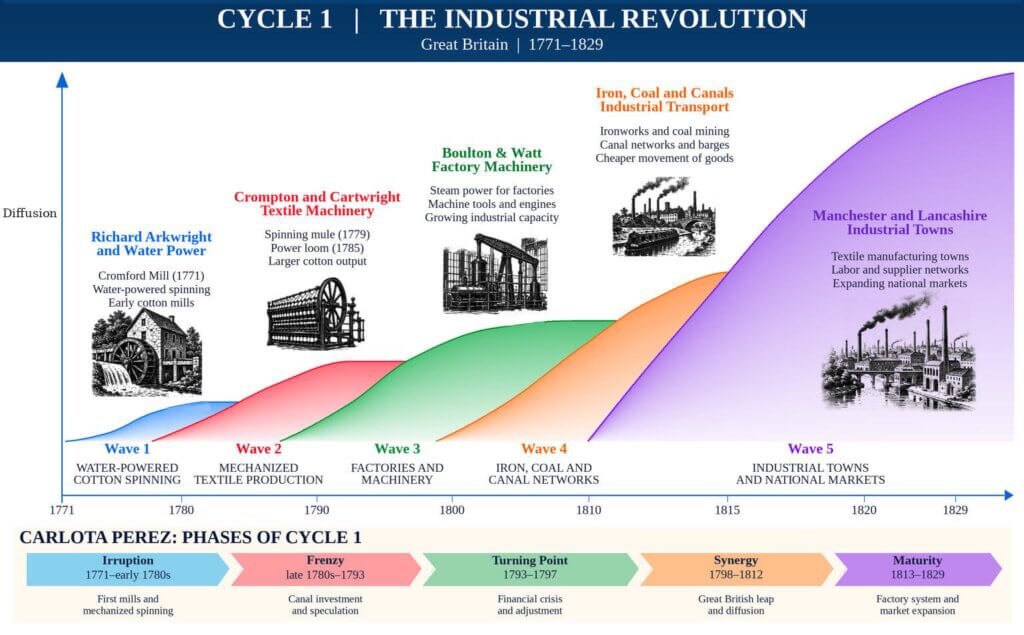
Supercycle One: The Industrial Revolution, 1771–1829
The Five Waves that Laid the Foundations for the Modern Industrial Economy
Wave One: Water-Powered Cotton Spinning
The emergence of mechanized production
In 1771, Richard Arkwright began building a cotton mill beside the River Derwent at Cromford, England. The building itself was ordinary. Britain already had workshops, mills, manufacturers and well-developed trading networks. What made Cromford new was that it put machinery, mechanical power, investment and organized labor together into one working system, and that system could produce on a scale that traditional manufacturing could not come close to.
For centuries, cloth had been made by hand. Yarn was usually spun at home or in small workshops, often by women, and weaving was done on handlooms. Merchants handed out raw materials to these workers and collected the finished goods, an arrangement known as the domestic or putting-out system. A merchant could produce more by hiring more people, but each person could only work as fast as their hands allowed.
Several inventions before Cromford had started to change this. John Kay’s flying shuttle, patented in 1733, let weavers make cloth faster, which raised the demand for yarn. James Hargreaves built the spinning jenny in the 1760s, which let one worker run several spindles at once. Arkwright’s water frame, patented in 1769, went further: it used powered rollers and spindles to make strong cotton yarn.
Cromford showed what happened when that machinery was connected to a steady source of power. A waterwheel turned the spinning equipment through a set of shafts and gears. Workers no longer had to supply the energy to spin the yarn, because the moving river supplied it for them. Their job shifted toward watching, feeding and repairing machines that did the repetitive work.
That changed the economics of making cloth. A mill could turn out more yarn, of more even quality, and its output now depended on its machinery, its power and the money invested in it. For the first time, a manufacturer could produce more than the physical strength of its workers would have allowed.
The new system also needed new kinds of coordination. Someone had to install and maintain the machines and keep them supplied with raw cotton. Someone had to manage the water, set production schedules and organize workers around the equipment. And because a mill cost far more than a traditional workshop, owners needed financial partners willing to put up the money.
For workers, the change was large. Factory jobs brought fixed hours, close supervision and full dependence on wages. Women and children did much of the work, often in harsh conditions. Output rose, and its benefits were shared unevenly.
So the first wave produced something larger than a faster spinning machine. It showed that energy, machinery, labor and capital could be organized into a new way of manufacturing. Once that arrangement proved profitable, it opened the door to further inventions across the whole textile industry, and the technological base of the first supercycle was in place.
Wave Two: Mechanized Textile Production
Innovation spreads through an entire industry
Mechanized spinning revealed something that happens in every technological revolution: when one stage of production gets faster, the stages around it come under pressure to catch up.
Before powered spinning, faster weaving had left the spinners struggling to keep up with the demand for yarn. Arkwright’s water frame reversed that. Now spinning could grow quickly, and the pressure moved to weaving, to the preparation and finishing of cloth, and to the machines that linked these steps together.
In 1779, Samuel Crompton finished his spinning mule, which combined the best features of the spinning jenny and the water frame. It produced finer and stronger yarn than most earlier methods, so manufacturers could make a wider range of better cotton cloth. The mule is a good example of how revolutions rarely turn on a single invention. Earlier machines become parts of new designs that fix the problems the earlier ones left behind.
Edmund Cartwright patented a power loom in 1785. Mechanized weaving promised to bring weaving back into balance with spinning, but the early looms were unreliable and hard to run profitably. They needed decades of improvement before mills adopted them widely, so handloom weaving stayed important well into the nineteenth century.
Every other step in making cloth felt the same pressure. Cotton had to be cleaned, carded, spun, woven, bleached, dyed and finished, and a gain in one step pushed manufacturers to improve the others. Chemical bleaching shortened a process that had once taken weeks of laying cloth out in the sun. Better carding machines prepared fiber fast enough to feed the new spinning frames. Sturdier gears and more dependable shafts let a single power source drive more machines without breaking down. Step by step, a connected system of specialized machines replaced the loose collection of household tasks that had made cloth before.
The growth of the industry also changed the market for raw materials. Britain’s cotton mills depended on imported cotton carried by sea, and rising demand tied British manufacturers more closely to merchants, shipping firms and overseas growers. Much of that cotton was grown by enslaved people, especially as plantations expanded in the Americas. Industrial growth in Britain and human exploitation abroad became bound up in the same global cotton trade.
At the same time, manufacturers needed more money, more buildings, better transport, more mechanical skill and steadier supplies of material. The new machines could only be used to their full capacity when all of these grew alongside them.
The effects spread well beyond the largest mills. Machine builders gained customers. Merchants handled more goods. Carriers found new business, and skilled mechanics were in demand. Every improvement created openings for businesses that could supply something the growing industry needed.
That spreading effect defines the second wave. A new capability moved into the activities around it, producing further inventions and new business. The process fed itself: more production encouraged improvements, and the improvements made further expansion profitable.
By the end of the eighteenth century, textile machinery had become the main source of Britain’s industrial growth. But continuing that growth now depended on a new set of industrial skills and machines, and the next wave would supply the engines, tools and engineering practices that carried the revolution beyond cotton.
Wave Three: Factories and Machinery
The creation of an industrial production system
As the textile industry grew, the factory itself became a place where new ideas were tested. Manufacturers found that producing more required better buildings, better equipment, better power and better ways of organizing work. The factory was turning into a single, integrated system of production.
Steam power was one of the most important of these developments. Earlier in the eighteenth century, Thomas Newcomen had shown that steam engines could pump water out of mines. James Watt later made steam engines far more fuel-efficient. His partnership with Matthew Boulton brought engineering, manufacturing, money and sales together in one firm.
In the 1780s, Boulton and Watt built rotary steam engines that could turn machinery as well as pump water. That meant steam could drive the shafts and equipment in factories, mills and workshops.
Waterpower stayed important, but steam gave manufacturers more freedom in choosing where to build. A factory no longer had to sit beside a river. It could be placed near workers, coal, transport routes and customers, and this freedom shaped where industry grew over the following decades.
The factory system also pushed mechanical engineering forward. John Wilkinson’s precision boring methods made better steam-engine cylinders. Henry Maudslay’s lathes and screw-cutting machines made it possible to produce precisely shaped metal parts. Better iron construction, machine tools, gears and power transmission made industrial equipment more reliable and easier to copy.
These advances created a new web of relationships between industries. Textile mills bought machines from specialist builders. Those builders relied on ironfounders, toolmakers, engineers and skilled craftsmen. Steam-engine makers needed accurately made parts, and mines and ironworks came to depend on mechanical power. Factories had become customers of other factories.
Work changed along with the machines. Running a factory took engineers, mechanics, supervisors, accountants, clerks and workers trained in specialized processes. Traditional craft knowledge was still needed even as machines took over certain manual tasks. The factory created demand for new skills while weakening the position of workers whose old skills were being mechanized.
Money became a larger concern as well. Bigger factories meant large fixed investments, and manufacturers came to depend on banks, merchant credit, partners and the confidence of lenders. The financial crisis of 1793 showed how quickly a business boom could stall when credit dried up.
Even so, industry kept growing. Manufacturers learned to run larger operations, financiers gained experience lending against machinery, and engineers built up knowledge they could carry into other industries.
By the early nineteenth century, the factory system had become more than a way to make textiles. It had become a general method for organizing industry around mechanical power, specialized equipment, coordinated labor and continuing investment. The third wave gave Britain the ability to build, improve and copy industrial production systems themselves. The next challenge was to supply those systems with enough materials and energy, and to move goods cheaply.
Wave Four: Iron, Coal, and Canal Networks
The infrastructure that allowed industrialization to expand
A growing industrial economy needed huge quantities of physical resources. Factories needed machines and buildings. Steam engines burned fuel. Ironworks needed coal, and manufacturers needed reliable ways to move raw materials in and finished goods out over longer and longer distances. Iron, coal and transport became central to the first supercycle.
Some of the groundwork had been laid before 1771. In 1709, Abraham Darby I showed at Coalbrookdale that iron could be smelted with coke made from coal, which began to free ironmaking from its dependence on charcoal. Better furnaces and better practice made coal-based ironmaking steadily more important over the eighteenth century.
In the 1780s, Henry Cort developed puddling and rolling, which improved the production of wrought iron. Better iron made better machines, tools, building components and equipment for the growing industries.
Coal was just as essential. It supplied the heat for industrial processes, the fuel for steam engines and the energy for making iron. As demand rose, mines expanded and invested in pumps, ventilation, transport and better equipment.
Each industry strengthened the other. More coal kept factories running, and better engines made it possible to dig and use more coal. More iron made better machines, and better machines raised the output of mines and factories.
None of this was enough without cheap transport. Before canals spread across the country, moving coal, iron and manufactured goods overland was costly and slow. Roads were often poor, and horse-drawn wagons carried small loads. High transport costs limited how far a product could be sold at a profit.
The Bridgewater Canal, opened in 1761, had already shown that moving coal by canal could pay. Over the following decades, canal building spread, linking coalfields, industrial towns, rivers and ports.
The 1790s brought a rush of canal investment. Speculation funded good and bad projects alike, and some investors lost heavily. But the canals that survived changed the economics of moving heavy goods. A manufacturer could buy coal and raw materials from farther away. An ironworks could sell across a wider region. Merchants could move larger loads to ports and to the growing cities.
Canal building also advanced civil engineering. Surveyors, lock builders, bridge designers, tunnel engineers and laborers developed skills they would later apply to larger projects.
Together, these changes redrew the map of British industry. Manufacturers could draw on wider supply networks, and cheaper transport made new places viable for industry.
The fourth wave shows how a technological revolution depends on infrastructure that carries its first inventions farther. Industrial machinery could only reach its full economic value once energy, materials and transport developed alongside it. By the early nineteenth century, Britain had a connected network of factories, mines, ironworks, canals and trading centers, and that network set the stage for the fifth wave: the rise of industrial towns and national markets.
Wave Five: Industrial Towns and National Markets
The industrial revolution transforms economic society
By the early nineteenth century, the Industrial Revolution was reshaping the physical and economic life of Britain. What had started as a series of improvements in textile manufacturing had become a connected system of industries, transport links, financial relationships and fast-growing towns.
The change was most visible in Manchester and the surrounding towns of Lancashire. Cotton manufacturing drew in workers, merchants, machine builders, engineers and investors. New mills brought construction work, and the growing population supported shops, workshops, warehouses, carriers and other services. Factory workers needed housing, food and clothing, which created more business still. Growth in one industry spread through the whole local economy.
Manchester became a major center of cotton manufacturing and trade, while nearby towns such as Bolton, Oldham and Stockport each developed their own industrial specialties. Birmingham’s metalworking, the ironworks of the Midlands and the port of Liverpool formed further parts of Britain’s growing industrial system.
Canals and better roads strengthened the links between these centers. Merchants could gather supplies from different regions, manufacturers could reach more distant customers, and specialized producers could sell into markets far larger than earlier generations had known. Production now depended on relationships that reached beyond any single town or business.
As industry expanded, new jobs and opportunities appeared. Mechanical engineers, accountants, warehouse keepers, transport managers, merchants, shopkeepers and skilled factory workers became essential to running the economy. Knowledge built up inside businesses and communities, and later businesses could use and improve on it.
These changes helped lay the foundations of the modern middle-class ecosystem. However, the growth of the first supercycle did not quickly produce a prosperous industrial middle class or a broad rise in living standards.
Factory work could be dangerous and exhausting. Child labor was widespread, workers’ housing was often overcrowded, and disease spread easily in the fast-growing towns. Machines threatened established trades, which led to resistance such as the Luddite protests that began in 1811. Political unrest, including the Peterloo Massacre in Manchester in 1819, exposed the gap between the new industrial wealth and the political and economic position of ordinary workers.
Industry was producing wealth on a large scale, while the institutions that could have spread its benefits more widely were still weak. Even so, the outline of a new economic order was taking shape. Manufacturing generated trade, specialized skills, investment and infrastructure, along with businesses whose customers were other businesses. Industrial towns became places where practical knowledge could build up over generations.
By 1829, the first supercycle had created a system able to support further industrial growth. That year, the Rainhill Trials showed what a new generation of steam locomotives could do, pointing toward the railway revolution of the next supercycle.
The move from one supercycle to the next built directly on what had come before. The factories, ironworks, coalfields, engineering skills and markets of the first revolution supplied much of the foundation for the second.
Conclusion: The First Great Transformation
How the waves created the foundations of modern economic growth
The first technology supercycle began with a better way to make cotton yarn and grew into a transformation of economic life. Between 1771 and 1829, Britain built a connected system of industrial machinery, mechanical power, factories, ironworks, coal mines, transport networks and expanding markets.
To understand that transformation, it helps to look past the individual inventions. Arkwright’s water-powered mill proved that mechanized production could pay. Better spinning and weaving raised the output of the textile industry. Factories, machine tools and steam engines gave industry ways to copy and extend production. Iron, coal and canals supplied the materials, energy and transport that growth required. Industrial towns and national markets then joined these pieces into a larger economic system. Each wave widened the possibilities opened by the ones before it.
The waves also overlapped. Canals and steam engines existed before Cromford, and improvements in spinning, metallurgy, machinery and transport continued throughout the supercycle. The five-wave framework describes the step-by-step assembly of an industrial ecosystem rather than five separate periods of invention.
That is the key to understanding technological revolutions. A breakthrough creates opportunities, but its larger economic effects come from the supporting capabilities that grow up around it. More textile production created demand for machinery. Machinery needed iron and mechanical skill. Bigger factories needed fuel and transport. Better transport connected markets, which encouraged more investment in manufacturing. The combined system could then keep developing on its own.
The process also says something about where wealth comes from. Industrial production depended on accumulated knowledge, skilled workers, commercial institutions, infrastructure and relationships built up over generations. Inventors and entrepreneurs were indispensable, but their achievements drew on capabilities created by a much larger society.
The first supercycle also showed that growing wealth does not guarantee that it will be fairly shared. Industrial growth went hand in hand with dangerous working conditions, poverty, political exclusion and dependence on enslaved labor in overseas supply chains. Broader prosperity would require further economic development, institutional reform, education, public investment and changes in the relationship between labor and capital.
The modern middle class emerged over a long stretch of history. The first Industrial Revolution laid productive foundations that its later development would depend on. The gap between creating wealth and sharing its benefits would remain a central problem in every supercycle that followed.
By 1829, the achievements of the first revolution had become the inheritance of the second. Railways would extend the reach of factories and markets. Steel and electricity would multiply industrial capacity. Mass production would put manufactured goods within reach of ordinary households. Digital technology would reorganize information, commerce and the coordination of economic activity. Each revolution would start from what its predecessors had made possible.
This is what the five-wave model offers: a way to see how technological breakthroughs grow into connected economic systems, how those systems build up productive capability, and how they lay the groundwork for the next revolution. The first supercycle set the pattern, and the five that followed would extend it into nearly every part of modern life. The history of technological revolutions is the history of people learning to create the wealth that makes further wealth possible.