

Supercycle Five: The Age of Information and Telecommunications, 1971–Present
The Five Waves That Transformed Information, Globalized Production, and Reorganized Economic Power
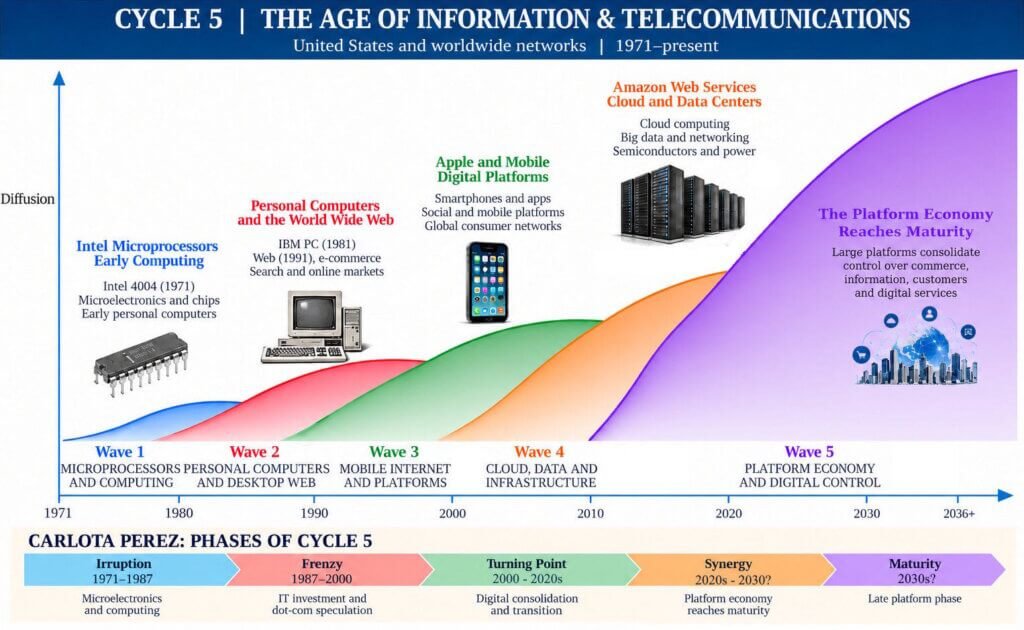
Wave One: Microprocessors and Computing
When the power to process information began moving into everything
On November 15, 1971, Intel introduced the 4004 microprocessor, a programmable central processing unit built on a single silicon chip. Originally designed for Busicom, a Japanese calculator maker, it held about 2,300 transistors and could carry out tens of thousands of instructions per second.
By today’s standards it could do very little. Its importance lay elsewhere. For the first time, a general-purpose processor could be bought commercially, built as a single integrated circuit and programmed to perform different tasks. That fact would eventually transform nearly every industry.
Earlier computers had been large, expensive assemblies of electronic parts. Mainframes were usually run by corporations, universities, research institutes and government agencies that could afford to buy and maintain them. The microprocessor opened a path toward computers that kept getting smaller, cheaper and easier to obtain.
The 4004 drew on decades of scientific and industrial investment. Semiconductor research, the transistor, the integrated circuit, precision manufacturing and electronic engineering had laid the foundations on which Intel and other chipmakers could build.
The new technology also introduced a striking relationship between performance and cost. As chipmakers learned to fit more and more transistors onto a single circuit, computing power rose while the cost of each operation fell dramatically. In 1965, Gordon Moore had noticed how quickly the number of components that could economically be placed on a chip was growing. The continuing improvement of semiconductors would become one of the defining features of the fifth supercycle.
In the 1970s and 1980s, microprocessors spread into calculators, industrial equipment, telephone systems, cars, office machines and more powerful computers. Manufacturers found that programmable electronic controls could replace many mechanical and electromechanical parts.
Factory automation advanced as computer-controlled machines became more capable. Computer numerical control improved the precision of machining, and computerized inventory and production systems made better coordination possible. These changes began to alter the organization of industrial work. The fourth supercycle had built factories that depended on large numbers of workers. Digital controls let manufacturers automate selected tasks, raise output, improve consistency and need fewer workers for some jobs.
The economic effects were uneven. New technical occupations appeared, while workers doing routine tasks came under growing pressure. In June 1979, American manufacturing employment reached its historical peak of about 19.6 million workers. Over the following decades it fell substantially, even as many industries kept raising their output. Automation was one cause, alongside international trade, changing demand, corporate strategy and the relocation of production.
The microprocessor also carried a possibility whose full significance was not yet clear. Once information could be processed electronically at very low cost, connecting computers and sharing information between them would become far more valuable.
The first wave established the base capability of the fifth supercycle: information could be processed cheaply, reliably and automatically. That capability would soon leave the specialized computer room and reach ordinary businesses and households.
Wave Two: Personal Computers and the Desktop Web
When information became accessible, transferable, and geographically mobile
In August 1981, IBM introduced its Personal Computer, the IBM 5150. Apple, Commodore and many smaller manufacturers had already brought personal computers to market, but IBM’s entry helped make personal computing a mainstream business technology.
The IBM PC combined parts from several suppliers with an operating system from Microsoft. Its design encouraged a growing market for compatible hardware, software, accessories and specialized business programs, and over time this ecosystem became one of the most important foundations of the modern technology industry.
Personal computers gradually transformed office work. Spreadsheets replaced many paper financial calculations. Word processors changed how documents were produced, and databases made it easier to store, organize and find business information. Businesses could do more sophisticated work without depending entirely on a central computer department. Accounting, inventory, engineering, publishing, administration and financial analysis came to rely on desktop computers. The economic effects spread through a vast network of software developers, hardware makers, distributors, consultants and technical service firms.
In the 1980s, another change was developing alongside personal computing. Computer networks let organizations link systems that had worked in isolation, and advances in telecommunications cut the cost of sending digital information.
The Internet grew out of research investments, technical standards and institutions built up over several decades. In 1983, TCP/IP became the standard set of protocols for ARPANET, laying the foundations of modern networking between computer systems. In 1989, Tim Berners-Lee proposed the World Wide Web while working at CERN. By 1991 the first website was publicly accessible, and CERN’s decision in 1993 to make the Web software freely available helped it spread around the world.
The commercial possibilities were enormous. Information that had once required printed documents, phone calls, physical delivery or specialized communication links could now be distributed electronically. Companies began using websites to talk to customers, publish information and sell products. Search engines, online marketplaces and information services grew up around the expanding network. The Internet was becoming a new infrastructure for commerce.
The effects on production were just as important. Computer-aided design, electronic data interchange, manufacturing software and international telecommunications made it easier for companies to coordinate work in distant places. Manufacturing had always involved international trade, but the digital revolution greatly expanded the options for placing different stages of production in different countries. Engineering drawings, specifications, purchase orders, inventories and production schedules could all move electronically, which removed an important barrier to relocating production.
A manufacturer could now design a product in one country, buy parts from several others, assemble it somewhere else and manage the whole supply chain through information systems. Lower shipping costs, trade liberalization and differences in labor costs reinforced these technological possibilities.
The effects became visible in established American manufacturing towns. Factories faced competition from foreign producers and from multinational corporations that could move production to cheaper locations. Some communities gained new investment and jobs, while others suffered plant closures, falling wages and the loss of local industrial skills.
The excitement around the Internet also fueled heavy financial speculation. In the late 1990s, investors poured money into technology companies, many of them with little revenue and uncertain prospects of ever turning a profit. The Nasdaq Composite peaked in March 2000 and then collapsed as expectations for Internet businesses proved unrealistic. The destruction of wealth and the failure of many dot-com companies showed how far a revolutionary technological opportunity can be from any one company’s ability to earn lasting profits.
Yet the computers, networks, software and telecommunications infrastructure survived. The second wave had laid the foundations of a connected digital economy. Its next transformation would put those capabilities into the hands of billions of mobile users.
Wave Three: Mobile Internet and Digital Platforms
When the network became the marketplace
In January 2007, Steve Jobs introduced Apple’s iPhone, which combined a mobile phone, Internet access and a capable handheld computer in a single consumer device. Smartphones already existed, but the iPhone set a new direction for mobile computing with its sophisticated touchscreen and tightly integrated software.
Apple’s App Store, launched in 2008, was another important step. Independent software developers could distribute their programs through a central digital marketplace and reach everyone who owned a compatible device. Google’s Android offered developers similar opportunities through a second mobile operating system and app distribution network.
The effects were profound. The Internet was no longer something people mainly used at a desktop computer. Digital information and commercial services now went with people wherever they went. Phones became tools for communication, navigation, shopping, banking, entertainment, photography and professional work, and the number of people who could take part directly in digital markets grew enormously.
These developments strengthened the commercial power of Internet platforms. Amazon grew from an online bookstore into a vast retail business and third-party marketplace. Google built search and advertising businesses that matched commercial information with customer attention. Facebook and other social networks developed new ways of organizing communication, relationships and advertising.
Digital marketplaces connected buyers, sellers, developers, advertisers and service providers across borders, and their advantage often grew with the number of people using them. More customers drew more sellers, and more sellers made the marketplace more valuable to customers. Developers wrote apps that made an operating system more useful, and more device owners drew still more developers. These network effects created strong pressure toward market concentration.
They also began to change the relationship between independent businesses and their own markets. A small retailer could reach customers across an entire country through a digital marketplace, while the platform increasingly set the terms on which that retailer reached them. Search rankings, advertising prices, commissions, product visibility and access to customer information became important factors in whether a business succeeded. The network widened commercial opportunity and, at the same time, gave its operator substantial control over who could reach the market and on what terms.
Meanwhile, digital globalization kept advancing. China’s entry into the World Trade Organization in 2001 sped up its integration into international manufacturing networks, and multinational corporations expanded production and sourcing across Asia and other regions. Digital coordination made it easier to manage production spread over many locations, although better transport, labor costs, trade policy and industrial investment were also essential.
The consequences for established manufacturing communities could be severe. Research into the China trade shock has documented lasting losses of jobs and income in American regions most exposed to import competition. New service jobs often failed to match the quality and pay of the industrial jobs that disappeared.
During the same period, financial instability imposed another heavy burden. The collapse of the dot-com boom was followed by low interest rates, expanding mortgage credit, rising house prices and increasingly complex securitization. By 2007, weaknesses in mortgage lending and housing finance were destabilizing the financial system. The failure of Lehman Brothers in September 2008 deepened a global financial crisis that devastated household wealth, employment and economic security.
The two financial collapses had different immediate causes. Together, they show how speculative investment, credit expansion and financial policy shaped the wider economy during the digital revolution.
By the end of the 2000s, the third wave had fundamentally changed how people and businesses reached markets. The next wave would reorganize the infrastructure behind those markets.
Wave Four: Cloud, Data, and Infrastructure
When computing became a global industrial utility
In March 2006, Amazon launched its Simple Storage Service, known as S3. Later that year it introduced Elastic Compute Cloud, or EC2, which let customers rent computing capacity instead of buying and running all their own servers. These services helped establish a new business model for information technology.
For decades, corporations had invested heavily in their own computer systems, data centers, software, networks and specialist staff. Cloud computing let businesses obtain many of these capabilities as services run by outside providers. Computing capacity became available on demand.
The implications were large. A small technology company could launch a digital service without first building an expensive data center. Large companies could add computing capacity more quickly, and software developers gained access to infrastructure that had once required heavy capital investment.
Cloud computing drew on advances in virtualization, networking, distributed systems, storage, chip manufacturing and software automation, all of them developed through decades of investment by technology companies, research institutes, universities and governments. It was another stage in the accumulation of technological capability.
Microsoft Azure, Google Cloud and other providers widened the market for remote computing, while software-as-a-service companies transformed applications that customers had once installed and maintained themselves. The relationship between capital investment and starting a business began to change. New companies could buy technical capabilities as services, which let some of them enter markets with far smaller upfront investment in infrastructure.
The same developments created new forms of dependence. As more organizations relied on cloud services, a small number of infrastructure providers gained growing influence over computing capacity, storage, networking, cybersecurity and software distribution. Digital infrastructure was concentrating inside enormous networks of data centers.
Data also became more important. Online shopping, smartphones, industrial sensors, connected devices and business software generated rapidly growing amounts of information. Organizations developed more sophisticated ways to collect, store, analyze and apply that data to business decisions. Advertising became more targeted. Retailers improved their analysis of inventory and customers, and banks, manufacturers and logistics companies expanded their use of prediction and automated decision-making.
The effects reached across industries. Digital infrastructure let companies coordinate international operations more efficiently and spread technical and administrative work across borders. In the earlier stages of globalization, manufacturing had become movable. In the 1990s and 2000s, office, clerical and customer-service work could be relocated too. By the 2010s, software development, engineering support, accounting, analysis and other specialized knowledge work were increasingly organized through international teams and outside service firms. The distance that had protected many established occupations no longer protected them.
This created opportunities in countries building sophisticated technology workforces, particularly India and other emerging service economies. It also intensified competition for workers in mature industrial economies. How that played out depended on education, labor institutions, corporate strategy and government policy. Some workers found exceptional opportunities in growing technology industries, while others faced weaker bargaining power and less secure employment.
The COVID-19 pandemic, beginning in 2020, rapidly accelerated the adoption of remote work, digital collaboration, online shopping and cloud services. Businesses and households found that much activity once tied to offices and storefronts could continue over digital networks.
The fourth wave showed how much flexibility the digital revolution had created. It also raised the stakes of who owned digital infrastructure. The same technologies that lowered the barriers to entering many markets made taking part in those markets more dependent on systems controlled by a few large companies. That contradiction would become central to the fifth wave.
Wave Five: Platform Economy and Digital Control
When control over economic coordination became a source of extraordinary wealth
From the mid-2010s, the fifth technological supercycle entered a new stage. Microprocessors, personal computers, telecommunications, mobile networks, digital platforms and cloud infrastructure had become interlocking parts of everyday economic life. The original innovations of the digital revolution were reaching maturity in many established uses, yet their combined economic influence kept growing.
More and more businesses relied on digital platforms to reach customers, advertise, take payments, distribute software, manage information and obtain essential computing services. The platform economy was setting the conditions under which other businesses operated.
Amazon’s marketplace is one example. Independent merchants gained access to customers and to commercial infrastructure that would have been very expensive to build themselves, and many businesses grew through the opportunities the platform created. But the marketplace operator controlled key features of the trading environment, including search visibility, fees, advertising, customer information and the rules of participation.
Similar relationships developed around app stores, search engines, online advertising networks, social platforms and digital commerce. The companies running these platforms often benefited from strong network effects, accumulated data, economies of scale and deep financial resources, which made their positions hard for competitors to copy. A growing share of economic activity flowed through systems controlled by a fairly small number of companies.
This was a different kind of industrial concentration from those of earlier supercycles. The steel companies of the third revolution controlled major physical production facilities. The carmakers of the fourth controlled enormous manufacturing and distribution systems. The leading companies of the fifth increasingly controlled essential channels of economic coordination: how businesses found customers, how information was discovered, how software reached users and how transactions were organized.
The benefits remained substantial. Consumers gained access to vast amounts of information, products, services and entertainment. Small businesses could sell across national borders, and digital services supported innovation in education, medicine, science, finance and communication. The central economic question was how the resulting wealth and bargaining power were shared.
The digital revolution had created enormous new opportunities, yet many established American middle-class communities followed a different path. Industrial employment fell, international competition intensified, and the link between rising productivity and the pay of typical workers weakened. Automation, offshoring, weaker bargaining power, changes in corporate governance and policy choices all interacted to produce these outcomes.
The benefits of digital globalization were spread around the world, supporting industrial development and the growth of middle-class populations in countries that gained new manufacturing and service capabilities. Within mature economies, the same transformation often weakened communities that had depended on established industries. The geography of economic opportunity was shifting.
The international balance of economic power shifted with it. China became a major manufacturing and technological power, India expanded its role in internationally traded services and technology, and European economies continued to develop sophisticated industrial and digital capabilities. American leadership in many frontier technologies remained strong, but economic power was now spread across several major centers.
Meanwhile, the financial and institutional adjustments that the digital revolution required remained incomplete. The rapid growth of technology companies and digital infrastructure ran alongside repeated financial interventions, rising public debt and continuing concern about the concentration of wealth. Governments began responding to platform power through competition investigations, digital market regulation, privacy protections and efforts to strengthen domestic industry. The European Union’s Digital Markets Act was one important institutional response to the growing influence of the largest digital gatekeepers.
By 2022, another revolutionary capability had emerged from the computing infrastructure built during the fifth supercycle. The public release of ChatGPT showed what widely accessible generative artificial intelligence could do in practice. Conventional software had to be explicitly programmed for each task. Large foundation models could produce language, analyze information, write software and help with work that had previously depended on human thinking.
The fifth supercycle was still maturing when the sixth began. The emerging AI revolution would inherit the chip manufacturing, cloud infrastructure, software ecosystems, data and technical workforce built during the digital age.
The final wave of Supercycle Five is therefore unfinished. Its course through the 2030s may be shaped by competition policy, changing trade arrangements, new ownership structures, evolving labor markets and the growing power of artificial intelligence. The digital revolution has transformed the economics of information, and its lasting legacy will depend partly on how societies govern the productive systems it has created.
Conclusion: The Revolution That Changed the Geography and Ownership of Wealth
How five waves transformed economic coordination and challenged the modern middle-class ecosystem
The fifth technological supercycle fundamentally changed how modern economic activity is organized. Starting in 1971, microprocessors and digital technologies steadily lowered the cost of processing, storing, transmitting and applying information, with effects that reached nearly every industry.
The five waves trace the development of a connected digital economy. The first established cheap programmable computing. The second brought computing into businesses and homes and connected those machines through the Internet and the World Wide Web. The third put digital networks into the hands of mobile users and created powerful commercial platforms. The fourth turned computing infrastructure into services available worldwide. The fifth is extending the reach of those platforms and infrastructure across the wider economy.
Together, these developments changed the relationship between economic activity and location. Manufacturing, administration, information processing and specialized services could now operate through networks spread across the world. This created opportunities for businesses and workers everywhere while putting new competitive pressure on communities built around established industries. It helped emerging economies build their productive capabilities, contributing to the remarkable growth of the global middle class.
Within mature industrial economies, the experience was often different. For generations, industrial employment had supported a set of relationships among wages, household spending, local businesses, public institutions and community prosperity. The digital revolution weakened important parts of those relationships. Globalization, corporate decisions, financial instability, shifts in labor’s bargaining power and economic policy all amplified the effect, shaping how the gains from higher productivity were shared.
The fifth supercycle also changed the nature of economic concentration. The most powerful companies increasingly controlled digital infrastructure, networks, information and the access to markets that other businesses depended on. These systems drew their value from capabilities built by society as a whole, including education, scientific research, infrastructure, skilled labor and generations of public and private investment. Yet ownership and control of their most valuable assets stayed concentrated. The result was a basic tension between the broad ecosystem that generated productive capability and the narrow ownership through which much of the resulting wealth accumulated.
The consequences reach beyond the United States. The redistribution of manufacturing, technical expertise and economic power has helped create a world economy with several major centers. As earlier supercycles showed, shifts in technological and industrial leadership can affect political institutions, relations between nations and the stability of the international order.
By the early 2020s, the fifth supercycle had produced a digital infrastructure capable of connecting billions of people and coordinating economic activity worldwide. That infrastructure also laid the foundation for a sixth revolution. Artificial intelligence would open a new stage in the relationship between technology and productive work, potentially changing the economic value of human expertise and the organization of entire industries.
The fifth supercycle therefore leaves a question that the sixth will make more urgent: how can societies preserve and strengthen the productive middle-class ecosystem when technology lets economic activity move freely across borders and lets control over essential economic infrastructure become concentrated in a few hands?
The first four supercycles expanded humanity’s ability to manufacture, move, power and distribute physical goods. The fifth transformed the economics of information and coordination. Its greatest achievement may be the productive possibilities those capabilities created. Its greatest unresolved challenge is making sure the wealth they generate continues to support the broad human ecosystem that makes further innovation possible.