
Singularity Stacks: The Technology Supercycles Reference Library
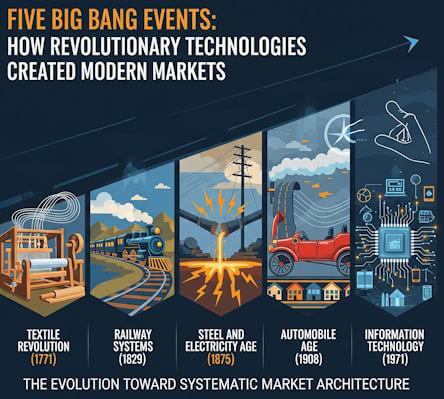
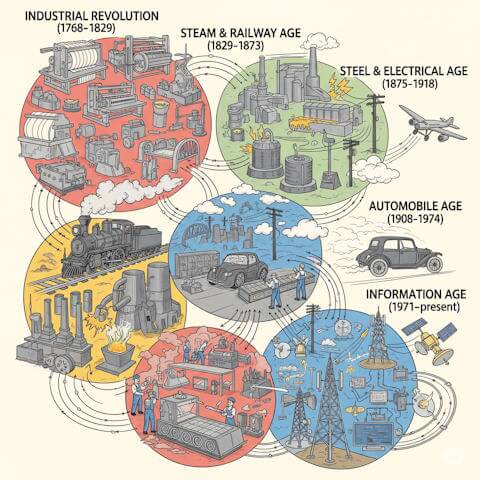
The repository currently documents the five historical technological revolutions identified by Carlota Perez. Within the larger six-supercycle framework, these collections provide a foundation for comparing how innovations combine into productive systems.
Structural comparison: This collection examines recurring technological, industrial, and institutional dynamics side by side. It begins with Disruptions Dawn, the initiating Big Bang of each of the five historical revolutions. Comparing the revolutions reveals patterns that are harder to see when each is studied in isolation.
Chronological research: This collection follows each revolution from its early development through its later stages, with separate innovation lists and bibliographies where available. Coverage varies by cycle and continues to expand.
Structural Comparison: The Five Historical Revolutions
Explore ten recurring dynamics associated with the technological Big Bang of each revolution. Chapter Eleven considers the economic and social consequences of these changes. The linked research currently covers Perez’s five historical revolutions, with the sixth supercycle planned for subsequent expansion.
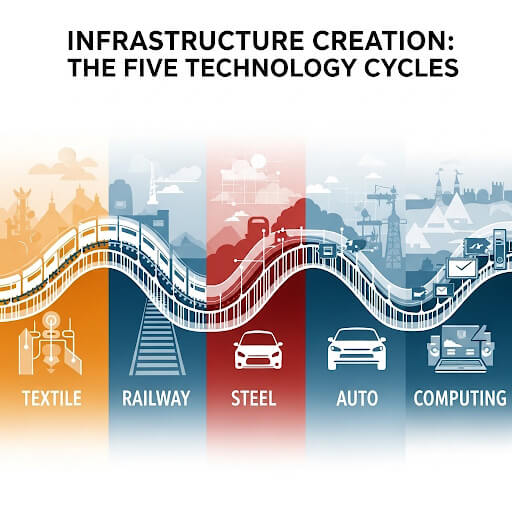
Chapter One: Infrastructure Creation
Infrastructure systems make new technologies useful at scale. From canals and railways to electricity grids and digital networks, each revolution depended on shared facilities that connected producers, workers, suppliers, and markets.
The Innovations and bibliography listings for Infrastructure Creation
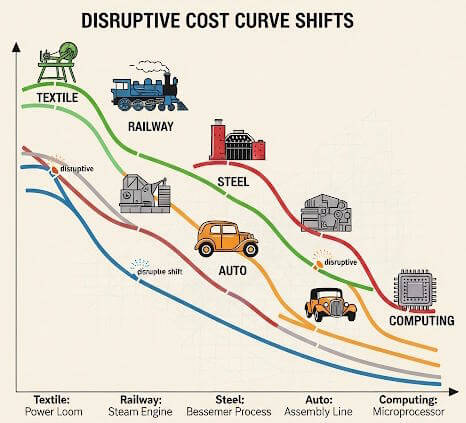
Chapter Two: Disruptive Cost Curve Shifts
Dramatic reductions in the cost of producing, transporting, or using a technology can turn specialized inventions into widespread economic capabilities. The chapters compare how those cost shifts changed markets across five technological revolutions.
The innovations and bibliography for Disruptive Cost Curve Shifts
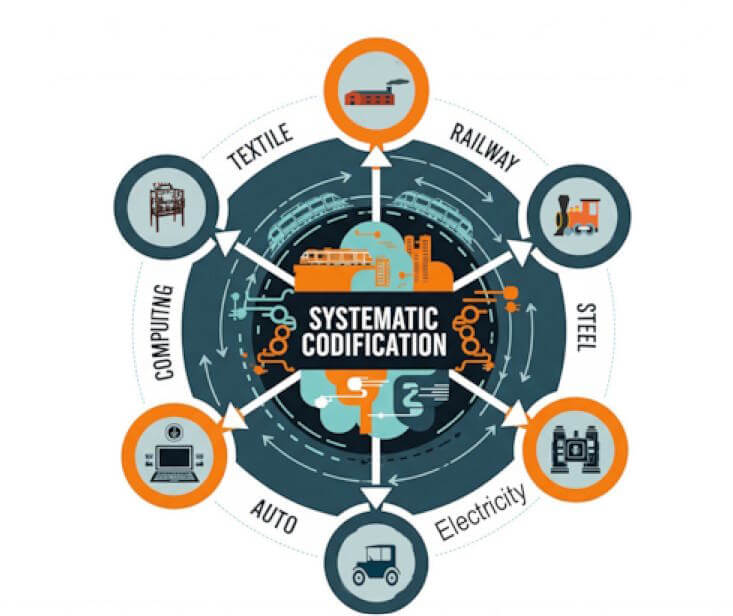
Chapter Three: Systematic Codification
Common measurements, standards, instructions, and technical languages allow inventions to be replicated and combined. Codification made increasingly complex production and coordination possible across firms, industries, and regions.
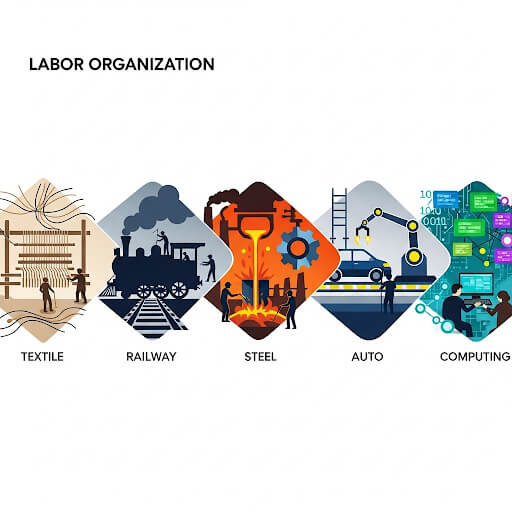
Chapter Four: Labor Organization
Each revolution reorganized work as well as machinery. New skills, divisions of labor, methods of management, and forms of cooperation changed who could participate in production and how work was coordinated.
Chapter Five: New Markets
Breakthrough technologies created markets that had scarcely existed before. New customers, distribution systems, and complementary products expanded demand and opened opportunities for additional industries.
Chapter Six: Innovation Clustering
Major innovations rarely developed alone. Entrepreneurs, inventors, suppliers, and investors formed clusters of related technologies that reinforced one another and accelerated economic change.
Chapter Seven: Socioeconomic readiness
The spread of a new technological system depended upon skills, education, infrastructure, access to capital, and social institutions. Comparing revolutions reveals the conditions that enabled adoption and those that held it back.
The innovations and bibliography for Socioeconomic readiness
Chapter Eight: Capital Alignment
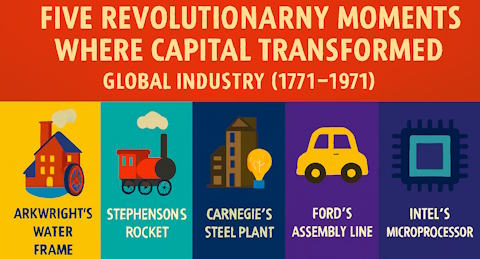
Investment moved toward new technologies as their possibilities became apparent. The chapters examine how financial capital, industrial investment, and institutional support helped determine which innovations expanded.
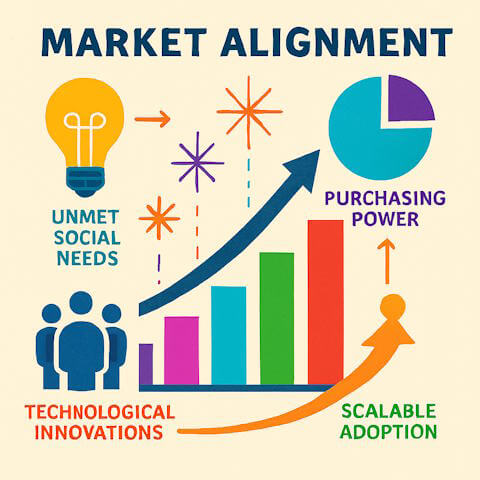
Chapter Nine: Market Alignment
For an invention to spread, its usefulness must meet demand, purchasing power, and viable routes to market. This section compares the conditions through which new technological capabilities became economically sustainable.
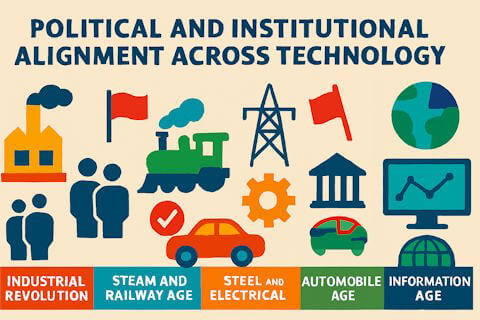
Chapter Ten: Political & Institutional Alignment
Political decisions and institutions shape the development and diffusion of technology. Standards, regulation, property rights, public investment, and collective action can enable growth or obstruct the transition to a new productive system.
The innovations and bibliography for Political & Institutional Alignment
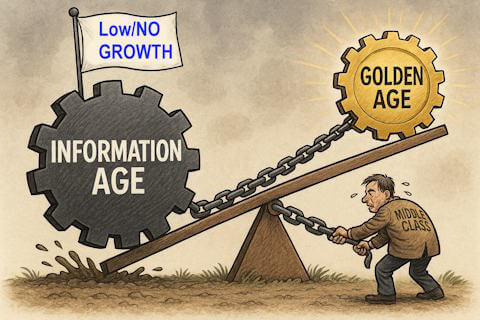
Chapter Eleven: Relevance & Impacts
The consequences of technological revolutions extend into employment, wealth, communities, and political stability. The global middle class expanded enormously alongside industrialization, while many established middle-class communities have faced prolonged insecurity during the digital shift. This chapter examines how the benefits and costs of change have been distributed.

Chronological Library: Innovations and Sources
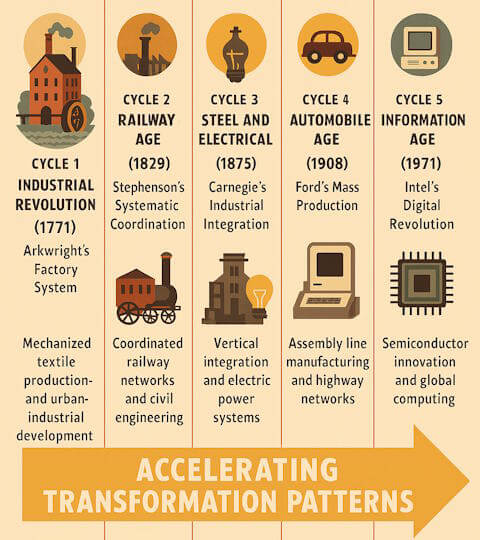
Technology Cycle One: Textiles & Canals

1771–1829
The Industrial Revolution, beginning with mechanized textiles, water power, and the expanding transport systems that supported industrial production.
Bibliography for Technology Cycle One
Innovations and technological improvements for Cycle One
Technology Cycle Two: Steam & Railroads

1829–1873
Steam power and railways transformed transport, industrial production, and the geographical reach of markets.
Gestation research
Innovations and bibliography: Gestation
Installation through Deployment
Bibliography
Innovations
Technology Cycle Three: Steel, Electricity, & Heavy Engineering

1875–1918
Steel, electricity, and heavy engineering supported the growth of large industrial systems and expanding urban infrastructure.
Innovations and bibliography: Gestation
Innovations and bibliography: Installation through Deployment
Technology Cycle Four: Autos, Oil & Mass Production

1908–1974
Oil, automobiles, and mass production reshaped manufacturing, transport, cities, and consumer markets.
Innovations and bibliography: Gestation
Installation through Deployment
Innovations
Bibliography
Technology Cycle Five: Age of Information & Telecommunications

1971–present
Microprocessors, computing, software, and telecommunications created the foundation for the digital economy. This supercycle continues to evolve alongside the sixth.
Innovations and bibliography: Gestation
Innovations: Installation through the Turning Point
Bibliography: Installation through the Turning Point
Supercycle Six: Artificial Intelligence and Autonomous Systems
2022–2060s (projected)
Generative AI and foundation models mark the beginning of a sixth technology supercycle in my framework. Its successive waves are expected to expand autonomous knowledge work, computational and energy infrastructure, scientific discovery, and new productive systems. The dedicated innovations and bibliography collection is planned and is not yet presented as complete. Read about all six technology supercycles.