
Technology Cycle One: Looms to Locks
1771–1829. The first Industrial Revolution began a transformation unlike anything humanity had previously experienced. For thousands of years, economic production depended heavily upon agricultural land, human and animal labor, natural energy sources, and the skills accumulated within households, workshops, and communities. In the late eighteenth century, a new combination of machines, energy systems, industrial organization, and transportation infrastructure began changing the relationship between human effort and productive output.
Carlota Perez identifies 1771 as the beginning of the first great surge of technological development, using Richard Arkwright’s water-powered cotton mill at Cromford, England, as its defining event. The significance of Cromford extended beyond the introduction of a machine. It demonstrated how mechanized production, centralized power, disciplined work organization, financing, and supporting infrastructure could be combined into a new productive system.
The historical importance of this revolution reaches far beyond Britain. It began a process through which industrial productivity would eventually support the expansion of modern cities, commercial institutions, education, infrastructure, and the middle-class ecosystem. That development took generations and spread unevenly across countries. The early factories created enormous productive possibilities while introducing serious new forms of labor exploitation and social disruption.
My Technology Supercycles framework examines this transformation as the first of six major technological revolutions, each developing through overlapping waves of innovation. Understanding how the first revolution emerged helps explain the cumulative process through which later revolutions acquired their productive capabilities.
The Industrial Revolution: Humanity’s Great Discontinuity
Around 1800, the world’s population was approaching one billion people, and most lived under conditions of severe economic constraint. Agricultural productivity, weather, disease, transportation costs, political institutions, and the availability of land shaped the opportunities open to ordinary families. Even where sophisticated commerce and manufacturing existed, sustained improvements in living standards were difficult to maintain across large populations.
Preindustrial societies were capable of remarkable achievements. China, India, the Islamic world, Europe, and other civilizations developed sophisticated technologies, extensive trading networks, engineering practices, and commercial institutions. Advances occurred in agriculture, metallurgy, textiles, shipbuilding, mathematics, and countless other fields. Yet the ability to translate those capabilities into sustained increases in production per person remained limited across much of the world.
The first Industrial Revolution began altering those constraints. Mechanized spinning made it possible to produce textile yarn in quantities that would previously have required much larger amounts of manual labor. Water-powered machinery provided a dependable source of mechanical energy in suitable locations. Improvements in ironworking, construction, and mechanical engineering supported increasingly capable equipment. Canals reduced the expense of moving heavy materials, fuel, and manufactured goods.
The resulting productive system allowed output to expand through combinations of machinery, energy, capital, and organized labor. Its capacity was no longer limited by the number of workers performing each operation through traditional hand methods. The economic consequences accumulated gradually, but the direction of change was profound.
The revolution also established a pattern that would recur in later technological supercycles. New productive capabilities created additional opportunities, attracted investment, generated demand for supporting technologies, and encouraged further industrial development. The economy began reorganizing around an expanding collection of interconnected innovations.
The System Behind the Machines
The Industrial Revolution is often described through its most famous inventions. The spinning jenny, water frame, spinning mule, steam engine, and power loom deserve their place in technological history. Yet their larger significance becomes clear only when we examine how these inventions worked together.
John Kay’s flying shuttle, introduced in 1733, increased the productivity of weaving and contributed to growing demand for yarn. James Hargreaves’ spinning jenny, developed during the 1760s, allowed one worker to operate multiple spindles. Richard Arkwright’s water frame, patented in 1769, made it possible to produce strong cotton yarn using powered machinery. Samuel Crompton’s spinning mule, developed in 1779, combined useful features of earlier spinning technologies and expanded the range and quality of yarn that could be manufactured.
Each improvement changed the economic conditions facing other parts of textile production. Faster weaving increased pressure upon spinning. Improved spinning subsequently increased pressure upon weaving and fabric finishing. This continuing interaction encouraged further innovation in machinery, materials, chemical processes, and manufacturing organization.
W. Brian Arthur’s work on technological evolution provides a valuable way to understand this process. Innovations emerge from combinations of existing technologies, and their adoption creates opportunities for additional combinations. The first Industrial Revolution illustrates how a collection of inventions can develop into a larger productive system whose economic importance exceeds that of any individual machine.
Investment and infrastructure were equally important. Mill owners needed financing, buildings, reliable water supplies, machinery, skilled mechanics, raw materials, transportation, and access to markets. Engineers and manufacturers developed the supporting capabilities needed to construct, operate, and improve increasingly complex industrial equipment.
At Cromford, Arkwright and his partners assembled these elements into an early example of the modern factory system. The mill became a model for industrial establishments that coordinated machinery, energy, labor, and production within a single organization. UNESCO recognizes the Derwent Valley Mills as an important surviving landscape associated with the development of this factory system. UNESCO: Derwent Valley Mills.
Self-Reinforcing Feedback Loops
As manufacturing expanded, its supporting industries developed alongside it. Greater demand for machinery encouraged advances in metalworking and precision engineering. Increasing production created demand for more efficient transportation. Improved transportation widened access to raw materials and customers, making additional industrial investment economically attractive.
Canals were particularly important in this early system. The Bridgewater Canal, opened in 1761, demonstrated how water transportation could reduce the cost of moving coal and other heavy materials. During the following decades, canal construction connected industrial districts, towns, mines, and commercial markets. The new waterways allowed businesses to operate at scales that would have been difficult when transportation depended upon roads and animal-drawn vehicles alone.
These developments established reinforcing relationships among production, infrastructure, markets, and investment. Larger markets encouraged more production. Greater production justified improved transportation. Better transportation reduced costs and created additional markets. The new industrial economy became increasingly capable of supporting its own expansion.
This pattern would later reappear in railways, electricity, automobiles, digital networks, and artificial intelligence. Each revolution developed new technologies that depended upon supporting infrastructure and complementary capabilities. As those systems expanded, they created opportunities that had been difficult to imagine when the original inventions first appeared.
The Social Transformation
The first Industrial Revolution transformed work and social organization as profoundly as it transformed machinery. Before mechanized factories became widespread, much textile production was performed within households and small workshops. Families, merchants, and skilled workers participated in networks of spinning, weaving, finishing, and commercial distribution.
Factory production reorganized these relationships. Work became concentrated in buildings where machines and labor could be coordinated around common sources of power. Employers increasingly controlled the hours, methods, and pace of production. The emerging factory system created new opportunities for industrial employment while reducing the independence of some established producers.
Industrialization did not transform every occupation overnight. Agriculture remained important, hand production continued in many industries, and industrial development varied considerably among regions. Nevertheless, the relationship between households, labor, technology, and employers began changing in ways that would influence the development of modern industrial societies.
The consequences were often harsh. Early factories employed children and adults under working conditions that could be dangerous and exhausting. Families sometimes depended upon the earnings of several members to survive. Industrial towns struggled with housing, sanitation, and the social demands created by concentrated employment. The economic gains generated by new machinery were initially distributed very unevenly.
The expansion of cotton manufacturing also depended upon international trade and, increasingly, cotton produced through enslaved labor in the Americas. The growth of Britain’s textile industry cannot be separated from these global relationships or from the commercial and imperial systems that supplied raw materials and purchased manufactured goods.
These realities are essential to understanding the emergence of the middle-class ecosystem. Industrialization introduced productive capabilities that could eventually support higher living standards, broader education, new occupations, and expanding social participation. Realizing those possibilities required additional generations of institutional change, political struggle, public investment, and economic development.
The Reinvention of Time and Work
Industrialization gradually changed how work was organized in relation to time. Agricultural production had always depended heavily upon seasons and weather. Craft and household production operated through arrangements that varied by occupation, community, and employer. Factory production increasingly organized labor around regular hours, machinery, scheduled operations, and the continuous movement of materials through production processes.
This development encouraged new forms of management, recordkeeping, supervision, and labor coordination. Machines required maintenance and dependable operation. Raw materials had to arrive when needed, while finished products had to be distributed through increasingly extensive markets. The factory became an institution for organizing people, energy, equipment, and information around predictable production.
Over time, these changes contributed to a new understanding of economic progress. Improvements in machinery and production methods could transform the opportunities available within a generation. Families and communities began encountering technological change as a recurring force shaping employment and daily life.
Later technological revolutions would accelerate these relationships. Railways introduced more demanding transportation schedules. Electricity enabled new patterns of industrial operation. Mass production expanded the organization of standardized work. Digital computing eventually compressed many forms of coordination into near-instantaneous electronic systems.
The first Industrial Revolution established important foundations for this evolving relationship between technological capability, organized production, and economic time.
The Four Developmental Periods of Cycle One
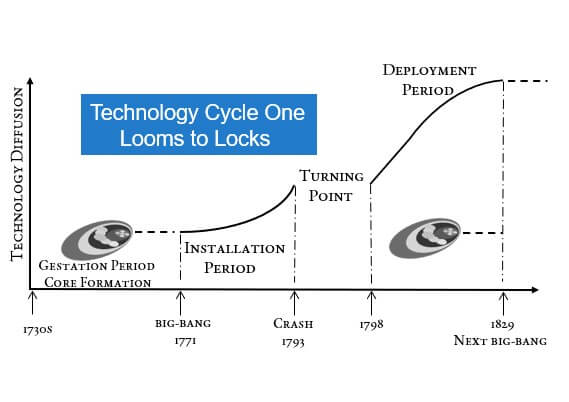
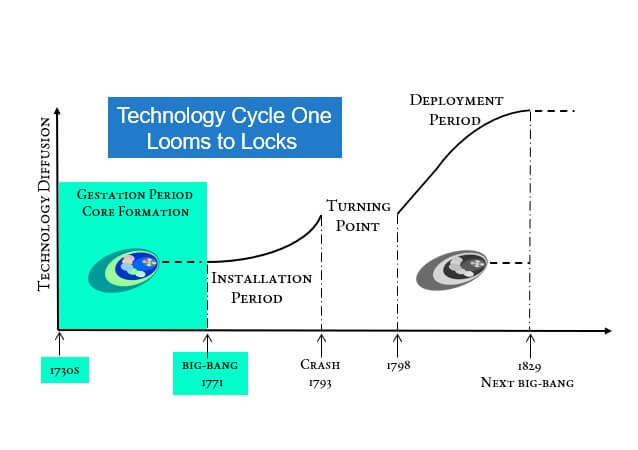
The historical framework developed by Carlota Perez identifies major technological revolutions through Installation, Turning Point, and Deployment. My interpretation adds an earlier Gestation or Core Formation period to examine how the technologies supporting a revolution develop before its initiating breakthrough.
The dates used below are approximate historical boundaries intended to organize the narrative. Technological developments, financial crises, and institutional adjustments did not occur simultaneously across every industry or country. Many processes associated with one period continued into the next.
Gestation and Core Formation: The Hidden Foundation of Revolution
Approximately 1730–1771. The technologies that made the first Industrial Revolution possible emerged through generations of experimentation and improvement. Agricultural innovations, metallurgy, waterwheel engineering, mechanical construction, transportation, and textile manufacturing established capabilities that would eventually be combined into a new industrial system.
John Kay’s flying shuttle increased weaving productivity in the 1730s. The Newcomen steam engine, already introduced earlier in the eighteenth century, continued to undergo improvements. John Smeaton studied waterwheel efficiency, while James Brindley’s canal engineering contributed to the development of more effective water transportation. James Hargreaves and Richard Arkwright developed spinning technologies that addressed the growing need for yarn.
Advances in metallurgy, precision manufacturing, and machine construction helped make these inventions practical. James Watt’s separate condenser patent in 1769 represented an important improvement in steam-engine efficiency, although the commercial development and diffusion of the technology would continue over subsequent decades.
Each innovation contributed to an expanding foundation of productive capabilities. The importance of Core Formation lies in the relationships among these inventions and the industrial opportunities they gradually created. By the early 1770s, several essential technologies could be assembled into factories capable of producing textile materials on a much larger scale.
Arkwright’s Cromford mill became a defining moment because it combined technological innovation with an effective commercial and organizational system. It provides a visible starting point for the first technological revolution while reminding us that the breakthrough depended upon capabilities developed long before 1771.
Read the detailed Cycle One Core Formation chapter.
The Installation Period: Creative Destruction Unleashed (1771–1793)
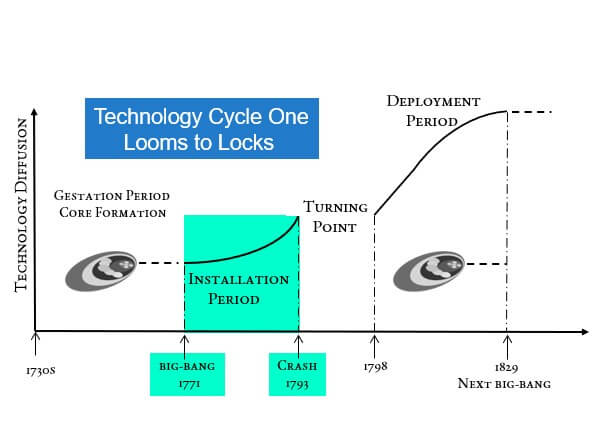
The Installation period began as the emerging factory system demonstrated its commercial potential. Arkwright’s mills showed how water-powered machinery could support production at a scale previously difficult to achieve through dispersed household operations. Investors, manufacturers, and engineers increasingly pursued opportunities associated with mechanized textiles and supporting industries.
New mills appeared in industrializing regions, and machinery became more sophisticated. The spinning mule developed by Samuel Crompton in 1779 improved the production of fine yarn. Edmund Cartwright’s power loom, patented in 1785, introduced an important step toward mechanized weaving, although its widespread commercial success required additional improvements over many years.
The new production methods created competitive pressure upon established manufacturers and workers. Traditional hand production remained economically important, but mechanized spinning began changing prices, output, and the organization of textile manufacturing. Machinery required investment and skilled maintenance, encouraging the growth of supporting industries and specialized engineering capabilities.
Infrastructure expanded alongside production. Canals connected industrial districts with raw materials, coalfields, ports, and markets. New commercial relationships developed among manufacturers, merchants, transport providers, machinery builders, and financial institutions. The emerging productive system increasingly depended upon the coordination of enterprises that performed different but complementary economic functions.
This expansion also attracted financial capital. Industrial ventures required buildings, machines, transportation systems, and working capital. Investors encountered new opportunities as well as substantial uncertainty about profitability, demand, and technological performance. The financial environment was shaped by wars, trade restrictions, credit conditions, and political events extending far beyond the textile industry itself.
The Installation period illustrates the central insight of Perez’s framework: technological revolutions create new productive possibilities before the institutions and economic relationships needed to support them have fully developed. The expansion is therefore both creative and disruptive. New industries grow while established arrangements encounter increasing pressure.
The first revolution also demonstrates the importance of technological recombination. The productivity of textile machinery depended upon power systems, engineering, finance, transportation, and labor organization. Its industrial success emerged from the development of an interconnected productive system.
The Turning Point: When Promise Meets Reality (1793–1797)
By the 1790s, Britain’s industrial development was unfolding within an increasingly unstable financial and political environment. The French Revolution, war between Britain and France, pressure upon international trade, and financial disturbances created substantial difficulties for businesses, investors, and government institutions.
The commercial crisis of 1793 exposed vulnerabilities in credit markets. Business failures and financial difficulties occurred alongside disruptions associated with war and changing commercial conditions. These pressures influenced the resources available for trade and investment, including the continued development of the emerging industrial economy.
In 1797, fear of invasion and demands for gold contributed to a serious monetary crisis. The British government ordered the Bank of England to suspend the conversion of its banknotes into gold. This measure began the Restriction Period, which lasted until 1821. The suspension illustrates the extraordinary financial and institutional pressures confronting Britain during the period. Bank of England: Historical Timeline.
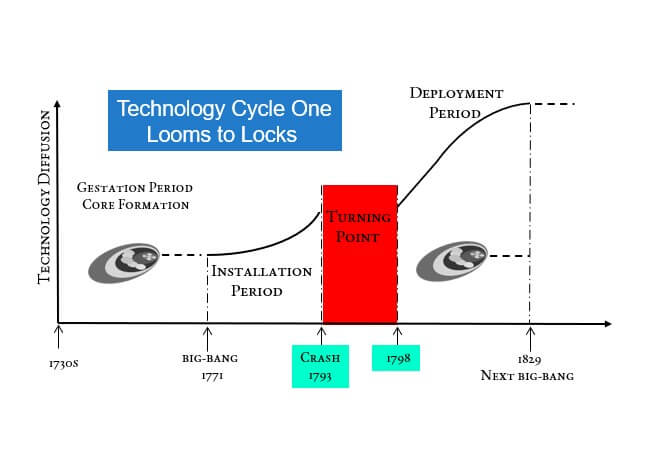
These events provide a useful setting for examining the Turning Point identified in Perez’s model. Financial instability and institutional stress affected the economy while the new industrial technologies continued expanding. Productive development depended upon arrangements capable of supporting investment, trade, banking, and manufacturing despite considerable uncertainty.
However, the difficulties of the 1790s should not be treated as a single crisis caused entirely by industrial speculation. War, international finance, government borrowing, trade conditions, and established commercial institutions all played important roles. The connection between these events and the technological revolution is an interpretation of the broader historical transition rather than a claim that the machinery of the Industrial Revolution directly caused each financial disturbance.
Institutional adaptation also extended far beyond 1797. Changes in banking, industrial organization, labor arrangements, commercial law, and government responsibilities continued throughout the nineteenth century. The historical Turning Point can therefore be understood as part of a wider process through which an economy adjusted to new productive capabilities.
The productive significance of the revolution remained intact. Mills, machinery, canals, technical knowledge, and industrial skills continued providing foundations for further economic development. The challenge was to establish commercial and institutional conditions in which those capabilities could expand and become more widely integrated into the economy.
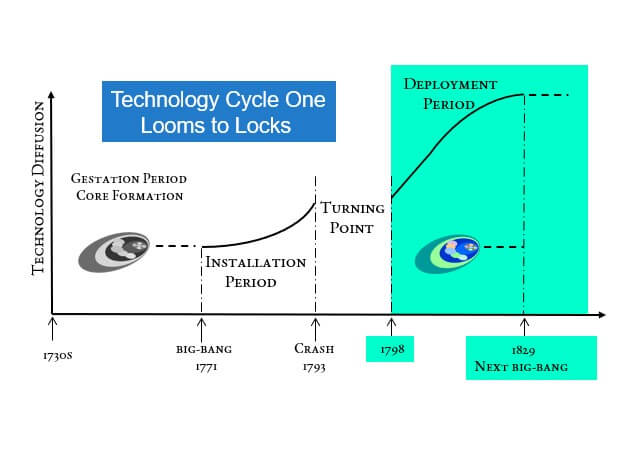
The Deployment Period: Technology Finds Its Purpose (1798–1829)
During the early nineteenth century, mechanized production became more deeply established within Britain’s industrial economy. Textile manufacturing expanded, factory methods developed, and improvements in machinery and industrial organization increased the productive capabilities available to manufacturers.
Steam power became increasingly important as improved engines found wider applications in mining, manufacturing, and transportation. Water power remained significant in many factories, while improvements in ironworking, machine construction, and precision engineering supported additional industrial development.
Canal networks connected manufacturing districts with markets and raw materials, reducing transportation constraints that had previously limited industrial activity. Improved access to coal, cotton, machinery, and finished goods encouraged the growth of supporting businesses and industrial communities.
The development of the productive system created opportunities beyond the owners of the original textile machinery. Machine builders, engineers, canal operators, merchants, transport providers, financiers, and commercial enterprises became participants in an expanding industrial ecosystem. Their activities supported additional specialization and improvements in productive efficiency.
The period also witnessed increasing industrial development outside the original British centers. Manufacturing capabilities spread through commercial relationships, skilled workers, technological transfer, and investment. Some technologies were adopted rapidly in suitable regions, while other societies encountered different conditions involving labor costs, resources, institutions, and access to capital.
Industrial expansion continued producing severe social costs. Factory employment could involve long hours and dangerous conditions, while workers had limited political and economic protections. Child labor remained an important part of the industrial economy. Growing public concern, worker organization, and political debates would eventually contribute to reforms extending well beyond this first Deployment period.
The Deployment phase therefore represents the wider productive establishment of a technological system. It does not imply that the revolution immediately delivered prosperity to every participant. The development of industrial productivity preceded many of the educational, legal, political, and labor institutions that later enabled greater numbers of people to benefit from it.
The emergence of commercial railways marked an important boundary between the first and second technological revolutions. Railways depended upon steam engines, metallurgy, mechanical engineering, and other capabilities that had been developed and refined during the earlier industrial era. As those capabilities combined into a new transportation system, they established the foundations of another revolution.
In 1829, George Stephenson’s Rocket demonstrated the advancing capabilities of steam locomotion during the Rainhill Trials. The opening of the Liverpool and Manchester Railway followed in 1830. Perez uses 1829 as the starting point of the second great technological surge, centered upon steam power and railways.
This transition illustrates one of the most important relationships in technology-cycle theory. The productive capabilities of one revolution can become the essential foundation of the next. The first Industrial Revolution created machinery, skills, materials, infrastructure, and institutional experience that made the railway revolution possible.
The Long Emergence of the Modern Middle Class
The historical importance of the first Industrial Revolution becomes still more significant when viewed across the following two centuries. Industrialization created a new relationship between accumulated knowledge, productive capital, labor, infrastructure, and economic growth. The resulting capabilities gradually expanded beyond Britain and became the foundations for successive waves of industrial development across the world.
At the beginning of this transformation, a large modern middle class did not yet exist. Merchants, professionals, skilled artisans, and other relatively prosperous groups had existed for centuries, but the productive opportunities and purchasing power that would eventually support a middle-class population of billions were still developing.
From the early nineteenth century onward, industrial development began expanding the economic capabilities available to growing populations. The process first advanced strongly in parts of Europe, subsequently spread through North America, Oceania, and Japan, and eventually became a major force in the industrialization of Asia and other developing regions.
This expansion depended upon much more than mechanical inventions. New productive systems required educated workers, engineering knowledge, transportation, financial institutions, public infrastructure, legal arrangements, and increasingly sophisticated forms of economic cooperation. The accumulation of these capabilities across generations created the foundations of the modern middle-class ecosystem.
The middle class became an increasingly important participant in the creation of wealth itself. Its accumulated skills, knowledge, productive work, entrepreneurial activity, taxes, savings, investment, and support for public institutions contributed to the development of the capabilities upon which later technological revolutions depended.
The history of the first Industrial Revolution therefore raises a question that remains important today. When a society collectively develops the capabilities making technological wealth possible, how do its institutions determine who participates in the resulting economic rewards?
The question became more consequential as railways, electricity, automobiles, computing, and artificial intelligence transformed the productive systems inherited from earlier generations. Each revolution drew upon a larger foundation of accumulated knowledge and infrastructure, while introducing new forms of economic power and new possibilities for concentrating or sharing its benefits.
From Cycle One to the Six Technology Supercycles
The first Industrial Revolution provides the starting point for the historical framework developed by Carlota Perez. Its emergence demonstrates how technological breakthroughs, complementary innovations, industrial investment, infrastructure, and organizational change can combine into a new productive system.
My broader six-supercycle framework builds upon this historical pattern by examining five overlapping waves of innovation within each technological revolution. The development of mechanized spinning, factory production, industrial power, transportation infrastructure, and supporting engineering capabilities illustrates how the first revolution developed through related technological clusters that reinforced one another.
Later revolutions extended these productive capabilities. The railway revolution built upon advances in steam machinery, ironworking, and transportation. Steel and electricity transformed industrial production. Automobiles and mass production reorganized transportation, manufacturing, and consumer markets. Digital computing enabled worldwide networks of production and communication. Artificial intelligence is now developing from the accumulated capabilities created by those earlier systems.
Across all six supercycles, the economic consequences depend upon how technologies are combined, how financial and institutional systems respond, and whether their productive benefits reach the wider population. The historical transformations create new opportunities, but the resulting distribution of wealth and economic security is shaped by the institutions and relationships established around them.
Explore the Six Technology Supercycles and Their Five Innovation Waves.
Cycle One Research: The Singularity Stacks

The Singularity Stacks Reference Library contains research material documenting the inventions, technological improvements, and historical publications associated with the first Industrial Revolution.
The Cycle One collections bring together developments during Core Formation, Installation, Turning Point, and Deployment. They provide a foundation for examining how textile machinery, water power, industrial engineering, transportation, finance, and institutional change contributed to the development of the first technological revolution.
Cycle One: Bibliography and Historical Research
Why the First Industrial Revolution Still Matters
The first Industrial Revolution established a new foundation for human economic development. Its machinery made production more capable. Its factories introduced new forms of industrial organization. Its canals and supporting infrastructure connected production with markets. Its engineers, manufacturers, financiers, and workers created an increasingly interconnected productive system that would support further technological revolutions.
The transformation also demonstrated that rising technological capability does not automatically create broad prosperity. The economic benefits of industrialization developed unevenly, and many workers endured difficult conditions before political, social, and institutional changes gradually expanded their opportunities.
Those two developments remain central to understanding technological history. Each revolution creates new wealth by combining capabilities developed across generations. The institutions governing the resulting economy influence whether that wealth becomes a foundation for wider productive opportunity or remains concentrated among a relatively small number of owners.
The first revolution began the industrial transformation that eventually made a global middle class possible. The five revolutions that followed expanded humanity’s productive capabilities beyond anything its early industrial pioneers could have imagined. The challenge for the emerging AI supercycle is to understand how those accumulated capabilities can continue generating economic progress while supporting the people and institutions that made them possible.
Continue Exploring the Technology Cycles
Return to Carlota Perez’s Five Historical Technology Cycles.
Continue to Cycle Two: Steam Power and Railways.
Explore the Six Technology Supercycles.
Explore Disruptions Dawn: The Recurring Dimensions of Technological Transformation.