
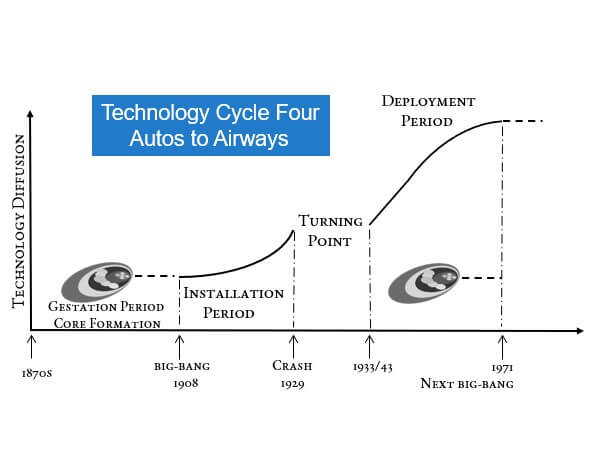
Technology Cycle Four: Autos to Airways
1908–1974. Oil, Automobiles, and Mass Production. The fourth technological revolution changed the economics of manufacturing, transportation, energy, and ordinary family life. Built on the steel, electricity, machine tools, and industrial chemistry of the preceding revolution, it turned complex manufactured products into standardized goods produced in enormous quantities. Motor vehicles became the most recognizable expression of this transformation, but its consequences spread through petroleum refining, rubber, chemicals, roads, aviation, household appliances, housing, communications, and public infrastructure.
Carlota Perez dates the beginning of the fourth technological surge to the arrival of Ford’s Model T in 1908. The car made an emerging productive possibility visible: a reliable, relatively affordable vehicle designed for a large market. Ford introduced the moving automobile assembly line five years later, in 1913. The distinction matters. The defining commercial product came first; the manufacturing system that dramatically reduced its cost developed afterward through further experimentation and accumulated capability.
In my Technology Supercycles framework, this revolution demonstrates how productive capacity becomes a foundation for mass purchasing power. Machinery, factory organization, energy, materials, transport, labor institutions, public investment, and consumer markets had to develop together. When they eventually did, large portions of the population in several advanced industrial countries acquired greater economic room to act. The relationship between productivity, wages, ownership, and access to markets became central to the prosperity of a modern middle-class ecosystem.
The revolution also reveals how damaging the transition can be. Financial speculation and the crash of 1929 preceded years of banking failure, unemployment, and political instability. World War II mobilized industrial capacity on a staggering scale, with profound human destruction. Only later did much of the mass-production system become the foundation for a broad postwar expansion. Its successes and exclusions both matter to understanding the fifth digital revolution and the AI supercycle now developing upon it.
The Productive System Behind Mass Production
The automobile and standardized manufacturing
The automobile drew together technologies that had been developing for decades: the internal-combustion engine, steel frames, precision machinery, gears, ignition systems, tires, and refined fuel. Karl Benz and Gottlieb Daimler built practical motor vehicles in the 1880s, while firms in Europe and America experimented with designs, engines, and manufacturing methods. Automobiles initially remained expensive products that required substantial attention from skilled mechanics.
Ford’s achievement was to make the automobile suitable for a much larger market and then reorganize production to serve that market. At Highland Park, beginning in 1913, the moving line brought the work to employees rather than requiring teams to move around a nearly complete vehicle. Subassemblies, standard parts, specialized tools, work sequencing, and material supply were coordinated to reduce delays and increase throughput. Continuous-flow practices already existed in other industries, including meatpacking. Ford’s innovation lay in combining and applying them effectively to automobile manufacturing.
The enormous increase in output lowered unit costs and encouraged others to improve manufacturing methods. The same organizing principles spread to appliances, farm equipment, consumer goods, and many forms of industrial production. They also reduced discretion over the pace and organization of factory work. Assembly-line efficiency brought difficult questions about fatigue, turnover, skill, and management control.
Petroleum, rubber, steel, and industrial chemistry
A mass market for automobiles required a dependable fuel system. Oil producers, refiners, pipeline operators, tank-car companies, and service stations formed a supporting network through which gasoline could reach drivers. Petroleum became increasingly important to industrial and military transportation, while its refining and chemical byproducts created new commercial opportunities. The revolution therefore reorganized energy supply as well as transportation.
Steel and rubber supplied other essential foundations. Improved steelmaking made large quantities of durable components available. Natural rubber and later synthetic rubber supported tires, hoses, belts, and numerous industrial products. Industrial chemistry generated plastics, coatings, fertilizers, synthetic fibers, medicines, and specialized materials that expanded the range of things factories could produce. These industries reinforced one another as growing markets encouraged investment in research, machinery, and scale.
Roads, logistics, and aviation
A car is valuable only when people can drive it. Roads, bridges, fuel distribution, repair shops, vehicle registration, traffic rules, insurance, and maintenance services became part of the new productive system. Trucks allowed businesses to connect factories, warehouses, farms, and customers using routes less dependent on railway terminals. The economic geography of homes, employment, retailing, and distribution began changing with them.
Aviation developed alongside this transformation. The Wright brothers’ powered flight in 1903 preceded the fourth revolution’s starting date, and aviation grew through aircraft design, lightweight materials, engines, navigation, airfields, military demand, and commercial operations. By the middle of the century, increasingly capable airliners were reducing travel times between continents. Aviation followed its own technical and institutional development rather than simply growing out of automobile manufacturing, but both benefited from shared advances in engines, materials, mass production, and modern logistics.
Electrical appliances and mass communication
The third revolution’s electrical networks supplied another essential foundation. Manufacturers used electric motors and increasingly sophisticated machines, while households gradually acquired appliances that altered cooking, cleaning, refrigeration, and other daily activities. These changes required dependable electric service, manufacturers, retailers, financing, and repair networks. Their diffusion remained uneven across income groups and between rural and urban communities.
Radio, and later television, developed into powerful mass-communication industries. National advertising, entertainment, consumer brands, and increasingly sophisticated retail distribution helped connect production to large markets. Mass culture expanded alongside the mass-production economy, creating new possibilities for participation and new concentrations of commercial influence.
The Four Developmental Periods of Cycle Four
Perez’s historical model describes Installation, a Turning Point, and Deployment, with Irruption and Frenzy inside Installation and Synergy and Maturity within Deployment. My framework adds an earlier Gestation or Core Formation period to examine the invention and industrial preparation preceding the initiating commercial breakthrough. The dates below are approximate: industries, nations, and institutional arrangements moved at different speeds.
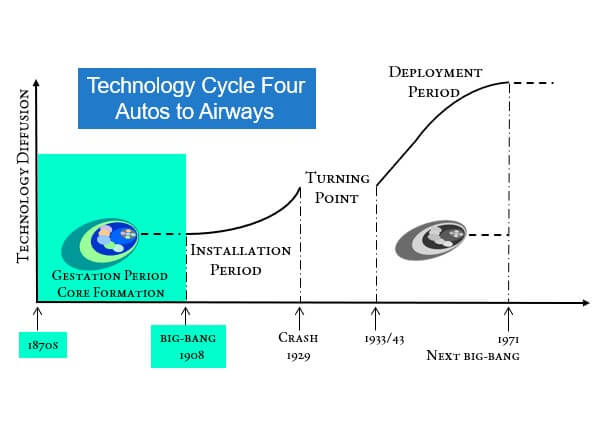
Gestation and Core Formation: The Industrial Foundations of the Automobile (1870s–1908)
The fourth revolution was prepared within the third. The development of inexpensive steel, precision machine tools, electrical systems, industrial chemistry, and complex engineering enterprises made a mass-produced motor vehicle possible. These capabilities accumulated through successive technical improvements and through institutions capable of combining research, investment, skilled workers, and commercial experimentation.
Nikolaus Otto’s four-stroke engine of 1876 was an important step in the development of internal combustion. The practical automobiles created by Karl Benz and the work of Daimler and Maybach during the 1880s demonstrated that engines, transmissions, steering, ignition, and chassis could be combined into motor vehicles. The experiments exposed weaknesses that later engineers worked to correct: reliability, weight, cooling, starting, fuel supply, and the high cost of production.
The petroleum industry was evolving at the same time. Refining facilities, tank cars, pipelines, and distribution systems grew during the late nineteenth century. The availability of gasoline, initially one of several refined petroleum products, became much more important as motor vehicles appeared. Meanwhile, advances in tires, steel production, electric ignition, and standardized machinery made automobiles increasingly practical.
Early car companies experimented with distinctive designs and production arrangements. Ransom E. Olds introduced a form of stationary progressive assembly for the Curved Dash Oldsmobile in the early 1900s. Ford Motor Company was founded in 1903. The Wright brothers achieved powered, controlled flight that same year, another visible indication that improvements in engines, materials, and precision engineering were opening new transportation possibilities.
During Gestation, these advances had not yet produced the full mass-production economy. The essential capabilities were developing across separate industries and firms, gradually solving one another’s technical and commercial bottlenecks. By 1908, Ford could introduce the Model T as a comparatively simple, durable vehicle for a broad potential market. The next stage would require reorganizing manufacturing and creating the infrastructure needed to reach those customers.
The detailed Cycle Four Core Formation chapter examines the five developmental stages of this preparatory period. I treat Core Formation as an extension to Perez’s original model.
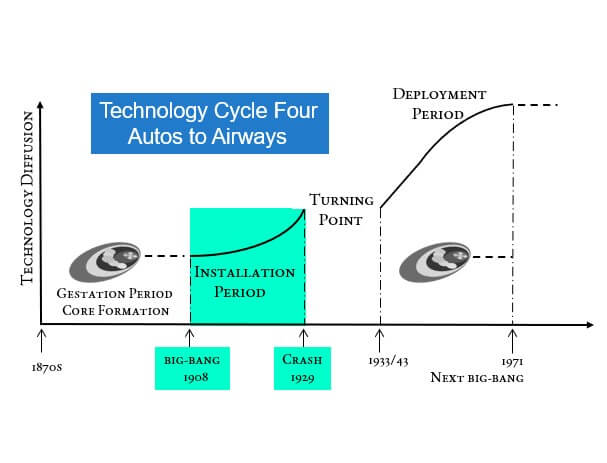
The Installation Period: The Model T, the Factory, and the New Consumer Economy (1908–1929)
The Model T entered the market in 1908. It initially came from Ford’s Piquette Avenue factory, where manufacturing still relied on established assembly arrangements. Highland Park opened in 1910 and became the place where Ford’s production team introduced the moving assembly line for automobiles in October 1913. Production methods improved continually, and the time required for major assembly operations fell dramatically.
The growing efficiency of the system reduced prices and expanded the market. Lower costs helped put automobiles within reach of families who could not have contemplated buying one a generation earlier. In 1914, Ford introduced the famous five-dollar workday, including profit-sharing arrangements and eligibility conditions, together with shorter shifts. The policy helped address severe labor turnover and drew workers to Ford. It also revealed a powerful relationship between production costs, wages, the organization of work, and the size of the consumer market.
Ford’s system was both a technological and managerial innovation. Standardized components and repetitive tasks allowed a large number of workers to contribute to complex production without every worker mastering the construction of the entire vehicle. The resulting output required careful coordination of suppliers, machinery, maintenance, raw materials, and distribution. Other manufacturers adopted and modified these methods, producing a wider industrial transformation.
Oil and vehicle industries expanded together. Automobile demand encouraged investment in refining, fuel distribution, rubber, steel, glass, and highway construction. Growing numbers of trucks changed freight distribution, while farm machinery and other engine-powered equipment altered agricultural production. The economic value of the automobile increased as roads, service stations, repair shops, and supporting services spread.
The transformation extended into everyday life. Communities built roads, and households began moving across larger territories for work, shopping, and recreation. Manufacturers developed washing machines, vacuum cleaners, refrigerators, radios, and other consumer goods for increasingly large markets. Advertising, installment credit, and department stores helped organize the demand necessary to support high-volume production.
These gains arrived unevenly. Access to automobiles and modern appliances depended upon income, race, geography, credit, and local infrastructure. Assembly-line work was frequently exhausting, and labor conflict remained widespread. The new system increased productive capacity without automatically establishing the labor and institutional arrangements required to distribute its gains broadly.
The Casino Phase: When the Financial Boom Outran Productive Earnings
The American economy of the 1920s appeared to demonstrate the extraordinary possibilities of the new productive system. Automobiles, radios, consumer appliances, and electrical equipment encouraged both industrial investment and widespread enthusiasm about the future. Public companies attracted investors who expected sales, earnings, and share prices to continue expanding.
Financial speculation grew alongside legitimate industrial development. Credit financed consumer purchases, commercial expansion, and securities investment. Buying stocks on margin made it possible to acquire claims on financial assets with substantial borrowed money. Rising prices encouraged further buying, reinforcing expectations that continued appreciation would make borrowing safe.
The financial boom cannot be explained solely by automobile manufacturing or by a single technology. Monetary conditions, international capital flows, banking arrangements, real-estate development, distribution of income, and financial incentives all contributed to the vulnerabilities accumulated during the decade. The productive achievements of the revolution and the speculative valuations attached to future profits were related, but they were not the same thing.
The stock-market crash of October 1929 revealed the fragility of those expectations. The crash occurred within an economy already entering recession. Investment contracted, and later banking panics intensified the deterioration. The productive value of factories, machinery, and technical knowledge did not vanish, but the financial and demand conditions needed to employ those assets collapsed.
This is one of the central lessons of Perez’s Installation period: a technological revolution can generate genuinely valuable infrastructure and new productive capabilities while financial capital creates claims whose values cannot be sustained. The adjustment that follows can damage the wider economy long after the speculative investments have failed.
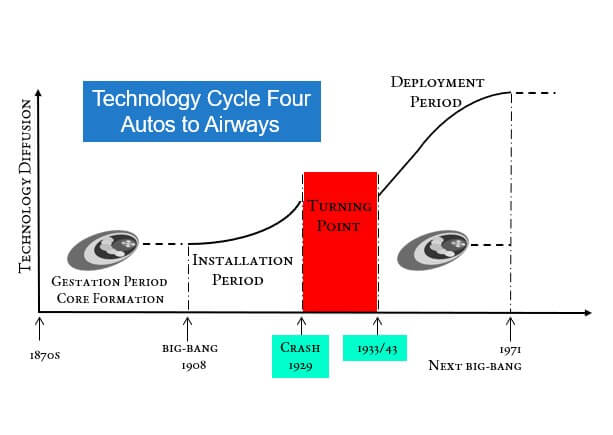
The Turning Point: Depression, Institutional Crisis, and War (1929–1943)
The Great Depression began in 1929 and grew into a catastrophe of unemployment, banking failures, deflation, declining production, and political instability. Falling prices increased the real burden of debts, while the collapse of credit and spending damaged businesses that had not themselves created speculative financial arrangements. Industrial capacity remained available even as factories closed and workers lost their incomes.
A central historical problem was that the mass-production system had greatly increased the economy’s ability to manufacture goods, but the institutions connecting productive capacity to durable purchasing power remained weak. Industrial workers faced insecurity, farm incomes were depressed, and financial losses spread through banks and households. The crisis involved many causes, including weaknesses in banking and monetary institutions, international financial constraints, investment collapse, and unequal economic conditions.
The American banking system reached its most acute crisis in March 1933. Roosevelt’s administration responded with emergency banking measures, financial reforms, relief programs, and public investment under the New Deal. Recovery began after 1933, although unemployment remained severe and the recession of 1937–1938 interrupted progress. It would be inaccurate to describe the 1930s as a period without any economic recovery.
The Turning Point also developed differently across the Atlantic. Germany’s political crisis led to the appointment of Adolf Hitler as chancellor in January 1933 and the rapid destruction of parliamentary democracy. Other European countries experienced authoritarian pressure, political instability, and sharply different institutional responses. Economic distress helped destabilize societies, but the path from economic crisis to dictatorship was shaped by distinct political institutions, ideology, leadership, and historical conditions.
Authoritarian states sometimes used industrial mobilization and state-directed investment to consolidate power and prepare for warfare. The economic effects of these policies must be separated from their profoundly destructive political and human purposes. The transformation of the productive economy did not determine a single political destination; national choices and institutions mattered enormously.
World War II exposed the extraordinary production capacity created by decades of industrial development. Governments organized supplies of steel, petroleum, rubber, machine tools, ships, aircraft, vehicles, and weapons. Manufacturers converted factories to wartime production, while workers and suppliers coordinated operations across very large production networks. Ford’s Willow Run facility became famous for the assembly of B-24 bombers, and American shipyards developed methods for building standardized vessels in enormous quantities.
This was a massive demonstration of what industrial organization could accomplish when finance, procurement, science, labor, and manufacturing were mobilized toward common objectives. It was also a period of unprecedented loss of life and destruction. The mobilization cannot be represented as an economic success divorced from the war’s human consequences.
In this site’s chronology, 1929–1943 is the principal Turning Point for the United States, with important institutional responses beginning in the 1930s and the reorganization of industrial production becoming especially visible by 1943. The dates differ across countries. The European political break beginning in 1933 and the later American shift toward wartime mobilization should be distinguished from the beginning of postwar consumer Deployment.
The wartime experience raises an important question for the larger technology-supercycle model. If an economy can coordinate extraordinary productive capacity through public policy and private industry, what institutions allow that capacity to serve households and communities in peacetime? The postwar answer involved a different set of investments, labor arrangements, public institutions, and international relationships.
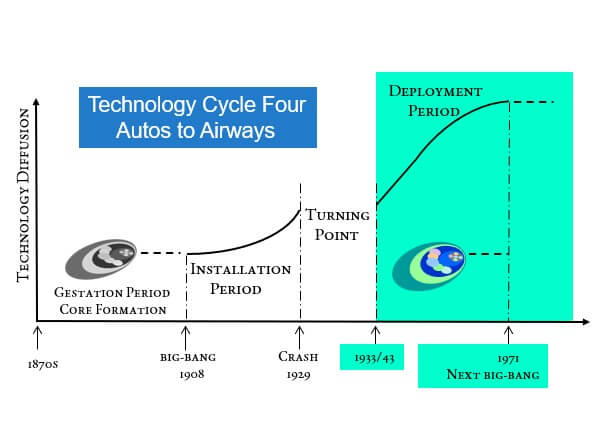
The Deployment Period: Mass Production Becomes a Broad Economic System (1943–1970s)
The Deployment of Cycle Four emerged from the institutional and industrial changes of the Depression and war. Factories, machinery, technical skills, production procedures, research, and large supply networks could increasingly support civilian demand. The transition from military mobilization to household prosperity required changes in employment, housing, finance, education, infrastructure, international trade, and the organization of production.
Mass production proved capable of supplying automobiles, appliances, machinery, construction materials, packaged goods, and numerous other products at volumes and costs that earlier generations could scarcely have imagined. Yet the spread of these capabilities depended upon whether households possessed the income and access required to purchase what industry could produce. The stronger connection between productivity and purchasing power in many advanced economies helped create a distinctive postwar period of growth.
The postwar middle-class settlement
In the United States, collective bargaining, higher productivity, public education, home financing, social insurance, and rising industrial employment helped enlarge the economic room available to many families. The five-dollar day introduced by Ford decades earlier had demonstrated a link between employment and consumer demand, but the broad postwar middle class developed through much wider institutional changes.
The Servicemen’s Readjustment Act of 1944, widely known as the GI Bill, supported education and housing opportunities for millions of veterans. Public investment expanded transportation, utilities, schools, and community infrastructure. The effects were substantial but uneven; racial discrimination, segregation, and unequal access to lending, housing, education, and employment limited the benefits available to many households.
Several European countries and Japan rebuilt their productive systems after wartime destruction. Institutional arrangements differed, but expanded industrial capability, training, infrastructure, export markets, and social protections helped support rising living standards. The period was a major stage in the international expansion of modern middle-class economic participation.
The middle class developed into a productive ecosystem as well as a consumer market. Workers and households contributed taxes, skilled labor, education, savings, entrepreneurship, and investments in the next generation. Those capabilities supported the continued expansion of industry and the accumulation of knowledge inherited by later revolutions.
Highways, suburbs, and the new economic geography
The automobile became integral to a much larger transportation system. In the United States, the Federal-Aid Highway Act of 1956 provided a durable financing structure for accelerated interstate construction. Roads, bridges, service stations, distribution centers, motels, shopping areas, and suburban development changed the relationship between homes, employment, and commerce.
Trucking grew more competitive for many kinds of freight, complementing and sometimes displacing railway services. Manufacturers and retailers reorganized their operations around road transport and increasingly dispersed supply chains. Suburban housing expanded, along with commuting, consumer services, and a powerful new pattern of land development.
These changes also carried costs. Highway construction displaced neighborhoods, frequently including lower-income and Black communities. Automobile dependence increased energy consumption, air pollution, congestion, and the costs of maintaining extensive road infrastructure. Access to jobs and services increasingly depended on transportation and housing choices that were unequally available.
Airways, global logistics, and mass communication
Commercial aviation expanded rapidly after the war. Better aircraft, airports, navigation systems, engines, and international operating arrangements supported faster travel and freight movement. Jet airliners, including the Boeing 707 entering commercial service in 1958, began transforming long-distance passenger transportation. The widespread affordability and routine character of international air travel developed gradually over subsequent decades.
Radio and television connected mass audiences, supporting advertising, entertainment, political communication, and national consumer brands. These networks gave large enterprises new ways to create demand and organize commercial relationships. The transformation of communications would become one of the foundations of the fifth technological revolution.
The limits of a Golden Age
The postwar decades are often described as a Golden Age of capitalist expansion, particularly in Western Europe, Japan, and North America. The description reflects unusually strong productive growth and the broadening of middle-class opportunities in many industrial economies. It should not be taken to mean that all people or countries shared equally in those gains.
Industrial jobs could provide wages and security unavailable to many earlier workers, but access remained shaped by race, gender, immigration status, geography, and collective bargaining institutions. Outside the richest industrial countries, many economies remained constrained by colonial legacies, unequal trade relationships, limited infrastructure, and restricted access to capital.
The productive system itself also generated long-term vulnerabilities. Oil dependence exposed households and industry to energy supply disruptions. Suburban expansion placed substantial demands upon land and public infrastructure. Large corporations could achieve efficiency through scale while accumulating considerable influence over workers, suppliers, and markets.
Maturity and the Transition Toward Cycle Five (1960s–1974)
By the late 1960s and early 1970s, parts of the mass-production economy were approaching maturity. Established manufacturers faced changing competition, rising costs, pressures on profitability, and the need to adapt to new technologies and international production relationships. Japan and Western European industries were increasingly important competitors in automobiles and other manufactured goods.
The breakdown of the Bretton Woods dollar-gold convertibility arrangement in 1971, followed by the oil shocks beginning in 1973, altered the economic and financial environment in which the fourth revolution had developed. Inflation and slower growth challenged institutional arrangements that had performed well during the postwar expansion. Oil dependence made the disruption particularly consequential for transportation and industry.
Meanwhile, the first commercial microprocessor introduced in 1971 helped initiate Cycle Five in Perez’s chronology. Digital computing, telecommunications, and software had begun developing a new productive system while automobiles, petroleum, mass production, and the supporting industrial infrastructure remained essential. The two revolutions overlapped, just as steel and electricity had continued expanding after the Model T appeared in 1908.
The site’s approximate ending date of 1974 for Cycle Four is a historical boundary for the fourth surge’s maturity, rather than a claim that the automobile, oil, or mass-production industries ceased to develop. Their capabilities continued evolving and became part of the productive foundation inherited by the digital economy.
What Cycle Four Tells Us About the Origin of Wealth
The fourth technological revolution helped demonstrate how modern wealth is generated through a productive ecosystem. Its manufacturers depended upon generations of investments in metallurgy, electricity, engineering, industrial chemistry, education, roads, scientific research, and commercial institutions. No single automobile or energy company created those foundations independently.
Workers, suppliers, engineers, entrepreneurs, public institutions, and households made the system function. Their collective contributions accumulated across decades, helping to create a powerful middle-class economy capable of supporting further technological investment. The broadening of purchasing power became part of the productive system itself: factories could operate at scale because millions of people had the income and institutional access needed to participate in the markets they served.
The period also shows why the distribution of economic gains is a central productive question. Mass production had existed for decades before postwar institutions connected its capabilities to substantially broader prosperity. The relationship between productivity, wages, financial arrangements, public infrastructure, and market access shaped the social consequences of technology.
This lesson matters to the digital and AI revolutions. Enormous productive capabilities can develop while financial rewards concentrate among relatively few owners. The institutions that translate technological capacity into durable economic participation deserve the same attention as the innovations themselves.
Why This Story Was Told
The Model T made a new market visible. The moving assembly line and its supporting industries transformed the economics of supplying that market. Financial excess then exposed the fragility of the economic arrangements developing around the revolution, and the Depression demonstrated the human cost when productive capacity could no longer find sufficient demand.
The later broadening of prosperity required industrial capability, public investment, labor institutions, education, infrastructure, and economic coordination. Cycle Four shows that technology creates possibilities while institutions determine much of their reach. Its central lesson is that a productive revolution becomes durable when the capabilities accumulated across society can be used by a growing share of the population.
Cycle Four Research: The Singularity Stacks

The Singularity Stacks library provides detailed research into the inventions, industrial capabilities, and supporting sources associated with the fourth technological revolution. Its materials document Core Formation and the later Installation, Turning Point, and Deployment periods.
Cycle Four: Core Formation Research and Innovations
Enter the Main Singularity Stacks Reference Library
The library also contains separate research collections for the technological developments of the Installation and Deployment periods.
Cycle Four: Installation through Deployment Bibliography and Cycle Four: Innovations Listing.
Further Historical Sources
Ford Motor Company: History of the Model T. The 1908 introduction and its place in automobile production.
Library of Congress: Ford Implements the Moving Assembly Line. The 1913 change in automobile manufacturing.
Ford Motor Company: The Moving Assembly Line and the Five-Dollar Workday. Factory organization and labor conditions.
Federal Reserve History: The Great Depression. Financial collapse, recovery, and the consequences of banking failures.
National Archives: Servicemen’s Readjustment Act of 1944. Education and housing benefits under the GI Bill.
Federal Highway Administration: History of the Interstate System. The Federal-Aid Highway Act of 1956 and highway financing.
Continue Through the Technology Supercycles
Return to Cycle Three: Steel, Electricity and Heavy Engineering.
Continue to Cycle Five: Chips to Clouds.
Explore Perez’s Five Historical Technology Cycles.
Explore the Six Technology Supercycles and Their Five Innovation Waves.