

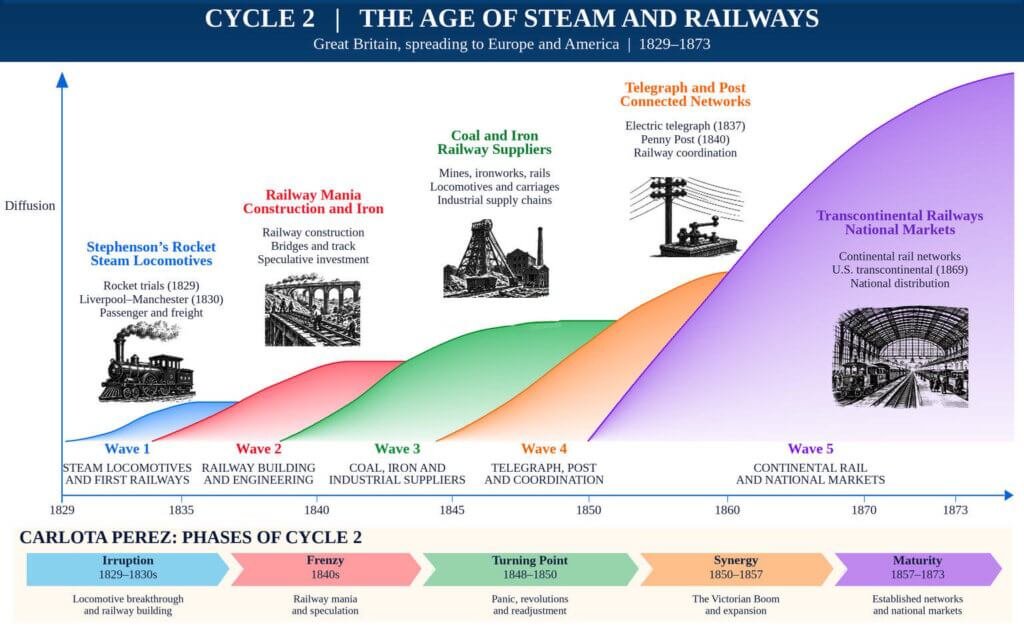
Supercycle Two: The Age of Steam and Railways, 1829–1873
The Five Waves That Connected the Industrial World
Wave One: Steam Locomotives and Early Railways
When mechanical power conquered distance
In October 1829, engineers gathered at Rainhill, a small village between Liverpool and Manchester, for a competition to test whether steam locomotives could reliably haul heavy loads over long distances. One of the entries was the Rocket, designed by Robert Stephenson and built by the engineering firm he had founded with his father, George Stephenson.
The Rocket brought together several advances in locomotive design, including a boiler with many small fire tubes and an improved exhaust that drew more air through the fire. During the trials it reached more than 30 miles per hour, a remarkable speed at a time when most travel over land still depended on horses. The demonstration came to mark the beginning of the second technology supercycle.
Steam power was not new. For decades, engines had pumped water from mines, driven factory machinery and powered steamboats. Railways existed too, mostly carrying coal and minerals, pulled by horses, stationary engines or early locomotives. What Rainhill showed was that a moving steam engine on a properly engineered railway could provide regular service between major commercial cities.
In September 1830, the Liverpool and Manchester Railway opened, linking one of Britain’s busiest ports with its fast-growing cotton district. It was the first major railway between two cities built for regular steam-powered passenger and freight service.
The economic effects were large. Manchester’s mills depended on cotton landed at Liverpool, and their finished cloth had to reach merchants, ports and customers in Britain and abroad. Until then, goods moved by canal, road and wagon, with a great deal of loading and unloading along the way. The railway offered a faster and more predictable way to move large amounts of freight between the two cities.
It also changed what travel felt like. A journey that had taken much of a day now took a fraction of the time, at speeds that had been rare or impossible on land.
Perhaps more important, the railway changed the link between production and place. The first Industrial Revolution had raised how much a factory could make, but factories still paid a lot to bring in materials and ship out goods. Railways began to loosen that limit, letting industry draw on and sell to much wider areas.
The locomotive was only one part of the picture. Railways needed permanent track, stations, signals, repair shops, trained crews and steady supplies of fuel and water. The engine was one piece of a much larger system.
The new technology was also dangerous. At the opening of the Liverpool and Manchester Railway, the politician William Huskisson was struck and killed by a locomotive, an early sign of how unprepared people were for powerful machines moving at speeds no one had experienced.
Still, the commercial promise was obvious. Investors, industrialists and governments began to see that railways could change the economics of transport. A new industry had arrived, and growing it would require a huge mobilization of engineering skill, money and industrial resources.
Wave Two: Railway Building and Engineering
The creation of a new industrial infrastructure
The first steam railways soon showed how far apart proving a technology and spreading it across an economy really are.
A locomotive could carry passengers and freight only where there was track. Expanding rail service therefore meant something far more expensive and difficult than building more engines. It meant building an entirely new infrastructure across towns, cities, farmland, rivers, valleys and hills.
In the 1830s and 1840s, Britain went through an intense period of railway building. Engineers surveyed routes, worked out gradients, designed bridges, dug tunnels and built embankments and cuttings. Railway companies bought land, negotiated rights of way, sold shares and bonds, and organized thousands of workers.
The London and Birmingham Railway, opened in 1838, showed the size of these undertakings. It needed extensive earthworks, tunnels, viaducts and bridges, and it exposed the financial and organizational difficulty of building a transport line across a large stretch of country.
Railway engineering became a major profession. Isambard Kingdom Brunel, chief engineer of the Great Western Railway, designed ambitious bridges, tunnels and stations. His work showed how better surveying, structural engineering and construction methods could support larger and more complex networks.
The railway also pushed mechanical engineering forward. Locomotives needed reliable boilers, wheels, axles, bearings, brakes and precisely made parts. Keeping them running required specialized workshops and skilled workers who could repair equipment under heavy and constant strain.
As the network grew, a new problem appeared: different companies built to different technical standards. Track gauges, signals, operating rules and equipment varied, which made it hard to move trains and goods from one company’s lines to another’s. The problem eventually led to standardization, including Britain’s Railway Regulation (Gauge) Act of 1846. Railways had to work as connected systems rather than as separate businesses.
Paying for all this construction brought its own upheaval. A railway needed large sums of money long before the first passenger bought a ticket or the first shipment earned any revenue. Joint-stock companies became the main way to raise that money from large numbers of investors.
The results were spectacular and often disastrous. During the railway mania of the 1840s, huge sums poured into proposed lines. Investors bought shares in companies with doubtful prospects, speculation pushed share prices up, and promoters pressed ahead with lines whose expected earnings could never cover their construction costs.
When the speculation collapsed, it added to financial instability, and Britain’s commercial crisis of 1847 was made worse by failed harvests, monetary strain and tightening credit.
Yet the loss of speculative wealth did not remove the railways already built. The track, bridges, tunnels and stations kept carrying traffic even after their original investors had lost their money.
This second wave set a pattern that recurs in every supercycle. Money rushes toward a revolutionary opportunity and often overshoots what the business can sustain. The crash that follows hurts investors and institutions, while much of the physical infrastructure survives. The railway boom left two legacies: a warning about speculative investment, and a growing transport network that could support further industrial growth.
Wave Three: Coal and Iron Suppliers
The industrial supply system expands
Railway building created enormous demand for materials and energy. Every new line needed rails, locomotives, bridges, stations, tools and equipment, and every working line needed a steady supply of fuel and spare parts. The railways became a major source of growth for the industries that supplied them, above all coal and iron.
Coal fueled the locomotives and many of the factories that built railway equipment. It also fueled the iron industry, which made the rails, wheels, machinery, bridges and structural parts.
The railways and their suppliers kept each other growing. Laying more track raised demand for iron and coal. Mining more coal required better transport to reach distant buyers. The railways provided that transport, which made new mines profitable and let coal reach more industrial towns.
Ironmakers benefited in the same way. Railway orders encouraged investment in furnaces, rolling mills, foundries and machinery. Better iron made more reliable railway parts, which in turn helped the railway companies extend their lines.
This interaction is one of the central workings of a technological supercycle. A growing industry becomes a customer of another industry. The second industry’s growth produces new capabilities that make the first more productive, and the relationship between them creates reasons for further investment and invention.
Railway manufacturing also called for more advanced machine tools. Workshops had to make large parts to exact measurements and assemble equipment that could survive constant, repeated strain. Building locomotives improved metalworking, boring, turning, forging and assembly, and engineering firms developed know-how they could apply to other kinds of machinery. Industrial skills were spreading through a widening network of connected businesses.
The railway economy created jobs for mechanics, engineers, miners, ironworkers, metalworkers and factory supervisors. Firms that supplied equipment and services grew up around the larger industrial companies, adding employment and trade.
But this growth rested on hard and often dangerous work. Coal miners faced accidents underground, lung disease and hazardous conditions. Ironworkers labored in extreme heat at physically punishing jobs. Industrial towns often had poor sanitation and crowded housing. The growing economy created opportunities without guaranteeing security or prosperity for the workers whose labor kept it running.
Meanwhile, metallurgy kept advancing. In 1856, Henry Bessemer introduced a new steelmaking process that showed steel could be made far more cheaply and in far larger quantities. The process needed further refinement before it was widely adopted, but it pointed toward the transformation of metallurgy that would sit at the center of the third supercycle.
This overlap between supercycles is significant. A technology linked with one revolution can begin during an earlier one and reach its full economic weight only once the supporting capabilities exist.
By the 1860s, railways, coalfields, ironworks, machinery makers and engineering firms had become parts of one connected industrial system. Depending on each other, they could do what no single business or invention could have done alone. The third wave showed that a technology’s full economic impact comes through the growing industries needed to build, maintain and improve it.
These industrial relationships were becoming more sophisticated. But coordinating activity across rapidly growing distances posed an entirely new challenge.
Wave Four: Telegraph and Postal Coordination
When information began moving faster than transportation
The spreading railway system created a new problem of coordination. Trains ran between cities, factories shipped to distant customers, and merchants did business over large territories. Yet information still traveled mostly by physical transport. A letter, an order or a warning usually moved no faster than the person carrying it. Railways sped up the mail, but the need to coordinate complicated networks eventually brought another breakthrough: the electric telegraph.
In the 1830s, several inventors, among them William Fothergill Cooke, Charles Wheatstone and Samuel Morse, developed ways to send messages by electricity. Cooke and Wheatstone showed practical uses for the telegraph on British railways, while Morse and his collaborators developed an influential system based on coded electrical signals. On May 24, 1844, Morse sent his famous message, “What hath God wrought?”, from Washington, D.C., to Baltimore.
The effects reached far beyond that demonstration. For the first time, business information could regularly travel long distances in minutes instead of hours or days. As telegraph lines spread, railway companies gained a new way to coordinate train movements and send operating instructions. Manufacturers could learn about distant markets, merchants could exchange orders faster, and banks could send prices and instructions between cities. The railway moved goods, and the telegraph moved the information needed to coordinate them.
Postal reform added a matching change. In Britain, Rowland Hill’s campaign for cheaper and simpler postage led to the uniform penny post in 1840. The Penny Black, issued that year, gave people an easy way to prepay postage with an adhesive stamp.
Lower prices led to a surge in letter writing, and the railways supplied the capacity to carry the growing volume of mail between towns and cities. Traveling post offices and better sorting made delivery more efficient. Similar changes followed in other countries as their rail networks became major carriers of mail.
Together, the telegraph, the post and the railway changed the everyday practice of business. Companies could stay in closer touch with suppliers, customers, employees and financial partners. Families separated by work or migration could write to each other more easily. Newspapers got news faster, which helped connect distant communities through shared reports of events.
The new transport and communication networks also needed common standards. Railway timetables pushed towns toward the same clock time, because local differences in time made scheduling and connections difficult. Railway companies gradually adopted standard time, laying the groundwork for wider systems of coordinated timekeeping.
By 1866, a lasting transatlantic telegraph cable linked Europe and North America, greatly speeding communication between the two continents. Information had become part of the infrastructure that coordinated economic life.
The importance of this fourth wave reaches well beyond the nineteenth century. Modern economies depend on two things: moving materials and coordinating information. Railways and telegraphs showed how improvements in each could strengthen the other.
They also opened new possibilities for large businesses. Companies could now manage operations spread across many locations, which led to more complex management structures and greater opportunities to concentrate commercial power. In this way, the fourth wave supplied the communication and coordination that continental railway networks and integrated national markets would need.
Wave Five: Continental Railway Networks and National Markets
When distance ceased to define the limits of commerce
By the middle of the nineteenth century, railways were reshaping the economic map of Europe, North America and other industrializing regions. What had begun as a service linking individual cities was becoming a network of commercial relationships that stretched across entire countries.
Britain’s railways linked its industrial regions, ports, farming districts and cities. Continental European nations built their own networks, and the United States launched an enormous expansion of railway building across its growing territory.
The change was most dramatic in America. On May 10, 1869, the Central Pacific and Union Pacific railroads completed the first transcontinental railway at Promontory Summit, Utah, creating for the first time a continuous rail link between the existing eastern network and the Pacific coast.
The railway changed the commercial relationship between East and West. Manufacturers could reach distant markets, farmers could ship produce toward larger cities, and migrants could cross the continent far more quickly.
The project took huge investments of money, materials, engineering and labor. Thousands of workers, many of them Chinese and Irish immigrants, laid the track in dangerous and exhausting conditions.
The expansion also came at enormous cost to Indigenous peoples. The railways crossed tribal homelands, encouraged further settlement and sped up the displacement and destruction of established communities and economies. The gains from the new infrastructure could not be separated from deep inequality in how its costs and rewards were shared.
Elsewhere, railways helped knit together the economies of France, the German states and other parts of Europe. In India, railway building began under British colonial rule in the 1850s, linking important commercial and administrative centers while serving colonial trade and political goals.
These networks extended the distance over which industries could operate profitably. Farming regions gained access to city customers. Manufacturers could buy raw materials from farther away. Mines found wider markets, and ports handled growing volumes of domestic and international trade.
Railways also changed where people lived and worked. Industrial cities drew migrants looking for jobs, and growing towns supported merchants, shopkeepers, railway employees, accountants, engineers, teachers and other occupations. Through these widening economic relationships, a broader middle-class ecosystem continued to take shape.
The railway became a powerful symbol of the modern age. In 1844, J. M. W. Turner painted Rain, Steam, and Speed, showing a locomotive bursting out of rain and haze. The machine seems to dissolve the familiar landscape, capturing the experience of a world undergoing rapid technological change.
Yet the new economy remained exposed to financial instability. Railways required immense investment, often financed through debt and speculative securities. By the early 1870s, reckless expansion, uncertain profits and international financial pressure exposed weaknesses in railway finance.
The Panic of 1873, made worse in the United States by the collapse of the investment bank Jay Cooke & Company and by failures in railway finance, was a major financial shock. It laid bare the speculative excesses of the supercycle. Yet the railways, factories, engineering knowledge and trading networks it had produced remained in place to support the next period of growth.
By 1873, the second supercycle had vastly extended the territorial reach of industrial society. The age of steel, electricity and heavy engineering was already emerging from the industrial capabilities the railway revolution had helped build.
Conclusion: The Revolution That Connected the Industrial Economy
How five waves transformed transportation into economic infrastructure
The second technology supercycle began with a reliable steam locomotive and grew into a deep reorganization of industrial society. Between 1829 and 1873, steam railways grew from individual transport projects into connected networks supported by engineering firms, coalfields, ironworks, communication systems and increasingly integrated national markets.
Each of the five waves added a different capability. The first established practical steam railway transport. The second extended it through railway construction, civil engineering and infrastructure investment. The third built the supply industries needed to manufacture and run larger networks. The fourth provided the telegraph and postal systems that let growing economic activity be coordinated over distance. The fifth joined these developments into continental railway networks and larger markets.
The waves overlapped and strengthened one another. Better manufacturing made railways cheaper to build and run, and railways widened the markets open to manufacturers. Larger markets encouraged more production, which created more demand for transport, materials, machinery and communication. The result was a system of industrial growth that kept feeding itself.
The economic significance of a technological revolution comes from the way productive capabilities accumulate and combine across a society. The railway depended on knowledge inherited from the first Industrial Revolution. Steam engines, iron production, factories, machine tools, engineering skills and financial institutions made it possible to build the transport networks of the second. Those networks then opened the way for technologies whose greatest impact would come in later supercycles. The railway revolution also widened the reach of the middle-class ecosystem. Larger markets supported new businesses, specialized occupations and commercial services. Skilled workers, engineers, merchants, accountants and shopkeepers took part in an ever more complex system of production and exchange, and their capabilities grew through education, experience, investment and the development of institutions that could coordinate economic activity.