

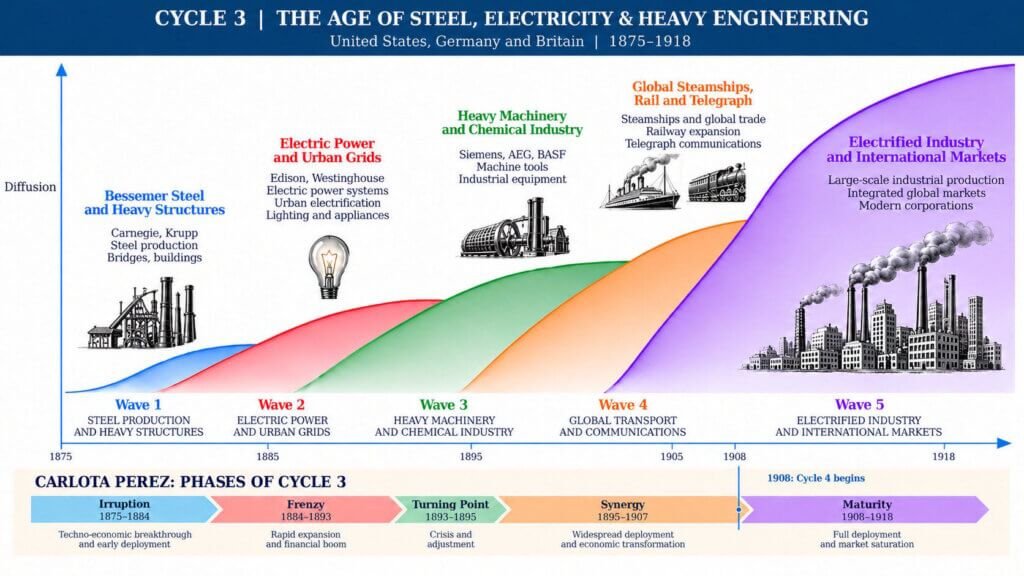
Supercycle Three: The Age of Steel, Electricity and Heavy Engineering, 1875–1918
The Five Waves That Created the Modern Industrial World
Wave One: Steel Production and Heavy Structures
The materials that transformed the possibilities of industrial civilization
In 1875, Andrew Carnegie’s Edgar Thomson Steel Works began production near Pittsburgh, Pennsylvania. Named after the president of the Pennsylvania Railroad, the plant marked a turning point in American industry. It combined modern steelmaking equipment, heavy investment, railway connections and careful organization to make steel on a scale earlier generations could hardly have imagined. The economist Carlota Perez dates the start of the third great technological revolution to this event.
The technologies behind it had been developing for decades. Henry Bessemer’s process, introduced in 1856, showed that blowing air through molten iron could burn off excess carbon and make large-scale steel production far cheaper. The Siemens-Martin open-hearth process, developed in the 1860s, offered another method that gave steelmakers more control over the metal’s composition. Together, these advances changed the economics of one of the most important materials in the world.
Iron had carried the first two industrial revolutions, providing machinery, rails, bridges and building parts. Steel was stronger, more durable and suited to more demanding uses. As production grew and prices fell, manufacturers could use steel in products and structures that had once been impractical or far too expensive.
The effects spread through the whole industrial economy. Railway companies replaced worn iron rails with longer-lasting steel. Shipbuilders built bigger and stronger vessels. Manufacturers made more capable machines, and engineers designed bridges and structures that could span longer distances and carry heavier loads.
The Forth Bridge in Scotland, opened in 1890, was a spectacular example. Built with about 53,000 tons of steel, the huge cantilever railway bridge showed how better materials and engineering knowledge could reshape the physical landscape.
Buildings also began to rise to new heights. Structural metal frames laid the foundation for the modern skyscraper, letting cities fit more commercial activity into dense urban centers.
But steel’s importance reached far beyond the finished structures. Making steel required iron ore, coal, coke, limestone, furnaces, rolling mills, machinery, transport and large numbers of skilled and unskilled workers, so every increase in output raised demand across all of these supporting industries. Steelworks became the hubs of a connected industrial ecosystem.
The gains came with large shifts in economic power. Steelmaking required enormous investment, which favored the growth of corporations that could control mines, transport, production and sales. These companies could operate efficiently at a scale most smaller competitors could not reach.
For workers, the consequences were often severe. Dangerous conditions, long hours and growing conflict over wages and bargaining power became defining features of the industry. The Homestead Strike of 1892 brought the conflict between growing industrial wealth and the workers who helped create it into the open. The violent confrontation at Carnegie’s Homestead works exposed how unequal the power of industrial corporations and organized workers had become.
Even so, the revolution in steel created capabilities that would support generations of industrial growth. Stronger and cheaper materials made possible larger machines, more ambitious structures and more sophisticated industrial systems. The next wave would transform the energy that powered them.
Wave Two: Electric Power and Urban Grids
The transformation of energy into a distributed industrial utility
On September 4, 1882, Thomas Edison’s Pearl Street generating station began supplying electricity to customers in lower Manhattan. At first it served only a small area, but its importance went far beyond the buildings it lit. Pearl Street showed that electricity could be sold as a commercial service, generated at a central plant and delivered through a network to customers who paid for the power they used.
This was a fundamental change in how energy was organized. Factories of the first Industrial Revolution usually ran on waterwheels or steam engines that drove machinery through elaborate systems of shafts, belts and gears. Those systems dictated where each machine could stand, so the layout of the factory followed the path of the power. Electricity made it possible to separate where power was generated from where it was used.
Edison’s station combined generating equipment, wiring, lighting, meters, maintenance and billing into one system. Achieving it took inventions well beyond the light bulb. Electricity could not become a general-purpose resource until engineers found practical ways to generate it, transmit it, control it and use it safely.
Competition between rival electrical systems sped up these improvements. Edison’s direct-current systems worked well over short distances but ran into serious limits when power had to travel farther from the station. Alternating current, championed by engineers and entrepreneurs including Nikola Tesla and George Westinghouse, used transformers to raise and lower voltage, which made long-distance transmission and local distribution far more economical.
The Niagara Falls hydroelectric project proved the commercial value of this approach. Power generation began there in 1895, and electricity reached Buffalo in 1896, showing that large amounts of power could be delivered over distances that had been too costly to serve before.
The new electrical infrastructure began to change cities. Electric streetlights lit commercial districts. Electric streetcars extended urban transport. Businesses installed lighting that improved working conditions and allowed longer opening hours. Electric motors began to let factories run machinery without relying entirely on a central drive shaft.
The potential gains were large, but the full transformation took time. Electrical equipment was expensive. Existing factories had heavy investments in steam engines and mechanical drives. Utilities needed power stations, transmission lines, distribution networks, technical standards and enough customers to cover their costs. Even after electricity arrived, factories often had to reorganize production before they could gain its biggest advantages.
This slow spread is typical of technological supercycles. Decades can pass between the invention of a revolutionary technology and its full economic effect.
Electrification also created new industries. Manufacturers made generators, transformers, motors, switches, cables, meters and lighting equipment. Power companies employed engineers, electricians, maintenance crews, managers and administrators. Universities and technical schools expanded their teaching of electrical engineering, and governments faced the new challenge of regulating companies that supplied an essential service. Like the steel industry, the electrical system created wealth through many capabilities working together.
By the early twentieth century, electricity was becoming an essential part of industrial and urban infrastructure. The second wave had created a new way to distribute power. Its larger value would appear as manufacturers learned to combine it with advances in machinery, metallurgy, chemistry and industrial organization.
Wave Three: Heavy Machinery and Chemical Industries
When scientific knowledge became an industrial capability
The third supercycle changed more than the materials and energy industry used. It changed the relationship between scientific discovery and commercial production.
In the earlier industrial revolutions, inventions often came from hands-on experiment by mechanics, craftsmen, entrepreneurs and engineers. Science played its part, but formal research and manufacturing were only loosely connected. By the late nineteenth century, that was changing. Companies began setting up research laboratories, hiring professional scientists and engineers, and investing in systematic experiments to improve their products and processes.
Germany led this shift. Chemical companies such as BASF, Bayer and Hoechst built sophisticated research and production organizations, drawing on discoveries in organic chemistry, including synthetic dyes made from compounds in coal tar.
The commercial impact was enormous. Traditional dyes came from plants, insects and minerals whose supply and quality varied widely. Synthetic chemistry let manufacturers create colors through controlled industrial processes, producing more consistent and more specialized products. The same scientific methods soon spread into medicines, industrial chemicals, fertilizers, photographic materials and other fields. Scientific knowledge was becoming a repeatable input to industrial production.
One of the most important breakthroughs came from research into nitrogen fixation. The atmosphere holds vast amounts of nitrogen, but turning it into compounds usable in fertilizer and industry was extremely difficult. Fritz Haber worked out a practical chemical route for making ammonia, and Carl Bosch and his colleagues at BASF developed the equipment and processes to produce it industrially. In 1913, BASF opened its first large-scale ammonia plant at Oppau.
The Haber-Bosch process eventually transformed farming by making synthetic nitrogen fertilizer available on an unprecedented scale. It also made possible the materials used in explosives, a sign that the same scientific capability could serve both economic development and war.
Meanwhile, heavy engineering grew quickly. Better machine tools, steel alloys, measuring instruments and production methods let manufacturers build more sophisticated turbines, engines, pumps, generators and specialized machines.
Charles Parsons developed the practical steam turbine in 1884, which opened the way to more efficient electricity generation and ship propulsion. Rudolf Diesel’s compression-ignition engine of 1897 offered another way to turn fuel into mechanical power. Both would support the growing transport and industrial systems of the decades that followed.
These developments tied suppliers, manufacturers, laboratories and schools together in more complex relationships. A chemical plant depended on metallurgists, equipment makers, industrial chemists, engineers, energy suppliers and transport companies. An electrical manufacturer needed precisely machined parts, insulating materials, copper, steel and specialized technical knowledge. The capabilities of these industries had become interconnected.
Their growth also changed employment. Engineers, chemists, laboratory technicians, machinists, draftsmen and industrial managers became more important, and education and technical expertise became central to industrial competitiveness. At the same time, the rising complexity and cost of manufacturing strengthened the large corporations that could pay for research and coordinate production.
The third wave established a new economic capability: the systematic conversion of scientific knowledge into commercial products and industrial processes. Innovation was becoming an organized, continuous activity inside the productive economy.
Wave Four: Global Transportation and Communications
The industrial economy becomes an international system
By the late nineteenth century, the great technological revolutions were having effects that reached far beyond any single national economy. Railways had already transformed transport across continents. Steamships connected the major ports, and telegraph cables carried information across oceans in minutes. The third supercycle extended these capabilities through better materials, more powerful machines, electrical communication and more sophisticated industrial organization, and international economic relationships grew dramatically in scale and complexity.
Steel hulls made ships larger and more durable. Better marine engines and steam turbines made ocean transport more efficient. Refrigeration let meat, dairy products and other perishable goods reach markets that had been out of reach. Farming, mining, manufacturing and international trade became more closely connected.
A British manufacturer could now buy raw materials from distant regions, process them with advanced machinery and sell the finished goods in markets around the world. American producers increasingly worked within the same trading system. German machinery and chemical companies expanded their exports, and Japan began building modern industry through investment in education, infrastructure, manufacturing and the adaptation of foreign technology. The international division of industrial work was growing more complicated.
New communication technology made these relationships easier to manage. Alexander Graham Bell’s telephone, patented in 1876, made it possible to transmit speech electrically. As telephone exchanges and networks spread, businesses gained a faster and more direct way to coordinate work across cities and regions.
International telegraph networks kept growing, linking banks, governments, news organizations and businesses. Wireless telegraphy appeared in the last years of the nineteenth century, making it possible to communicate with ships and with places beyond the reach of wires. Information could now travel independently of physical goods.
This changed how international finance worked. Investors received market news sooner, banks could coordinate transactions across borders, and companies could respond more quickly to changes in supply and demand.
Greater connection also brought greater risk. Financial trouble could spread through the ties linking banks, investors, governments and businesses in different countries. The Baring crisis of 1890 showed how international lending and speculation could threaten major financial institutions when hopes for foreign investments collapsed.
This international expansion took place within a political order shaped by imperial rivalry. European powers often used colonial relationships to secure raw materials, trading advantages and strategic influence. The benefits of growing trade were shared unequally, and many colonized societies paid heavy costs through coercion, the extraction of their resources and the loss of economic independence.
Industrial growth was also shifting the international balance of power. Britain had led the first two technological supercycles, backed by its early industrialization, its shipping and trade, its financial institutions and its empire. During the third, the United States and Germany built up their manufacturing quickly. American industry drew on abundant resources, a large home market, expanding education and sophisticated corporate organization. Germany combined engineering expertise, scientific research, close ties between banks and industry, and coordinated industrial development. Industrial leadership was being shared among several powers.
The fourth wave thus changed both the global reach of technological development and the competition among industrial nations. The same networks that widened commercial opportunity also deepened interdependence, financial exposure and strategic rivalry. The international economy had gained the means to cooperate on a vast scale, while the political institutions that governed it remained divided among competing national powers.
Wave Five: Electrified Industry and International Markets
The emergence of the modern corporate and industrial economy
By the early twentieth century, the technologies of the third supercycle had become deeply woven into industrial society. Steel, electricity, heavy machinery, scientific chemistry and global communications had become complementary capabilities supporting complex production systems, and together they were reshaping how industry was organized.
The large modern corporation became one of the defining institutions of this period. In 1901, J. P. Morgan helped create the United States Steel Corporation by merging Carnegie Steel with other major firms. It became one of the largest industrial organizations in the world, showing how much capital and productive capacity could now be gathered under a single management.
Large firms increasingly controlled every stage from mining raw materials through manufacturing, transport, finance and sales. This brought real advantages. Integrated production could cut some costs, improve coordination, pay for expensive research and let a company take on projects beyond the means of smaller firms.
But concentration also created great economic power. Corporations that dominated major industries could influence prices, suppliers, access to markets and working conditions. Independent businesses and workers often found themselves bargaining with organizations far richer and more powerful than themselves. Governments responded with new systems of antitrust enforcement, labor regulation, utility oversight and financial reform.
The Panic of 1907 showed that the more sophisticated industrial economy was still vulnerable to severe financial shocks. The crisis eventually led to the creation of the Federal Reserve System in 1913, a major institutional response to weaknesses in American banking.
Meanwhile, electricity kept spreading through manufacturing. Individual electric motors let machines run without long chains of shafts and belts, which gave factory designers more freedom to arrange equipment to suit the work. But the largest gains often required rebuilding factories around these capabilities, a process that continued well past the end of the supercycle.
The new industrial system also supported a growing professional and skilled workforce. Engineers, technicians, machinists, chemists, accountants, clerks, managers and specialized service providers became more important, and education and technical training became essential investments in a nation’s productive capacity. These occupations added to the growth of the middle-class ecosystem, although industrial prosperity remained unevenly shared.
The third supercycle also brought a profound shift in economic leadership among nations. Britain remained a major industrial, financial and imperial power, but the United States had become a leading manufacturing economy, and Germany had become a formidable competitor in engineering, chemistry, electricity and industrial production. The industrial dominance Britain had enjoyed during the first two revolutions was ending.
Growing national power, imperial rivalry, military competition, alliance commitments and political crises eventually helped bring about the First World War in 1914. Industrial competition alone cannot explain the war. But the shifting distribution of industrial capability shaped the resources, ambitions and military options of the powers involved.
The war showed how destructive modern industrial systems could be. Steel, chemicals, electrical communication, railways and heavy machinery became essential tools of industrial warfare. By 1918, the war had devastated much of Europe and deeply altered the international political order.
Yet the technological revolution carried on through the capabilities it had created. The automobile and mass-production revolution had already begun in 1908 with Ford’s Model T, which is where Supercycles Three and Four overlap.
The fifth wave completed the rise of a modern industrial system built on advanced materials, distributed power, science-based manufacturing, corporate organization and international economic integration. Its productive capabilities would support much of the twentieth century.
Conclusion: The Revolution That Created Modern Industrial Power
How five waves transformed the foundations of wealth and global economic leadership
The third technology supercycle was a decisive turn in the development of modern industrial civilization. Between 1875 and 1918, steel, electricity, heavy engineering, scientific chemistry, transport and communications became closely connected parts of a productive system that reached across national borders.
The five waves show how this happened. The first made cheap steel a foundational industrial material. The second introduced commercial generation and distribution of electricity, beginning the change of energy into a widely available industrial service. The third expanded machinery, chemistry and science-based manufacturing, proving the commercial value of organized research. The fourth connected the advanced industrial economies through transport and communications. The fifth combined these developments into electrified industries, large corporations and expanding international markets.
Each wave enlarged what the others made possible. Steel made stronger machinery and electrical equipment possible. Electricity created demand for generators, cables, motors and specialized materials. Industrial chemistry widened the range of products and processes available. Transport and communications linked producers, suppliers, investors and customers across ever larger markets. The resulting industrial system could do far more than its individual technologies could have done separately.
This revolution also showed the importance of accumulated human knowledge. Research universities, technical schools, laboratories, workers, engineers, public infrastructure and industrial firms all contributed to capabilities that developed over generations. Scientific discovery became an organized source of wealth, and education and specialized expertise became essential to economic development. These changes widened the foundations of the modern middle-class ecosystem.
At the same time, the third supercycle introduced institutional problems that would persist through later revolutions. Large corporations gained unprecedented control over capital, infrastructure, production and markets. Industrial concentration made great efficiency possible while increasing the power of those who controlled essential productive assets. Labor struggles and financial crises showed that technology could advance much faster than the institutions governing its economic effects.
The revolution also changed which nations led the industrial world. Britain’s early dominance gave way to an industrial economy with several centers, in which the United States and Germany became leading producers, engineers and innovators. The rise of competing industrial powers helped shift the international balance of power, while military rivalry, imperial ambition and political failure helped produce the catastrophic wars of the early twentieth century. Technological revolutions can reshape the distribution of power among nations as deeply as they reshape production within them.
By 1918, the third supercycle had built much of the industrial foundation of the modern world. Its steel, electrical networks, chemical industries, engineering expertise, research institutions and organizational skills would become indispensable to the next revolution, which was already under way and would combine them with petroleum, automobiles and mass production to transform industrial productivity and everyday life.
An unresolved question was also becoming more pressing: how could the wealth created through society’s accumulated knowledge, labor and investment be shared in ways that sustained the broad ecosystem that produced it? The third supercycle expanded humanity’s capacity to create wealth beyond anything seen before. It also showed how easily control over that capacity could become concentrated, and that tension would remain central to every technological revolution that followed.