

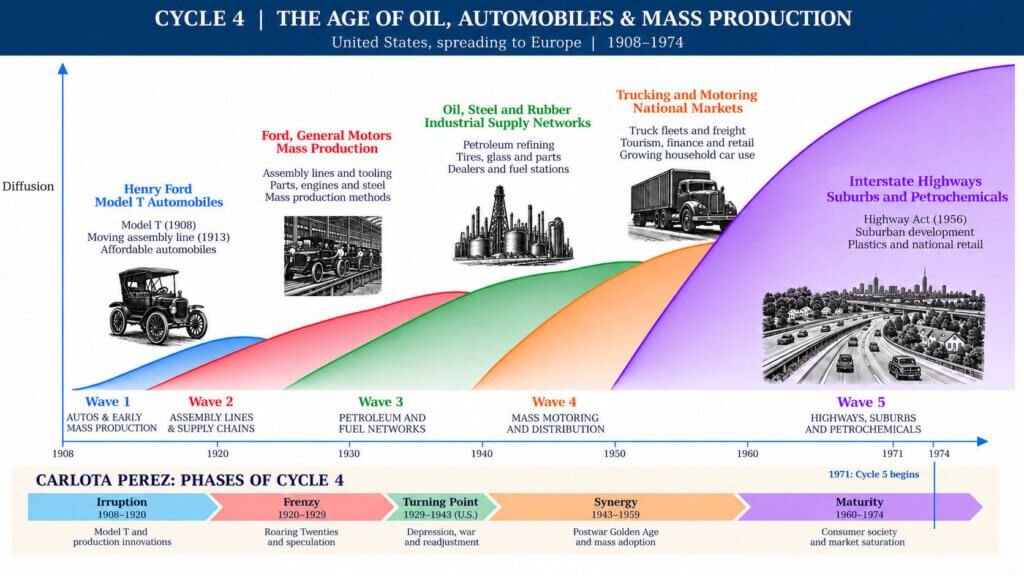
Supercycle Four: The Age of Oil, Automobiles and Mass Production, 1908–1974
The Five Waves That Created the Modern Consumer Economy
Wave One: Automobiles and Early Mass Production
When industrial manufacturing began creating its own mass markets
On October 1, 1908, the Ford Motor Company introduced the Model T. It was a fairly simple machine, powered by a four-cylinder gasoline engine and built to run reliably on the rough roads of early twentieth-century America.
Automobiles already existed. European and American manufacturers had spent decades developing cars powered by gasoline, steam and electricity. But most cars were still expensive, bought by the wealthy or by enthusiasts willing to put up with the breakdowns of early motoring.
Henry Ford saw a much larger opportunity. The car could become everyday transportation if manufacturers found ways to build reliable vehicles at prices ordinary households could afford. The Model T was a major step toward that goal. At about $850, it was still out of reach for many American families. But its simple engineering, standardized construction and ability to handle bad roads gave Ford a basis for cutting costs as production grew.
Ford’s achievement drew on the industrial capabilities built up during the earlier revolutions. Steel mills supplied durable materials. Precision machine tools made accurate parts possible. Electrical equipment ran the factories, and railways connected suppliers, plants and markets. The internal combustion engine itself came out of decades of progress in metallurgy, chemistry, fuel systems and mechanical engineering. The fourth supercycle began by combining capabilities inherited from the third.
Ford also took a different approach to customers. Instead of building expensive cars in small numbers, he set out to build a standard car in enough volume to serve a much larger market. That strategy created a cycle that fed itself. Higher volume justified investment in specialized machinery and better methods. Greater efficiency lowered costs, which allowed lower prices. Lower prices brought in more buyers, which supported still higher production. This self-reinforcing link between productivity and consumer demand became central to the automobile economy.
Early car manufacturing also created business for companies that supplied engines, tires, steel, glass, electrical parts, lubricants, tools and spare parts. As more people drove, garages, repair shops, dealerships and trained mechanics appeared to provide services that the old horse-and-wagon trades could not. The car was beginning to support a whole ecosystem of related businesses.
By 1910, Ford had moved production to its new Highland Park plant near Detroit, which gave the company the space and flexibility to experiment with more systematic production methods. Those experiments would lead to something far larger than the success of a single car.
The Model T showed that industrial manufacturing could create entirely new consumer markets by making products steadily cheaper. In doing so, it introduced a relationship that would define much of the twentieth-century economy: rising industrial productivity could support larger markets, more jobs and growing household spending. The next wave would build the manufacturing system that made that possible.
Wave Two: Assembly Lines and Supply Chains
The invention of industrial production at unprecedented scale
In 1913, Ford introduced the moving assembly line at Highland Park, and it transformed the way industrial goods were made.
Before then, car assembly usually meant teams of workers building each vehicle in one place. Parts were carried to the car, and each worker did a range of tasks as the vehicle slowly took shape. Ford’s engineers turned this around. The car now moved through a series of specialized workstations, with parts, tools and workers arranged along a coordinated flow. Each worker did a narrower set of tasks, and the speed of the line set the pace of the work.
The results were dramatic. By 1914, Ford had cut the time needed to assemble a Model T chassis from more than twelve hours to about ninety-three minutes.
The moving conveyor was only part of the achievement. Interchangeable parts, precision manufacturing, specialized machine tools, standardized components, materials handling and careful planning were all needed to make the system work. The assembly line was the visible face of a much larger industrial capability. Manufacturers could now organize equipment, labor, materials and schedules into predictable systems that turned out huge quantities of identical products.
Ford’s methods also changed the economics of employment. Assembly-line work was repetitive, physically demanding and widely disliked, and high worker turnover threatened to disrupt production. In January 1914, Ford introduced his famous five-dollar day, roughly doubling the daily pay of qualifying workers while cutting the standard shift from nine hours to eight.
The decision helped Ford attract workers, reduce turnover and keep production steady. It also showed that higher productivity could make much higher industrial wages affordable. But the program came with intrusive oversight of workers’ private lives, and at first only some workers qualified. How much of the gain from efficiency reached workers still depended on management decisions and on bargaining power that was far from equal.
As production grew, Ford built more extensive manufacturing and supply operations. The River Rouge complex, begun in 1917, eventually brought steelmaking, glassmaking, power generation, parts manufacturing and final assembly together in one enormous integrated plant. Raw materials went in at one end, and finished cars came out at the other. The Rouge showed how production could be coordinated across activities that had once been entirely separate.
Other manufacturers built their own networks of specialized suppliers, assembly plants, distribution organizations and management practices. Mass production spread beyond cars to household appliances, farm equipment, machinery and other manufactured goods.
Yet the new system also created financial risks. Large factories required heavy fixed investment and needed steady demand to run profitably. When demand fell, output could drop quickly, leaving companies with idle capacity and workers without jobs. The Great Depression, which began in 1929, exposed these weaknesses on a devastating scale. Financial collapse, falling demand and mass unemployment showed that efficient production alone could not guarantee economic stability.
Still, the industrial capabilities built through mass production survived. They became essential during the Second World War, when American factories turned out aircraft, vehicles, ships, engines and military equipment at enormous scale.
The second wave made mass production a general industrial capability. Its continued growth would require an equally large system for supplying energy, materials and transport.
Wave Three: Petroleum and Fuel Networks
The energy system that powered the automobile economy
The automobile transformed the economic importance of oil. In the nineteenth century, oil refining had mainly served the demand for kerosene used in lamps and heaters, and gasoline was a low-value byproduct. The internal combustion engine changed that. As gasoline-powered cars spread, demand for motor fuel rose quickly, and oil producers, refiners, shippers and retailers began building the infrastructure to supply millions of vehicles.
The foundations of the modern oil industry had been laid earlier. Edwin Drake’s oil well at Titusville, Pennsylvania, in 1859 helped launch the American petroleum industry, and the huge Spindletop strike in Texas in 1901 showed that there was enough oil to support much larger operations. The fourth supercycle connected those resources to a fast-growing market for personal transport.
By 1920, about nine million gasoline-powered motor vehicles were on American roads. Keeping them running required a complex system of oilfields, pipelines, refineries, storage tanks, tankers, rail shipments, distribution terminals and gas stations. Each new car created ongoing demand for fuel, lubricants, maintenance products and spare parts.
The effects reached across the oil industry. Refiners invested in better ways to turn crude oil into more valuable products. Thermal cracking, and later catalytic cracking, raised the amount of gasoline and other fuels that could be extracted from each barrel. Pipelines cut transport costs, and storage and distribution networks carried petroleum products to more distant markets. Oil had become an essential part of the automobile ecosystem.
Each side strengthened the other. Cheaper cars encouraged more fuel use. A growing network of fuel supply made owning a car more practical. Reliable fuel encouraged longer trips, and greater mobility created more demand for vehicles.
The oil economy also created enormous industrial and financial power. Companies that controlled oil production, refining, transport and distribution gained influence over a resource that was becoming essential to modern economic life. Oil’s strategic importance grew during both world wars, as armies came to depend on trucks, aircraft, ships and mechanized equipment.
After the Second World War, oil sat at the center of an international energy system linking producing regions with industrial consumers. The United States emerged from the war as the leading industrial economy, and the rebuilding of Europe and Japan raised world demand for energy. Oil production expanded across the Middle East and other regions, and control over oil reserves, shipping routes and trading arrangements became a central part of national economic and strategic planning.
In 1960, Iran, Iraq, Kuwait, Saudi Arabia and Venezuela founded the Organization of Petroleum Exporting Countries, reflecting the producing nations’ determination to have a say in the terms on which their oil was sold.
The risks of oil dependence became impossible to miss in 1973, when the Arab oil embargo and production cuts helped cause steep price increases and fuel shortages. The oil networks that had supported enormous economic growth had also created new weaknesses.
The third wave showed that a growing technological ecosystem depends on reliable energy supplies. It also showed that control over an essential resource can bring economic power far beyond the industries that produce it.
Wave Four: Mass Motoring and Distribution
When the automobile transformed commerce and everyday life
The automobile revolution became a much larger economic transformation once ordinary households bought cars in large enough numbers to change how communities, businesses and markets worked. By 1930, more than half of American families owned a car.
The effects went far beyond getting from place to place. Cars widened the distance people could travel for work, shopping, school, recreation and social life. Businesses could reach customers outside their immediate neighborhoods, and households had more choice about where to work and where to live.
The commercial possibilities drew enormous investment. Carmakers built national dealer networks, financing arrangements, advertising and maintenance services. General Motors, under Alfred P. Sloan, took a different approach from Ford’s single low-cost car. GM offered cars at different price levels, expanded consumer credit and encouraged repeat purchases through styling changes and a range of distinct models. Between them, the two approaches showed how mass production and sophisticated marketing could support huge consumer markets.
The automobile ecosystem kept expanding through independent businesses. Repair shops, tire dealers, gas stations, parts suppliers, insurers, driving schools, roadside businesses, restaurants and hotels grew up to serve the growing number of drivers. The car became the base of an enormous network of commercial activity.
Trucks brought another important change. Railways remained essential for hauling large quantities of freight, but trucks could carry goods directly between factories, warehouses, stores, farms and customers. Better roads, engines, tires, refrigeration and more reliable vehicles helped commercial trucking grow. Businesses gained more flexibility in how they distributed goods, and farmers gained new ways to reach city buyers. Manufacturing, transport and distribution became more closely linked, widening the reach of producers and retailers.
But the benefits of mass motoring depended heavily on household purchasing power. During the Great Depression, unemployment and falling incomes sharply cut demand for cars and other manufactured goods. Restoring broad consumer markets required economic stabilization and changes in the institutions that governed industrial employment.
The National Labor Relations Act of 1935 strengthened workers’ right to bargain collectively, and the Fair Labor Standards Act of 1938 set federal standards for wages and hours. These reforms helped build an institutional framework through which workers could win a larger and steadier share of industrial income.
After the Second World War, strong industrial employment, collective bargaining, public investment and wider access to education supported an exceptional period of growth in household purchasing power. Returning veterans benefited from programs that helped with education, jobs and housing, although access to those programs was unequal.
The result was a powerful economic cycle. Businesses paid wages that supported household spending. Consumer purchases created demand for more production, and growing businesses created jobs and opportunities for suppliers. The mass consumer economy was becoming able to sustain its own growth.
The fourth wave showed how the potential of mass production could reach across society when households had enough income to take part in the markets that industrial productivity made possible. The automobile had grown from a manufactured product into an essential part of economic life. Its final transformation would reshape the physical layout of entire communities.
Wave Five: Highways, Suburbs, and Petrochemicals
The transformation of the physical and economic organization of society
After the Second World War, the automobile revolution entered a period of rapid expansion. Rising industrial employment, growing household incomes, mortgage finance, public infrastructure spending and accumulated manufacturing know-how set the stage for a major transformation of American society. The car became central to how neighborhoods, transport networks, retail markets and commercial development were organized.
Suburban housing spread quickly. Developers such as William Levitt applied standardized construction methods and specialized work crews to homebuilding, cutting costs and speeding up the creation of whole new neighborhoods. Levittown, built on Long Island starting in 1947, became an influential model of large-scale suburban development. Houses, roads, utilities, schools, shopping and car travel became interlocking parts of suburban life.
The Federal-Aid Highway Act of 1956 sped up this transformation by creating a major federal funding program for the Interstate Highway System. The law provided for a national network of about 41,000 miles, with the federal government paying 90 percent of eligible construction costs. The new highways increased transport capacity, linked metropolitan regions and supported long-distance trucking and car travel.
They also changed where businesses located. Retailers moved closer to highways and suburban populations. Shopping centers, motels, restaurants, service stations and distribution centers followed patterns of development shaped by access by car. The economic ecosystem around mass motoring extended into construction, finance, public administration, retailing, transport and household services.
Petrochemicals brought another major expansion in what industry could make. Oil and natural gas became raw materials for plastics, synthetic fibers, detergents, fertilizers, industrial chemicals and countless manufactured products. Chemical innovations from earlier supercycles reached mass consumer markets through cheap materials such as nylon, polyethylene and synthetic rubber, and these transformed packaging, clothing, household goods, medicine, agriculture and industrial manufacturing.
By the 1960s, the production systems of the fourth supercycle were woven deeply into everyday economic life. But their expansion also carried heavy costs.
Highway construction displaced established communities, often damaging lower-income and Black neighborhoods. Discriminatory mortgage practices and restrictive housing rules shut many Americans out of the suburban wealth-building that was open to others. Dependence on the car exposed households to fuel prices, traffic, pollution and the cost of owning and maintaining vehicles. Industrial growth polluted the air and water, and petroleum-based products created environmental problems that became harder and harder to ignore. The environmental movement, and laws such as the Clean Air Act of 1970, reflected growing public concern about these consequences.
By 1973, the oil-based economy faced another challenge. The Arab oil embargo, production cuts and higher oil prices exposed the vulnerability created by decades of growing dependence on imported fuel. Inflation rose, growth slowed, and the industrial system came under pressure from energy costs and foreign competition.
The fourth supercycle had produced an enormous expansion of productive capacity and middle-class prosperity, but in its maturity it revealed unresolved dependencies and structural weaknesses.
By 1974, the digital revolution had already begun, with the introduction of the commercial microprocessor in 1971. The fifth technological supercycle was emerging from the industrial, scientific, educational and institutional foundations built by its predecessors.
Conclusion: The Revolution That Created the Modern Middle-Class Consumer Economy
How five waves transformed industrial productivity into broad economic prosperity
The fourth technology supercycle was one of the most important transformations in modern economic history. Between 1908 and 1974, the automobile and mass-production system grew into a connected economy that took in manufacturing, oil, transport, housing, retailing, consumer credit and the infrastructure of modern daily life.
The five waves show how this happened. The first made the affordable car a potential mass-market product. The second created manufacturing systems that could turn out huge quantities of standard goods at steadily lower cost. The third built the oil production and distribution networks that fueled expanding transport. The fourth connected mass production to consumer purchasing power, distribution and commercial services. The fifth reshaped where and how people lived through highways, suburban development and the growing petrochemical economy.
Each wave built on capabilities created by earlier revolutions. Steel, electricity, precision machinery, scientific research, railways and modern industrial organization made mass production possible, and the fourth supercycle combined these inherited capabilities into systems that could make and distribute consumer goods on an unprecedented scale.
Yet its most important economic consequence went beyond industrial production. This supercycle showed how rising productivity could produce broad middle-class prosperity when it was backed by good wages, collective bargaining, education, infrastructure, housing finance and institutions that strengthened households’ economic security. The link between productive capacity and household purchasing power became a central feature of the twentieth-century American economy.
Workers became customers in markets supplied by the industries that employed them. Their spending supported more investment, more jobs and more new businesses. Households built up assets, bought homes, educated their children and helped create the capabilities that later generations would inherit. Together these developments formed a powerful economic cycle.
But the expansion was never universal. Racial discrimination, unequal access to housing and education, regional disparities and concentrated corporate ownership limited who shared in the gains. The Great Depression also showed that industrial productivity alone could not sustain prosperity without a working financial system and enough demand.
The fourth supercycle therefore carries an important lesson about technology and economic institutions. New technologies create new productive possibilities. Whether those possibilities turn into broadly shared prosperity depends on how a society organizes employment, investment, ownership and consumption.
By the early 1970s, the American middle-class economy had become deeply dependent on the production systems and institutions built during the automobile revolution. Yet rising energy costs, foreign industrial competition, inflation and changes in how corporations were run were beginning to strain the arrangements that had supported its remarkable postwar growth.
The fifth supercycle would bring a different source of change. Microprocessors, computers, telecommunications and digital networks would steadily lower the cost of processing information and coordinating work across borders. These capabilities would create large new opportunities while gradually changing the relationship between industrial production, employment, national economies and household prosperity.
The next revolution would test whether modern middle-class societies could preserve the economic relationships that had allowed industrial productivity and broad prosperity to advance together.