

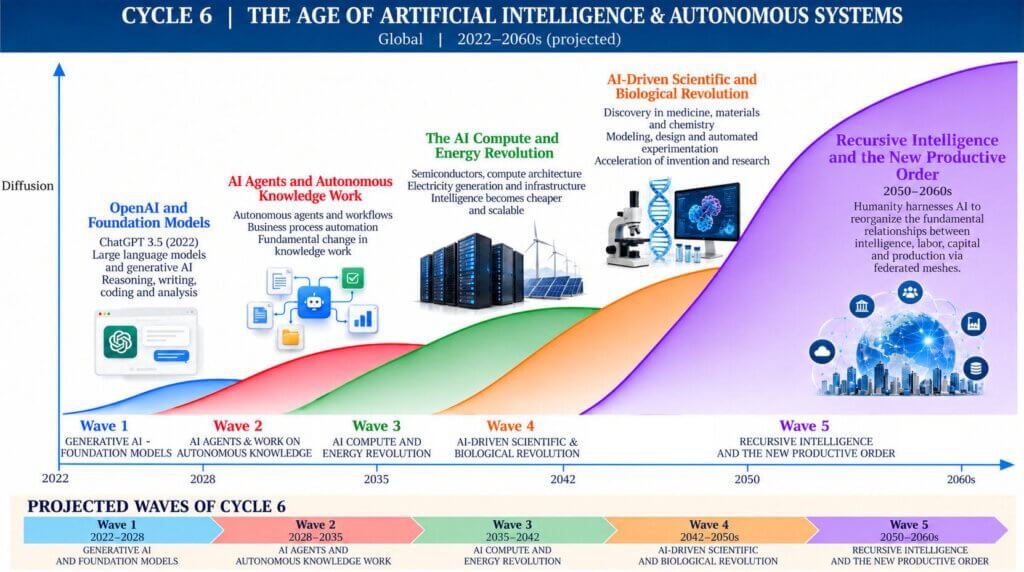
Supercycle Six: The Age of Artificial Intelligence and Autonomous Systems, 2022–2060s
The Five Waves That May Transform Intelligence, Production, and the Organization of Economic Life
Wave One: Generative AI and Foundation Models, 2022–2028
When machines began performing an expanding range of cognitive tasks
On November 30, 2022, OpenAI released ChatGPT to the public. It let ordinary people talk with an artificial intelligence system in plain language: asking questions, drafting documents, writing computer programs and working through problems without any programming knowledge.
Artificial intelligence was not new. Research into neural networks, machine learning and natural language processing had already produced important advances. By 2020, large language models were showing remarkable abilities, and AI systems had achieved significant results in image recognition, translation, scientific analysis and other specialized work.
What set ChatGPT apart was the combination of broad, general-purpose language ability with an interface that put that ability directly in front of millions of people.
The release may prove to be a turning point comparable to the commercial microprocessor in 1971 or the Stephensons’ Rocket at Rainhill in 1829. A new productive capability had become visible.
For most of economic history, complex thinking work required human attention, education, experience and time. Machines could calculate, store information and follow programmed instructions, but applying knowledge to unfamiliar problems still depended on human judgment. Generative AI began to change that. Large foundation models showed they could write coherent prose, produce software, interpret documents, analyze information and create images and other content from fairly simple instructions.
These capabilities grew out of the technological foundations of the fifth supercycle. Advances in semiconductors supplied enormous computing power. Cloud infrastructure provided processing and storage at large scale. Digital networks made vast amounts of information available, and decades of machine-learning research produced the algorithms and techniques needed to train ever more capable models. The sixth supercycle began by combining capabilities built up during its predecessor.
In the years after ChatGPT’s release, AI systems spread into software development, customer service, education, marketing, research, engineering and professional administration. Their performance improved quickly, although their reliability stayed uneven. A system that could solve hard mathematical problems might still fail at a much simpler task, and its output needed checking, especially for financial, medical, legal or safety decisions.
The economic implications were still large. Businesses began experimenting with systems that could do work once assigned entirely to employees. Individuals gained access to analytical and creative help that had once required specialized expertise or expensive professional services. New companies formed around building models, writing applications, supplying specialized data, testing systems and fitting them into existing businesses.
The cost of building frontier models, however, set this revolution apart from the early days of personal computing. Training and running the largest systems required expensive chips, enormous computing facilities, large amounts of electricity and highly specialized technical talent. A technology that could make sophisticated knowledge services more widely available was at the same time creating huge demand for concentrated capital investment.
This first wave established the revolutionary capability on which the rest of the supercycle may build. Machines were becoming capable participants in work that had been limited by the supply of human thinking. The larger transformation would depend on whether these capabilities could be organized into dependable systems that complete productive work.
Wave Two: AI Agents and Autonomous Knowledge Work, 2028–2035
When AI begins moving from assistance toward independent execution
The second wave of the sixth supercycle is projected to turn artificial intelligence from a tool that people direct one instruction at a time into a more independent participant in productive work.
The difference lies in who organizes the work. Early generative AI systems mostly responded to questions and instructions from users. They could draft documents, analyze information and write software, but people remained responsible for planning the larger sequence of tasks. AI agents work differently. An agent can be given a goal, work out the intermediate steps, use software tools, look up information and carry out a series of actions to reach the result. Early versions already exist.
The projected second wave concerns their growing reliability, coordination and adoption across the economy.
Consider what it takes to build a commercial software application. A conventional project involves gathering requirements, design, programming, testing, documentation, deployment and ongoing maintenance, and these tasks require coordination among specialists with different skills. More capable AI agents could take over growing portions of this work while passing information to one another, catching errors and revising their output.
Similar opportunities exist in accounting, engineering, logistics, administration, customer service, financial analysis and other knowledge-intensive work.
The economic consequences could be profound. During the fifth supercycle, digital networks let knowledge work move across borders. Companies could shift administrative, technical and professional services to places with lower labor costs or specialized expertise. The sixth supercycle adds another possibility: some of that work may be done by automated systems, without a human employee carrying out every task. This marks a further change in the relationship between productive activity and labor.
Technical capability does not automatically lead to business adoption, however. Businesses need reliability, accountability, security and predictable results. AI agents that perform well in controlled demonstrations may fail when they meet vague instructions, missing information, changing circumstances or unexpected consequences. The second wave will therefore depend heavily on improvements in software design, verification, cybersecurity, the organization of work and the supervision of autonomous systems.
The effects on employment will vary. Some occupations may become far more productive as workers gain more capable assistants. Others may see falling demand for particular tasks, new skill requirements or significant job losses. New opportunities may open for workers who design, supervise, integrate and improve AI-based production systems. Even so, the transition could put heavy pressure on workers whose expertise used to protect them from automation.
The first four supercycles mainly transformed manual production, transport, energy and manufacturing. The fifth changed where knowledge work was done and how it was coordinated. The sixth may directly reduce the amount of human labor needed to do that work, and its effects on middle-class economic security could reach professions that benefited from the earlier digital revolution.
The second wave also raises questions about ownership. An AI system that can do the work of many employees is a valuable productive asset. The company that owns the system, controls its infrastructure or decides who can use it may capture a large share of the resulting gains. Whether those gains support broader household prosperity will depend on labor institutions, competition, investment, ownership and public policy.
By the mid-2030s, AI agents may have become important parts of business operations. Their continued growth, however, will depend on the availability and cost of the physical infrastructure needed to run them.
Wave Three: The AI Compute and Energy Revolution, 2035–2042
When the physical cost of producing intelligence becomes a central economic challenge
One of the most striking facts about artificial intelligence is that its seemingly weightless abilities rest on an enormous physical industrial system. Every AI computation requires hardware, electricity, memory, communications equipment and facilities that can remove the heat produced by ever more powerful processors. As AI systems become more capable and more widely used, these requirements carry real economic weight.
The third wave of the sixth supercycle is projected to center on the infrastructure and technical improvements needed to support AI at enormous scale. Its foundations are already being laid. By the mid-2020s, technology companies were investing huge sums in advanced chips, specialized computing equipment, data centers and electricity supply.
In 2026, the International Energy Agency projected that global data-center electricity use could rise from about 485 terawatt-hours in 2025 to around 950 terawatt-hours in 2030, with AI computing accounting for an important part of that increase.
The challenge goes far beyond building more data centers. Advanced AI processors depend on sophisticated chip manufacturing, high-bandwidth memory, chip packaging, specialized networking and manufacturing equipment supplied through complex international supply chains. Power generation has to be backed by transmission lines, transformers, substations, cooling systems and more sophisticated ways of managing electricity demand.
These requirements point to a way the sixth supercycle may differ from the fifth. Digitalization made many kinds of productive activity easier to move. Artificial intelligence is creating powerful new demand for physical capital, industrial capacity and energy infrastructure. Computing is becoming a major industrial consumer of electricity and advanced manufacturing.
The third wave may develop along two complementary paths. The first is building more physical infrastructure: more power generation, transmission capacity, chip fabrication, advanced cooling and data centers to supply continued growth. The second is improving how efficiently computers do useful work. More efficient chip designs, specialized processors, better algorithms, smaller models, lower-precision calculation and new memory systems could all reduce the energy needed for a given task.
Future computing technologies may add further options. The goal would be to get more useful AI work out of each unit of energy and capital.
Large gains in efficiency could transform the economics of AI. But lower costs may also encourage much greater use, which could cancel out part of the energy savings per task. The overall outcome will depend on the balance between efficiency gains and rising demand.
This wave will also reshape industrial competition among nations. Countries with advanced chip manufacturing, reliable electricity, technical expertise and deep financial resources may gain an advantage in building and running AI infrastructure. China, the United States, the European economies, India and other industrial regions will compete to strengthen their positions.
The concentration of critical infrastructure could also increase the influence of the corporations that control chips, cloud computing, electricity supply arrangements and the major AI platforms.
The third wave may therefore prove decisive in shaping the sixth supercycle. Its outcome may determine whether advanced AI stays expensive and concentrated or becomes a widely available productive capability. The future of artificial intelligence may depend as much on breakthroughs in energy and industrial engineering as on advances in model design.
Wave Four: The AI-Driven Scientific and Biological Revolution, 2042–2050s
When artificial intelligence begins accelerating the process of discovery
Throughout modern history, scientific discovery has been limited by the time, expertise, equipment and money needed to investigate complex problems. Researchers form hypotheses, design experiments, gather evidence, interpret results and gradually refine their understanding of the natural world. Computers have already changed much of this process, letting scientists analyze enormous datasets and simulate systems that would otherwise be hard to study.
Artificial intelligence raises the possibility of speeding up still more stages of scientific work.
Early examples are already visible. Google DeepMind’s AlphaFold systems showed a remarkable ability to predict protein structures, and advances in computational protein design opened new avenues for biological research. The 2024 Nobel Prize in Chemistry, awarded to David Baker, Demis Hassabis and John Jumper for work on computational protein design and protein structure prediction, recognized these achievements. They form important foundations for the projected fourth wave.
Over the following decades, more capable AI systems may help researchers identify promising hypotheses, design experiments, interpret complex results and find patterns that conventional methods would miss. The effects could reach across medicine, biology, chemistry, materials science, agriculture and industrial engineering.
In drug research, AI may help identify candidate molecules, predict how they will interact and make early-stage development more efficient. But biological predictions still have to be tested. Clinical trials, manufacturing requirements, regulation and the complexity of living systems will continue to impose real limits.
In materials science, AI could help investigate new alloys, semiconductors, catalysts, superconductors and energy-storage materials. Discoveries like these could improve electrical infrastructure, manufacturing efficiency, transport systems and the very computing technologies that AI runs on.
The process may come to feed itself. Better AI could improve scientific research. Scientific discoveries could produce better computing equipment and energy systems. Those improvements could in turn support further development of AI. The fourth wave may thus create a new relationship between scientific discovery and industrial production, with research becoming an organized process in which human scientists, AI systems, automated laboratories and advanced simulations work together.
Greater scientific capability would not remove the need for human judgment. Scientific results must be reproducible, tested by experiment, interpreted and backed by institutions that answer for them. Automated systems may produce plausible explanations that turn out to be wrong, so dependable verification will be essential.
The economic effects will also depend on how discoveries are owned and shared. A breakthrough made possible by publicly funded research, universities, accumulated scientific knowledge and commercially run AI systems may create enormous value. Who controls the resulting patents, manufacturing capacity and commercial rights will shape how widely its benefits reach people. This is especially important in medicine, agriculture and other industries whose products meet essential human needs.
The fourth wave could also raise the strategic importance of scientific and technological capability among competing nations. Countries that successfully combine AI infrastructure, scientific education, manufacturing and research institutions may gain substantial productive advantages.
The resulting economic transformation could be enormous, but its eventual scale remains uncertain. Many scientific problems involve experimental difficulties and physical limits that better computation alone cannot remove. The fourth wave holds out the possibility that AI will steadily speed up humanity’s ability to create new knowledge, and its greatest consequence may be productive capabilities that no one can foresee from the technologies available today.
Wave Five: Recursive Intelligence and the New Productive Order, 2050–2060s
When intelligence becomes an increasingly active input into its own improvement
The fifth wave is the most speculative, and potentially the most consequential, stage of the sixth supercycle. If the earlier waves unfold as projected, artificial intelligence may become deeply built into knowledge work, industrial infrastructure, scientific discovery and the organization of production. The resulting systems could have abilities far beyond those seen in the revolution’s first decades.
One possibility is recursive technological development. AI systems already help researchers and engineers write software, analyze performance, find errors and improve parts of other computing systems. As these abilities advance, AI may contribute more to the research and engineering that produce the next generations of AI, and that feedback could speed up technological progress.
Recursive improvement would still have limits. Technical progress would face limits set by energy, hardware, experimental validation, physical manufacturing, cost, reliability and the availability of useful knowledge. How fast recursive development can go, and how far, remains unknown.
The larger economic possibility concerns how production is organized. Advanced AI systems may increasingly coordinate manufacturing, research, logistics, infrastructure, administration and commercial operations through connected networks. Robots and autonomous machines could carry these abilities into physical production, although their commercial development will depend on progress in mechanical engineering, sensing, energy storage, safety and reliable operation in unpredictable settings.
The economy may become steadily more automated in both thinking work and physical work.
Such developments could profoundly change the relationship among labor, capital and enterprise. For centuries, production has depended on human knowledge and labor working with tools, machines, infrastructure and accumulated capital. Earlier technological revolutions made workers more productive while eliminating particular occupations and creating new industries. The sixth supercycle raises the possibility that some companies will need far less human labor to produce large amounts of economic value.
That would challenge the established ways households take part in the economy. Wages have long been the main source of income for most middle-class families. A job also provides benefits, economic independence, savings and the chance to build wealth. If AI sharply reduces the labor needed for certain kinds of production, the link between rising output and rising household income may weaken further.
The outcome would depend on who owns the productive systems and on the institutions that govern them. A highly automated economy could generate great wealth while channeling much of it to the owners of computing infrastructure, intellectual property, industrial systems and financial assets. Broader ownership, competitive markets and institutions that tie productive gains to household prosperity could produce very different results. The technology alone does not decide how its benefits are shared.
Relations among nations may change just as much. Countries with abundant energy, advanced manufacturing, technical expertise and access to AI infrastructure could gain substantial advantages. Established economic powers may face new competitors, while governments struggle to manage disruption to employment, industrial organization and national security.
The fifth wave could therefore bring enormous productive capability along with difficult political and institutional adjustment. Its defining challenge may be the relationship among intelligence, ownership and economic participation. By the 2060s, the sixth supercycle could have built productive systems far more capable than those that existed at its start.
Whether they become the foundation of lasting prosperity will depend on whether society develops economic arrangements that sustain the human ecosystem those capabilities came from.
Conclusion: The Revolution That May Transform the Origins of Economic Wealth
How five waves could reshape intelligence, production, and the middle-class ecosystem
The sixth technology supercycle brings a productive capability fundamentally different from those of the earlier industrial revolutions. The first supercycle mechanized manufacturing. The second connected industrial production across distance. The third transformed materials, energy and science-based industry. The fourth organized mass production and consumer markets. The fifth transformed information processing and economic coordination.
The sixth may transform how intelligence itself is applied to productive work.
Its five projected waves describe how this could unfold. Generative AI and foundation models establish capable systems for producing and applying information. AI agents may extend these abilities into more independent execution of knowledge work. Advances in computing and energy infrastructure could support AI at far greater scale. Scientific and biological applications may speed up discovery, and recursive technological development could eventually lead to new ways of organizing production.
Each wave depends on the capabilities created by those before it.
Like every earlier technological revolution, this one will play out through the interaction of technology, investment, infrastructure, labor, education, institutions and markets. AI’s development rests on generations of scientific research, chip engineering, electrical infrastructure, software development, public investment and the accumulated knowledge of human civilization.
The wealth AI creates therefore comes from a productive ecosystem that reaches far beyond the companies selling its most visible applications.
Yet the sixth supercycle could raise an especially hard problem. Earlier revolutions often created new occupations and industries while changing or eliminating old forms of work. Artificial intelligence may gain abilities across a much broader range of thinking work, potentially changing the relationship between economic growth and the demand for human labor.
The consequences remain uncertain, but the economic question cannot be avoided. If an increasingly automated economy generates growing wealth, how will that wealth support the households and institutions that sustain its productive foundations? The answer will depend on ownership, competition, education, investment, taxation, labor institutions and the distribution of economic opportunity.
The concentration of AI infrastructure also deserves attention. The physical resources required for advanced computing may encourage very large companies to control several stages of production at once, from chip supply and data centers to software, platforms and commercial applications. That could reinforce the patterns of concentration that developed during the fifth supercycle.
Meanwhile, the international distribution of technological capability may keep shifting, creating new opportunities for economic development alongside geopolitical competition.
None of these outcomes is fixed. The five-wave model describes a possible path, and its destination is open. Scientific obstacles, energy limits, economic corrections, institutional decisions and unforeseen discoveries may change the timing, direction or scale of the revolution.
Even so, the sixth supercycle holds out a remarkable possibility. Humanity may be developing technologies that can take a growing part in creating the knowledge, tools and productive capabilities on which future wealth depends. That possibility does not promise an economic utopia. Greater productive capacity cannot eliminate scarcity, competing interests, political conflict or the need for institutions that organize economic life.
The central challenge will remain a familiar one. Technological revolutions create new productive possibilities, and societies must decide how those possibilities become lasting improvements in human prosperity. The sixth supercycle may greatly expand the wealth civilization can create. Its lasting achievement will depend on whether that wealth strengthens the broad human ecosystem that makes continued economic development possible.