
Evolutionary Economics
Economies do not stand still. Businesses emerge, compete, learn, grow and disappear. New technologies change how people work, what companies produce, and how entire societies organize themselves.
Evolutionary economics explains these changes by examining how innovations emerge, how markets select among them, and how successful ideas spread through the economy.
What Is Evolutionary Economics?
Think about how your family has listened to music over the years. Your grandparents probably played vinyl records on a turntable. Your parents may have bought CDs at a record store in the mall. Today most people stream songs on a phone and own no music at all.
Each of those changes put companies out of business that once looked permanent, and each one created companies nobody had imagined a few years earlier. Record stores disappeared, while businesses that did not exist twenty years ago now deliver music to hundreds of millions of people.
Evolutionary economics is the branch of economics that studies change like this. It asks where new products and new ways of working come from, why some spread while others die out, and how a whole economy can remake itself over a few decades.
It takes its central idea from biology. New variety keeps appearing, a selection process keeps some of it and discards the rest, and whatever survives gets copied and passed on.
Two Ways to Picture an Economy
The Economy as a Machine
Most economics textbooks describe an economy that tends toward balance. Prices adjust until the amount people want to buy matches what sellers want to sell.
Economists call that resting point equilibrium. It is a useful way to examine everyday questions, such as how a new gasoline tax changes the price at the pump.
The Economy as an Ecosystem
Evolutionary economics pictures an economy as something closer to a living ecosystem. Businesses are born, grow, imitate one another and die.
New technologies continually emerge because people and companies deliberately search for better ways of doing things. The economy never fully settles.
Both pictures have their uses. The machine picture helps explain how markets behave today. The ecosystem picture helps explain how they change across generations.
Why this matters for technology cycles: Technological revolutions unfold over decades. Their development depends on continuous innovation, competition, learning, investment and institutional adaptation. Evolutionary economics provides a framework for understanding those processes.
Borrowing an Idea From Biology
In nature, evolution operates through variation, selection and inheritance. Living things differ from one another, their surroundings favor some variations over others, and successful traits are passed to subsequent generations.
Economies display a similar process. Businesses maintain established ways of operating, experiment with new products or methods, compete for customers, and copy successful innovations.
The following comparison uses a neighborhood pizza shop to show how the concepts correspond.
| In Nature | In the Economy | At the Pizza Shop |
|---|---|---|
| Genes | Routines: the habits and procedures a business repeatedly uses. | Every pizza uses the same dough recipe and oven temperature. |
| Mutation | Innovation: new products, methods or forms of organization. | The shop begins selling individual slices to lunchtime customers. |
| Natural Selection | Competition: customers and investors reward some businesses and abandon others. | Office workers favor the shop with the shortest lunchtime queue. |
| Inheritance | Imitation and the transfer of knowledge and skills. | Competing pizza shops adopt the successful practice of selling slices. |
| Species | Industries and technological families. | Pizza shops compete within the larger market for quick lunches. |
| Ecosystem | The interconnected economy. | Restaurants depend on office workers, who depend on transportation, businesses and infrastructure. |
One Important Difference
Biological organisms cannot deliberately rewrite their genes in response to commercial opportunities. Businesses, however, can intentionally change their routines and immediately pass what they have learned to their employees.
Economists Richard Nelson and Sidney Winter, whose 1982 work helped establish modern evolutionary economics, described this characteristic as Lamarckian.
Jean-Baptiste Lamarck believed acquired characteristics could be inherited biologically. His explanation of animal inheritance was incorrect, but the idea offers a useful comparison for businesses. A firm that learns a better way to operate can transmit that knowledge directly to the next generation of employees.
Five Ideas That Explain Economic Evolution
Evolutionary economics uses several concepts to explain why industries change, how firms respond to competition, and why some technologies survive while others disappear.
1. Routines
Businesses depend on established methods. A diner prepares familiar meals using familiar procedures. An accounting department closes its books in much the same way every month.
These routines preserve knowledge and make organizations dependable. They can also make change difficult.
Kodak developed its factories, distribution, management and expertise around photographic film. Those capabilities eventually made adapting to digital photography more difficult.
2. Search
When established routines stop working, businesses search for alternatives. A restaurant changes its menu. An automobile manufacturer develops a more efficient engine.
Search introduces new variety into the economy. Unlike biological mutation, much of this experimentation is deliberate, occurring in laboratories, workshops, factories and ordinary businesses.
3. Selection
Customers and investors determine which innovations receive support. Their decisions influence which companies expand and which decline.
Apple’s introduction of the iPhone in 2007 accelerated the transition toward touchscreen smartphones. BlackBerry, previously a leading manufacturer, subsequently lost much of its market.
The market increasingly selected a different technological design.
4. Path Dependence and Lock-In
Economic development is shaped by previous decisions. The QWERTY keyboard originated with mechanical typewriters, yet remains widely used today.
Workers have learned it, manufacturers produce it, and organizations have built their systems around it. Changing to another arrangement carries substantial costs.
Path dependence means future choices are influenced by the route already taken. Lock-in occurs when those established arrangements become difficult to replace.
5. Creative Destruction
Joseph Schumpeter gave technological transformation its most famous description: creative destruction.
New technologies establish industries while undermining older ones. A breakthrough can create enormous economic opportunities and simultaneously destroy previously valuable businesses.
Kodak engineer Steven Sasson developed an early digital camera in 1975. Decades later, digital photography had transformed the industry, and Kodak filed for bankruptcy in 2012.
The larger implication: Economic evolution operates through countless individual decisions. Businesses innovate, customers choose, competitors imitate, and industries reorganize. Over time, these activities can transform the productive capabilities of an entire society.
From One Product to a Whole Technological Era
Technological Paradigms and Trajectories
A successful technological design often becomes the foundation for years of further development. Engineers and businesses concentrate on improving the same basic approach, making it more efficient, reliable and affordable.
Italian economist Giovanni Dosi called the established design and its method of solving problems a technological paradigm. He described the resulting direction of continued improvement as a technological trajectory.
The microprocessor provides an example. Following its emergence in 1971, the semiconductor industry spent decades improving chip performance, reducing costs and increasing the number of transistors that could be placed on a chip.
Moore’s law described the long-running pattern under which transistor counts approximately doubled every two years. Engineers across competing companies pursued similar improvements because they shared a technological direction.
Techno-Economic Paradigms
Christopher Freeman and Carlota Perez extended this reasoning beyond individual technologies. They argued that some innovations are powerful enough to change the way entire economies organize production, investment, management and commercial activity.
They called this a techno-economic paradigm. Perez describes it as a new common sense about the most effective ways of operating.
The Industrial Corporation
A modern company was often imagined as a large factory organized around assembly lines, standardized production, hierarchical management and extensive paper records.
Physical production and administrative control were central features of the dominant business model.
The Networked Corporation
A modern company increasingly operated through computer networks, websites, distributed work, international suppliers and interconnected business partners.
Digital information and networked coordination had become standard features of economic organization.
No single law ordered every company to make this transition. Competitive pressure, accumulated experience and technological improvements progressively changed what businesses considered efficient.
These transformations are the foundation for understanding technology supercycles. They extend far beyond the introduction of new products and can eventually change the economic organization of society.
Read about Christopher Freeman’s contribution to technology-cycle theory
The Six Technology Supercycles
Bringing these ideas together reveals the process described on TechnologyCycles.org as a technology supercycle. A cluster of interconnected innovations initiates a transformation that unfolds across several decades.
Carlota Perez identified five great technological surges beginning in 1771. The framework developed on this website adds a sixth, associated with artificial intelligence and autonomous systems, beginning in 2022.
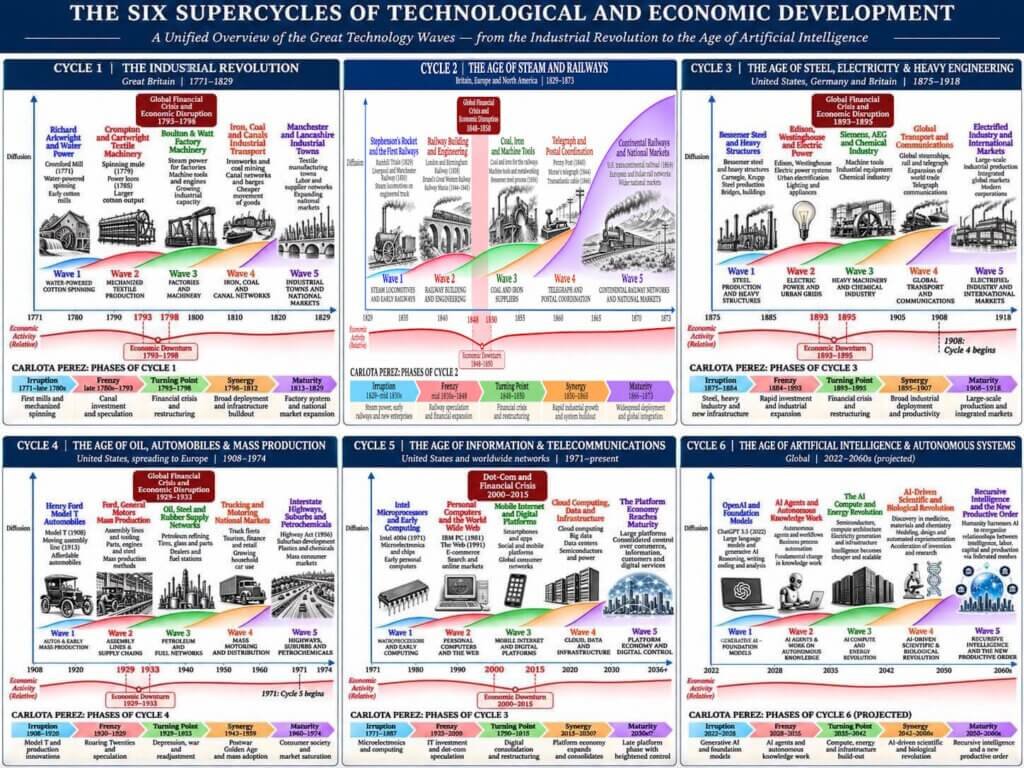
The Industrial Revolution
Big Bang: Richard Arkwright’s water-powered cotton mill at Cromford, England.
Mechanized textiles, water power, factories, machinery, iron, coal and canals helped establish the modern industrial economy.
Explore Supercycle One →The Age of Steam and Railways
Big Bang: Stephenson’s Rocket locomotive, demonstrated at the Rainhill Trials.
Railways, locomotives, coal, iron, engineering and communications connected distant producers and markets.
Explore Supercycle Two →The Age of Steel, Electricity and Heavy Engineering
Big Bang: Andrew Carnegie’s Bessemer steelworks near Pittsburgh.
Cheap steel, electrical power, heavy machinery, chemicals and modern communications transformed industrial and urban life.
Explore Supercycle Three →The Age of Oil, Automobiles and Mass Production
Big Bang: Henry Ford’s Model T automobile.
Assembly lines, petroleum, mass manufacturing, highways, national distribution systems and suburban development reorganized production and everyday life.
Explore Supercycle Four →The Age of Information and Telecommunications
Big Bang: Intel’s 4004 microprocessor.
Computing, software, digital networks, mobile communications, cloud services and global digital platforms transformed economic coordination.
Explore Supercycle Five →The Age of Artificial Intelligence and Autonomous Systems
Big Bang: The public release of ChatGPT on November 30, 2022.
Generative models, autonomous knowledge work, computing infrastructure, physical AI, scientific discovery and new productive systems may establish another economic era.
Explore Supercycle Six →An important feature of the model: Successive supercycles overlap. A new technological revolution can begin while its predecessor continues developing. The AI supercycle, in this interpretation, is forming while the Information and Telecommunications supercycle remains incomplete.
How a Technology Supercycle Unfolds
Technological revolutions display recurring patterns of innovation, investment, financial speculation, institutional adjustment and widespread economic adoption.
Carlota Perez’s framework explains much of this economic process. The broad progression moves from core formation into Installation, through a Turning Point, and onward into Deployment and Maturity.
Two different ways of examining one revolution: These stages describe the economic and institutional progression of a technological revolution. They are different from the five overlapping waves of technological innovation discussed in the next section.
Gestation: New Variety Builds Quietly
Before a supercycle begins, many of its important inventions already exist. They may be scattered across research laboratories, military projects, universities and specialized commercial applications.
The central challenge is often integration rather than invention. The transistor appeared at Bell Labs in 1947, and integrated circuits followed in 1958 and 1959. These technologies developed well before the microprocessor initiated the fifth supercycle in 1971.
In evolutionary terms, gestation allows technological variety to accumulate within relatively protected environments.
Installation: Innovation, Investment and Frenzy
A supercycle becomes visible when a major technological breakthrough demonstrates its commercial potential. New businesses enter the market, investors supply capital, and competing designs multiply.
Selection begins to determine which approaches survive.
In 1922, the number of American tire manufacturers reached approximately 278. Research by Steven Klepper and Kenneth Simons showed that fewer than one in five survived fifteen years later, even though the automobile market continued expanding for much of that period.
Financial capital accelerates the installation process. Investors support companies, infrastructure and technologies long before their eventual profitability is clear.
This enthusiasm can develop into speculation. Britain’s Railway Mania in the 1840s produced extraordinary railway investment before the financial collapse. The internet boom of the late 1990s followed a comparable pattern, with the dot-com collapse beginning in 2000.
Although speculative bubbles destroy substantial financial wealth, they can leave valuable infrastructure behind. Railway lines continued serving Britain long after the railway bubble burst. Fiber-optic networks installed during the internet boom later supported cloud computing, streaming and digital services.
Turning Point: Crisis and Institutional Change
A financial collapse can expose a mismatch between the productive possibilities of a new technology and the rules inherited from the previous economic era.
Perez identifies this mismatch as a central feature of the Turning Point. The resulting adjustment may extend for years or decades, involving financial restructuring, public policy and changes in economic institutions.
The fourth supercycle illustrates the process. The crash of 1929 was followed by the Great Depression and major changes in American economic governance. Federal deposit insurance was established in 1933, the Securities and Exchange Commission in 1934, and Social Security in 1935.
These and other institutional changes helped establish the conditions under which mass production could eventually support much broader economic prosperity.
In the fifth supercycle, the turning point began with the dot-com collapse in 2000. Monetary and financial interventions delayed the adjustment, while growing mortgage-related risks contributed to the crisis of 2007–2009. The larger institutional adjustment remains unresolved in this site’s framework.
Deployment: Widespread Adoption
During Deployment, the technologies created during Installation spread through the broader economy. Established methods are replaced, complementary industries grow, and the new technological paradigm becomes ordinary commercial practice.
Perez describes a shift toward production capital, as businesses reinvest in productive operations and increasingly employ the technologies developed earlier.
The 1950s and 1960s illustrate this process in the fourth supercycle. Mass production, automobiles, highways, household appliances and suburban development became integrated features of economic life.
From an evolutionary perspective, Deployment emphasizes imitation and inheritance. Successful technologies and organizational routines spread until they are no longer considered new.
Maturity: Preparing the Next Revolution
Eventually, opportunities for major improvements within an established technological paradigm begin to narrow. Profits and accumulated capital search for alternative opportunities.
Some of that investment moves into technologies that may become the foundations of the next supercycle.
This helps explain why technological revolutions overlap. The foundations of the digital revolution developed within the mass-production economy, just as artificial intelligence developed within the information and telecommunications economy.
Five Waves Within Each Supercycle
The model developed on TechnologyCycles.org adds another dimension to the economic progression described by Perez.
Within each supercycle, five broad, overlapping waves of technological development can be identified. The first establishes a revolutionary capability. Subsequent waves extend, combine and distribute that capability across industries and markets.
These descriptions are broad interpretive categories. The specific innovations, timing and industrial relationships differ among revolutions. Several waves can develop simultaneously, and one wave may continue expanding while later waves emerge.
How the Waves Build on One Another
Consider the Industrial Revolution. Water-powered spinning established an early mechanized production capability. Further improvements to spinning and weaving expanded textile production. Factories, machinery and steam power increased the scale of industrial activity.
Coal, iron, canals and other infrastructure supported expanding production and distribution. Industrial towns, specialized suppliers and increasingly connected markets developed around these capabilities.
By the end of the process, an innovation that began in textile production had contributed to the creation of an interconnected industrial economy.
The same cumulative relationship can be traced in the development of railways, steel, electricity, automobiles, computing and digital communications.
The evolutionary connection: Each wave builds on knowledge, productive capabilities and infrastructure inherited from earlier developments. Innovation creates new possibilities, competition selects successful approaches, and cumulative learning spreads those capabilities throughout the economy.
Two Common Misunderstandings
Technology Cycles Do Not Run on a Clock
During the 1920s, Russian economist Nikolai Kondratiev identified apparent long-term movements in economic prices and production. Joseph Schumpeter subsequently popularized the expression Kondratiev waves.
The association with long waves has sometimes encouraged the belief that technological revolutions follow a fixed fifty-year rhythm.
The historical evidence does not support a perfectly regular schedule. The duration of technological revolutions varies because each society requires a different amount of time to absorb the new technology.
Perez preferred the term great surges to emphasize that these transformations develop through economic and institutional processes rather than a mechanical timetable.
Innovations Cluster, but Not Necessarily During Depressions
Schumpeter argued that successful innovations attract imitators and complementary investment. Once an entrepreneur demonstrates that a new technology can be profitable, related innovations often follow.
Economist Gerhard Mensch proposed a more specific explanation in 1975. He argued that basic innovations tend to cluster during economic depressions, when businesses become more willing to abandon established methods.
Christopher Freeman, John Clark and Luc Soete later examined Mensch’s evidence and challenged important aspects of his findings.
Their work nevertheless reinforced the importance of technological clustering. Related innovations develop into new technology systems, spreading together as complementary capabilities become commercially useful.
Synthetic materials and petrochemicals offer an example. Their development during the 1930s, 1940s and 1950s involved connected innovations that created new industries, products and production methods.
Freeman’s interpretation is especially relevant to the supercycle framework because it emphasizes technological integration rather than the timing of isolated inventions.
Why Innovation Clustering Matters
A technological revolution rarely begins with one invention operating independently. Its economic consequences expand when complementary technologies, infrastructure, investment and productive capabilities begin reinforcing one another.
Reading Today’s Artificial Intelligence Revolution
TechnologyCycles.org identifies November 30, 2022, the date of ChatGPT’s public release, as the symbolic beginning of a sixth technology supercycle.
This interpretation remains contested. Carlota Perez has argued that artificial intelligence belongs within the fifth technological revolution, comparable to the emergence of important new technologies during earlier surges.
Evolutionary economics suggests that the distinction should be examined through observable changes in technological and economic organization.
1. A New Input Becoming Less Expensive
Earlier supercycles developed around productive capabilities whose costs declined substantially. Cheap steel transformed heavy engineering, while falling semiconductor costs enabled the digital revolution.
For artificial intelligence, the candidate is the declining cost of machine intelligence.
The guide cites 2026 trend data from Epoch AI indicating that inference costs at a fixed capability level have fallen exceptionally rapidly, with an estimated decline of approximately fortyfold per year in the measured period.
Sustained cost reductions could enable applications that are currently too expensive for widespread use.
2. New Physical Infrastructure
Earlier technological revolutions required substantial investment in new infrastructure. Railways transformed transportation, and telecommunications networks established the foundations of the digital economy.
Artificial intelligence requires advanced semiconductors, computing facilities, electrical generation, transmission networks and supporting infrastructure.
The International Energy Agency has projected that data-center electricity demand could roughly double by 2030. This illustrates the scale of physical investment associated with the emerging AI economy.
3. New Companies and Established Leaders
Previous supercycles often produced new industrial leaders while established companies struggled to adapt.
The artificial intelligence revolution presents a more complicated picture. Newer firms have introduced influential AI products, while some of the largest corporations of the fifth supercycle are funding much of the required infrastructure.
The guide cites early-2026 plans by five major technology companies involving approximately $680 billion in combined capital expenditure, much of it associated with AI.
This combination of technological newcomers and established financial and infrastructure leaders makes the process especially important to study.
4. Investment, Debt and Speculation
Installation periods are characterized by intense investment in technologies whose long-term commercial returns remain uncertain.
AI infrastructure requires enormous capital commitments, and an increasing portion of that investment involves borrowed funds and complex financing.
These conditions resemble aspects of earlier Installation periods. They raise questions about the relationship between technological opportunities, productive returns and speculative capital.
What the Evidence Suggests
The combination of falling costs for machine intelligence, expanding physical infrastructure, new productive capabilities and exceptional investment supports the interpretation presented on this website: artificial intelligence may represent a sixth supercycle rather than another development within the fifth.
This remains a working hypothesis. Its strength will depend on whether AI establishes a distinct technological and economic paradigm over the coming decades.
Historical observation and projection: The five earlier supercycles provide historical evidence for the model. The dates, future waves and eventual economic consequences of the sixth supercycle are projections that remain subject to revision.
Explore Supercycle Six: The Age of Artificial Intelligence and Autonomous Systems
The Short Version
Economies evolve through the continuous interaction of businesses, workers, consumers, investors, technologies and institutions.
Companies preserve knowledge through routines, search for new opportunities, compete for resources and customers, and imitate successful approaches.
Occasionally, clusters of complementary innovations produce changes powerful enough to reorganize much of the economy. These transformations develop through technological supercycles.
During each supercycle, emerging technologies attract investment, create industries, challenge established firms, and generate pressures for economic and institutional change. Over time, successful innovations diffuse through increasingly interconnected systems of production and exchange.
The five-wave framework developed on TechnologyCycles.org examines how those technological capabilities accumulate and combine. Carlota Perez’s framework examines the economic and institutional transformations accompanying them.
Together, these perspectives help explain how technological revolutions repeatedly transform economic organization, productive capacity and society.
The People Behind the Ideas
Nikolai Kondratiev (1892–1938)
A Russian economist who investigated long movements in prices and production during the 1920s. His research helped establish the study of long-term economic cycles. He was arrested under Stalin in 1930 and executed in 1938.
Joseph Schumpeter (1883–1950)
An Austrian economist who emphasized entrepreneurship and innovation as driving forces of capitalism. He examined innovation swarms and popularized the concept of creative destruction in Capitalism, Socialism and Democracy (1942).
Explore Schumpeter’s contribution
Christopher Freeman (1921–2010)
A British economist who founded the Science Policy Research Unit at the University of Sussex in 1966. Freeman examined innovation clustering, new technology systems and the relationship between technical change and economic growth. His work with Carlota Perez contributed to the development of techno-economic paradigm theory.
Read about Christopher Freeman
Richard Nelson and Sidney Winter
American economists whose book An Evolutionary Theory of Economic Change (1982) helped establish modern evolutionary economics. Their model examines organizational routines, search, selection and economic adaptation.
Giovanni Dosi
An Italian economist whose 1982 work introduced influential concepts of technological paradigms and technological trajectories. His research helps explain how established technological directions guide subsequent innovation.
Carlota Perez
A Venezuelan-British scholar whose research explains the recurring economic and institutional patterns associated with major technological revolutions.
Her 2002 book, Technological Revolutions and Financial Capital, describes five great surges and examines the changing relationships among financial investment, productive capital, economic crises and institutional adjustment.
Explore Carlota Perez’s framework
W. Brian Arthur
An economist associated with the Santa Fe Institute whose research examines increasing returns, path dependence, technological lock-in, and the ways new technologies emerge through combinations of existing capabilities.
Key Terms in Evolutionary Economics
- Creative Destruction
- The process by which new technologies create industries while undermining established ones.
- Equilibrium
- A condition of economic balance in which prices and quantities have adjusted to existing conditions.
- Evolutionary Economics
- The study of economic change through innovation, competition, selection, imitation and learning.
- Financial Capital
- Funds held by investors and lenders seeking financial returns, often supporting new technologies during early development.
- Production Capital
- Capital employed by businesses in productive operations, investment and expansion.
- Routines
- Established organizational practices that preserve and reproduce business knowledge.
- Search
- The deliberate effort to discover improved technologies, products, organizational arrangements or business methods.
- Selection
- The competitive process through which customers and investors influence which businesses and innovations survive.
- Path Dependence
- The influence of earlier decisions and established arrangements on future economic possibilities.
- Lock-In
- A condition in which an established technology or practice becomes difficult to replace because switching carries substantial costs.
- Technological Paradigm
- An established technological design and approach to solving problems that directs further innovation.
- Technological Trajectory
- The continuing direction of improvement established by a technological paradigm.
- Techno-Economic Paradigm
- A broadly adopted set of technologies and organizational practices that changes the economic common sense of an era.
- New Technology System
- Christopher Freeman’s description of related innovations that develop and spread together.
- Gestation / Core Formation
- The period during which foundational technologies develop before their integration into a revolutionary system.
- Installation
- The early period of a technological revolution characterized by innovation, industrial investment, infrastructure construction and often speculation.
- Frenzy
- The speculative portion of Installation during which financial investment can exceed realistic productive returns.
- Turning Point
- A period of crisis and adjustment separating Installation from wider Deployment, often involving institutional change.
- Deployment
- The period during which revolutionary technologies become widely adopted throughout the economy.
- Technology Supercycle
- A decades-long transformation in which interconnected innovations reorganize productive capabilities, industries, markets and institutions.
Further Reading
The following books and articles provide useful introductions and more detailed examinations of evolutionary economics, technological change and long-term economic transformation.
- Carlota Perez. Technological Revolutions and Financial Capital: The Dynamics of Bubbles and Golden Ages. Edward Elgar, 2002. A central account of technological surges, financial capital and economic transformation.
- W. Brian Arthur. The Nature of Technology: What It Is and How It Evolves. Free Press, 2009. An accessible explanation of how technologies develop from earlier capabilities.
- Christopher Freeman and Francisco Louçã. As Time Goes By: From the Industrial Revolutions to the Information Revolution. Oxford University Press, 2001.
- Joseph A. Schumpeter. Capitalism, Socialism and Democracy. Harper & Brothers, 1942. An influential account of capitalism and creative destruction.
- Christopher Freeman, John Clark and Luc Soete. Unemployment and Technical Innovation: A Study of Long Waves and Economic Development. Frances Pinter, 1982.
- Richard R. Nelson and Sidney G. Winter. An Evolutionary Theory of Economic Change. Belknap Press of Harvard University Press, 1982. A foundational text of modern evolutionary economics.
- Giovanni Dosi. “Technological Paradigms and Technological Trajectories.” Research Policy, volume 11, number 3, 1982, pages 147–162.
- Carlota Perez. “What Is AI’s Place in History?” Project Syndicate, March 2024. A contrasting interpretation of artificial intelligence within technological revolution theory.
Sources for the AI Discussion
The AI discussion in this guide draws on Epoch AI’s research on inference costs and computing performance; International Energy Agency analysis of data-center electricity consumption; and 2026 reporting on major technology companies’ capital expenditure plans, including CoStar’s discussion of approximately $680 billion in planned hyperscaler investment.
These figures describe particular observations and forecasts. They should be updated as new evidence becomes available.