


The History of Technology Supercycle Theory: Part One
The Early Models and Nikolai Kondratiev
The Nineteenth-Century Search for Economic Cycles
Nineteenth-century economists were already struggling to explain the repeated expansions and contractions of industrial economies. Their theories differed greatly, but they recognized that industrialization was changing the character of economic activity. William Stanley Jevons examined possible links between sunspots, harvests, and business fluctuations. Karl Marx and Friedrich Engels examined the disruptive effects of machinery, industrial production, and capital accumulation on capitalist societies. Much of this early work would be revised or rejected, yet it helped establish the questions that later researchers would address with increasingly systematic historical evidence.
I examine Marx and Engels’ interpretation of industrial capitalism, and where I believe their conclusions went wrong, in a separate article. Here, the history moves toward the economists who tried to identify recurring economic patterns and develop models capable of explaining them.
The Early Twentieth-Century Debate
During the early twentieth century, research into economic cycles developed along two broadly different paths. One emphasized measurement, historical records, and the search for patterns in economic data. The Harvard Business Barometer, Wesley Mitchell’s work with the National Bureau of Economic Research, Roger Babson’s forecasting efforts, and Nikolai Kondratiev’s research in Moscow reflected different versions of this empirical approach. Another tradition concentrated on theoretical explanations, including work associated with John Maynard Keynes and Dennis Robertson at Cambridge and Ludwig von Mises and Friedrich Hayek in the Austrian school. These approaches sometimes competed, but together they expanded the study of economic fluctuations beyond descriptions of individual financial crises.
One of the most important institutions in this history was Moscow’s Institute of Conjuncture, established in 1920 and directed by Nikolai Kondratiev. Its researchers studied movements in prices, output, trade, and other economic indicators at a time of immense upheaval in Russia. Kondratiev’s work would eventually become associated with long economic cycles, but his career unfolded under a government increasingly hostile to independent economic analysis. He lost his directorship in 1928, was arrested in 1930, and was executed in 1938 during Stalin’s purges. His fate illustrates how political repression can destroy both the people conducting research and the institutions needed to sustain it.
Nikolai Dmitriyevich Kondratiev: The Study of Long Cycles (Никола́й Дми́триевич Кондра́тьев)
The history of long economic cycles is closely associated with Nikolai Dmitriyevich Kondratiev. His surname appears in English in several forms, including Kondratieff and Kondratyev, because of differences in transliteration from Russian. Kondratiev began his mature research in the aftermath of the 1917 Bolshevik Revolution and the Russian Civil War. During that conflict the Bolshevik government’s economic policies were known as War Communism. The devastation that followed, and the subsequent turn toward the New Economic Policy, formed the political and economic background to his work.
Kondratiev became director of the Institute of Conjuncture in 1920, at a moment when Russian economic policy was beginning to confront the damage caused by civil war, collapsing production, and disrupted trade. Lenin’s New Economic Policy, introduced in 1921, restored a measure of market activity and allowed limited private enterprise. Kondratiev argued for agricultural incentives, cooperation, and stronger commercial relationships with other countries as part of Russia’s recovery and industrial development. His economic research and his policy recommendations were closely connected: he believed that understanding economic change required evidence drawn from the actual movement of markets, agriculture, and industry.1
Kondratiev’s emphasis on improving agricultural productivity through incentives and cooperative arrangements increasingly conflicted with Stalin’s drive toward compulsory collectivization. He was removed from his position, imprisoned, and ultimately executed after years of political persecution. The human consequences of collectivization were catastrophic, particularly in Ukraine, where Soviet requisitioning and related policies contributed to the mass starvation of 1932–1933 known as the Holodomor. Kondratiev’s biography therefore belongs both to the history of economic thought and to the much darker history of Stalinist repression.
Kondratiev’s Early Long-Cycle Research
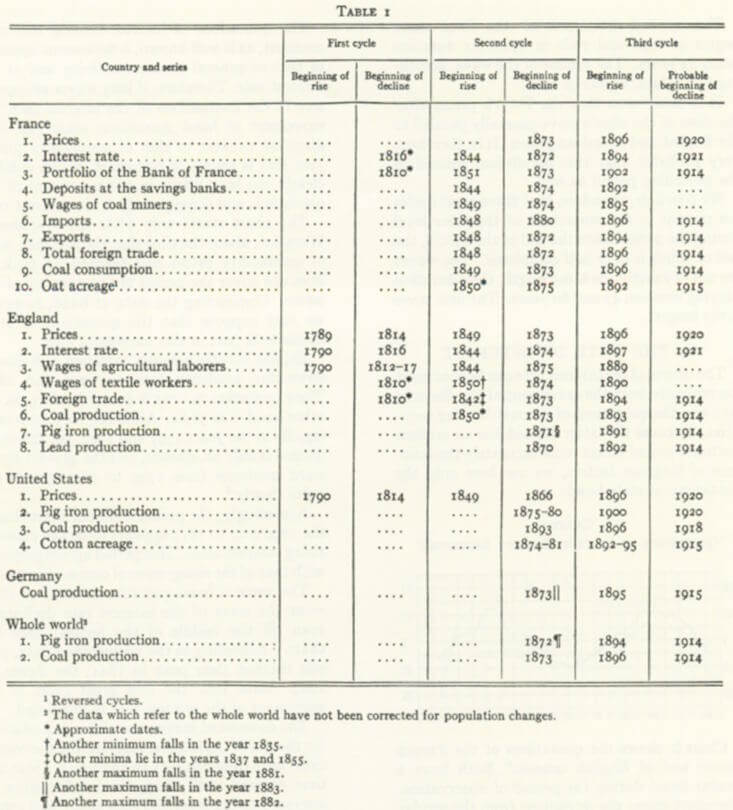
During the 1920s Kondratiev assembled historical series extending back into the late eighteenth century. He examined movements in commodity prices, interest rates, wages, foreign trade, and other measures, with evidence drawn particularly from Britain, France, and the United States. These records were incomplete and uneven, yet he believed they suggested economic movements much longer than the familiar shorter business cycles. He proposed that these long cycles extended roughly 45 to 60 years, with a sustained rising movement followed by a prolonged falling movement. His claim was an ambitious empirical hypothesis, based on the limited historical evidence available to him rather than a precisely timed economic law.
The Original Evidence and Later Reconstructions
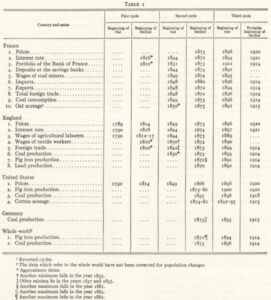
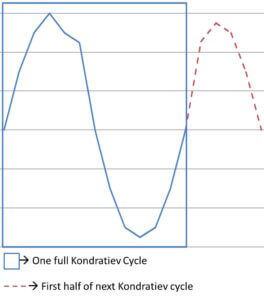
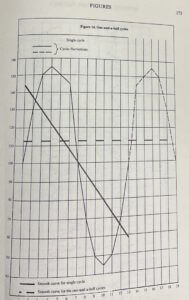
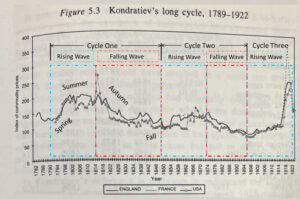
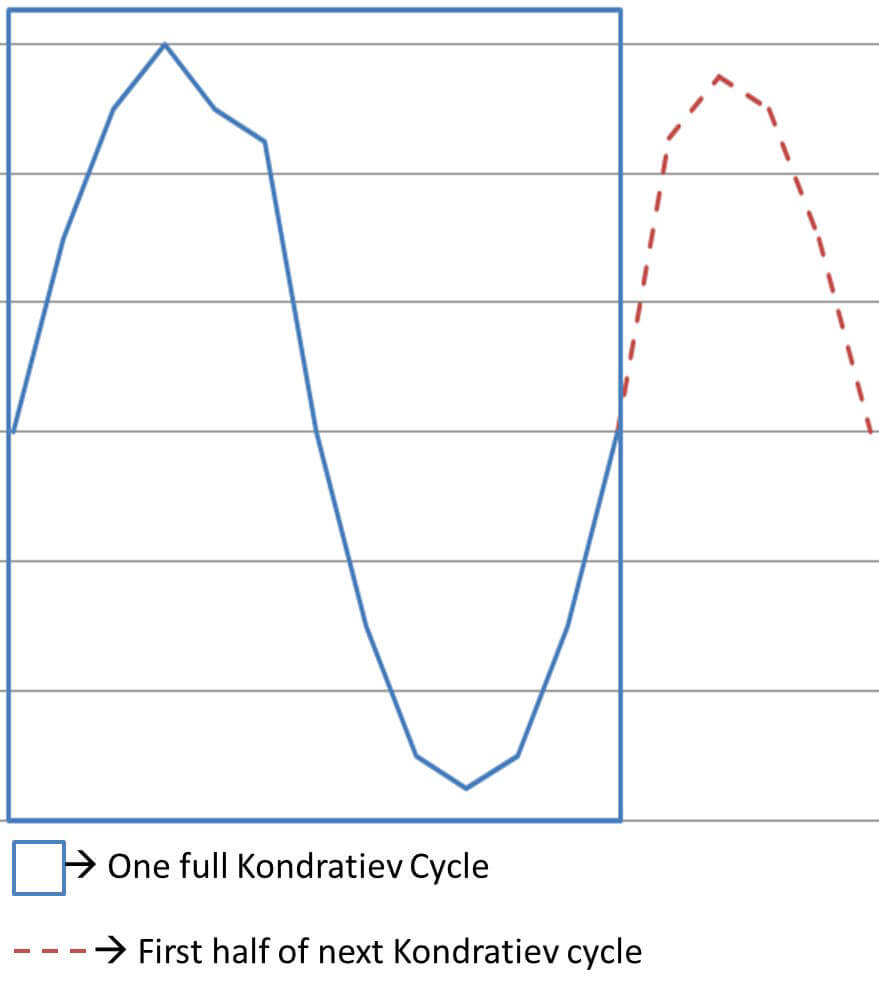
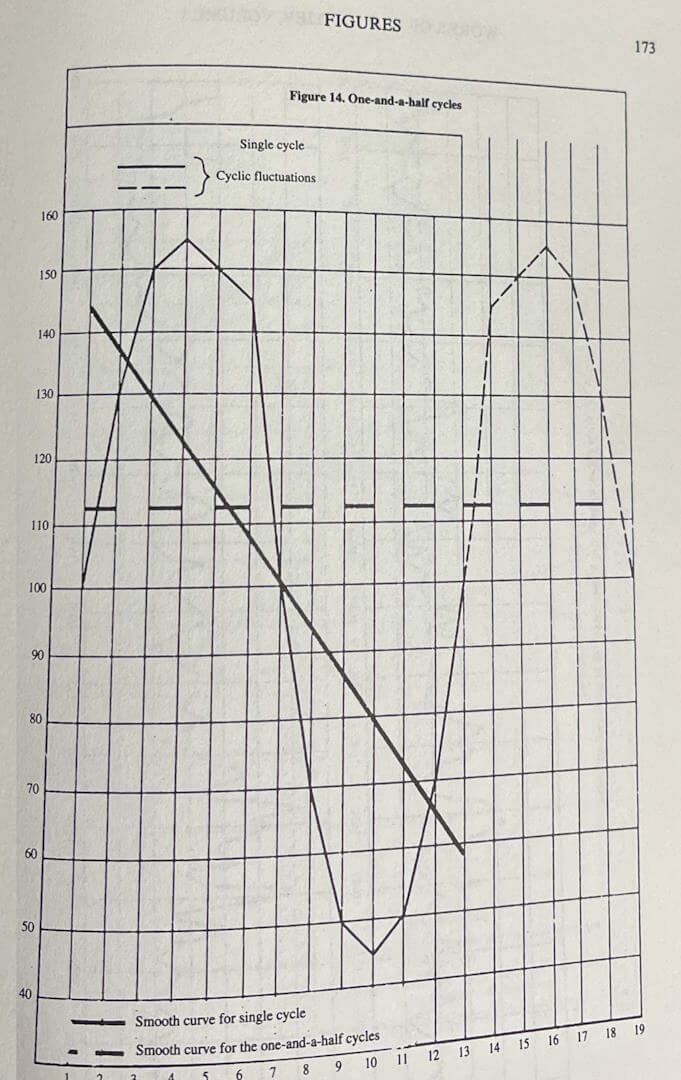
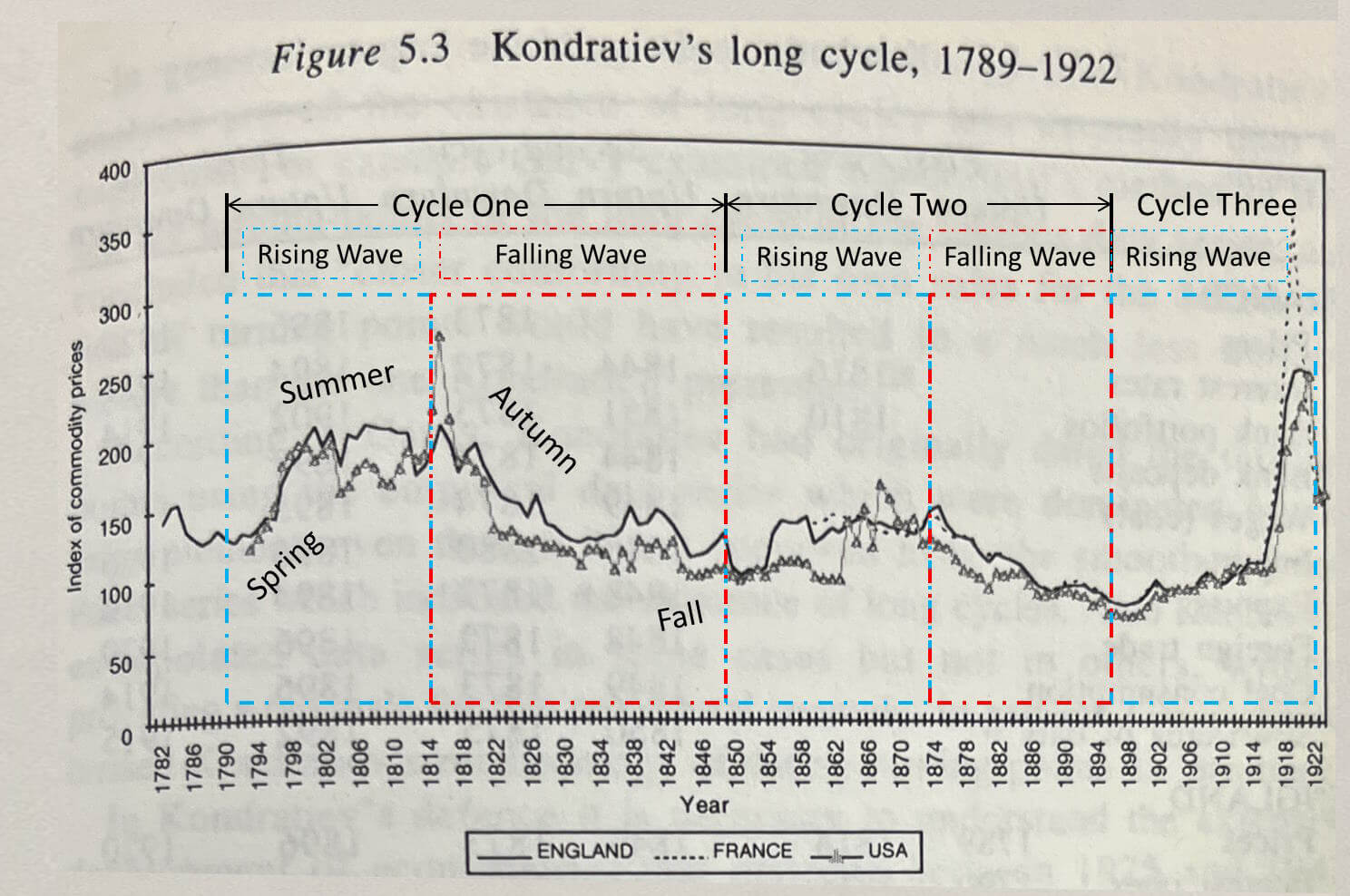
The gallery below presents several materials central to my research into Kondratiev’s original work. It includes a table associated with his early published analysis, a reconstruction of a long-cycle drawing, a photograph of the historical drawing, and a chart of commodity-price movements. Some of Kondratiev’s surviving materials became more accessible through archival recovery and later publications, including the collection of his writings released in the 1990s.2 These images are worth examining carefully because later diagrams often simplify, reinterpret, or extend what he actually published.
I have included my redraw of the historical long-cycle illustration alongside a photograph because the original is difficult to read. Comparing them helps separate Kondratiev’s surviving evidence from the many modern diagrams produced in his name. Popular accounts frequently combine his early observations with later cycle dates, seasonal labels, and technological interpretations without explaining which details came from Kondratiev himself and which were added afterward. My purpose here is to make that distinction visible, so readers can follow the development of the theory rather than treat every familiar diagram as an original source.3
Kondratiev’s Research and Publications
The rightmost chart in the gallery illustrates commodity-price movements used in the study of long cycles. For clarity, I added annotations showing the proposed cycles and their rising and falling portions. Kondratiev presented an extensive version of his long-cycle argument in Russian in 1925. An abridged German publication followed in 1926, and an English version appeared in 1935, bringing his research to a wider readership.4 The charts reproduced in those publications, and the differences introduced by translation and abridgment, matter when evaluating what he actually argued. The Kondratiev biography on this website provides additional historical context.
One important distinction concerns the terms cycle and wave. Kondratiev described a long economic cycle as consisting of two broad movements: a rising wave and a falling wave. Together they make up one complete cycle. Later writers often used the expression ‘Kondratiev waves’ to describe the entire phenomenon, and translations contributed to differences in terminology. Seasonal metaphors such as spring, summer, autumn, and winter also became common in popular accounts, but those labels should not be mistaken for precise measurements. This distinction is particularly relevant to my own research: the five technological waves of a supercycle describe a different pattern from Kondratiev’s rising and falling movements.
Kondratiev’s Contributions
Kondratiev’s principal achievement was recognizing that historical economic data might contain long movements extending across several decades. He examined recurring changes in prices and economic activity and attempted to distinguish these from shorter fluctuations. His results were open to debate, and the evidence available to him could not establish a rigid calendar of industrial revolutions. Nevertheless, he gave later economists a challenge worth pursuing: to understand whether sustained expansions and contractions reflected deeper changes in the organization of the economy. Carlota Perez would approach that question from a different direction, placing the development of new technological systems and their financial and institutional consequences at the center of the analysis.
In 1976, the statistician George Box expressed a useful principle: ‘All models are wrong, but some are useful.’ His point was that a model can illuminate important relationships without capturing every detail of the real world. Kondratiev’s work illustrates the principle. His proposed long cycles were imperfect and remain debated, but the attempt to connect long periods of economic change with measurable historical patterns helped inspire generations of further research.
Kondratiev helped establish the empirical study of long economic fluctuations through painstaking analysis under extraordinarily difficult political conditions. His findings did not settle the causes of technological revolutions, and he did not develop the later supercycle framework. They did, however, inspire economists who would investigate the role of innovation, investment, and structural change in long economic movements. The next article follows Joseph Schumpeter, whose work on innovation clusters and creative destruction brought technological transformation much closer to the center of the explanation. Continue to the Schumpeter article.
Footnotes Follow:
- Kondratiev and the Dynamics of Economic Development, Long Cycles and Industrial Growth in Historical Context. Palgrave Macmillan; 1998. Author Vincent Barnett. Pages 47 – 48. ↩︎
- The Works of Nikolai D Kondratiev (The Pickering Masters). Basic problems of Economic Statistics and Dynamics. Volume 1. Nikolai D. Kondratiev (Author), Edited by Natalia Makasheva, Warren J. Samuels and Vincent Barnett. Translated by Stephen S. Wilson. Publisher: Routledge (1998). Page xxxiii. ↩︎
- The Works of Nikolai D Kondratiev (The Pickering Masters). Basic problems of Economic Statistics and Dynamics. Volume 1. Nikolai D. Kondratiev (Author), Edited by Natalia Makasheva, Warren J. Samuels and Vincent Barnett. Translated by Stephen S. Wilson. Publisher: Routledge (1998). Pages 37 image left & right image page 173. ↩︎
- W.F. Stolper of Harvard University for The Review of Economic Statistics (Vol XVII, No. 6) Nov 1935. ↩︎